Tulsi Vivah 2026 Puja Vidhi
By Pt. Suvrat Sharma
Shaligrama union, Kanyadan and sattvic marriage remedies
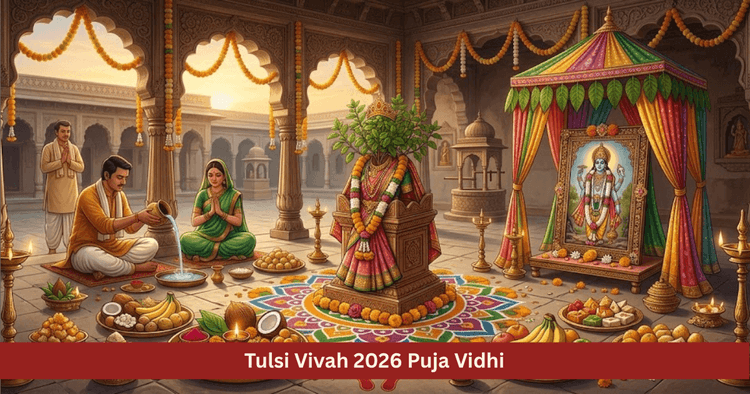
Table of Contents
The Sacred Union of Tulsi and Shaligrama
Tulsi Vivah is the sacred marriage festival of Mother Tulsi with Lord Vishnu in the form of Shaligrama. It is performed during the bright fortnight of Kartik after Devutthana or Prabodhini Ekadashi. In 2026 Devutthana Ekadashi is observed on Friday, 20 November. In most traditions Tulsi Vivah will be performed on the following day, Kartik Shukla Dwadashi, which falls on Saturday, 21 November.
Some families perform Tulsi Vivah on Ekadashi itself. Other traditions consider Dwadashi the main day of the marriage. In 2026 Dwadashi will begin at about 6:21 in the morning on 21 November and end at about 4:56 in the morning on 22 November. Many regions perform the marriage during the evening Pradosh Kaal.
Tulsi Vivah is regarded as a spiritual remedy for marriage obstacles, marital conflict and instability in the family. It is not appropriate to promise that marriage will certainly happen or that a birth chart affliction will completely disappear through the ritual. Worship steadies the mind, brings an auspicious feeling into relationships and encourages responsibility toward marriage and family.
| Detail | Tulsi Vivah 2026 information |
|---|---|
| Festival | Tulsi Vivah |
| Devutthana Ekadashi | Friday, 20 November 2026 |
| Main marriage date | Saturday, 21 November 2026 |
| Tithi | Kartik Shukla Dwadashi |
| Dwadashi begins | About 6:21 in the morning on 21 November |
| Dwadashi ends | About 4:56 in the morning on 22 November |
| Worship time | Evening Pradosh Kaal according to local Panchanga |
| Groom form | Shaligrama or Lord Vishnu |
| Bride form | Mother Tulsi |
| Main worship | Tulsi, Shaligrama, Vishnu and Lakshmi |
| Special acts | Kanyadan, garland exchange, Mangal Arati and Prasada |
| Core feeling | Sacred relationship, dharma, prosperity and marital welfare |
Basic Rules of Tulsi Vivah
• Keep the Tulsi plant clean and healthy
• Install Shaligrama on a separate clean platform
• Use natural and sattvic materials for the marriage
• Keep Kanyadan symbolic and devotional
• Do not damage branches or leaves while decorating the plant
• Avoid people who create fear about marriage obstacles
• Continue practical marriage efforts along with worship
• Connect the ceremony with service through Prasada and donation
Spiritual Form of Mother Tulsi
Tulsi is regarded in the Vaishnava tradition as beloved of Lord Vishnu and a sacred Devi. Tulsi is not only a plant. She is a symbol of cleanliness in the home, medicinal value, respect for nature and devotion.
Lighting a lamp near Tulsi creates a feeling of peace and auspiciousness in the home. Tulsi leaves are offered in the worship of Lord Vishnu and Krishna. In many families Tulsi is respected like a daughter or daughter in law of the household.
The spiritual meaning of Tulsi Vivah is that nature and the Divine, earth and protection and vegetation and dharma are connected. Marriage is not only the union of two people. It is a balanced relationship between two streams of life.
Importance of Shaligrama
Shaligrama is regarded as a natural sacred stone obtained from the Gandaki River region of Nepal. In the Vaishnava tradition it is considered a form of Lord Vishnu. Instead of constructing an idol the natural stone itself is worshipped as a symbol of the Lord.
Before keeping Shaligrama at home the family should understand its method of worship, cleanliness and maryada. Offering Tulsi leaves to Shaligrama is considered especially important in Vaishnava worship.
The spiritual feeling of Shaligrama includes the following.
• Protection
• Dharma
• Stability
• Maryada
• Grace of Vishnu
• Balance in family life
If Shaligrama is not available Tulsi Vivah may be performed with an image or idol of Lord Vishnu. A sacred object should not be treated only as a means of display or trade.
Puranic Story of Tulsi Vivah
The story of Tulsi Vivah is connected with Vrinda and Jalandhara. According to the story Vrinda was a great devotee of Lord Vishnu and the wife of Jalandhara. Her power of chastity made Jalandhara extremely strong and he became a threat to the gods.
Jalandhara ego increased and he challenged dharma and the divine order. To protect the gods Lord Vishnu performed a divine act through which Vrinda austerity was disturbed. When Vrinda learned the truth she cursed Lord Vishnu to become a stone.
Respecting Vrinda devotion and austerity Lord Vishnu established her in the form of Tulsi. Shaligrama became a symbol of the stone form of Vishnu. The marriage of Tulsi and Shaligrama is performed in remembrance of this story.
Details vary in different versions. Its spiritual message is that power, devotion and dharma should not be misused through ego. Tulsi Vivah is a festival of repentance, respect, protection and sacred relationship.
Devutthana Ekadashi and Tulsi Vivah
During Chaturmas Lord Vishnu is traditionally believed to remain in Yoga Nidra. Devutthana Ekadashi celebrates the awakening of Lord Vishnu. After this the tradition of beginning weddings and auspicious activities appears in many regions.
Tulsi Vivah is regarded as the sacred marriage performed after the awakening of the Divine. For this reason it is connected with the beginning of the wedding season. Actual wedding Muhurat should still be decided separately according to the Panchanga and birth charts.
The feeling of Devutthana Ekadashi includes the following.
• Awakening of dormant consciousness
• Beginning of dharmic activity
• Preparation for married life
• Auspiciousness in family and society
• Celebration after discipline
Tulsi Vivah Puja Materials
Tulsi Vivah does not require excessive material. Give priority to cleanliness and feeling.
| Material | Use |
|---|---|
| Healthy Tulsi plant | Form of the bride |
| Shaligrama or Vishnu image | Form of the groom |
| Platform and clean cloth | Installation |
| Red or yellow Chunari | Decoration of Tulsi |
| Mauli thread | Marriage bond |
| Roli and turmeric | Tilak and auspiciousness |
| Akshata | Completeness and resolve |
| Flowers and garland | Garland exchange |
| Lamp and incense | Light and purification |
| Fruits and sweets | Naivedya |
| Sugarcane mandap | Regional tradition |
| Kalasha | Auspiciousness and completeness |
| Dakshina | Service and gratitude |
Do not tie wires, pins or heavy ornaments to the Tulsi branches. Do not allow water to collect around the roots.
Simple Tulsi Vivah Puja Vidhi
Tulsi Vivah is generally performed in the evening. Wedding songs, Mangalashtaka or Vishnu hymns may be recited according to family tradition.
Worship Order
- Clean the home and the Tulsi platform
- Make Rangoli near the Tulsi plant
- Decorate Tulsi with turmeric, sandal paste, Roli and Chunari
- Place Shaligrama or the Vishnu idol on a separate platform
- Create a symbolic boundary of rice or flowers between them
- Remember Ganesha
- Apply Tilak to Tulsi and Shaligrama
- Offer garlands
- Tie the Mauli as a sacred bond
- Perform symbolic Kanyadan of Tulsi
- Chant marriage and Vishnu mantras
- Perform Arati before fire or a lamp
- Offer fruits, sweets and Kheer
- Distribute Prasada among family and neighbours
- Light a lamp near Tulsi after the marriage
Rule of Kanyadan in Tulsi Vivah
Kanyadan is an important symbolic part of Tulsi Vivah. Tulsi is treated as the daughter and Shaligrama as the groom. The family performs the marriage rite. Kanyadan does not mean that ownership of the plant or Devi is transferred to a person. It means that the family offers respect, protection and a blessing for a sacred household life.
Symbolic Kanyadan Method
- Place Tulsi and Shaligrama facing each other
- Keep red cloth and flowers near Tulsi
- Let an elder of the family take the resolve
- Hold water, flowers and Akshata
- Hold the symbolic feeling of offering Tulsi to Shaligrama
- Offer flowers to both
- Perform Mangal Arati
- Pray for peace and prosperity in the family
- Donate food or useful items after Kanyadan
An unmarried woman should not fear that performing Kanyadan in Tulsi Vivah will stop her own marriage. This is an unfounded folk fear. Kanyadan is a symbol of merit, responsibility and auspicious surrender.
Tulsi Vivah Mantras
Tulsi Mantra
Om Tulsiyai Namah
This means salutations to Mother Tulsi.
Shaligrama Mantra
Om Shaligramaya Namah
This means salutations to Lord Shaligrama.
Vishnu Mantra
Om Namo Bhagavate Vasudevaya
This means salutations to Lord Vasudeva.
Tulsi Hymn
Mahaprasada Janani Sarva Saubhagyavardhini.
Adhi Vyadhi Hara Nityam Tulasi Tvam Namostute.
Its feeling is salutations to Mother Tulsi who gives Mahaprasada, increases good fortune and removes mental and physical suffering.
Chant according to family tradition and ability. Complex Vaishnava mantras should be practised with guidance from a guru.
Astrological Importance for Marriage Obstacles
Tulsi Vivah is considered a worship that helps remove marriage obstacles. This is because Tulsi is connected with Vishnu Tattva and the dharma of marriage. Lord Vishnu is regarded as the deity of protection, maryada and stable relationships.
In Vedic astrology the seventh house, seventh lord, Shukra, Guru, Chandra, Navamsha and planetary periods are studied for marriage. Guru has special importance in the horoscope of a woman and Shukra has special importance in the horoscope of a man. The complete chart of both people remains necessary.
| Astrological element | Marital feeling |
|---|---|
| Seventh house | Marriage and spouse |
| Seventh lord | Direction of marriage |
| Shukra | Love, marriage and attraction |
| Guru | Dharma, blessing and marital protection |
| Chandra | Emotional connection |
| Navamsha | Depth of marriage |
| Second house | Family and household |
| Eleventh house | Fulfilment and social support |
Tulsi Vivah may give peace and positive feeling to the mind. Actual reasons for marriage obstacles may include chart combinations, social circumstances, communication, financial condition, health and decision making.
Simple Remedies for Unmarried People
An unmarried person may perform the following sattvic remedies on Tulsi Vivah.
• Serve a Tulsi plant
• Chant a Vishnu Mantra
• Donate yellow clothes or chickpea lentils
• Receive the blessing of teachers and elders on Thursday
• Avoid unnecessary fear and haste about marriage
• Maintain clear dialogue with the family
• Give importance to chart matching and practical understanding
• Support the education of a needy girl or family
• Work on personality and responsibility along with the wish for marriage
It is improper to force anyone into marriage or frighten someone in the name of tantra.
Feeling of Worship for Marital Conflict
Tulsi Vivah is not only for unmarried people. Couples experiencing conflict may jointly worship Tulsi and Shaligrama on this day.
Take the following resolves with worship.
• Reduce harsh speech
• Take financial decisions together
• Respect elders in the family
• Acknowledge each other labour
• Resolve old conflicts through dialogue
• Do not make decisions in anger
• Care for health and mental peace
Worship cannot replace a relationship. It strengthens the resolve to improve the relationship.
Care of the Tulsi Plant
The comfort and health of the plant should receive the highest priority during Tulsi Vivah. Excess water around Tulsi can damage the roots. Many families avoid plucking leaves at night. Do not pluck more leaves than necessary for worship.
Rules for Tulsi Care
• Do not allow water to collect in the soil
• Provide suitable sunlight and air
• Remove dry leaves
• Avoid chemicals and artificial decoration
• Do not tie heavy objects to the plant
• Continue regular care after the marriage
• Do not treat Tulsi only as an object of ritual
Does Tulsi Vivah Guarantee Marriage?
It is not proper to treat Tulsi Vivah as a fixed guarantee of marriage. It is a religious and spiritual practice. Marriage also requires a suitable partner, maturity, communication, family agreement, financial preparation and personal decisions.
When there is a marriage obstacle the following should be pursued together.
• Proper birth chart analysis
• Clear expectations from a life partner
• Honest dialogue with the family
• Preparation for education and career
• Health and mental balance
• Avoiding haste in marriage
• Suitable social and family guidance
Tulsi Vivah can develop purity and responsibility toward relationships.
Caution in Astrological Remedies
Astrological remedies should not create fear. If someone pressures a person for expensive rituals, gemstones or secret tantra in the name of Tulsi Vivah caution is necessary.
Avoid the following.
• Promising a fixed time limit for marriage
• Creating fear of curses or planetary affliction
• Gemstones without chart examination
• Decoration that damages the plant
• Fear based Kanyadan
• Unhealthy or improper fasting for marriage
• Blaming a family member for marriage delay
Marriage is a sacred rite but dignity and independence of every person are equally important.
Tulsi Vivah and the Environment
Tulsi Vivah gives nature the honour of a bride. The festival carries a message of protecting the environment and biodiversity. Tulsi is a medicinal plant and can represent green life within the home.
The following environmental activities may be performed.
• Plant a sapling
• Save water
• Reduce plastic decoration
• Make an organic Rangoli
• Improve the soil of the plant
• Keep water for birds
• Do not throw worship material into waste
Tulsi Vivah for Family and Society
Tulsi Vivah brings the family together. Children learn the marriage method, mantras, plant care and distribution of Prasada. Elders share stories and tradition. Women often arrange worship and food. Men may help with the mandap, materials and service.
No single person labour should remain unseen in the festival. Marriage means cooperation. Tulsi Vivah gives this practical lesson to the household.
Lasting Message of the Sacred Union
According to most traditions Tulsi Vivah 2026 will be performed on Saturday, 21 November. Some families perform it on Devutthana Ekadashi on 20 November while others keep Dwadashi as the main day. Confirmation through the local Panchanga is necessary.
The union of Tulsi and Shaligrama symbolises nature and protection, devotion and maryada and love and responsibility. For marriage obstacles this worship may bring hope. During marital conflict it may create a resolve for dialogue and improvement. In the family it may bring the feeling of cooperation and prosperity.
When Tulsi is understood not only as a plant but as respect for life and Shaligrama is understood not only as a stone but as a symbol of dharma and protection Tulsi Vivah moves beyond a divine celebration. It becomes a sacred arrangement of life.
FAQ
When will Tulsi Vivah be performed in 2026?
According to most traditions Tulsi Vivah will be performed on Saturday, 21 November 2026 on Kartik Shukla Dwadashi. Some families perform it on Devutthana Ekadashi on 20 November.
Who is married during Tulsi Vivah?
Mother Tulsi is ceremonially married to Lord Vishnu in the form of Shaligrama or to an image of Vishnu.
How is Kanyadan performed in Tulsi Vivah?
Place Tulsi and Shaligrama facing each other, let an elder take the resolve, offer water and Akshata, offer flowers and perform symbolic Kanyadan followed by Arati.
Does Tulsi Vivah remove marriage obstacles?
Tulsi Vivah is a spiritual and symbolic remedy. It may bring positivity but chart analysis, communication, life circumstances and suitable effort are also necessary for marriage.
Is Tulsi Vivah only for unmarried people?
No. Married couples may perform it for marital peace and love. Unmarried people may pray for a suitable partner and families may perform it for prosperity and auspiciousness.
Get your accurate Kundali
Generate KundaliDid you like it?
Author
Pt. Suvrat Sharma (63)
Experience: 20
Consults About: Family Planning, Career
Clients In: Punjab, Haryana, Delhi
Share this article with friends and family
WELCOME TO
ZODIAQ
Right Decisions at the right time with ZODIAQ
