Why Bathe with Arka Leaves?
By Pt. Sanjeev Sharma
The Ratha Saptami Arka Bath, Solar Radiance and Precautions
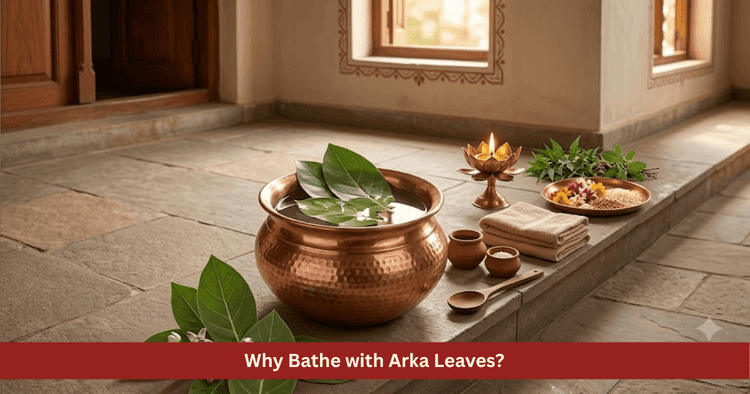
Table of Contents
Key Facts About the Arka Leaf Bath on Ratha Saptami
On Magha Shukla Saptami, the day of Ratha Saptami, there is a very ancient and distinctive bathing tradition called the Arka Patra Snan, the bath with arka leaves. On this day, while bathing, 7 leaves of the arka plant are placed on 7 particular parts of the body and the bath is taken while meditating on Surya Dev. The arka plant is known as madar or aakda in common speech and as arka in Sanskrit. One meaning of the word arka is the Sun itself. This is why arka is regarded as the plant that represents the Sun.
| Element of the Bath | Details |
|---|---|
| Tithi | Magha Shukla Saptami, that is Ratha Saptami |
| Time | Arunodaya, just before sunrise |
| Required Material | 7 fresh and whole arka leaves |
| Where the Leaves Are Placed | 1 on the head, 2 on the shoulders, 2 on the knees and 2 on the feet |
| Direction | Facing east |
| Along with the Leaves | In some traditions rice grains, sesame or turmeric are placed on the leaves |
| After the Bath | Solar arghya and recitation of the Aditya Hridaya Stotram |
| Main Caution | The milky sap of arka must not enter the eyes or mouth |
The Basic Rules of the Bath in Brief
- The day before or in the morning, pluck 7 fresh and whole arka leaves from a clean place.
- Wash the leaves and wipe away the milky sap that comes from the stalks.
- Sit or stand facing east and place the leaves on the prescribed parts of the body.
- Keep your eyes closed and slowly pour water over your head while meditating on Surya Dev.
- After the bath, place the leaves in a sacred spot or at the root of a tree.
Why Is Arka Regarded as the Plant of the Sun?
In Sanskrit, one of the many names of the Sun is Arka. Om Arkaya Namah is also one of the 12 names of the Sun. The Sanskrit name of the arka plant is also arka. This shared name is no coincidence. The arka plant stays green even in harsh sunlight, dry ground and difficult conditions. It blossoms while bearing the full heat of the Sun. Because of this quality, it came to be regarded as a carrier of the Sun's energy.
In Navagraha worship and homa, a special plant is prescribed as the samidha, the sacred firewood, for each planet. Arka samidha is used for the Sun. This scriptural tradition clearly links arka with the Sun.
| Planet | Plant Used as Samidha |
|---|---|
| Sun | Arka |
| Moon | Palasha |
| Mars | Khadira |
| Mercury | Apamarga |
| Jupiter | Peepal |
| Venus | Udumbara, the cluster fig |
| Saturn | Shami |
| Rahu | Durva |
| Ketu | Kusha |
Arka is not connected only with the Sun. Its flowers are very dear to Lord Shiva and it is traditional to offer a garland of arka flowers to Hanuman. An image of Ganesha made from the root of the white arka is also regarded as auspicious in tradition.
The Secret of Placing Leaves on 7 Parts of the Body
Several symbolic meanings are given for placing 7 leaves on Ratha Saptami. The number 7 symbolises the 7 horses of the Sun that draw his chariot. It is also linked with the 7 days of the week, the 7 colours of light and the 7 main chakras of the yogic tradition.
| Part of the Body | Number of Leaves | Symbolic Meaning |
|---|---|---|
| Head | 1 | Purification of intellect and consciousness |
| Both Shoulders | 2 | Strength to carry duties and responsibilities |
| Both Knees | 2 | Stability and movement in life |
| Both Feet | 2 | Firmness in walking the path of dharma |
Tradition holds that bathing with leaves placed on these parts fills the whole body, from head to foot, with the radiance of the Sun. From an astrological point of view, this practice is believed to pacify faults related to the Sun in the horoscope and to bring balance to the energy centres of the body. It is a symbolic practice rooted in faith and its real power lies in the purity of feeling.
The Verses Recited During the Bath
It is traditional to recite certain verses during the Arka Patra Snan. One popular verse is as follows.
"Namami Saptamim Devim sarvapapapranashinim, saptarkapatrasnanena mama papam vyapohatu."
Its meaning is that the seeker bows to the goddess Saptami, the destroyer of all sins and prays that this bath taken with 7 arka leaves may remove all sins.
In another popular verse, the prayer is that this Saptami of Magha month may destroy the sins committed over many births and the disease and sorrow that arise from them. A person who cannot pronounce the Sanskrit verse correctly may bathe while chanting Om Suryaya Namah or Om Arkaya Namah. Purity of feeling matters more than purity of pronunciation.
The Complete Method of the Arka Patra Snan
| Step | Method |
|---|---|
| Choosing the Leaves | Take 7 fresh, green and whole leaves from a plant growing in a clean place |
| Removing the Sap | Wash the leaves and wipe away with a cloth the milky sap that comes from the stalks and any broken part |
| Sankalpa | Before bathing, remember Surya Dev and take a resolve for health and freedom from sin |
| Position | Sit or stand facing east |
| Placing the Leaves | Place 1 leaf on the head, 2 on the shoulders, 2 on the knees and 2 on the feet |
| Bath | Keep the eyes closed and slowly pour water on the head while reciting the verse or mantra |
| Removing the Leaves | After the bath, remove the leaves carefully and bathe once more with clean water |
| Immersion | Place the leaves in a sacred spot, at the root of a tree or in flowing water |
| Arghya | After the bath, offer arghya to the rising Sun from a copper lota |
| Recitation | Recite the Aditya Hridaya Stotram or the 12 names of the Sun |
In some regions a few rice grains and sesame seeds are placed on the leaf on the head, while in some places turmeric is placed. Following one's own family and regional tradition is most appropriate.
The Importance of Arka in Ayurveda and the Caution It Needs
In Ayurveda, arka is a highly potent medicinal plant. Different medicinal uses are described for its leaves, flowers, root and milky sap. Traditionally, arka leaves are warmed and tied over painful and swollen joints. Its leaves are believed to have properties that relieve skin ailments and fight germs.
But it is equally important that Ayurveda places arka in the category of upavisha, a secondary poison. This means that it is a medicine in limited and correct amounts but can be harmful when used carelessly. The milky sap of arka is especially strong.
- Keep it away from the eyes: The milky sap of arka can cause severe burning and damage if it enters the eyes. Keep your eyes closed during the bath.
- Do not let it enter the mouth: No part of arka should be eaten or chewed.
- Take care with children: Be especially careful when placing a leaf on a small child's head or simply touch the leaf to them as a symbol.
- Sensitive skin: Those with very sensitive skin or any allergy should simply touch the leaf to the body and set it aside.
- Wash your hands: Wash your hands well after plucking and handling the leaves.
- Medicinal use: Use arka to treat any illness only on the advice of a qualified Ayurvedic doctor.
If burning, redness or itching appears on the skin after the bath, wash immediately with clean water and consult a doctor if needed. The purpose of a religious tradition is to protect the body, not to cause it pain.
The Arka Leaf Bath Through the Lens of Vedic Astrology
In Vedic astrology, the Sun signifies the soul, health, bones, eyes, the glow of the skin and radiance. When the Sun is weak or afflicted by Saturn and Rahu, a person may experience a lack of confidence, fatigue, eye troubles and skin problems. The Arka Patra Snan on Ratha Saptami is regarded as a traditional remedy for pacifying faults related to the Sun.
| Concern | Astrological Indication | Remedy |
|---|---|---|
| Fatigue and lack of radiance | Weak Sun | Arka leaf bath and arghya to the rising Sun |
| Skin problems | Imbalance between the Sun and Saturn | Arka leaf bath and Sun worship |
| Lack of confidence | Afflicted ascendant or Sun | Recitation of the Aditya Hridaya Stotram |
| Differences with the father | Afflicted Sun in the 9th house | Donation of jaggery and wheat |
What Should Be Done and Avoided in the Arka Leaf Bath?
| Do | Do Not |
|---|---|
| Choose fresh, green and whole leaves | Do not use dry, insect damaged or broken leaves |
| Wipe away the milky sap before use | Do not let the sap touch the eyes or mouth |
| Keep your eyes closed while bathing | Do not trample the leaves underfoot after the bath |
| Immerse the leaves respectfully after the bath | Do not uproot the plant while plucking the leaves |
| Wash immediately if the skin burns | Do not consume any part of the arka plant |
The Blessing of Health Hidden in the Leaves of the Sun
The Arka Patra Snan is an example of the beautiful union of nature and faith. A plant that looks ordinary, growing along roadsides and on dry land, becomes the representative of Surya Dev on the day of Ratha Saptami. This tradition teaches that some divine quality lies hidden in every plant of nature and all that is needed is to recognise it and use it with respect.
For the person who bathes with arka leaves at dawn on this day with faith and care, offers arghya to the rising Sun and feels its radiance within, this bath does not remain merely a cleansing of the body. It becomes a sacred ritual that connects the soul with the light of the Sun.
FAQ
Why is the bath with arka leaves taken on Ratha Saptami? Arka is the Sanskrit name of the plant and it is also a name of the Sun. On the Sun's birthday, bathing with 7 arka leaves is regarded as a remedy for health and freedom from sin.
Where are the 7 arka leaves placed on the body? According to tradition, 1 leaf is placed on the head, 2 on the shoulders, 2 on the knees and 2 on the feet and then the bath is taken.
Is the arka leaf safe for the skin? Ayurveda regards arka as a secondary poison. Its milky sap must not enter the eyes or mouth. Use the leaves only after washing them and wiping away the sap.
Which mantra should be recited during the arka leaf bath? The verse Namami Saptamim Devim sarvapapapranashinim is recited during the bath. For simplicity, one may also chant Om Suryaya Namah or Om Arkaya Namah.
What should be done with the arka leaves after the bath? After the bath, respectfully place the leaves in a sacred spot, at the root of a tree or in flowing water. Do not let them fall underfoot.
Get your accurate Kundali
Generate KundaliDid you like it?
Author

Pt. Sanjeev Sharma (63)
Experience: 20
Consults About: Family Planning, Career
Clients In: Punjab, Haryana, Delhi
Share this article with friends and family
WELCOME TO
ZODIAQ
Right Decisions at the right time with ZODIAQ
