Why Offer Tarpan on Bhishma Ashtami?
By Pt. Suvrat Sharma
The Bed of Arrows, Death at Will and Tarpan for All
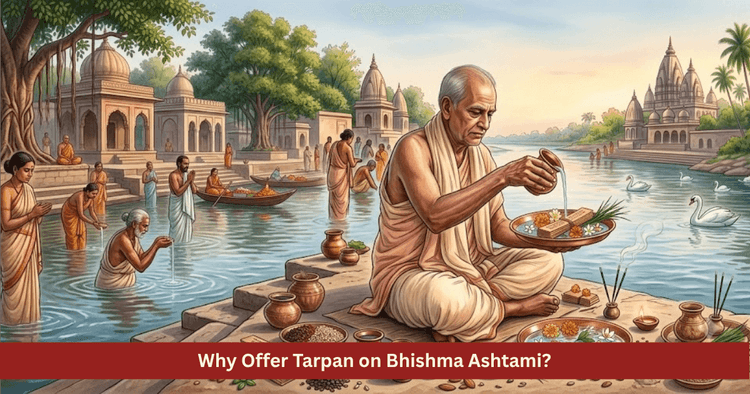
Table of Contents
Date, Tarpan and Core Rules of Bhishma Ashtami
The Ashtami tithi of the bright fortnight of Magha month is called Bhishma Ashtami. According to traditional belief, it was on this tithi that Bhishma Pitamaha, the great warrior of the Mahabharata, after a long wait on his bed of arrows, gave up his life through the power of yoga once the Sun had entered Uttarayana and attained the supreme state. In the Gregorian calendar, this tithi usually falls between late January and February. On this day there is a special tradition of offering tarpan and arghya in the name of Bhishma Pitamaha and according to scriptural tradition anyone may offer this tarpan, even if their own parents are alive.
| Element of the Observance | Details |
|---|---|
| Tithi | Magha Shukla Ashtami |
| Remembrance | The day of Bhishma Pitamaha's departure |
| Principal Acts | Bhishma tarpan, arghya, sacred bath and charity |
| Right to Offer Tarpan | People of all backgrounds, even if their parents are alive |
| Tarpan Materials | Water, black sesame, kusha grass and rice grains |
| Direction | Facing south |
| Special Recitation | The Vishnu Sahasranama |
| Expected Fruit | Freedom from Pitru Dosha, inner strength and the joy of children |
The Basic Rules of Bhishma Ashtami
- In the morning, bathe in a sacred river or at home in water mixed with Gangajal.
- After bathing, face the south and offer tarpan for Bhishma with water, black sesame and kusha.
- Recite the Bhishma tarpan mantra and remember his sacrifice with reverence.
- During the day, recite the Vishnu Sahasranama, which Bhishma Pitamaha himself recited to Yudhishthira.
- Donate grain, sesame and clothes according to your means.
Who Was Bhishma Pitamaha?
The original name of Bhishma Pitamaha was Devavrata. He was the son of King Shantanu of Hastinapura and Devi Ganga. According to Puranic belief, he was the incarnation of one of the 8 Vasus, who had to take birth in human form because of a curse.
The vow that Devavrata took for his father's happiness made him immortal in history. King Shantanu wished to marry Satyavati, the daughter of a fisherman chief but Satyavati's father set the condition that only his daughter's son would become king. To fulfil his father's wish, Devavrata not only gave up his right to the throne but also took the stern vow of lifelong celibacy, so that no child of his could ever raise a dispute in the future. It was because of this terrible vow that he came to be called Bhishma, the one of the fearsome vow.
Pleased by this sacrifice, King Shantanu granted him the boon of Ichha Mrityu, death at will. This meant that death could touch him only when he himself wished it.
The Bed of Arrows and the Wait for Uttarayana
On the 10th day of the Mahabharata war, wounded by Arjuna's arrows, Bhishma fell from his chariot. His whole body was so pierced with arrows that he did not even touch the ground but lay on a bed of arrows. His head was hanging down, so Arjuna shot 3 arrows into the ground to make a pillow of arrows for him. When he became thirsty, Arjuna shot an arrow into the earth, brought forth a stream of the Ganga and carried its water to his lips.
Because he had the boon of death at will, Bhishma did not give up his body at that moment. At that time the Sun was in Dakshinayana. The scriptures regard Uttarayana as the day of the gods and the best time for liberation. The Bhagavad Gita also describes the supreme destination of the yogi who leaves the body during Uttarayana. So Bhishma waited for the Sun to enter Uttarayana. According to the Mahabharata, he lay on the bed of arrows for 58 nights.
The Priceless Wisdom Given from the Bed of Arrows
Even while lying on the bed of arrows, Bhishma did not abandon his duty. After the war was over, Lord Shri Krishna brought Yudhishthira to him so that he could receive the knowledge of the duties of a king. Bhishma gave Yudhishthira detailed teachings on Rajadharma, Apaddharma and Mokshadharma, the duties of kings, the duties in times of distress and the path of liberation, which are collected in the Shanti Parva and Anushasana Parva of the Mahabharata.
During these teachings, Yudhishthira asked which one deity, when praised, brings welfare to human beings. In reply, Bhishma recited the 1000 names of Lord Vishnu, known today as the Vishnu Sahasranama. This hymn remains part of the daily worship of crores of people even today. This is why reciting the Vishnu Sahasranama on Bhishma Ashtami is regarded as highly meritorious.
Why Does Everyone Have the Right to Offer Bhishma Tarpan?
Ordinarily, the right to offer ancestral tarpan is given to those whose father has passed away. But on Bhishma Ashtami this rule is different. According to scriptural tradition, on this day people of all backgrounds, even if their parents are alive, may offer tarpan and arghya in the name of Bhishma Pitamaha.
The reason is deeply moving. Bhishma Pitamaha remained celibate all his life. He had no son who could offer him tarpan. He gave his whole life for his father, his family and his kingdom. So tradition arranged that the whole of society should become his children and offer him water. He became the grandfather of all of India.
There is another deep meaning in this tarpan. It is believed that the water offered in Bhishma's name reaches all those souls who have no descendants and who have no one left to offer them tarpan. In this way, Bhishma tarpan becomes not the tarpan of one individual but of all childless and forgotten souls.
The Method and Mantra of Bhishma Tarpan
| Step | Method |
|---|---|
| Bath | In the morning, bathe in a sacred river or in water mixed with Gangajal |
| Seat | Sit on a kusha mat facing south |
| Materials | Take water, black sesame, kusha and rice grains in a copper vessel |
| Sankalpa | Take a resolve to offer tarpan for the satisfaction of Bhishma Pitamaha |
| Sacred Thread | Those who wear the sacred thread should move it to the right shoulder |
| Tarpan | While reciting the tarpan mantra, offer water 3 times through the Pitru Tirtha, the part of the palm between the thumb and index finger |
| Arghya | Then offer arghya to Surya Dev and bow in the name of Bhishma |
| Recitation | Recite the Vishnu Sahasranama |
| Charity | Donate grain, sesame, clothes and dakshina |
The Bhishma Tarpan Mantra
By tradition, this mantra is recited during Bhishma tarpan.
"Vaiyaghrapada gotraya Sankritya pravaraya cha, Gangaputraya Bhishmaya ajanma brahmacharine."
Its meaning is: this water is offered to Bhishma, of the Vaiyaghrapada lineage and the Sankritya line, the son of Ganga and a celibate from birth. After this, the prayer is that Bhishma, the son of Shantanu, the brave, the truthful and the master of his senses, may receive through this water the same satisfaction that comes from water offered by a son and grandson. A person who cannot recite the Sanskrit mantra may offer water with faith while taking the name of Bhishma Pitamaha.
The Spiritual Fruits of Bhishma Ashtami
- Freedom from Pitru Dosha: Bhishma tarpan is regarded as an effective remedy for pacifying Pitru Dosha.
- Growth of inner strength: Remembering Bhishma's sacrifice and firmness awakens willpower within a person.
- The joy of children: Tradition holds that fasting and offering tarpan on this day brings the blessing of virtuous children.
- Cleansing of sins: The merit of bathing and tarpan multiplies many times in Magha month.
- Understanding of dharma: The life of Bhishma teaches duty, keeping one's word and sacrifice.
Lessons from the Life of Bhishma
The life of Bhishma Pitamaha is not merely a story but a mirror in which every person can see their own duties and decisions.
| Quality | Example in Bhishma's Life | Message for Life Today |
|---|---|---|
| Sacrifice | Giving up the throne and family life for his father's happiness | Giving up personal comfort for the family |
| Keeping One's Word | Honouring a lifelong vow | Firmness in keeping one's word |
| Patience | Waiting 58 nights on a bed of arrows | Patience in difficult times |
| Sharing Knowledge | Teaching Yudhishthira until his last moments | Passing one's experience and knowledge to the next generation |
| Self Control | Using death at will at the right time | Mastery over the senses and desires |
A warning is also hidden in Bhishma's life. Bound by his vow, he remained silent when Draupadi was insulted and he had to fight on the side of adharma. This teaches that keeping one's word is important but dharma stands even higher. No vow should force a person to remain silent before injustice.
Bhishma Ashtami Through the Lens of Vedic Astrology
In Vedic astrology, the Sun signifies the father and the ancestors and the 9th house is linked with ancestral grace and fortune. When the Sun is afflicted by Rahu or Saturn or when malefic planets influence the 9th house, astrology sees this as a sign of Pitru Dosha. Bhishma Ashtami falls during Uttarayana, when the Sun is moving towards strength. So tarpan offered on this day is believed to bring the grace of both the Sun and the ancestors.
| Concern | Astrological Indication | Remedy on Bhishma Ashtami |
|---|---|---|
| Pitru Dosha | Sun afflicted by Rahu or Saturn | Bhishma tarpan and feeding Brahmins |
| Obstacles related to children | Afflicted 5th house | Fasting, tarpan and the Vishnu Sahasranama |
| Blocks in fortune | Malefic influence on the 9th house | Solar arghya and donation of grain |
| Lack of confidence | Weak Sun | Remembering Bhishma's life and the Aditya Hridaya Stotram |
What Should Be Done and Avoided on Bhishma Ashtami?
| Do | Do Not |
|---|---|
| Offer tarpan in the name of Bhishma Pitamaha | Do not treat the tarpan as a mere formality |
| Recite the Vishnu Sahasranama | Do not eat tamasic food on this day |
| Resolve to keep your promises | Do not lightly break a promise given to anyone |
| Serve childless elderly people | Do not disrespect your elders |
| Donate grain, sesame and clothes | Do not make a display of your charity |
The Immortal Grandfather on the Bed of Sacrifice
Bhishma Ashtami is the remembrance of a great soul who gave up everything for others and asked for nothing in return. He had no son, no kingdom and no family life. Yet he became the grandfather of the whole nation. This is proof that a person's greatness is measured by their sacrifice, not by their possessions.
The person who offers water to Bhishma Pitamaha with faith on this day does not merely offer tarpan to a warrior. That person satisfies all those souls who have no one left to remember them. And at the same time, that person awakens within the qualities of sacrifice, faithfulness to one's word and patience through which Bhishma became immortal.
FAQ
When is Bhishma Ashtami observed? Bhishma Ashtami is observed on the Ashtami tithi of the bright fortnight of Magha month. Traditional belief holds that Bhishma Pitamaha left his body on this day during Uttarayana.
Can one offer Bhishma tarpan even if one's parents are alive? Yes. According to scriptural tradition, everyone may offer tarpan in the name of Bhishma Pitamaha on Bhishma Ashtami, even if their parents are alive.
How long did Bhishma Pitamaha lie on the bed of arrows? According to the Mahabharata, Bhishma Pitamaha lay on the bed of arrows for 58 nights, waiting for the Sun to enter Uttarayana.
Why is the Vishnu Sahasranama recited on Bhishma Ashtami? Bhishma Pitamaha recited the 1000 names of Lord Vishnu to Yudhishthira from his bed of arrows, so reciting the Vishnu Sahasranama on this day is especially fruitful.
What are the benefits of Bhishma tarpan? Bhishma tarpan is believed to bring freedom from Pitru Dosha, greater inner strength and the joy of children. It is also a means of satisfying souls who have no descendants.
Get your accurate Kundali
Generate KundaliDid you like it?
Author
Pt. Suvrat Sharma (63)
Experience: 20
Consults About: Family Planning, Career
Clients In: Punjab, Haryana, Delhi
Share this article with friends and family
WELCOME TO
ZODIAQ
Right Decisions at the right time with ZODIAQ
