Why Donate Sesame on Bhishma Dwadashi?
By Pt. Amitabh Sharma
Damodara Worship, 12 Lamps and Peace for Ancestors
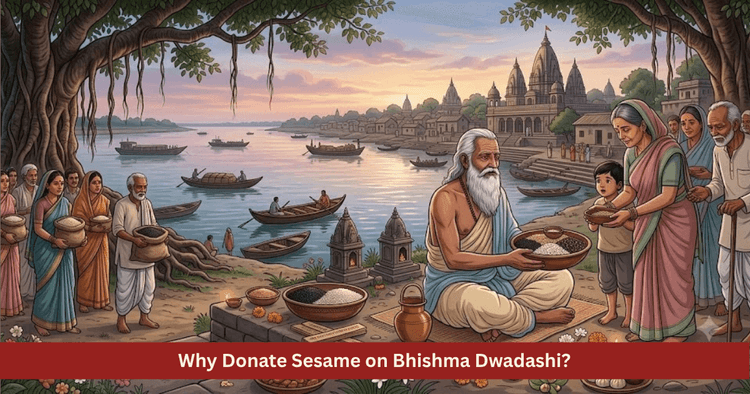
Table of Contents
Date, Worship and Lamp Offering of Bhishma Dwadashi in Brief
Magha Shukla Dwadashi, the day right after Jaya Ekadashi, is called Bhishma Dwadashi. It is also known as Til Dwadashi, the Dwadashi of sesame. On this day the Damodara form of Lord Vishnu is worshipped and a special offering of sesame is made to him. It is believed that after the departure of Bhishma Pitamaha, the Pandavas performed tarpan and acts of charity for the peace of his soul on this very Dwadashi, under the guidance of sage Vedavyasa. In the Gregorian calendar, this tithi usually falls between late January and February.
| Element of the Observance | Details |
|---|---|
| Tithi | Magha Shukla Dwadashi |
| Other Name | Til Dwadashi |
| Principal Deity | The Damodara form of Lord Vishnu |
| Remembrance | Bhishma Pitamaha and the rites performed by the Pandavas |
| Principal Acts | Sesame bath, sesame bhog, tarpan, lighting 12 lamps and sesame charity |
| Place of the Lamp Offering | A riverbank or the home shrine |
| Main Mantras | ॐ दामोदराय नमः and the 12 names of the Lord |
| Ekadashi Parana | The Jaya Ekadashi fast is also broken on this day |
| Expected Fruit | Satisfaction of the ancestors, growth of the family line, long life and fulfilment of wishes |
The Basic Rules of This Day
- In the morning, bathe in water mixed with a few black sesame seeds.
- If you kept the Jaya Ekadashi fast, break it at the auspicious time given in the local Panchang.
- Offer sesame, tulsi leaves, yellow flowers and naivedya made of sesame to Lord Damodara.
- Offer tarpan to the ancestors with water mixed with sesame.
- In the evening, light 12 ghee lamps, remember the ancestors and donate sesame.
The Beautiful Sequence of Ashtami, Ekadashi and Dwadashi
The bright fortnight of Magha month is deeply linked with the memory of Bhishma Pitamaha. On Ashtami Bhishma left his body, on Ekadashi comes the fast of Jaya Ekadashi and on Dwadashi, as Bhishma Dwadashi, the rites performed for the peace of his soul are remembered. This sequence shows that in the Sanatana tradition the remembrance of a great soul is not limited to one day but continues with reverence over several days.
According to Puranic belief, after Bhishma's departure Yudhishthira and his brothers were in deep grief. Sage Vedavyasa advised them to give up grief and fulfil their duty and he described the rites of tarpan, charity and worship for the peace of Bhishma's soul. The Pandavas performed all these rites on the day of Dwadashi. In memory of this, the tithi came to be called Bhishma Dwadashi.
Who Is Lord Damodara?
On this day there is a special tradition of worshipping the Damodara form of Lord Vishnu. The word Damodara is made of 2 words. Dama means rope and udara means belly. This name is connected with a sweet childhood leela of Lord Shri Krishna.
According to the story in the Shrimad Bhagavata Purana, the child Krishna once broke Mother Yashoda's pots of butter and began feeding the butter to monkeys. Troubled by his mischief, Mother Yashoda tried to tie him to a wooden mortar with a rope. But each time the rope fell short by 2 finger widths. The mother joined many ropes together, yet the rope still fell short. At last, when the mother was tired and drenched in sweat, the Lord, moved by her love, allowed himself to be bound. Because he was tied with a rope around his belly, he came to be called Damodara.
This leela shows that no power can bind the Lord who holds the entire universe. But the innocent love of a devotee binds even Him. The worship of Damodara on Bhishma Dwadashi is a remembrance of this very love and surrender. Bhishma Pitamaha was himself a great devotee of Lord Shri Krishna and at his final hour the Lord Himself stood before him.
Why Is It Called Til Dwadashi?
Sesame has special importance in Magha month. The tradition of sesame that begins with Shattila Ekadashi in the dark fortnight is seen in its complete form on this Dwadashi of the bright fortnight. On this day sesame is used for bathing, for bhog, for tarpan, for homa and for charity. This is why it is called Til Dwadashi.
| Use of Sesame | Method | Spiritual Fruit |
|---|---|---|
| Sesame Bath | Adding black sesame to the bathing water | Purification of body and mind |
| Sesame Bhog | Offering sesame laddoos to Lord Damodara | The pleasure of the Lord |
| Sesame Tarpan | Tarpan to the ancestors with water mixed with black sesame | Satisfaction of the ancestors |
| Sesame Homa | Oblations of sesame and ghee | Purification of the atmosphere and the mind |
| Sesame Charity | Giving a vessel filled with sesame to a Brahmin or a needy person | Imperishable merit and peace from Saturn |
Why Light 12 Lamps?
On Bhishma Dwadashi it is traditional to light 12 ghee lamps on a riverbank or at the home shrine and remember the ancestors. It is believed that this greatly satisfies the ancestors, who bless their lineage with growth and long life.
The 12 lamps are linked in several ways. Dwadashi is itself the 12th tithi. There are 12 months in a year and 12 Adityas. In the Vaishnava tradition, 12 principal names of Lord Vishnu are given, known as the Keshavadi Dwadasha Nama, the 12 names beginning with Keshava. Lighting each lamp with one name makes this lamp offering even more sacred.
| Lamp | Name of the Lord | Mantra |
|---|---|---|
| 1 | Keshava | Om Keshavaya Namah |
| 2 | Narayana | Om Narayanaya Namah |
| 3 | Madhava | Om Madhavaya Namah |
| 4 | Govinda | Om Govindaya Namah |
| 5 | Vishnu | Om Vishnave Namah |
| 6 | Madhusudana | Om Madhusudanaya Namah |
| 7 | Trivikrama | Om Trivikramaya Namah |
| 8 | Vamana | Om Vamanaya Namah |
| 9 | Shridhara | Om Shridharaya Namah |
| 10 | Hrishikesha | Om Hrishikeshaya Namah |
| 11 | Padmanabha | Om Padmanabhaya Namah |
| 12 | Damodara | Om Damodaraya Namah |
The last of these 12 names is Damodara. Offering lamps in this sequence on Bhishma Dwadashi is especially meaningful, because this day is itself the day of Damodara's worship.
The Complete Worship Method of Bhishma Dwadashi
| Time | Observance |
|---|---|
| Morning | Bath in water mixed with sesame and clean yellow clothes |
| Parana | If the Jaya Ekadashi fast was kept, break it at the auspicious time |
| Worship | Bathe Lord Damodara with panchamrit and offer yellow flowers, tulsi leaves and sandalwood |
| Bhog | Sesame laddoos, preparations of sesame and jaggery and seasonal fruits |
| Tarpan | Face the south and offer tarpan to the ancestors with water mixed with black sesame |
| Recitation | Recite the Vishnu Sahasranama or the Damodarashtakam |
| Charity | Donate a vessel filled with sesame, grain, clothes and dakshina |
| Evening | Light 12 ghee lamps and remember the ancestors along with the 12 names of the Lord |
The Damodarashtakam is a famous hymn to Lord Damodara that describes the beauty and love of the child Krishna bound by Mother Yashoda. Reciting it on Bhishma Dwadashi fills the heart with devotion.
The Spiritual Fruits of Bhishma Dwadashi
- Satisfaction of the ancestors: Sesame tarpan and the offering of 12 lamps are believed to bring supreme peace to the forefathers.
- Growth of the family line: It is believed that satisfied ancestors bless their lineage with children and growth.
- Long life: The charity and worship of this day are regarded as auspicious for the long life of family members.
- Fulfilment of wishes: Tradition describes this vow as one that fulfils all wishes.
- Growth of devotion: The worship of Damodara awakens innocent love and surrender in the heart.
Bhishma Dwadashi Through the Lens of Vedic Astrology
In Vedic astrology, Lord Vishnu is regarded as the lord of the Dwadashi tithi. Sesame is linked with Saturn and the lamp with the Sun and the element of fire. In Magha month the Sun is in the sign of Saturn, so this union of sesame and lamp symbolises the balance of both the Sun and Saturn. The Sun signifies the ancestors and the 9th house is linked with ancestral grace.
| Concern | Astrological Indication | Remedy on Bhishma Dwadashi |
|---|---|---|
| Pitru Dosha | Afflicted Sun or 9th house | Sesame tarpan and the offering of 12 lamps |
| Obstacles related to children | Afflicted 5th house | Damodara worship and recitation of the Damodarashtakam |
| Troubles linked with Saturn | Sade Sati or Dhaiya | Donating a vessel filled with sesame |
| Unrest in the family | Afflicted 4th house | Lighting lamps at home in the evening and chanting Vishnu's names |
| Blocks in fortune | Weak Jupiter | The Vishnu Sahasranama and offering yellow flowers |
What Should Be Done and Avoided on Bhishma Dwadashi?
| Do | Do Not |
|---|---|
| Bathe in water mixed with sesame | Do not pluck tulsi leaves on Dwadashi |
| Break the Ekadashi fast at the right time | Do not break the fast during Hari Vasar |
| Offer tarpan and lamps for the ancestors | Do not disrespect or mock the ancestors |
| Donate sesame and grain | Do not give spoiled items in charity |
| Worship Damodara with love | Do not eat meat, alcohol or tamasic food on this day |
The Memory of the Ancestors Shining in a Row of Lamps
Bhishma Dwadashi is the evening when the memories of the ancestors shine in a row of 12 lamps. This day teaches that remembering and remaining grateful to those who gave everything for their descendants is not only dharma but the very root of humanity. The rites that the Pandavas performed for their grandfather still inspire every family to honour its elders.
For the person who worships Lord Damodara with love on this day, offers water mixed with sesame to the ancestors and remembers them with 12 lamps in the evening, the flames of the lamps do not merely remove darkness from the home. They become a light of ancestral blessing that keeps illuminating the path of the lineage for generations.
FAQ
When is Bhishma Dwadashi observed?
Bhishma Dwadashi is observed on the Dwadashi tithi of the bright fortnight of Magha month, the day after Jaya Ekadashi. It is also called Til Dwadashi.
Which deity is worshipped on Bhishma Dwadashi?
On this day the Damodara form of Lord Vishnu is worshipped. He is offered sesame as bhog, tulsi leaves and yellow flowers.
Why is Bhishma Dwadashi called Til Dwadashi?
On this day sesame is used for bathing, bhog, tarpan, homa and charity, so it is called Til Dwadashi.
Why are 12 lamps lit on Bhishma Dwadashi?
Dwadashi is the 12th tithi and Lord Vishnu has 12 names beginning with Keshava. It is believed that lighting 12 ghee lamps in memory of the ancestors satisfies them.
What fruit does Bhishma Dwadashi bring?
It is believed that the tarpan, lamp offering and sesame charity of this day bring satisfaction to the ancestors, growth of the family line, long life and fulfilment of wishes.
Get your accurate Kundali
Generate KundaliDid you like it?
Author
Pt. Amitabh Sharma (56 Years)
Experience: 20
Consults About: Family Planning, Career
Clients In: Punjab, Haryana, Delhi
Share this article with friends and family
WELCOME TO
ZODIAQ
Right Decisions at the right time with ZODIAQ
