How to Perform Gayatri Purashcharan in Magha?
By Pt. Abhishek Sharma
Short Anushthan, Nyasa, Havan and Awakening the Intellect
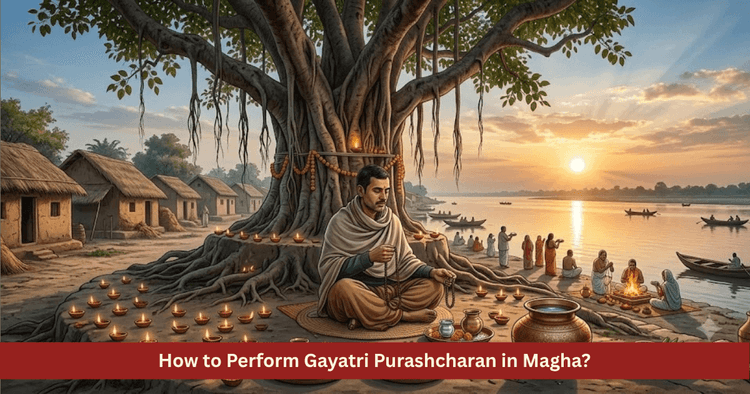
Table of Contents
Gayatri Sadhana in Magha Month at a Glance
The calm, deep and cool nights and the moments of dawn in Magha month are regarded as a time of nectar for yogis and seekers of Gayatri. Tradition holds that sattvic vibrations are strongest in the atmosphere during this month. Chanting the Gayatri Mahamantra on a rosary for at least 5 or 11 rounds every day during Brahma Muhurta and at dusk, facing east or north, is regarded as purifying the seeker's aura. It is believed that seekers who perform a short anushthan of 24,000 Gayatri mantras in this month see a remarkable growth in their intellect, decision making and power of speech.
| Element of Sadhana | Details |
|---|---|
| Mantra | Om Bhur Bhuvah Svah Tat Savitur Varenyam Bhargo Devasya Dhimahi Dhiyo Yo Nah Prachodayat |
| Best Time | Brahma Muhurta and dusk |
| Direction | East in the morning and north or west in the evening |
| Rosary | A rosary of 108 beads of rudraksha, tulsi or sandalwood |
| Daily Japa | At least 5 or 11 rounds |
| Short Anushthan | 24,000 mantras, usually in 9 days |
| Full Purashcharan | 24 lakh mantras, over a long period |
| Conclusion | Havan, tarpan, marjan and feeding Brahmins |
The Basic Rules of Gayatri Sadhana
- Chant at the same time, in the same place and on the same seat every day.
- During the days of japa, keep to sattvic food, celibacy and restrained speech.
- Seek guidance from someone knowledgeable so that the mantra is pronounced correctly.
- During japa, meditate on the light of Savita Dev in the mind.
- If you have taken the resolve of an anushthan, do not abandon it midway.
The Meaning and Glory of the Gayatri Mahamantra
The Gayatri Mantra is a mantra of the Rigveda and sage Vishvamitra is regarded as its seer. It is called the mother of the Vedas. The mantra is a worship of Savita Dev. Savita means the inspirer and in the Vedic tradition the Sun himself is worshipped as Savita.
The meaning of the mantra is as follows. The seeker meditates on the supreme and divine radiance of Savita Dev, who pervades all 3 worlds, Bhu, Bhuvah and Svah, that is the earth, the intermediate space and heaven and who inspires the intellect of all towards the right path. This mantra does not ask for wealth, splendour or worldly pleasure. It only prays that the intellect be pure and move in the right direction. This is the greatest speciality of the mantra, because the solution to every problem of life comes from a pure intellect.
| Part of the Mantra | Meaning |
|---|---|
| Om | The primordial sound, symbol of the Supreme |
| Bhur Bhuvah Svah | The earth, the intermediate space and heaven, the 3 worlds |
| Tat Savitur Varenyam | That supreme Savita, worthy to be chosen |
| Bhargo Devasya Dhimahi | The seeker's resolve to meditate on the divine radiance |
| Dhiyo Yo Nah Prachodayat | Who inspires the intellect towards the right path |
Why Is Gayatri Sadhana Special in Magha Month?
The Gayatri Mantra is a mantra of worship of Savita, the Sun and Magha is regarded as the finest month for Sun worship. At this time the Sun is in Uttarayana and its radiance slowly grows. This is why tradition regards Magha month as especially favourable for Gayatri sadhana.
The cold and long nights of Magha also favour sadhana. At this time nature is calm, outer activity is less and the mind naturally turns inward. The worship of Maa Saraswati on Vasant Panchami and the worship of Gayatri are both linked with intellect and knowledge, so this month is especially fruitful for students and seekers of knowledge.
The Difference Between the Short Anushthan and Purashcharan
Purashcharan means chanting a mantra according to the rules a set number of times in order to perfect it. Tradition prescribes lakhs of japa equal to the number of syllables in the mantra for its purashcharan. The Gayatri Mantra has 24 syllables, so its full purashcharan is 24 lakh japa. This is a long and demanding sadhana.
For householders and students, tradition prescribes a short anushthan in which 24,000 mantras are chanted. This is usually completed in 9 days, that is about 27 rounds of the rosary every day.
| Sadhana | Number of Japa | Usual Duration | For Whom |
|---|---|---|---|
| Daily worship | 5 or 11 rounds daily | Regular | All seekers |
| Short anushthan | 24,000 mantras | About 9 days | Householders and students |
| Medium anushthan | 1 lakh 25 thousand mantras | About 40 days | Experienced seekers |
| Full purashcharan | 24 lakh mantras | A long period | Dedicated seekers under a guru's guidance |
The 5 Limbs of Purashcharan
Tradition describes 5 limbs of purashcharan. Each following limb is a dashansh, one tenth, of the previous one.
| Limb | Details | Number for 24,000 Japa |
|---|---|---|
| Japa | Chanting the mantra according to the rules | 24,000 |
| Havan | Havan of one tenth of the japa | 2,400 oblations |
| Tarpan | Tarpan of one tenth of the havan | 240 times |
| Marjan | Marjan, sprinkling water, of one tenth of the tarpan | 24 times |
| Brahmin Bhojan | Feeding Brahmins or the needy according to one's means | According to faith |
For a seeker who cannot perform havan, tradition also gives the option of chanting additional japa equal to the number of havan oblations.
A Simple Introduction to Nyasa
Nyasa means the feeling of placing the syllables and powers of the mantra in the different parts of the body. This makes the seeker's body fit to hold the power of the mantra. A simple nyasa is regarded as enough for the householder seeker.
- Kara Nyasa: Touching the fingers and palms of both hands with the feeling of the mantra.
- Anga Nyasa: Touching the heart, head, crown, eyes and the whole body in sequence while feeling the power of the mantra being established.
- Dhyana: Meditating on the radiant form of Maa Gayatri or Savita Dev before japa.
The detailed method of nyasa is given in books on Gayatri worship. It is best to learn it from a knowledgeable person or a guru.
The Complete Method of the Short Anushthan
| Step | Method |
|---|---|
| Sankalpa | On the first day, bathe at an auspicious time and take the resolve of 24,000 japa |
| Place | A quiet shrine at home where you can sit every day |
| Seat | A kusha or woollen mat, the same seat for the whole anushthan |
| Lamp | Light a ghee lamp |
| Achamana and Pranayama | Sip water in the ritual way and calm the mind with some pranayama |
| Nyasa and Meditation | Perform a simple nyasa and meditate on Savita Dev |
| Japa | About 27 rounds of japa daily, at the same time |
| Conclusion | On the last day, havan, tarpan, marjan and feeding a Brahmin or a needy person |
| Prayer for Forgiveness | A prayer for forgiveness for any errors in the anushthan |
The Strict Rules of Gayatri Sadhana
| Rule | Details |
|---|---|
| Celibacy | Complete celibacy during the days of the anushthan |
| Diet | Sattvic food, one meal a day if possible |
| Sleep | Sleep on the ground if possible |
| Speech | Complete avoidance of harsh words, lies and criticism |
| Regularity | Do not change the time, place or seat of japa |
| Purity | Japa only after bathing, in clean clothes |
| State of Mind | Keep the mind focused on the meaning of the mantra during japa |
| Discretion | Do not publicise the anushthan or your experiences |
The Benefits of Gayatri Sadhana
Both tradition and experience show that regular Gayatri sadhana brings many positive changes to the seeker's life.
- Power of intellect: Gayatri is a mantra that inspires the intellect, so it is regarded as improving memory and understanding.
- Decision making: A calm and focused mind is able to make the right decisions.
- Power of speech: Regular japa brings clarity and effectiveness to speech.
- Growth of vital energy: Pranayama done with japa increases energy and vigour in the body.
- Spiritual awakening: Through regular sadhana a person begins to experience inner peace and strength.
- Peace of mind: The rhythm of the mantra calms the restlessness of the mind.
Gayatri Sadhana Through the Lens of Vedic Astrology
In astrology the Sun signifies the soul and radiance, Mercury the intellect and speech and Jupiter knowledge. The Gayatri Mantra is a worship of Savita, the Sun and its aim is the purification of the intellect. So in astrological tradition Gayatri sadhana is regarded as increasing the auspicious results of the Sun, Mercury and Jupiter together. It is especially useful for people who experience a lack of confidence or obstacles in studies because of a weak Sun.
What Should Be Done and Avoided in Gayatri Sadhana?
| Do | Do Not |
|---|---|
| Chant after learning the correct pronunciation | Do not rush through japa with wrong pronunciation |
| Chant at the same time every day | Do not abandon an anushthan midway after taking the resolve |
| Keep a sattvic diet and restraint | Do not take tamasic food or indulge in addictions |
| Reflect on the meaning along with japa | Do not focus only on completing the count |
| Seek a guru's guidance before a difficult sadhana | Do not publicise your experiences |
An Intellect Blossoming in the Light of the Mantra
The Gayatri Mantra is the heart of India's spiritual tradition. It holds no worldly demand and no fear. It is only a humble prayer that the intellect be illuminated. When the seeker chants this mantra in the quiet dawn of Magha month, the very light for which they pray slowly begins to awaken within.
For the seeker who practises Gayatri sadhana with discipline, faith and patience in this month, this mantra does not remain merely a group of words. It becomes a guide for life, showing the right direction at every difficult turn. This is the greatest blessing of Gayatri sadhana.
FAQ
What is the short anushthan of Gayatri? In the short anushthan the Gayatri Mantra is chanted 24,000 times, which is usually completed in 9 days by chanting about 27 rounds of the rosary daily.
How many japa make up the full purashcharan of the Gayatri Mantra? The Gayatri Mantra has 24 syllables, so tradition regards its full purashcharan as 24 lakh japa. It is a long sadhana performed under a guru's guidance.
What are the 5 limbs of purashcharan? The 5 limbs of purashcharan are japa, havan, tarpan, marjan and feeding Brahmins. Each following limb is one tenth of the previous one.
Why is Gayatri sadhana special in Magha month? The Gayatri Mantra is a worship of Savita, the Sun and Magha is the finest month for Sun worship. The calm atmosphere of this month also favours sadhana.
Which rosary is best for Gayatri japa? A rosary of 108 beads of rudraksha, tulsi or sandalwood is regarded as best for Gayatri japa. Use the same rosary throughout the anushthan.
Get your accurate Kundali
Generate KundaliDid you like it?
Author

Pt. Abhishek Sharma (63)
Experience: 20
Consults About: Family Planning, Career
Clients In: Punjab, Haryana, Delhi
Share this article with friends and family
WELCOME TO
ZODIAQ
Right Decisions at the right time with ZODIAQ
