Why Chant the Mahamantra in Magha?
By Pt. Sanjeev Sharma
The Kali Santarana Upanishad, 16 Names and Sankirtan
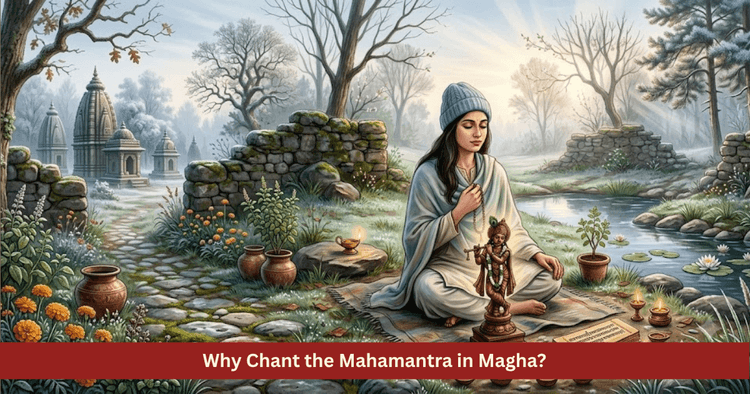
Table of Contents
The Kali Santarana Upanishad and the Mahamantra at a Glance
The Kali Santarana Upanishad describes the Mahamantra of 16 names and 32 syllables as the simplest means of crossing beyond the faults of the Kali Yuga and mental unrest. In Magha month, when Lord Madhava is regarded as the presiding deity, chanting or singing this Mahamantra every day on a tulsi rosary is regarded as highly meritorious. Tradition holds that just as dry grass burns in fire, the divine name chanted with faith burns away accumulated karmic bonds.
| Element of the Mahamantra | Details |
|---|---|
| Source | The Kali Santarana Upanishad |
| Order in the Upanishad | Hare Rama Hare Rama Rama Rama Hare Hare, Hare Krishna Hare Krishna Krishna Krishna Hare Hare |
| Popular Kirtan Order | Hare Krishna Hare Krishna Krishna Krishna Hare Hare, Hare Rama Hare Rama Rama Rama Hare Hare |
| Number of Names | 16 |
| Number of Syllables | 32 |
| Rosary for Japa | A tulsi rosary |
| Types of Japa | Spoken japa, whispered japa, mental japa and group sankirtan |
| Expected Fruit | Peace of mind, cleansing of sins and growth of devotion |
Core Points for Chanting the Mahamantra
- Chant on a tulsi rosary at a fixed time every day.
- While chanting, try to hear each name clearly.
- Feeling and concentration matter more than the number of rounds.
- Group sankirtan with the family makes the atmosphere of the home sacred.
- Along with chanting the name, adopt good conduct and compassion in life.
The Story of the Kali Santarana Upanishad
The Kali Santarana Upanishad is a short but very powerful Upanishad, regarded as belonging to the Krishna Yajurveda. It contains a dialogue between Devarshi Narada and Lord Brahma. At the end of the Dvapara Yuga, Narada went to Brahma and asked how, while wandering the earth, he could cross beyond the influence of the Kali Yuga.
Brahma replied that he would reveal the secret of all the Vedas, through which one can cross beyond the influence of the Kali Yuga. That secret is the chanting of the name of the primordial Lord Narayana. Then Brahma gave the Mahamantra of 16 names. The Upanishad says that these 16 names destroy the covering of the 16 kalas that veil the individual soul. After this, the light of the Supreme shines forth just as the rays of the Sun appear when the clouds part.
When Narada asked about the method of chanting this mantra, Brahma replied that it has no special rule. Anyone may chant it at any time, in any state, pure or impure. This is the greatest speciality of this Mahamantra. It is open to all, at all times and in every condition.
The Upanishad further says that one who chants this Mahamantra 3.5 crore times is freed from many kinds of sin. This number inspires the seeker to chant the name continuously throughout life.
The Meaning of the Mahamantra
The Mahamantra contains 3 names: Hare, Krishna and Rama. Tradition explains the meanings of these names as follows.
| Name | Meaning |
|---|---|
| Hare | An address to the blissful power of the Lord, Shri Radha or Mother Lakshmi and the vocative form of Hari |
| Krishna | The one who attracts all, the all attractive Supreme |
| Rama | The one who delights in the hearts of yogis, the source of joy |
In this way the Mahamantra is a prayer that calls upon both the Lord and his power together. It is a call in which the seeker prays to the Lord to be engaged in his service. It holds no worldly demand, only love and surrender.
The 2 Popular Orders of the Mantra
In the Kali Santarana Upanishad the Mahamantra begins with Hare Rama. But in the kirtan popular in the tradition of Shri Chaitanya Mahaprabhu and the Gaudiya Vaishnavas, it begins with Hare Krishna. Both orders are chanted with devotion and both contain the same 16 names. The seeker may chant in either order according to their own tradition.
The Special Importance of Chanting the Name in Magha Month
Magha is the month of Lord Madhava and Krishna and Rama in the Mahamantra are both forms of Narayana. So chanting the Mahamantra in this month is regarded as the simplest and most accessible path of worshipping Madhava.
The cold and long nights of Magha also favour chanting the name. At this time outer activity is less and the mind naturally turns inward. Tradition holds that chanting the name on the cold nights of this month gives the soul divine joy and deep peace.
Rules and Method of Chanting the Mahamantra
Although the Upanishad gives no strict rule for chanting, tradition offers some suggestions that make japa more focused and effective.
| Aspect | Suggestion |
|---|---|
| Time | Brahma Muhurta is best but japa can be done at any time |
| Rosary | A tulsi rosary of 108 beads |
| Number | Begin with at least 1 round a day and increase gradually |
| Seat | Sitting upright in a quiet place |
| Pronunciation | Each name clearly and attentively |
| Mind | Focus on the sound of the name |
| Care of the Rosary | Keep the rosary in a bead bag or clean cloth and not on the floor |
The 4 Types of Japa
- Vachika japa: Chanting the name aloud. This is easy for beginners.
- Upamshu japa: Chanting softly with moving lips, so that only the chanter can hear.
- Manasika japa: Remembering the name within the mind. It is regarded as the deepest.
- Sankirtan: Singing the name together with family or a group, with musical instruments.
The Tradition of Sankirtan
In the 16th century, Shri Chaitanya Mahaprabhu spread group Harinaam Sankirtan as a great movement in Bengal and Odisha. He taught that in the Kali Yuga, singing the name of the Lord is the finest sadhana. In his sankirtan there was no place for caste, class or discrimination. Everyone sang the name of the Lord together.
Even today this tradition has spread throughout the world. In Magha month, spending some time in sankirtan with the family in the evening makes the atmosphere of the home sacred, calm and joyful. It also sows the seeds of devotion and good values in children.
The Spiritual Benefits of Chanting the Name
- Peace of mind: The rhythm of the name calms the restlessness of the mind and reduces worry.
- Cleansing of sins: Tradition holds that chanting the name with faith destroys accumulated karmic bonds.
- Growth of devotion: Regular japa slowly deepens love for the Lord.
- Simplicity: It needs no special materials, place or method.
- Family harmony: Group sankirtan binds the family together.
- Inner joy: Seekers who chant the name often experience an inner joy without any outer cause.
Chanting the Name Through the Lens of Vedic Astrology
In astrology the Moon signifies the mind and chanting the name is the simplest way to steady the mind. Lord Vishnu is regarded as the presiding deity of Jupiter, so chanting his name is regarded as increasing the auspicious results of Jupiter. Tradition also holds that fear and confusion arising from Rahu and Ketu are calmed by remembering the name of the Lord.
| Concern | Astrological Indication | Remedy through Chanting |
|---|---|---|
| Mental unrest | Afflicted Moon | Daily mental japa of the Mahamantra |
| Confusion and unknown fear | Adverse Rahu | Group sankirtan in the evening |
| Lack of fortune and the guru's grace | Weak Jupiter | Extra rounds of japa on Thursday |
| Family quarrels | Afflicted 4th house | Sankirtan with the family |
What Should Be Done and Avoided in Chanting the Name?
| Do | Do Not |
|---|---|
| Chant at a regular time every day | Do not turn japa into a task of merely completing a count |
| Listen carefully to each name | Do not talk or do distracting things while chanting |
| Respect the tulsi rosary | Do not keep the rosary on the floor or in an impure place |
| Do sankirtan with the family | Do not criticise the tradition or order of others |
| Adopt good conduct along with chanting | Do not justify wrong actions by relying on chanting |
The Darkness of the Kali Yuga Dissolving in the Sound of the Name
The message of the Kali Santarana Upanishad is very simple and compassionate. Reaching the Lord needs no hard penance, great yajna or special qualification. Taking his name with love is enough. This path is open to every person, whatever their caste, class or condition.
On the cold nights of Magha month, when the seeker chants this Mahamantra on a tulsi rosary or sings it with the family, the noise of the mind slowly begins to quiet. Just as sunlight appears when the clouds part, the coverings of the mind begin to fall away through the sound of the name and the light within awakens. This is the greatest blessing of this Mahamantra.
FAQ
Which mantra is given in the Kali Santarana Upanishad?
The Kali Santarana Upanishad gives the Mahamantra of 16 names and 32 syllables, in which the names Hare, Rama and Krishna are chanted.
What is the correct order of the Mahamantra?
In the Upanishad the mantra begins with Hare Rama, while in the kirtan popular in Chaitanya Mahaprabhu's tradition it begins with Hare Krishna. Both contain the same 16 names.
Is there any special rule for chanting the Mahamantra?
According to the Upanishad there is no strict method. Anyone may chant it at any time but regularity and concentration make japa effective.
What is the importance of chanting the Mahamantra in Magha month?
Magha is the month of Lord Madhava and the Mahamantra contains the names of his forms. Chanting the name on the quiet nights of this month is regarded as especially meritorious.
On which rosary should the Mahamantra be chanted?
Tradition regards a tulsi rosary of 108 beads as best for chanting the Mahamantra. Keep the rosary in a clean bead bag and not on the floor.
Get your accurate Kundali
Generate KundaliDid you like it?
Author

Pt. Sanjeev Sharma (63)
Experience: 20
Consults About: Family Planning, Career
Clients In: Punjab, Haryana, Delhi
Share this article with friends and family
WELCOME TO
ZODIAQ
Right Decisions at the right time with ZODIAQ
