What Are the Strict Rules of Kalpavas?
By Pt. Nilesh Sharma
3 Daily Baths, One Meal and the 21 Sacred Rules
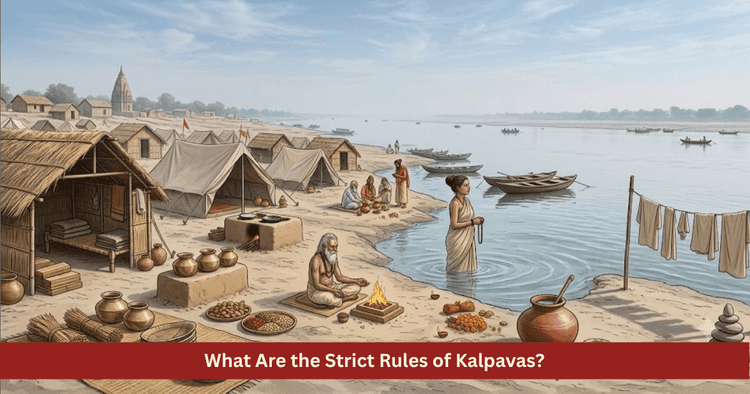
Table of Contents
Kalpavas at a Glance
The Kalpavas observed at Prayagraj during the Magha Mela is not an ordinary religious trip but an extremely strict spiritual austerity. Kalpavasis live for a whole month in tents on the bank of the Triveni Sangam and follow the 21 rules laid down in tradition. These include bathing in the cold waters of the Sangam 3 times a day, eating only one sattvic meal a day prepared with their own hands, sleeping on the ground, complete celibacy, listening to sacred stories every day and never criticising anyone.
| कल्पवास का तत्व | विवरण |
|---|---|
| स्थान | प्रयागराज में त्रिवेणी संगम का तट |
| अवधि | आमतौर पर एक माह, पौष पूर्णिमा से माघ पूर्णिमा तक |
| वैकल्पिक परंपरा | कुछ परिवारों में मकर संक्रांति से कुंभ संक्रांति तक |
| निवास | संगम के तट पर अस्थायी तंबू या कुटिया |
| स्नान | दिन में 3 बार, अर्थात त्रिकाल स्नान |
| भोजन | दिन में एक बार सात्त्विक भोजन, अर्थात एकभुक्त व्रत |
| शयन | भूमि पर, पुआल या चटाई पर |
| मुख्य नियम | परंपरा में बताए गए 21 नियम |
| समापन | माघ पूर्णिमा पर अंतिम स्नान, दान और घर वापसी |
The Core Principles of Kalpavas
- Kalpavas begins with a sankalpa and is observed by staying in one place for the whole month.
- The daily routine revolves around bathing, japa, worship, listening to sacred stories and service.
- Strict restraint is kept over food, speech, sleep and the senses.
- During Kalpavas one does not go outside the area chosen in the resolve.
- Kalpavas is completed on Magha Purnima with charity and worship.
The Meaning and Tradition of Kalpavas
The word Kalpavas is made of kalpa and vas. Vas means to dwell and kalpa means both resolve and a day of Brahma, that is an immensely long age. Tradition holds that one month of Kalpavas at Prayag brings as much merit as austerity performed for an entire kalpa. This statement shows the sanctity and importance of that period.
The tradition of Kalpavas is believed to be thousands of years old. The Puranas describe in detail the glory of dwelling at Prayag during Magha month. Goswami Tulsidas too describes in the Ramcharitmanas that in Magha month, when the Sun enters Makara, everyone comes to Prayag, the king of tirthas, dwells there and bathes.
In tradition, many families take a resolve to observe Kalpavas for 12 years in a row. When the 12 years are complete, the final offering of this resolve is made. Kalpavasis plant a tulsi plant and sow barley outside their tents, which grow along with their sadhana and are taken home as prasad at the end of the month.
The 21 Rules of Kalpavas
Tradition gives 21 rules for the Kalpavasi. These rules are based on the restraint of all 3, body, speech and mind.
| No. | Rule | Spiritual Meaning |
|---|---|---|
| 1 | Speaking the truth | Purity of speech |
| 2 | Non violence | Compassion for all living beings |
| 3 | Control of the senses | Protecting the mind from sense objects |
| 4 | Kindness to all beings | The widening of compassion |
| 5 | Observing celibacy | Conservation of energy |
| 6 | Giving up addictions | Purity of body and mind |
| 7 | Waking in Brahma Muhurta | Discipline of routine |
| 8 | A sacred bath 3 times a day | Constant purification of body and mind |
| 9 | Trikaal Sandhya | Worship at morning, noon and evening |
| 10 | Pind Daan and tarpan for the ancestors | Gratitude towards the forefathers |
| 11 | Charity according to one's means | Sacrifice and compassion |
| 12 | Inward japa | Concentration of the mind |
| 13 | Satsang | Keeping the company of good thoughts |
| 14 | Not leaving the chosen area | Stability and firmness of resolve |
| 15 | Not criticising anyone | Purity of speech and mind |
| 16 | Serving saints and sannyasis | Humility and the spirit of service |
| 17 | Japa and sankirtan | Growth of devotion |
| 18 | One meal a day | Restraint in diet |
| 19 | Sleeping on the ground | Giving up comforts |
| 20 | Not warming oneself by a fire | The austerity of bearing the cold |
| 21 | Worship of the Divine | Surrender to God |
Not warming oneself by a fire means that Kalpavasis do not sit near a fire to warm the body against the cold. In the bitter cold, this rule is an extremely hard austerity. In present times, considering age and health, many Kalpavasis relax this rule to some extent on the advice of their family and doctor.
The Secret of Bathing 3 Times a Day
The hardest rule of Kalpavas is bathing at the Sangam 3 times every day. In the bitter cold of Magha month, when the water of the Sangam is extremely cold, taking a dip 3 times a day is an extraordinary austerity.
| Time of the Bath | Spiritual Meaning |
|---|---|
| Morning, in Brahma Muhurta | Cleansing from the tamasic influence of night and a sacred start to the day |
| Midday | Purifying the mind again in the midst of activity |
| Evening | Washing away the faults of the day and peace for the night |
After each bath, Sandhya Vandana, solar arghya and japa are performed. This bathing 3 times a day reminds a person that purification is not a one time act but a continuous process.
The Ekabhukta Vow and Sattvic Food
Kalpavasis eat only once a day, which is called the Ekabhukta vow. They prepare this meal with their own hands. The food is entirely sattvic, without onion, garlic or any tamasic substance. Many Kalpavasis offer bhog to the Lord before eating and eat only after feeding a guest or a sadhu.
- Cooking one's own food is a symbol of self reliance and purity.
- Eating once a day brings restraint of the senses and rest to the digestive system.
- Sattvic food makes the mind calm and fit for meditation.
- Feeding others before eating reduces ego.
The Psychological Effects of Kalpavas
Kalpavas is not merely a religious ritual. It also has deep psychological effects that can be understood from a modern point of view as well.
- A disciplined routine: Rising, bathing, eating and sleeping at fixed times gives stability to the mind.
- Distance from worldly busyness: Staying away from business, work and household worries for a month gives the mind deep rest.
- Simple living: Living in a tent, sleeping on the ground and living with few possessions teaches that happiness does not need many things.
- Collective sadhana: Practising with thousands of others for one goal removes loneliness and brings an experience of collective energy.
- Self examination: Silence, japa and satsang give a person the chance to look within.
- Endurance: The ability to bear cold, hardship and discomfort grows and it helps in the other challenges of life too.
This is why those who return from Kalpavas often feel that their minds have become calmer, more patient and more content than before. The inner self of the seeker who observes Kalpavas begins to become completely pure.
The Daily Routine of Kalpavas
| Time | Practice |
|---|---|
| Brahma Muhurta | Waking, the first bath at the Sangam and solar arghya |
| Morning | Sandhya Vandana, japa, tulsi worship and worship of the Divine |
| Forenoon | Listening to the Shrimad Bhagavata, the Ramakatha or discourses |
| Midday | The second bath and the one sattvic meal of the day |
| Afternoon | Serving sadhus, charity, satsang and study of scripture |
| Evening | The third bath, offering lamps, aarti and sankirtan |
| Night | Japa, meditation and sleeping on the ground |
Health Precautions for Kalpavasis
Kalpavas is an extremely hard austerity and a large number of Kalpavasis are elderly. So discernment is necessary along with faith.
- Always have a health check by a doctor before beginning Kalpavas.
- Those with heart disease, high blood pressure or breathing problems should seek a doctor's advice about the rule of bathing in cold water.
- Carry necessary medicines and keep taking them regularly.
- Keep enough warm clothes and blankets to protect against the cold.
- Stay informed about the safety and health facilities provided by the Mela administration.
The scriptures regard sincere feeling as supreme. Austerity that puts the body in danger never pleases God. Following the rules according to one's own capacity is true Kalpavas.
Kalpavas Through the Lens of Vedic Astrology
In Magha month the Sun is in Makara, the sign of Saturn. Saturn signifies austerity, discipline, restraint, detachment and endurance. All the rules of Kalpavas, such as sleeping on the ground, eating once a day, bearing the cold and giving up worldly comforts, are a practice of these very qualities of Saturn. So astrological tradition holds that Kalpavas is a highly effective path for easing troubles linked with Saturn and purifying one's karma.
What Should Be Done and Avoided in Kalpavas?
| Do | Do Not |
|---|---|
| Begin Kalpavas with a sankalpa | Do not leave the chosen area |
| Bathe and perform Sandhya 3 times a day | Do not criticise anyone or speak harsh words |
| Eat one sattvic meal a day | Do not take tamasic food or indulge in addictions |
| Serve sadhus, give charity and join satsang | Do not break celibacy |
| Follow the rules with discernment according to your health | Do not insist on hardship that puts the body in danger |
The Gold of the Soul Refined on the Bank of the Sangam
Just as gold is purified by being heated in fire, the Kalpavasi burns away inner impurities by being tested in the cold, restraint and sadhana of Magha. This month of austerity teaches that the greatest wealth of life is not outer comfort but inner peace, contentment and connection with God.
When the seeker who follows the rules of Kalpavas with faith, restraint and discernment takes leave of the Sangam on Magha Purnima, that seeker does not remain merely a pilgrim. That seeker returns as a new person, with a pure heart, a calm mind and a meaningful life. This is the greatest fruit of Kalpavas.
FAQ
From when to when is Kalpavas observed? Kalpavas is usually observed for one month, from Paush Purnima to Magha Purnima. In some traditions it is observed from Makar Sankranti to Kumbh Sankranti.
What are the 21 rules of Kalpavas? The main ones include truth, non violence, celibacy, bathing 3 times a day, one meal a day, sleeping on the ground, giving up criticism, charity, japa, satsang, serving sadhus and not leaving the chosen area.
How many times a day do Kalpavasis bathe? Kalpavasis bathe at the Sangam 3 times every day, in the morning, at noon and in the evening. This is called Trikaal Snan.
Can elderly people observe Kalpavas? Yes but they should have a health check by a doctor before beginning and use discernment about strict rules such as bathing in cold water, according to their capacity.
How is Kalpavas concluded? Kalpavas is completed on Magha Purnima with a final bath, worship and charity to the pilgrimage priests. After this, Kalpavasis return home carrying tulsi, barley and Sangam water.
Get your accurate Kundali
Generate KundaliDid you like it?
Author
Pt. Nilesh Sharma (63)
Experience: 20
Consults About: Family Planning, Career
Clients In: Punjab, Haryana, Delhi
Share this article with friends and family
WELCOME TO
ZODIAQ
Right Decisions at the right time with ZODIAQ
