Why Worship Kamadeva on Vasant Panchami?
By Pt. Narendra Sharma
Madanotsav, Kamadeva and Rati Worship and Marital Harmony
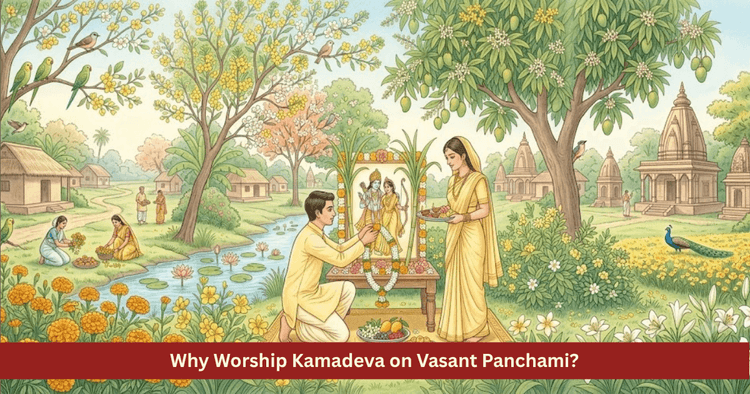
Table of Contents
The Worship of Kamadeva and Rati at a Glance
Magha Shukla Panchami, known as Vasant Panchami, is generally known as the festival of Maa Saraswati, the goddess of learning. But in ancient India this day was also linked with another beautiful celebration called Madanotsav or Vasantotsav. On this day there is a tradition of worshipping Kamadeva, the god of love, beauty and attraction and his wife Devi Rati. When the inertia of winter ends and new creation stirs in nature, Kamadeva and Rati are remembered to keep sweetness and mutual attraction alive in married life.
| Element of Worship | Details |
|---|---|
| Tithi | Magha Shukla Panchami, that is Vasant Panchami |
| Principal Deities | Kamadeva and Devi Rati |
| Ancient Names | Madanotsav, Vasantotsav |
| Symbols of Kamadeva | A bow of sugarcane, 5 flower arrows, a parrot as his vehicle and the makara banner |
| Astrological Link | Venus and the 7th house of the horoscope |
| Principal Offerings | Fragrant flowers, mango blossoms, sandalwood, perfume and sweets |
| Main Mantra | The Kamadeva Gayatri Mantra |
| Who Worships | Especially married couples, seated together |
The Basic Rules of Worship in Brief
- The couple should bathe in the morning and wear clean and beautiful clothes.
- First worship Maa Saraswati and Lord Ganesha.
- Then install a picture or symbol of Kamadeva and Rati and offer flowers, sandalwood and perfume.
- Husband and wife should sit together and chant the Kamadeva Gayatri Mantra.
- Take a resolve to maintain respect, trust and love for each other.
The Madanotsav of Ancient India
Classical Sanskrit literature contains beautiful descriptions of festivals celebrated at the arrival of spring. The Kamasutra mentions spring festivals such as Suvasantaka. The plays of the great poet Kalidasa and the play Ratnavali by Emperor Harsha contain scenes of Madanotsav, in which the people of the city gathered in gardens to worship Kamadeva, with music and dance and the sprinkling of fragrant powders on one another.
This festival is proof that Indian culture never looked down on love and beauty. Love was regarded as a sacred force of life that deserved to be celebrated. The only condition was that this love should remain within the bounds of dharma.
Who Is Kamadeva?
Kamadeva is the god of love, attraction and creation. He is also known as Madana, Manmatha, Ananga, Kandarpa and Ratipati. His form is described as extremely charming. In his hand he holds a bow of sugarcane, whose string is said to be made of a line of bees. His quiver holds 5 flower arrows. His vehicle is the parrot and his banner bears the sign of the makara, a mythical sea creature.
| Symbol | Meaning |
|---|---|
| Bow of Sugarcane | The sweetness of love |
| String of Bees | The hum of attraction |
| 5 Flower Arrows | The effect of love on the 5 senses |
| Parrot | Sweet speech and the message of love |
| Makara Banner | The depth of emotions |
| His Friend Vasant | The beauty of nature that awakens love |
Tradition names the 5 flower arrows of Kamadeva as Aravinda, the lotus, Ashoka, Amra Manjari, the mango blossom, Navamallika, the jasmine and Nilotpala, the blue lotus. All these flowers bloom in spring. This is why spring is called the dearest friend of Kamadeva. When spring arrives, the arrows of Kamadeva are scattered through nature itself.
The Story of Kamadeva Being Reduced to Ashes
The most famous story about Kamadeva concerns Lord Shiva. After Devi Sati gave up her body, Lord Shiva became absorbed in deep meditation. At that time the terror of the demon Tarakasura was growing and only a son of Shiva could slay him. The gods sent Kamadeva to break Shiva's meditation. Together with Vasant, Kamadeva shot a flower arrow at Shiva. When his meditation was broken, Shiva opened his third eye in anger and Kamadeva was reduced to ashes.
When her husband was burnt to ashes, Devi Rati lamented deeply. Moved by her grief, Lord Shiva granted a boon that Kamadeva would dwell in the hearts of all beings without a body, as Ananga, the bodiless one. Puranic tradition further says that in the Dvapara Yuga Kamadeva would be born as Pradyumna, the son of Lord Shri Krishna and would be reunited with Rati.
The message of this story is deep. Kamadeva being burnt to ashes shows that uncontrolled desire cannot stand before austerity and discernment. And his survival as Ananga shows that love itself is never destroyed. It rises above the body and becomes a feeling of the heart.
The Meaning of Desire in Harmony with Dharma
Sanatana Dharma describes 4 purusharthas or aims of life: dharma, artha, kama and moksha, that is righteousness, prosperity, desire and liberation. Kama is one of these. This means that Indian philosophy regards love, attraction and the wish for happiness as a natural and necessary part of life. But kama is placed after dharma and artha and before moksha. The idea is that desire should remain within the bounds of dharma and should ultimately lead towards spiritual growth.
In the Bhagavad Gita, Lord Shri Krishna says that among living beings He is the desire that is not opposed to dharma. This statement is the essence of the Indian vision. Love that is in harmony with dharma, that is restrained and that holds respect and faithfulness is itself a form of the Divine. The worship of Kamadeva and Rati on Vasant Panchami honours this sacred love.
Venus and the 7th House in Vedic Astrology
In Vedic astrology, Venus is the significator of love, attraction, beauty, art and marital happiness. The 7th house of the horoscope is linked with the life partner and marriage. When Venus is weak, afflicted or placed in difficult houses or when malefic planets influence the 7th house, married life may experience dullness, misunderstandings, quarrels or distance.
In astrological tradition, Vasant Panchami is regarded as favourable for remedies related to Venus, because the energy of this day is itself the energy of beauty, art and love.
| Concern | Astrological Indication | Remedy on Vasant Panchami |
|---|---|---|
| Dullness in marriage | Weak Venus | Worship of Kamadeva and Rati by the couple seated together |
| Repeated quarrels | Malefic influence on the 7th house | Joint worship of Radha Krishna and a resolve for sweet speech |
| Delay in marriage | Afflicted Venus or Jupiter | Remembrance of Maa Katyayani and donation of white clothes |
| Lack of charm and confidence | Weakness of Venus | Attention to cleanliness, fragrance and beauty |
| Lack of mutual trust | Imbalance between the Moon and Venus | Spending time together and open conversation |
The Kamadeva Gayatri Mantra and the Method of Worship
| Step | Method |
|---|---|
| Bath and Clothing | The couple should bathe and wear beautiful, clean clothes and the wife may adorn herself |
| Opening Worship | Begin with the worship of Maa Saraswati and Ganesha |
| Installation | Install a picture of Kamadeva and Rati or mango blossoms and flowers as their symbol |
| Offerings | Offer fragrant flowers, mango blossoms, sandalwood, perfume, rice grains and sweets |
| Lamp | Light a ghee lamp |
| Japa | Sit together and chant the Kamadeva Gayatri Mantra 108 times |
| Sankalpa | Take a resolve of respect, patience and love for each other |
| Prasad | Take the prasad by feeding the sweets to each other |
The Kamadeva Gayatri Mantra is: "Om Kamadevaya vidmahe pushpabanaya dhimahi, tanno Anangah prachodayat." Its meaning is that the seeker, knowing Kamadeva, meditates on the one who bears the flower arrows and prays that the bodiless god may inspire the seeker. This mantra should be chanted with a pure heart and with the wish for love towards one's own life partner.
Practical Principles for Sweetness in Marriage
Tradition holds that chanting the Kamadeva Gayatri Mantra on Vasant Panchami helps restore lost love and trust in married life. But a mantra bears fruit only when behaviour also changes along with it. Adopting these principles along with the worship is essential.
- Respect: Respect is the foundation of love. Honour each other's feelings and thoughts.
- Conversation: Instead of suppressing what is in the heart, speak calmly and listen carefully.
- Time: Even in a busy life, set aside some time for each other every day.
- Appreciation: Appreciate each other for small things.
- Forgiveness: Instead of repeating old mistakes again and again, learn to forgive.
- Sadhana together: Sitting together for worship, japa or meditation binds the minds in one thread.
If there is serious conflict or mental pain in married life, one should not hesitate to seek the help of family elders or a qualified counsellor along with the remedies. The purpose of dharma is to make life happy and taking every proper path towards this is itself in keeping with dharma.
What Should Be Done and Avoided in Kamadeva Worship?
| Do | Do Not |
|---|---|
| Worship with the wish for love towards your own life partner | Do not chant the mantra with the intention of controlling anyone else |
| Worship together as a couple | Avoid quarrels and harsh words on the day of worship |
| Offer fragrant flowers and mango blossoms | Do not offer withered flowers |
| Bring sweetness into behaviour along with the worship | Do not neglect the relationship by relying only on the mantra |
| Remember Kamadeva after the Saraswati worship | Do not take the worship beyond the bounds of decency |
Practices performed with the aim of attracting or controlling someone against their will are condemned in the scriptures. Love blossoms only in freedom and respect. The true worship of Kamadeva is that which deepens faithfulness and love towards one's own life partner.
Sacred Love Blossoming in the Gentle Breeze of Spring
Vasant Panchami teaches that both knowledge and love are necessary for life. Maa Saraswati gives discernment to the mind and Kamadeva gives tenderness to the heart. Only when discernment and love walk together does balance come into life. Without love, knowledge becomes dry and without discernment, love goes astray.
For couples who remember Kamadeva and Rati with faith on this day and also resolve to bring respect, patience and sweetness into their behaviour, spring does not remain merely a season. It becomes the lasting state of their relationship, in which love keeps blossoming every day like a new shoot.
FAQ
Why is Kamadeva worshipped on Vasant Panchami?
In ancient times, Vasant Panchami was celebrated as Madanotsav. Spring is regarded as the friend of Kamadeva, so on this day Kamadeva and Rati are worshipped for love and marital happiness.
What is the Kamadeva Gayatri Mantra?
The Kamadeva Gayatri Mantra is: Om Kamadevaya vidmahe pushpabanaya dhimahi, tanno Anangah prachodayat. It should be chanted with a pure feeling of love for one's own life partner.
Which planet signifies love and marriage in astrology?
In Vedic astrology, Venus signifies love, attraction, beauty and marital happiness and the 7th house of the horoscope is linked with the life partner.
Why is Kamadeva called Ananga?
After he was burnt to ashes by the third eye of Lord Shiva, Shiva granted a boon that Kamadeva would live in the hearts of all beings without a body. That is why he is called Ananga.
What should be done on Vasant Panchami for sweetness in married life?
The couple should sit together to worship Kamadeva and Rati, chant the Kamadeva Gayatri Mantra and resolve to keep respect, conversation and patience with each other.
Get your accurate Kundali
Generate KundaliDid you like it?
Author

Pt. Narendra Sharma (63)
Experience: 20
Consults About: Family Planning, Career
Clients In: Punjab, Haryana, Delhi
Share this article with friends and family
WELCOME TO
ZODIAQ
Right Decisions at the right time with ZODIAQ
