Why Is Magha Gupt Navratri So Mysterious?
By Pt. Suvrat Sharma
The 10 Mahavidyas, the Power of Secrecy and Awakening
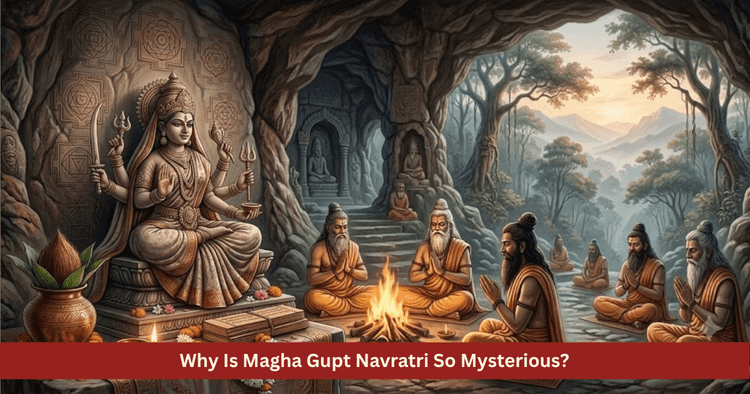
Table of Contents
Dates, Installation and Rules of Sadhana for Magha Gupt Navratri
In the Sanatana tradition, 4 Navratris occur in a year. The Navratris of Chaitra and Ashwin are called the manifest or open Navratris and society celebrates them with great festivity. The Navratris of Ashadha and Magha are called Gupt Navratri, the secret Navratri. Magha Gupt Navratri runs from Magha Shukla Pratipada to Magha Shukla Navami. In the Gregorian calendar it usually falls between late January and February. During these 9 days, seekers, followers of the Tantric tradition and selfless householders perform the secret worship of the 10 Mahavidyas, the 10 great wisdom forms of Maa Bhagavati.
| Element of Sadhana | Details |
|---|---|
| Duration | From Magha Shukla Pratipada to Navami |
| Principal Deities | The 10 Mahavidyas and Maa Durga |
| Beginning | Ghatasthapana at an auspicious muhurat on Pratipada |
| Nature of the Sadhana | Secret, inward and disciplined |
| Recitation for Householders | Durga Saptashati, Devi Kavach and japa of the Navarna Mantra |
| Special Tithis | Vasant Panchami on Panchami and Mahananda Navami on Navami |
| Conclusion | Havan and Kanya Pujan on Navami |
| Core Rules | Celibacy, sattvic food, sleeping on the ground and secrecy of the sadhana |
Basic Rules of Ghatasthapana
- Perform Ghatasthapana on Pratipada in the morning or during Abhijit Muhurat. Check the exact time in the local Panchang.
- According to tradition, it is advised to avoid Ghatasthapana during Chitra Nakshatra and Vaidhriti Yoga.
- Install the kalash on a red cloth in the northeast corner of the shrine and sow barley in an earthen vessel.
- Put Gangajal, a betel nut, a coin, rice grains and durva into the kalash and place mango leaves and a coconut on its mouth.
- If possible, keep an Akhand Jyoti of ghee burning for all 9 days.
Why Is This Navratri Called Secret?
The word gupt means hidden. There are several reasons why these Navratris are called secret. The first is that the sadhana performed in them is completely inward instead of being an outward celebration. No pandals are decorated and no public events are held. The seeker sits in solitude and worships the Devi.
The second reason is that the sadhana of these days is kept secret on purpose. Tradition holds that the more secret a sadhana is, the stronger its fruit will be. Behind this lies a deep psychological truth. When a person advertises their sadhana, ego enters it. The wish for praise from others pulls the energy of the sadhana outward. Secrecy keeps that energy gathered within and keeps the seeker humble.
The third reason is linked with the season. Magha Gupt Navratri comes at the junction between the bitter cold of Shishira Ritu and the arrival of spring. The junction of seasons is also a time of change in nature. In the traditions of yoga and Tantra, such junctions are considered especially suitable for sadhana, because at this time the energy of nature is itself in a state of transformation.
Who Are the 10 Mahavidyas?
The 10 Mahavidyas are the 10 wisdom powers of Maa Bhagavati. Vidya means knowledge and Mahavidya means that supreme knowledge which frees a human being from bondage. According to a Puranic story, when Lord Shiva stopped Devi Sati from going to the yajna of her father Daksha, the Devi manifested 10 forms of herself and surrounded Shiva from all 10 directions. These 10 forms came to be called the 10 Mahavidyas.
| No. | Mahavidya | Nature and Symbolism | Purpose of Sadhana |
|---|---|---|---|
| 1 | Kali | Presiding power of time and change | Freedom from fear, ignorance and the fear of death |
| 2 | Tara | The compassionate power that carries one across crises | Protection from crises and mastery of speech |
| 3 | Shodashi or Tripura Sundari | Goddess of beauty, completeness and grace | Good fortune, charm and inner fulfilment |
| 4 | Bhuvaneshwari | Sovereign of all the worlds | Expansion, stability and an all embracing vision |
| 5 | Chhinnamasta | Self sacrifice and control of energy | Mastery over desires and balance of life force |
| 6 | Bhairavi | The power of austerity and fire | Courage, tapas and inner purification |
| 7 | Dhumavati | The teacher of detachment and lack | Detachment, patience and strength to cross sorrow |
| 8 | Bagalamukhi | The power of restraint and stillness | Victory over enemies and in disputes |
| 9 | Matangi | Goddess of speech, art and learning | Mastery of speech, music and knowledge |
| 10 | Kamala | Goddess of prosperity in the form of Lakshmi | Wealth, splendour and domestic happiness |
When these 10 forms are seen together, they embrace almost every state of life. Kali teaches change, Dhumavati teaches steadiness even in lack and Kamala grants the blessing of prosperity. In this way, the worship of the Mahavidyas teaches a person to accept every colour of life and to rise above it.
The Mahavidyas and the Planets
In one astrological tradition, the 10 Mahavidyas are also linked with the planets. It is believed that worshipping the related Mahavidya pacifies the adverse influence of that planet.
| Mahavidya | Associated Planet |
|---|---|
| Kali | Saturn |
| Tara | Jupiter |
| Shodashi | Mercury |
| Bhuvaneshwari | Moon |
| Bhairavi | Ascendant |
| Chhinnamasta | Rahu |
| Dhumavati | Ketu |
| Bagalamukhi | Mars |
| Matangi | Sun |
| Kamala | Venus |
The Sattvic Path of Sadhana for Householders
The Tantric sadhana of the Mahavidyas is regarded as extremely deep and demanding. The scriptures and tradition clearly direct that such sadhana should be performed only after receiving initiation from a qualified guru and under their guidance. Difficult practices performed without guidance can cause mental and physical imbalance.
For the householder, Maa Bhagavati has also kept a sattvic and simple path open. When the feeling is pure, simple worship is just as fruitful.
- Recitation of the Durga Saptashati: Recite the complete Saptashati over the 9 days or read a few chapters every day.
- Japa of the Navarna Mantra: Chant Om Aim Hreem Kleem Chamundayai Vichche at least 108 times every day.
- Devi Kavach, Argala and Keelak: It is traditional to recite these before the Saptashati.
- Lalita Sahasranama: In the Shri Vidya tradition its recitation is regarded as highly meritorious.
- Meditation: Sit quietly for some time every day and meditate on any one form of the Mother.
- Service: Service to young girls, women and helpless beings is the worship dearest to the Devi.
The Secret of Kundalini Awakening and the Inner Chakras
The traditions of yoga and Tantra hold that there are 7 main energy centres or chakras, in the human body: Muladhara, Svadhishthana, Manipura, Anahata, Vishuddha, Ajna and Sahasrara. The Kundalini power lies dormant in the Muladhara Chakra. When this power awakens through sadhana and rises upward, the consciousness of the seeker expands.
The sadhana of Gupt Navratri is regarded as highly favourable for this inner awakening. The Devi Herself is the form of that Kundalini power. The 9 days of sadhana are also seen symbolically as 9 steps of consciousness. But it is necessary to understand that Kundalini awakening is not a matter of display or miracles. It is an inner process that unfolds slowly through patience, restraint, pure conduct and the grace of the guru. For the householder, the safest path to it is regular japa, meditation and a sattvic life.
Rules of Recitation and Sadhana for the 9 Days
| Rule | Details |
|---|---|
| Regular Timing | Practise every day at the same time, in the same place and on the same seat |
| Seat | Use a woollen or kusha mat and do not give it to anyone else |
| Direction | Sit facing east or north |
| Diet | Sattvic food, one meal a day or fruits |
| Celibacy | Complete celibacy for the 9 days |
| Sleep | Sleep on the ground if possible |
| Secrecy | Do not discuss your sadhana, japa count or experiences with anyone |
| Speech | Avoid harsh words, criticism and idle talk |
| Akhand Jyoti | If lit, take full care that it keeps burning |
| Conclusion | Havan, Kanya Pujan and a prayer for forgiveness on Navami |
A Simple Sequence for Reading the Saptashati
The Durga Saptashati has 13 chapters. A seeker who cannot complete the full recitation every day can divide it over the 9 days. A popular sequence is as follows.
| Day | Chapters |
|---|---|
| Pratipada | Chapter 1 |
| Dwitiya | Chapters 2 and 3 |
| Tritiya | Chapter 4 |
| Chaturthi | Chapters 5, 6, 7 and 8 |
| Panchami | Chapters 9 and 10 |
| Shashthi | Chapter 11 |
| Saptami | Chapters 12 and 13 |
| Ashtami and Navami | The full recitation again or repetitions as desired and havan |
The Festivals That Fall Within Magha Gupt Navratri
A unique feature of Magha Gupt Navratri is that several important festivals fall within its 9 days. This makes this Navratri even more powerful.
- Vasant Panchami falls on Panchami, when Maa Saraswati is worshipped. The Mahavidya Matangi is also called the Tantric Saraswati, so this combination is deeply meaningful.
- Ratha Saptami, the birth anniversary of the Sun, falls on Saptami.
- Bhishma Ashtami falls on Ashtami, the day Bhishma Pitamaha left his body.
- Mahananda Navami falls on Navami, when Maa Lakshmi is worshipped. This connects beautifully with the Mahavidya Kamala.
In this way, these 9 days bring together knowledge, light, sacrifice and prosperity.
What Should Be Done and Avoided in Gupt Navratri?
| Do | Do Not |
|---|---|
| Perform deep sadhana under the guidance of a qualified guru | Do not attempt difficult Tantric practices without guidance |
| Recite the Saptashati and chant the Navarna Mantra | Do not advertise or display your sadhana |
| Respect young girls and women | Do not perform any practice with the aim of harming anyone |
| Follow a sattvic diet and restraint | Do not eat meat, alcohol or tamasic food |
| Perform havan and Kanya Pujan on Navami | Do not let the Akhand Jyoti go out |
The fundamental purpose of Devi sadhana is the welfare of the self and the welfare of the world. The scriptures clearly say that sadhana performed with the intention of harming others ultimately brings suffering to the seeker. Maa Bhagavati is the embodiment of compassion and her grace is received only through pure feeling.
The Flame of Shakti Burning in the Cave of Silence
Magha Gupt Navratri is a sadhana that takes place far from outer noise, in the depths within. When the world is waking from the sleep of winter and moving towards spring, the seeker too tries to awaken the power sleeping within. The 10 Mahavidyas teach that every form of life, whether fearsome or beautiful, lack or splendour, is the expression of one divine power.
For the seeker who worships the Devi during these 9 days with restraint, secrecy and faith, this Navratri does not remain merely a festival. It becomes a journey of inner awakening whose light illuminates the path through the whole year.
FAQ
From when to when does Magha Gupt Navratri run? Magha Gupt Navratri runs from Magha Shukla Pratipada to Magha Shukla Navami. In the Gregorian calendar it usually falls between late January and February.
Which goddesses are worshipped in Gupt Navratri? The 10 Mahavidyas are worshipped in Gupt Navratri: Kali, Tara, Shodashi, Bhuvaneshwari, Chhinnamasta, Bhairavi, Dhumavati, Bagalamukhi, Matangi and Kamala.
Can householders observe Gupt Navratri? Yes. Householders can recite the Durga Saptashati, chant the Navarna Mantra and follow sattvic rules. Deep Tantric sadhana should be performed only under the guidance of a qualified guru.
Why is the sadhana of Gupt Navratri kept secret? According to tradition, the more secret a sadhana is, the stronger its fruit. Secrecy protects from ego and keeps the energy of the sadhana gathered within.
How should Ghatasthapana be performed in Magha Gupt Navratri? On Pratipada at an auspicious muhurat, install the kalash in the northeast, sow barley in an earthen vessel, place mango leaves and a coconut on the kalash and invoke the Devi.
Get your accurate Kundali
Generate KundaliDid you like it?
Author

Pt. Suvrat Sharma (63)
Experience: 20
Consults About: Family Planning, Career
Clients In: Punjab, Haryana, Delhi
Share this article with friends and family
WELCOME TO
ZODIAQ
Right Decisions at the right time with ZODIAQ
