Why Avoid Radish in Magha Month?
By Pt. Amitabh Sharma
Magha Diet, Old Jaggery, Dry Ginger and Incompatible Foods
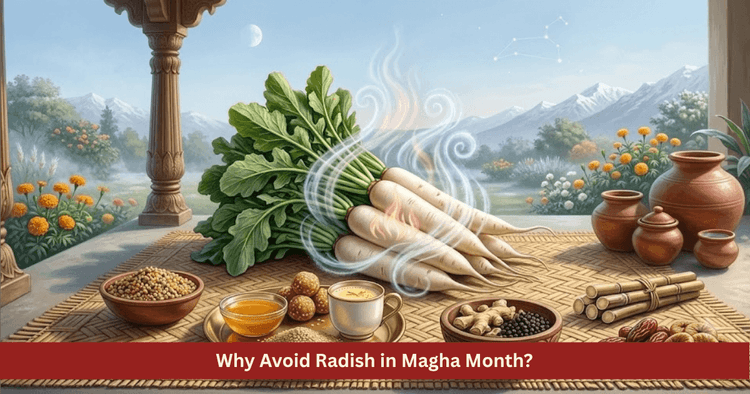
Table of Contents
The Diet of Magha Month at a Glance
Following the rules of diet in Magha month is regarded as essential for both religion and health. This is the time of Shishira Ritu, when the cold is at its peak and the digestive fire is strong. Both tradition and Ayurveda describe some foods as nectar for this month and some as foods to be avoided. The most famous of these rules is that radish should be given up in Magha month, while sesame, old jaggery, dry ginger and ghee are regarded as the finest foods of this month.
| Food Group | Like Nectar in Magha | To Avoid or Limit in Magha |
|---|---|---|
| Grains | New rice, wheat, pearl millet, maize, black gram, green gram | Stale and cold grain dishes |
| Sweeteners | Old jaggery, sesame and jaggery laddoos | Sugar candy in folk tradition, too many sweets |
| Spices | Dry ginger, ginger, black pepper, carom seeds, turmeric | Too much red chilli |
| Vegetables | Mustard greens, bathua, fenugreek, spinach, carrot, sweet potato | Radish by tradition, especially raw and large radish |
| Milk and Ghee | Warm milk, pure ghee | Curd at night, cold milk |
| Drinks | Lukewarm water, a decoction of dry ginger and tulsi | Cold drinks and iced items |
| Fruits | Amla orange, guava, jujube berry | Very sour and cold fruits at night |
The Basic Dietary Rules of Magha Month
- Always eat fresh and warm food and avoid stale food.
- Include sesame, old jaggery, ghee and dry ginger in the diet in balanced amounts.
- According to tradition, do not eat radish in Magha month.
- Keep dinner light and eat it some time after sunset.
- Do not eat viruddha ahara, that is incompatible foods, together.
Why Is Radish Regarded as Prohibited in Magha Month?
The rule of giving up radish in Magha month is very well known in Indian tradition. Folk and scriptural tradition even say that eating radish in Magha month is as harmful as alcohol. This statement sounds harsh but behind it lie both religious and Ayurvedic reasons.
From a religious point of view, Magha is the month of austerity, restraint and sattva. In this month the rule is to stay away from tamasic and stimulating foods. Tradition holds that the radish of this season increases tamasic tendencies in the body and mind, so it does not suit practices such as the Magha bath and Kalpavas.
The Ayurvedic view makes this even clearer. Ayurveda regards tender and small radish as easy to digest and balancing to the doshas but describes large, mature and hard radish as heavy and aggravating to all 3 doshas. By the time Magha month arrives, the winter radish has become large and hard. In Shishira Ritu, when Kapha has already accumulated and Vata has increased, such radish can aggravate both Vata and Kapha. This can increase problems such as gas, bloating, colds and joint pain.
| Point of View | Reason for Avoiding Radish |
|---|---|
| Religious | Not regarded as suitable for the sattvic sadhana of Magha month |
| Ayurvedic | Large and hard radish is heavy and can increase Vata and Kapha |
| Seasonal | It can further increase the Kapha already accumulated in Shishira Ritu |
| Digestive | Likelihood of gas, bloating and indigestion |
Essential Cautions Regarding Radish
Those who do not give up radish completely because of tradition should keep a few points in mind.
- Choose tender and small radish instead of large and hard radish.
- Cooked radish is easier to digest than raw radish.
- Ayurveda regards taking radish and milk together as incompatible food, so do not take them together.
- Do not eat radish at night.
- Keep the amount of radish limited.
Old Jaggery Versus New Jaggery
Jaggery has special importance in Magha month but Ayurveda makes a clear distinction between old and new jaggery. The texts of Ayurveda regard old jaggery as pathya, that is wholesome. Old jaggery is described as light, digestive, blood purifying and good for the heart. In contrast, fresh new jaggery is heavy and can increase Kapha and intestinal worms.
| Type of Jaggery | Ayurvedic Qualities | Use in Magha |
|---|---|---|
| Old Jaggery | Light, digestive, blood purifying and wholesome | Best for eating with sesame |
| New Jaggery | Heavy, increases Kapha | In limited amounts |
This is why somewhat old jaggery is regarded as best for making sesame laddoos and other dishes in Magha month. Folk tradition also advises avoiding too much sugar candy in Magha month, because in the cold jaggery gives warmth while sugar candy is regarded as cooling.
The Nectar Like Foods of Magha Month
According to both tradition and Ayurveda, certain foods are regarded as nectar in Magha month. These foods protect the body from the cold and dryness of Shishira Ritu.
- Sesame: Gives warmth, nourishing oiliness and nutrition for the bones.
- Old jaggery: Improves digestion and gives energy to the body.
- Dry ginger and ginger: Balance the digestive fire and reduce Kapha.
- Black pepper: Reduces Kapha and is good for the throat.
- Pearl millet and maize: Grains that give warmth to the body.
- Ghee: Calms Vata and nourishes the tissues.
- Warm milk: Taken with turmeric or dry ginger, it increases energy and immunity.
- New rice: Ayurveda describes cooked new rice as wholesome for Hemanta and Shishira Ritu.
- Green leafy vegetables: Mustard greens, bathua, fenugreek and spinach are the nourishing vegetables of this season.
- Amla: Rich in vitamin C and a booster of immunity.
What Should Be Avoided in This Month?
| Food | Reason to Avoid |
|---|---|
| Stale food | Spoils digestion and invites illness |
| Cold items left in the open | Increase Kapha and the risk of infection |
| Cold drinks and ice | Weaken the digestive fire and cause throat infections |
| Curd at night | Increases Kapha and colds |
| Very sour foods | Can increase Kapha and joint problems |
| Too much fried food | Heaviness and indigestion |
| Radish, by tradition | Increases Vata and Kapha |
Caution Against Incompatible Foods
The concept of viruddha ahara, incompatible food, is very important in Ayurveda. Some foods are beneficial on their own but become harmful when eaten together.
- Do not take radish, fish or sour fruits with milk.
- Do not heat honey or mix it into very hot food.
- Do not take ghee and honey together in equal amounts.
- Do not eat curd at night or heated.
Health Giving Dishes of Magha Month
| Dish | Main Ingredients | Benefit |
|---|---|---|
| Pearl Millet Roti | Pearl millet, ghee and old jaggery | Warmth and energy |
| Mustard Greens | Mustard greens, spinach, bathua and ghee | Nourishment and immunity |
| Gond Laddoos | Edible gum, flour, ghee, dry fruits and jaggery | Strength of bones and joints |
| Dry Ginger Laddoos | Dry ginger, jaggery, ghee and flour | Digestion and reduction of Kapha |
| Sesame Chikki | Sesame and jaggery | Calcium and energy |
| Green Gram Khichdi | Green gram, rice, ghee and ginger | Easy to digest and nourishing |
| Turmeric Milk | Milk, turmeric and dry ginger | Immunity |
| Amla Murabba | Amla and jaggery | Vitamin C and digestion |
These dishes should be eaten in balanced amounts according to one's constitution, age and health. People with diabetes, heart disease or any serious digestive problem should seek a doctor's advice about jaggery, ghee and sweet dishes.
Rules of Eating and the Spiritual View
In Magha month, food is not only nourishment for the body but also part of sadhana. Kalpavasis eat once a day in this month and take sattvic food prepared with their own hands. Some rules are also given for householders.
- Offer the food to the Lord before eating and then receive it as prasad.
- Eat with a calm mind, seated and chew well.
- Before eating, set aside a portion for the cow, the dog and the birds.
- Do not disrespect food and do not leave food on the plate.
- Feeding the hungry and those in need is regarded as the finest merit of Magha month.
What Should Be Done and Avoided in the Diet of Magha Month?
| Do | Do Not |
|---|---|
| Eat fresh, warm and sattvic food | Do not eat stale and cold food |
| Eat sesame, old jaggery and dry ginger | According to tradition, do not eat radish |
| Drink lukewarm water | Do not take cold drinks or iced items |
| Eat seasonal green vegetables | Do not eat incompatible foods together |
| Offer bhog before eating | Do not disrespect food |
The Blessing of the Season Served on a Plate
The diet of Magha month teaches that food is not only for taste but for keeping in harmony with the season. The warmth of sesame, the sweetness of old jaggery, the sharpness of dry ginger and the richness of ghee together protect the body from the harshness of Shishira. And abstaining from foods like radish teaches that not everything is wholesome at every time.
For the person who chooses their food in this month with the wisdom of tradition and the discernment of Ayurveda, the plate does not remain merely a vessel of food. It becomes the blessing of the season, keeping the body healthy, the mind calm and life balanced.
FAQ
Why should radish not be eaten in Magha month? Tradition regards radish as prohibited in Magha month. According to Ayurveda, the large and hard radish of this season is heavy and can increase Vata and Kapha.
Which jaggery should be eaten in Magha month? Ayurveda regards old jaggery as light, digestive and wholesome. So eating old jaggery with sesame is regarded as best in Magha month.
What is the best food to eat in Magha month? Sesame, old jaggery, dry ginger, ginger, black pepper, pearl millet, ghee, warm milk, new rice and green leafy vegetables are regarded as nectar in Magha month.
What should be avoided in Magha month? In this month one should avoid stale food, cold drinks, curd at night, very sour and fried foods and, according to tradition, radish.
What is incompatible food? Foods that are beneficial on their own but harmful when eaten together are called incompatible foods, such as radish or sour fruits with milk and heated honey.
Get your accurate Kundali
Generate KundaliDid you like it?
Author

Pt. Amitabh Sharma (56 Years)
Experience: 20
Consults About: Family Planning, Career
Clients In: Punjab, Haryana, Delhi
Share this article with friends and family
WELCOME TO
ZODIAQ
Right Decisions at the right time with ZODIAQ
