How to Read the Magha Month Panchang?
By Pt. Amitabh Sharma
30 Tithis, Festivals of Both Fortnights and 5 Limbs
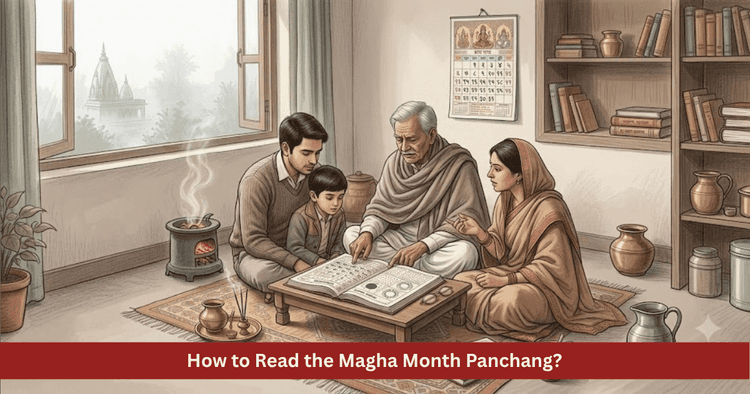
Table of Contents
The Magha Month Panchang at a Glance
Magha month holds a long series of religious rites, great sacred baths and festivals, which in the Gregorian calendar usually runs from mid January to mid February. Sakat Chauth, Shattila Ekadashi, Mauni Amavasya, Magha Gupt Navratri, Vasant Panchami, Ratha Saptami, Bhishma Ashtami, Jaya Ekadashi, Bhishma Dwadashi, Kumbh Sankranti and Magha Purnima, the whole month is full of festivals. This article presents all 30 tithis of Magha month and the festivals that fall on them in order and also explains a simple way to read the Panchang, the Hindu almanac.
| Element of the Panchang | Details |
|---|---|
| Position in the Year | The 11th month of the Hindu year |
| Beginning in the Purnimant System | From the day after Paush Purnima |
| Beginning in the Amant System | From the day after Paush Amavasya |
| In the Gregorian Calendar | Usually mid January to mid February, varying a little each year |
| Total Tithis | 30, with 15 in each fortnight |
| Season | Shishira |
| Transit of the Sun | Usually Makara and Kumbha around the end of the month |
| Nakshatra of the Full Moon | Usually Magha |
Core Points for Reading the Panchang
- The Hindu Panchang is based on the movements of both the Moon and the Sun.
- The Gregorian dates of the tithis change every year, so always check the Panchang of that year.
- Sometimes 2 tithis fall on the same day and sometimes a tithi lasts for 2 days.
- Fasts and festivals are decided by the tithi at sunrise, Pradosh Kaal or moonrise, according to their rules.
- Checking the local Panchang is necessary, because the times of sunrise and moonrise differ from place to place.
The 5 Limbs of the Panchang
The word Panchang means that which has 5 limbs. In the Hindu Panchang, time is reckoned on the basis of 5 main limbs.
| Limb | Meaning | Number |
|---|---|---|
| Tithi | A segment of 12 degrees of distance between the Moon and the Sun | 30 tithis |
| Vara | The day of the week | 7 varas |
| Nakshatra | The star group in which the Moon stands | 27 nakshatras |
| Yoga | Based on the sum of the degrees of the Sun and the Moon | 27 yogas |
| Karana | Half of a tithi | 11 karanas, of which 4 are fixed and 7 movable |
The tithi is the most important limb of the Panchang, because most fasts and festivals are observed according to the tithi. The nakshatra, yoga and karana change every day and are especially used in finding a muhurat.
The Purnimant and Amant Systems
2 kinds of Panchang systems are followed in India. North India follows the Purnimant system, in which the month ends on the full moon. South and West India follow the Amant system, in which the month ends on the new moon.
As a result, the bright fortnight falls in the same month in both systems but the name of the dark fortnight differs. For example, what the Purnimant system calls the Magha Krishna Paksha, the Amant system calls the Paush Krishna Paksha. The tithis of the festivals stay the same in both. Only the name of the month differs. This article uses the Purnimant system.
The Tithis and Festivals of Magha Krishna Paksha
| No. | Tithi | Main Festival or Significance |
|---|---|---|
| 1 | Krishna Pratipada | The start of Magha month and the Magha bath, Kalpavas continues |
| 2 | Krishna Dwitiya | Magha bath and charity |
| 3 | Krishna Tritiya | Magha bath and charity |
| 4 | Krishna Chaturthi | Sakat Chauth, Tilkuta Chauth, Sankashti Chaturthi |
| 5 | Krishna Panchami | Magha bath and charity |
| 6 | Krishna Shashthi | Magha bath and charity |
| 7 | Krishna Saptami | Sun worship |
| 8 | Krishna Ashtami | Worship of the Devi |
| 9 | Krishna Navami | Magha bath and charity |
| 10 | Krishna Dashami | Preparation for the Ekadashi fast, sattvic food |
| 11 | Krishna Ekadashi | Shattila Ekadashi |
| 12 | Krishna Dwadashi | Parana of Shattila Ekadashi |
| 13 | Krishna Trayodashi | Pradosh fast |
| 14 | Krishna Chaturdashi | Monthly Shivaratri |
| 15 | Amavasya | Mauni Amavasya, ancestral tarpan and the great bath |
The Tithis and Festivals of Magha Shukla Paksha
| No. | Tithi | Main Festival or Significance |
|---|---|---|
| 1 | Shukla Pratipada | Start of Magha Gupt Navratri, Ghatasthapana |
| 2 | Shukla Dwitiya | Gupt Navratri sadhana |
| 3 | Shukla Tritiya | Gupt Navratri sadhana |
| 4 | Shukla Chaturthi | Maghi Ganesh Jayanti, Til Chaturthi |
| 5 | Shukla Panchami | Vasant Panchami, Saraswati Puja, Vidyarambh |
| 6 | Shukla Shashthi | Gupt Navratri sadhana |
| 7 | Shukla Saptami | Ratha Saptami, Achala Saptami, Surya Jayanti |
| 8 | Shukla Ashtami | Bhishma Ashtami, Bhishma tarpan |
| 9 | Shukla Navami | Mahananda Navami, conclusion of Gupt Navratri |
| 10 | Shukla Dashami | Preparation for the Ekadashi fast |
| 11 | Shukla Ekadashi | Jaya Ekadashi |
| 12 | Shukla Dwadashi | Bhishma Dwadashi, Til Dwadashi, parana of Jaya Ekadashi |
| 13 | Shukla Trayodashi | Pradosh fast |
| 14 | Shukla Chaturdashi | Preparation for Magha Purnima |
| 15 | Purnima | Magha Purnima, conclusion of Kalpavas, Sant Ravidas Jayanti, Lalita Jayanti |
Solar Festivals: Makar and Kumbh Sankranti
Some festivals are based not on the tithi but on the Sun's change of sign. These are called solar festivals. 2 major Sankrantis fall around Magha month.
| Sankranti | Event | Usual Gregorian Date | Significance |
|---|---|---|---|
| Makar Sankranti | The Sun's entry from Dhanu into Makara | Around 14 or 15 January | Start of Uttarayana and end of Kharmas |
| Kumbh Sankranti | The Sun's entry from Makara into Kumbha | Around 12 to 14 February | Sacred bathing and charity |
Since the Sankranti is based on the Sun and the tithi on the Moon, Makar Sankranti sometimes falls at the end of Paush month and sometimes at the start of Magha month. Kumbh Sankranti usually falls in the latter half of Magha month or at the start of Phalguna month.
How Can the Correct Date of a Festival Be Known?
This article gives the lasting order of tithis and festivals but the Gregorian dates of these tithis change every year. To know the correct date and muhurat of any festival, keep the following in mind.
- The Panchang of the year: Check the authentic Panchang of that year.
- Udaya tithi: For most fasts, the tithi present at sunrise is accepted.
- Moonrise fasts: For fasts such as Sakat Chauth, the tithi at moonrise is checked.
- Pradosh fast: The Trayodashi at Pradosh Kaal, that is around sunset, is checked.
- Local time: Decide according to the times of sunrise, sunset and moonrise in your city.
- Nakshatra and yoga: Check the daily nakshatra, yoga and karana in the Panchang, because they differ every year.
Tithi Vriddhi and Tithi Kshaya
Sometimes a tithi lasts across 2 sunrises, which is called tithi vriddhi. And sometimes a tithi begins and ends between 2 sunrises, which is called tithi kshaya. This is why the same festival is sometimes shown on different days in different Panchangs. In such cases it is wise to follow the tradition of your region and the decision of a local scholar.
The Magha Panchang Through the Lens of Vedic Astrology
In Magha month the Sun is usually in Makara, the sign of Saturn. On the full moon the Moon is usually in Magha Nakshatra, which is ruled by Ketu and whose deities are the ancestors. So the influence of the Sun, Saturn, Ketu and the ancestors is especially seen in the Panchang of this month. This is why Sun worship, sesame charity, ancestral tarpan and restraint have special importance in this month.
What Should Be Done and Avoided in Using the Panchang?
| Do | Do Not |
|---|---|
| Check the authentic Panchang of that year | Do not rely on the dates of the previous year |
| Check the sunrise and moonrise times of your city | Do not decide by the times of another city |
| Ask a local scholar about tithi vriddhi and kshaya | Do not be confused by differences between Panchangs |
| Understand the difference between Purnimant and Amant | Do not mistake a difference in the month's name for a difference in tithi |
| Share the list of festivals with the family | Do not leave preparation for important fasts until the last moment |
A Garland of Festivals Bound in the Wheel of Time
The Panchang of Magha month is not merely a list of dates but a beautiful garland of festivals. In the dark fortnight come the motherly compassion of Sakat Chauth, the charity of Shattila Ekadashi and the silence of Mauni Amavasya. In the bright fortnight come the power of Gupt Navratri, the knowledge of Vasant Panchami, the light of Ratha Saptami, the sacrifice of Bhishma Ashtami and the completeness of Magha Purnima. Every tithi offers a chance to cultivate some quality of life.
For the person who understands this Panchang and plans the whole month, no important festival is missed. The Panchang becomes a map of time, leading day by day towards sadhana, service and joy.
FAQ
When does Magha month fall in the Gregorian calendar?
Magha month usually runs from mid January to mid February. Because it is a lunar month, its dates shift somewhat every year.
What are the 5 limbs of the Panchang?
The 5 limbs of the Panchang are tithi, vara, nakshatra, yoga and karana. There are 30 tithis, 7 varas, 27 nakshatras, 27 yogas and 11 karanas.
What are the main festivals of Magha month?
Sakat Chauth, Shattila Ekadashi, Mauni Amavasya, Gupt Navratri, Vasant Panchami, Ratha Saptami, Bhishma Ashtami, Jaya Ekadashi, Bhishma Dwadashi and Magha Purnima are the main festivals.
What is the difference between the Purnimant and Amant systems?
In the Purnimant system the month ends on the full moon and in the Amant system on the new moon. This changes the month name of the dark fortnight but the festival tithis stay the same.
How can the correct date of a festival be known?
Check the authentic local Panchang of that year and decide the fast according to the times of sunrise, sunset and moonrise in your city.
Get your accurate Kundali
Generate KundaliDid you like it?
Author
Pt. Amitabh Sharma (56 Years)
Experience: 20
Consults About: Family Planning, Career
Clients In: Punjab, Haryana, Delhi
Share this article with friends and family
WELCOME TO
ZODIAQ
Right Decisions at the right time with ZODIAQ
