Why Is Magha Purnima Called Mahamaghi?
By Pt. Narendra Sharma
The End of Kalpavas, Magha Nakshatra and Lunar Nectar
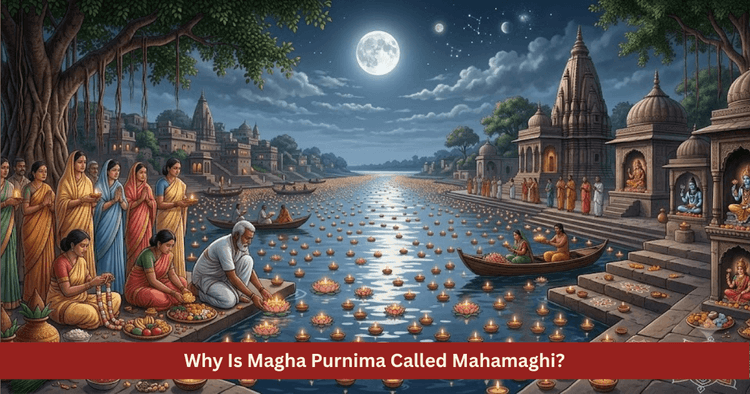
Table of Contents
Date, Sacred Bath and Worship of Magha Purnima in Brief
The last day of Magha month is celebrated as Magha Purnima, which is also called Mahamaghi. It is the grand summit of the bathing, charity, chanting and austerity that continued through the entire month. On this day the Kalpavas that has been going on for a month at Prayagraj is formally concluded and the Kalpavasis return to their homes after giving charity to saints and to their pilgrimage priests. In the Gregorian calendar, this tithi usually falls in February.
| Element of the Festival | Details |
|---|---|
| Tithi | The Purnima of Magha month |
| Other Names | Mahamaghi, Maghi Purnima |
| Speciality | The close of Magha month and the completion of Kalpavas |
| Position of the Moon | Usually in or near Magha Nakshatra |
| Position of the Sun | Usually in Makara (Capricorn), in some years in Kumbha (Aquarius) |
| Best Time to Bathe | Brahma Muhurta |
| Principal Worship | The Satyanarayana Katha and Vishnu worship |
| Night Observance | Arghya to the Moon with raw milk |
| Principal Donations | Sesame, blankets, grain, ghee, clothes and vessels |
| Other Festivals | Sant Ravidas Jayanti and Lalita Jayanti |
The Basic Rules of This Day in Brief
- Bathe during Brahma Muhurta in a sacred river or at home in water mixed with Gangajal.
- After bathing, offer arghya to the Sun and worship Lord Vishnu.
- During the day, listen to the Satyanarayana Katha and offer kheer as bhog.
- Donate grain, clothes, sesame and blankets according to your means.
- At night, offer arghya to the Moon with water mixed with raw milk.
The Secret of the Name Mahamaghi
In the Hindu Panchang, the months are named after the nakshatra near which the Moon stands on the full moon of that month. On the full moon of Magha month the Moon is usually in or around Magha Nakshatra and so the month came to be called Magha. In this way, Magha Purnima is the day when the nakshatra that gives the whole month its name is present with the Moon in its full brilliance. This is why it is called Mahamaghi, the great full moon of Magha.
The presiding deities of Magha Nakshatra are the Pitrus, the ancestors and its symbol is the royal throne. This connection is deeply meaningful. Through the whole of Magha month, tarpan for the ancestors, sacred bathing and charity continue and the month concludes in the light of the nakshatra that itself belongs to the ancestors. It is as if the ancestors place their seal of acceptance on the sadhana of the entire month.
The Formal Conclusion of Kalpavas
There is an ancient tradition of observing Kalpavas on the bank of the Sangam at Prayagraj during Magha month. Kalpavasis live on the bank of the Sangam for a month, from Paush Purnima to Magha Purnima or in some traditions from Makar Sankranti to Kumbh Sankranti. During this period they bathe 3 times a day, eat once a day, sleep on the ground and spend all their time in chanting, austerity and satsang.
Magha Purnima is the final offering of this stern austerity. On this day the Kalpavasis take their last bath and give charity to their pilgrimage priests. In tradition, the gift of a bed, vessels, clothes and grain has special importance on this day. After this, the Kalpavasis return to their homes with joyful hearts. It is believed that a person who could not bathe through the whole of Magha month receives the merit of the entire month's bathing by bathing and giving charity with faith on Magha Purnima alone.
| Concluding Rites of Kalpavas | Method |
|---|---|
| Final Bath | Bath at the Sangam during Brahma Muhurta |
| Worship | Worship of Mother Ganga, Veni Madhava and one's chosen deity |
| Honouring the Priest | Clothes, grain and dakshina to the pilgrimage priest |
| Gift of a Bed | By tradition, donating a bed, blankets and necessary items |
| Prasad | Returning home with Sangam water and prasad |
| Resolve | A resolve to observe Kalpavas again the next year |
The Full Nectar Gaze of the Moon
On Purnima the Moon is complete with all its 16 kalas. In astrology the Moon is regarded as the significator of the mind, water, the mother and medicinal herbs. The scriptures also call the Moon Soma and Soma is regarded as the king of medicinal herbs. It is believed that on Magha Purnima the nectar filled rays of the Moon give healing power to every particle of water.
This is why bathing in water on this day and offering arghya to the Moon at night have special importance. Offering water mixed with raw milk is a popular way of pleasing the Moon, because both milk and the Moon are regarded as white, cool and nourishing.
The Method of Offering Arghya to the Moon
- After moonrise, stand under the open sky facing the Moon.
- Take water in a silver or copper vessel and mix in a little raw milk, rice grains and white flowers.
- Offer the arghya slowly while chanting Om Somaya Namah or Om Chandraya Namah.
- After the arghya, stand quietly for a few moments, gaze at the Moon and pray for peace of mind.
- Place a vessel beneath so that the arghya water does not fall on your feet.
The Importance of the Satyanarayana Katha
The Purnima tithi is regarded as highly auspicious for the worship of Lord Satyanarayana and on Magha Purnima its importance grows even more. Satyanarayana is a form of Lord Vishnu, worshipped with the understanding that truth itself is Narayana.
The Satyanarayana Katha has 5 chapters, which tell the stories of a poor Brahmin, a woodcutter, King Ulkamukha, a merchant named Sadhu and King Tungadhwaja. The central message of all these stories is that the person who follows truth and keeps a promise made to the Lord finds welfare, while the person who forgets a promise or disrespects the prasad has to suffer.
| Stage of Worship | Method |
|---|---|
| Installation | Spread a yellow cloth on a wooden seat and install a picture of Lord Satyanarayana and a kalash |
| Worship | Worship Ganesha, the Navagrahas and Satyanarayana |
| Offerings | Offer tulsi leaves, yellow flowers, panchamrit and banana leaves |
| Katha | Sit with the family and listen to the story of the 5 chapters |
| Bhog | Prasad made of wheat flour, ghee, sugar and banana and kheer |
| Aarti | Perform the aarti after the katha |
| Distribution of Prasad | Give prasad to everyone and receive it yourself with reverence |
Other Festivals Linked with Magha Purnima
Magha Purnima is not only a day of bathing and charity. Several other important festivals are also celebrated on this day.
- Sant Ravidas Jayanti: The birth anniversary of the great saint poet and social reformer Sant Ravidas is celebrated on this day.
- Lalita Jayanti: In the Shri Vidya tradition, the appearance day of Maa Lalita Tripura Sundari is celebrated on this day.
- Conclusion of Kalpavas: This is a principal bathing festival of the Magha Mela at Prayagraj.
- The belief in the bath of the gods: Popular belief holds that on this day even the gods take human form and come to bathe at the Sangam.
Magha Purnima Through the Lens of Vedic Astrology
In Vedic astrology, the Moon is strong on Purnima. The Moon signifies the mind, emotion, the mother, water and memory. The lord of Magha Nakshatra is Ketu and its presiding deities are the ancestors. The Sun is usually in Makara, the sign of Saturn. Because of all these positions, Magha Purnima is regarded as favourable for peace of mind, satisfaction of the ancestors and purification of karma.
| Concern | Astrological Indication | Remedy on Magha Purnima |
|---|---|---|
| Mental unrest and worry | Weak or afflicted Moon | Arghya to the Moon with raw milk |
| Concern for the mother's health | Afflicted 4th house | Gifting white clothes and sweets to the mother |
| Pitru Dosha | Afflicted Sun or 9th house | Sacred bath, tarpan and donation of grain |
| Confusion linked with Ketu | Adverse Ketu | Ganesha worship and donation of blankets |
| Instability in life | Connection between the Moon and Saturn | Satyanarayana Katha and donation of kheer |
Magha Purnima for Body and Mind
From the point of view of Ayurveda, Magha Purnima falls in the latter part of Shishira Ritu. At this time the Kapha accumulated in the body slowly begins to melt. The rays of the Sun begin to grow stronger and the arrival of spring draws near. At this junction of seasons, a restrained diet, light food and sacred bathing prepare the body for the coming season.
Spending some time in the moonlight on the night of Purnima calms the mind. The prasad of kheer, made from milk and rice, is nourishing and easy to digest. In this way, the traditions of Magha Purnima protect health along with dharma.
What Should Be Done and Avoided on Magha Purnima?
| Do | Do Not |
|---|---|
| Take a sacred bath during Brahma Muhurta | Do not sleep past sunrise |
| Listen to the Satyanarayana Katha and receive the prasad | Do not disrespect the prasad |
| Donate grain, clothes, sesame and blankets | Do not give charity for show |
| Offer arghya to the Moon | Avoid anger and quarrels on this day |
| Seek the blessings of elders and your mother | Do not eat meat, alcohol or tamasic food |
A Sadhana Made Complete in the Light of the Full Moon
Magha Purnima is the day of completion of a month of sadhana. Just as the Moon is complete with all its kalas on this day, the bathing, charity and austerity of the whole month reach their completion on this day. When the Kalpavasis take leave of the Sangam on this day, they do not merely return home. They return to life with a new, pure and disciplined mind.
For the person who bathes with faith on this day, listens to the story of Lord Satyanarayana, serves those in need and prays for peace of mind while offering arghya to the Moon at night, Magha Purnima does not remain merely a date. It becomes a source of peace, purity and contentment for the whole year.
FAQ
When does Magha Purnima fall?
Magha Purnima is the last day of Magha month. In the Gregorian calendar it usually falls in February.
Why is Magha Purnima called Mahamaghi?
On this day the Moon is usually in or near Magha Nakshatra, after which the month is named. So it is called the great full moon of Magha, that is Mahamaghi.
How is Kalpavas concluded on Magha Purnima?
On this day the Kalpavasis take their last bath at the Sangam, give clothes, grain and dakshina to their pilgrimage priests and return home carrying Sangam water.
How should arghya be offered to the Moon on Magha Purnima?
After moonrise, take water, raw milk, rice grains and white flowers in a silver or copper vessel and offer arghya to the Moon while chanting Om Somaya Namah.
Which katha should be heard on Magha Purnima?
Listening to the story of Lord Satyanarayana on Magha Purnima is considered highly auspicious. After the katha, prasad and kheer are offered as bhog.
Get your accurate Kundali
Generate KundaliDid you like it?
Author
Pt. Narendra Sharma (63)
Experience: 20
Consults About: Family Planning, Career
Clients In: Punjab, Haryana, Delhi
Share this article with friends and family
WELCOME TO
ZODIAQ
Right Decisions at the right time with ZODIAQ
