Classical Protocol of Magha Snana: Scientific and Tantric Secrets of 'Maghe Nimagnah Salile Susheete'
By Aparna Patni
Pre-Dawn Ablutions, Brown Fat Activation, Sahasrara Nectar Showers And Home Protocols
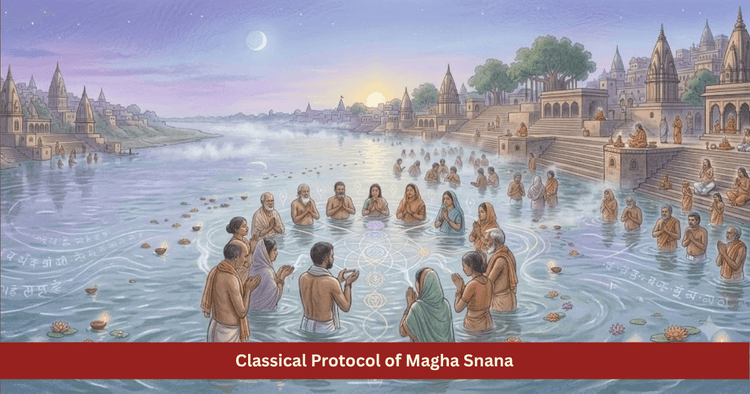
Table of Contents
In authentic Vedic philosophy, water is far more than a physical solvent for physiological thirst; it is revered as 'Apah'-a living, conscious and purifying cosmological element. Across the annual journey of the twelve lunar months, the pre-dawn bath during the month of Magha represents the pinnacle of spiritual austerity, energetic purification and somatic detoxification. Classical treatises, including the Padma Purana, Matsya Purana and Narada Purana, proclaim that during this sacred month, every drop of natural water across earthly reservoirs, ponds, wells and flowing rivers is elevated to the sanctity of the holy Ganga.
The Padma Purana highlights this metaphysical reality through an immortal verse:
"Maghe nimagnah salile susheete vimuktapapastridivam prayanti।
Na yajnairbahubhirdanairna tapobhistatha nripa। Yatha maghe prage snane krite papaih pramuchyate॥"
This translates to: Those souls who immerse themselves in the freezing, pristine waters of Magha before sunrise are completely liberated from all accumulated sins and attain the celestial realm of supreme liberation. Neither grand royal sacrifices, nor the gifting of boundless treasures, nor arduous penances can match the spiritual merit effortlessly secured through the simple act of pre-dawn ablution during Magha.
This discipline is not merely a symbolic religious convention; it is grounded in advanced biophysics, neurobiology and esoteric Tantric anatomy. Exposing the human physiology to cool, fresh water during the twilight of deep winter (January-February) stimulates systemic thermoregulation, awakens brown adipose tissue, enhances microcirculation and showers the Sahasrara chakra with revitalizing somatic energy. The analytical matrix below illustrates the scriptural parameters, empirical biophysical effects and subtle yogic influences of Magha Snana.
| Bathing Component | Scriptural & Elemental Standard | Biophysical & Physiological Impact | Tantric & Subtle Energy Influence |
|---|---|---|---|
| Sacred Timing | Arunodaya (48 to 96 mins before dawn) | Reset of circadian clock; regulation of melatonin | Direct stimulation of Ajna and Brahmarandhra |
| Water Nature | Fresh groundwater or natural cool water | Activation of Brown Adipose Tissue (BAT); lipid burn | Harmonization of Ida and Pingala nadis |
| Ganga Water Infusion | Adding drops or a spoonful of Ganga water | Natural bactericidal action; water memory restructuring | Purification of the bio-electromagnetic aura |
| Black Sesame Seeds | Infusing water with clean black sesame | Protection of skin lipid barrier; antioxidant action | Dissolution of tamasic Saturn-Rahu afflictions |
| Kusha Grass Touch | Wearing a Kusha ring or immersing the grass | Bio-electric shielding; grounding electromagnetic static | Upward movement of prana toward crown center |
| Physical Orientation | Facing East or North-East (Ishanya) | Absorption of early-morning infrared and ambient rays | Natural activation of the solar channel (Pingala) |
The Biophysical and Neurobiological Science of Cool-Water Immersion
During the height of winter in Magha, environmental temperatures drop to their annual minimums. Immersion in cool or unheated fresh groundwater during this specific window triggers a series of protective biological adaptations:
- Activation of Brown Adipose Tissue (BAT): Unlike white adipose tissue, which stores excess calories, brown adipose tissue is packed with iron-rich mitochondria designed specifically for non-shivering thermogenesis (generating heat by burning visceral fat). Exposure to cool water stimulates cutaneous thermal receptors, signaling the sympathetic nervous system to ignite brown fat reserves. This accelerates baseline metabolism, clears arterial sluggishness and generates steady core warmth.
- Vascular Gymnastics: The acute sensation of cold water causes immediate vasoconstriction of peripheral blood vessels, driving systemic blood inward to protect vital organs (heart, brain, kidneys and liver). Once the bath concludes and the body begins rewarming, rapid vasodilation occurs. This rhythmic contraction and dilation cleanses the cardiovascular tree, improves arterial elasticity and lowers resting blood pressure.
- Neurochemical Surge (Dopamine and Endorphins): Neurobiological investigations confirm that cool-water immersion elevates synaptic dopamine concentrations by up to 250% above baseline, maintaining this elevation for hours without crash. This neurochemical release dispels lethargy, alleviates Seasonal Affective Disorder (winter depression), sharpens executive focus and induces a state of calm alertness.
- Lymphatic Pumping and Immune Resistance: The muscular and vascular contraction induced by cool water acts as a mechanical pump for the lymphatic system, flushing cellular metabolic waste into regional lymph nodes for elimination. This increases the circulation of natural killer cells and circulating white blood cells (WBCs), protecting the upper respiratory tract against winter pathogens.
The Tantric Perspective: Nectar Showers on the Sahasrara Chakra
In the esoteric traditions of Tantra and Kundalini Yoga, the human frame is viewed as a microcosmic manifestation of the universe. At the apex of the cranium lies the Sahasrara Chakra-the thousand-petaled lotus representing the transcendental union of Shiva (pure consciousness) and Shakti (primordial energy).
During the pre-dawn Brahma Muhurta of Magha, pouring a steady stream of cool water over the crown of the head acts as an esoteric baptism known as 'Soma-Dhara' (the raining of divine nectar). In subtle physiology, heat represents the solar current (Pingala), while coolness embodies the lunar, restorative nectar (Ida/Soma). The sudden cool impact over the crown soothes excess psychic heat from the mental plane, calming intellectual agitation.
This stimulation sends an energetic impulse down the central channel (Sushumna Nadi). As the water cascades over the medulla oblongata and along the spinal axis, it provides a subtle energetic shock that encourages the upward movement of dormant prana from the lower chakras (Muladhara and Svadhisthana). Tantric masters affirm that during Magha, natural waters carry enhanced cosmic Soma, dissolving subtle blockages within the nervous system.
Step-by-Step Classical Protocol for Magha Snana at Home
If distance, health or circumstances prevent an individual from traveling to Prayagraj, Haridwar, Varanasi or a sacred river, classical texts provide an authentic methodology to invoke the spiritual potency of sacred waters within the domestic environment:
1. Chronological Precision (The Ideal Window)
Magha Snana must strictly be performed during Arunodaya-the pre-dawn twilight when stars remain visible in the celestial vault and the eastern horizon begins to show its initial subtle glow (roughly 45 to 60 minutes prior to sunrise). Classical hierarchies define the merits as:
- Bathing while stars are clearly visible: Superior (Uttama - Utmost spiritual potency)
- Bathing after stars fade but before sunrise: Moderate (Madhyama)
- Bathing after the solar disc appears: Common (Lacks the specific merit of Magha Snana)
2. Preparation of the Consecrated Vessel
Fill a clean domestic bucket or large copper/brass container with fresh, unheated tap or well water (frail or elderly individuals may use lukewarm water; avoid scalding water). Introduce three sacred physical substances:
- Ganga Water: Add a few drops or a spoonful of consecrated Ganga water while chanting the Gayatri or Narayana mantra.
- Black Sesame Seeds (Kala Tila): Add half a teaspoon of clean black sesame seeds into the water. Manifested from the divine exertion of Lord Vishnu, sesame absorbs planetary afflictions and dissolves ancestral distress.
- Sacred Kusha Grass: Dip a clean stalk of kusha grass into the vessel to stir the water or wear a consecrated kusha ring (Pavitri) on the ring finger of the right hand. Kusha acts as an energetic non-conductor, preventing the grounding of spiritual energy into the earth.
3. Invocation of the Sacred Tirthas
Stand before the vessel with folded hands, focusing your intention to invoke the subtle presence of sacred river systems:
"Gange cha Yamune chaiva Godavari Saraswati।
Narmade Sindhu Kaveri jalesmin sannidhim kuru॥"
Follow this with the specific Magha Snana Sankalpa resolution:
"Duhkhadaaridryanashaya Shrivishnostoshanaya cha।
Pratahsnanam karomyadya Maghe papavinashanam॥
Makarashthe ravau Maghe Govinda Achyuta Madhava।
Snanenanena me deva yathoktaphalado bhava॥"
4. Immersion Technique
Pour the first chalice of water directly over the crown of the head (Brahmarandhra), rather than starting at the feet or abdomen. Allow the cool water to cascade down the spinal column. Throughout the bath, maintain continuous mental recitation of 'Om Madhavaya Namah' or 'Om Namo Bhagavate Vasudevaya'.
4 Mandatory Post-Bath Classical Observances
A scriptural Magha bath is considered incomplete unless accompanied by four complementary spiritual actions:
- Aditya Arghya Dana: Step out of the bath, dry off and change into clean, unstitched white or yellow cotton garments. Fill an untarnished copper urn with fresh water, vermilion, unbroken raw rice, a touch of jaggery, red flowers and a pinch of black sesame. Raise the vessel above eye level and offer the water to the rising Sun in three measured streams.
- Sesame Application and Consumption: Apply a light coating of cold-pressed sesame oil to the skin or consume a small sanctified portion of sesame seeds mixed with jaggery after morning prayers.
- Ancestral Libations (Pitru Tarpana): Face the southern quadrant, take water and black sesame in the palms of your hands and offer three water libations to your departed ancestors.
- Lighting the Altar Lamp (Deepa Dana): Kindle an unblemished earthen lamp fueled with cow ghee or sesame oil before the domestic altar, near the sacred Tulsi plant or at the household threshold.
Spiritual and Practical Benefits of Magha Snana
- Dissolution of Accumulated Sins: The Padma Purana confirms that regular adherence to pre-dawn bathing throughout the 30 days of Magha incinerates bodily, verbal and mental transgressions.
- Radiance of Vital Ojas: Enhanced capillary perfusion and metabolic balance bestow a clear, luminous complexion and internal vitality.
- Sharpened Willpower and Sensory Mastery: Willingly relinquishing the comfort of a warm bed to step into cool water builds emotional resilience and disciplined willpower.
- Relief from Planetary Afflictions: Incorporating black sesame seeds and solar libations into the bath soothes difficult configurations of the Sun, Saturn, Rahu and Ketu across the birth chart.
FAQ
Should elderly or ill individuals bathe in cold water during Magha?
No. Classical scriptures state that preserving the physical vessel is a prerequisite for spiritual duty (Shariramadyam khalu dharmasadhanam). Those who are elderly, frail or ill should use pleasantly lukewarm water infused with Ganga water, sesame seeds and Tulsi leaves or perform 'Marjana Snana' by wiping the body with a damp cloth while chanting the mantras.
What is the precise duration of the Magha Snana vrata?
The full scriptural vrata begins on the full moon day of Pausha (Pausha Purnima) and concludes on the full moon day of Magha (Magha Purnima), lasting thirty days. An alternative tradition runs from Makar Sankranti to Kumbha Sankranti.
What if kusha grass is not available at home?
If fresh kusha grass cannot be obtained, one can complete the bath using clean black sesame seeds and Ganga water. Dipping a clean stem of the Tulsi plant into the water provides an equivalent sanctifying effect.
Can commercial chemical soaps be used during Magha Snana?
Traditional guidelines advise against synthetic chemical soaps during ritual bathing. Instead, use natural cleansing pastes made of sesame meal, chickpea flour, barley powder or herbal ubtan, which protect the skin's lipid barrier while remaining scripturally aligned.
What specific time constitutes the 'Amrita Snana' during Magha?
Bathing under the visible stars before sunrise during Arunodaya (typically between 4:30 AM and 5:30 AM, depending on local dawn) is considered the genuine 'Amrita Snana' that bestows maximum spiritual and biophysical benefits.
Get your accurate Kundali
Generate KundaliDid you like it?
Author

Aparna Patni (63)
Experience: 20
Consults About: Family Planning, Career
Clients In: Punjab, Haryana, Delhi
Share this article with friends and family
WELCOME TO
ZODIAQ
Right Decisions at the right time with ZODIAQ
