Why Go on Pilgrimage in Magha?
By Aparna Patni
The Merit of Prayag, Kashi, Ayodhya and Gaya
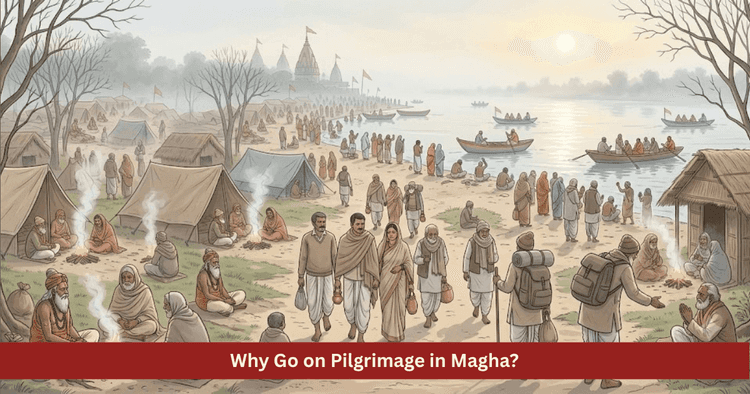
Table of Contents
Pilgrimage in Magha Month at a Glance
For followers of Sanatana Dharma, Magha month is regarded as the most sacred period for pilgrimage to India's major holy places. In this month, along with bathing at the Sangam in Prayagraj, the merit of darshan of Baba Vishwanath in Kashi, the giver of liberation, darshan of Lord Shri Ram Lalla in Ayodhya and pind daan for the ancestors on the bank of the Falgu river in Gaya is regarded as many times greater. Undertaken at the junction of bitter cold and spring, this journey does not only give religious merit but also frees the mind from worldly entanglements for a while and connects it with the roots of Sanatana culture.
| Tirtha | Main Attractions | Main Observances |
|---|---|---|
| Prayagraj | The Triveni Sangam, Veni Madhava, the Akshayavat, the reclining Hanuman | Bathing at the Sangam and Kalpavas |
| Kashi, that is Varanasi | The Kashi Vishwanath Jyotirlinga, the Ganga ghats, the Ganga Aarti | Bathing in the Ganga and darshan of Vishwanath |
| Ayodhya | The Shri Ram Janmabhoomi temple, Hanumangarhi, the bank of the Saryu | Darshan of Ram Lalla and bathing in the Saryu |
| Gaya | The Vishnupad temple, the Falgu river, the Akshayavat | Pind daan and shraddha for the ancestors |
The Basic Rules of Pilgrimage
- Take a resolve before the journey and keep a feeling of faith in your mind.
- At the tirtha, follow sattvic food, restrained speech and good conduct.
- Keep the sacred rivers and holy places clean.
- Follow local rules, temple arrangements and safety instructions.
- See the journey as sadhana, not tourism.
The Importance of Pilgrimage in Magha Month
The scriptures call Magha the finest month for bathing at holy places. In this month the Sun is on its auspicious northern course of Uttarayana in Makara. Tradition holds that at this time the merit of bathing in sacred rivers and visiting holy places grows many times compared to ordinary days.
The real purpose of pilgrimage is not merely to see places. The word tirtha means a place that carries one across. Pilgrimage takes a person out of the rush of daily life and lets them experience the peace and sanctity gathered at these places through centuries of spiritual practice. When a person travels far from home, with limited means and with faith, ego lessens and the mind becomes humble.
Prayagraj: The King of Tirthas
Prayagraj is called Tirtharaj, the king of holy places. Here the Ganga, the Yamuna and the unseen Saraswati meet. Every year in Magha month the Magha Mela is held here, in which lakhs of Kalpavasis live on the bank of the Sangam for a month. Mauni Amavasya, Vasant Panchami and Magha Purnima are its main bathing festivals.
- Bathing at the Sangam: Bathing at the Triveni Sangam during Brahma Muhurta is regarded as most meritorious.
- Veni Madhava: The presiding deity of Prayag, whose darshan is regarded as completing the pilgrimage.
- Akshayavat: The sacred banyan tree regarded as imperishable even at the dissolution of the world.
- Reclining Hanuman: The famous temple of Hanuman on the bank of the Sangam.
Kashi: The City of Liberation
Kashi, also called Varanasi and Banaras, is regarded as one of the oldest living cities in the world. Tradition says that Kashi rests on the trident of Lord Shiva and that one who leaves the body here attains liberation. This is why it is called Kashi, the giver of liberation.
- Kashi Vishwanath: One of the 12 Jyotirlingas, the darshan of Baba Vishwanath is the heart of a visit to Kashi.
- The Ganga ghats: Bathing in the Ganga at ghats such as Dashashwamedh, Assi and Panchganga.
- The Ganga Aarti: The grand Ganga Aarti held at Dashashwamedh Ghat in the evening.
- Annapurna and Kalabhairava: Darshan of Mother Annapurna and of Kalabhairava, called the guardian of Kashi.
Ayodhya: The Birthplace of Shri Rama
Ayodhya is the birthplace of Lord Shri Rama and is regarded as the first of the 7 sacred cities. This city on the bank of the Saryu river is a living memory of the ideals of Maryada Purushottam. Devotees come from all over the country for darshan of Ram Lalla in the grand temple built at the Shri Ram Janmabhoomi.
- Darshan of Ram Lalla: Darshan of Ram Lalla in his child form at the Shri Ram Janmabhoomi temple.
- Hanumangarhi: It is traditional to take darshan of Hanuman at Hanumangarhi before the darshan of Ram Lalla.
- Bathing in the Saryu: A sacred bath at the ghats of the Saryu river.
- Kanak Bhavan: A famous temple dedicated to Mother Sita and Shri Rama.
Gaya: The Tirtha of the Ancestors' Liberation
Gaya is regarded as the foremost tirtha for ancestral rites. Tradition says that pind daan offered on the bank of the Falgu river in Gaya grants liberation to the ancestors. The Vishnupad temple, bearing the footprint of Lord Vishnu, stands here. Although Pitru Paksha is the most famous time for pind daan in Gaya, tradition also allows pind daan here at other times of the year and Magha, being the month of the ancestors, is regarded as auspicious for it.
- The Vishnupad temple: An ancient temple bearing the footprint of Lord Vishnu.
- The Falgu river: On whose bank pind daan is offered.
- The Akshayavat: The sacred banyan tree of Gaya, where pind daan is concluded.
- Bodh Gaya: Nearby, the place where Lord Buddha attained enlightenment.
Planning a 4 Tirtha Journey
These 4 tirthas of North India are relatively close to one another, so they can be included in a single journey. Prayagraj to Varanasi is about 120 kilometres, Varanasi to Ayodhya about 200 kilometres and Varanasi to Gaya about 250 kilometres. These distances are approximate by road.
| No. | Tirtha | Suggested Time | Main Observances |
|---|---|---|---|
| 1 | Prayagraj | 1 to 2 days | Bathing at the Sangam and darshan of Veni Madhava |
| 2 | Kashi | 2 days | Bathing in the Ganga, darshan of Vishwanath and the Ganga Aarti |
| 3 | Ayodhya | 1 to 2 days | Darshan of Ram Lalla and Hanumangarhi and bathing in the Saryu |
| 4 | Gaya | 1 to 2 days | Darshan at Vishnupad and pind daan |
The order of the journey can be changed according to your convenience, time and transport. For pind daan in Gaya, it is wise to contact a qualified panda or priest in advance.
The Rules of Darshan
| Rule | Details |
|---|---|
| Clothing | Clean, simple and modest clothes |
| Queue | Patience and discipline in the darshan queue |
| Temple Rules | Follow the rules about mobile phones, cameras and luggage |
| Prasad | Take prasad from the authorised counter |
| Donations | Donate only at the official donation box or counter |
| Feeling | During darshan, focus on the Lord, not on the crowd |
Essential Precautions During the Journey
In Magha month North India has bitter cold and thick fog. The holy places also see huge crowds on major festivals. So discernment is necessary along with faith.
- Protection from cold: Carry enough warm clothes, caps, socks and blankets.
- Fog: Thick fog can delay trains and flights, so keep extra time in your plans.
- Advance booking: Book accommodation and travel in advance at festival times.
- Health: The elderly, children and the sick should not bathe too long in cold water and should carry necessary medicines.
- Care in crowds: Fix a meeting point with family members and take special care of small children.
- Beware of fraud: Be careful of unauthorised agents and those demanding excessive fees.
- Cleanliness: Do not throw plastic, soap or worship materials into the rivers.
Pilgrimage Through the Lens of Vedic Astrology
In Vedic astrology the 9th house of the horoscope is regarded as the house of dharma, fortune and pilgrimage. Jupiter signifies dharma and the grace of the guru and Ketu liberation. Tradition holds that pilgrimage increases the auspicious results of the 9th house and Jupiter and brings the grace of the ancestors.
| Goal | Related House or Planet | Recommended Tirtha |
|---|---|---|
| Peace from Pitru Dosha | The Sun and the 9th house | Pind daan in Gaya |
| Spiritual progress | Ketu and the 12th house | Darshan in Kashi |
| Fortune and dharma | Jupiter and the 9th house | Bathing at the Sangam in Prayag |
| Dignity and family happiness | The Sun and the 4th house | Darshan in Ayodhya |
What Should Be Done and Avoided on Pilgrimage?
| Do | Do Not |
|---|---|
| Travel with faith and a resolve | Do not turn the journey into mere tourism |
| Follow sattvic food and good conduct | Do not take meat, alcohol or tamasic food at the tirtha |
| Keep rivers and ghats clean | Do not throw plastic or waste into rivers |
| Carry enough warm clothes and medicines | Do not neglect your health in the cold and crowds |
| Donate and take prasad only at official counters | Do not trust unauthorised agents |
The Peace of the Soul Found in the Dust of the Tirthas
The pilgrimage of Magha month is a journey that leads from outside to within. The Sangam at Prayag teaches that the different streams of life come together to form completeness. Kashi teaches that even death can be a door to liberation. Ayodhya brings to mind the ideal of dignity and dharma and Gaya teaches the lesson of gratitude towards the ancestors.
The person who visits these tirthas in this month with faith, discernment and humility does not merely see places but reaches the roots of their own soul. On returning home, they bring back not only prasad but also a new peace, a new vision and a new resolve. This is the greatest merit of pilgrimage.
FAQ
What is the importance of pilgrimage in Magha month? The scriptures call Magha the finest month for bathing at holy places. Tradition regards the merit of bathing in sacred rivers and visiting tirthas in this month as many times greater.
Which tirthas should be visited in Magha month? In North India, the Sangam at Prayagraj, Kashi Vishwanath, Ram Lalla in Ayodhya and the Vishnupad temple in Gaya for pind daan are regarded as the main tirthas of Magha month.
What is the importance of pind daan in Gaya? Tradition regards Gaya as the foremost tirtha for ancestral rites. It is believed that pind daan offered on the bank of the Falgu river grants liberation to the ancestors.
What is the order of darshan in Ayodhya? It is traditional to take darshan of Hanuman at Hanumangarhi before the darshan of Ram Lalla. Bathing in the Saryu and darshan at Kanak Bhavan are also part of the visit.
What precautions should be taken on a Magha pilgrimage? Carry enough warm clothes and medicines, keep extra time for fog delays, book in advance, stay careful in crowds and avoid unauthorised agents.
Get your accurate Kundali
Generate KundaliDid you like it?
Author

Aparna Patni (63)
Experience: 20
Consults About: Family Planning, Career
Clients In: Punjab, Haryana, Delhi
Share this article with friends and family
WELCOME TO
ZODIAQ
Right Decisions at the right time with ZODIAQ
