Why Worship Lakshmi on Mahananda Navami?
By Aparna Patni
Driving Out Alakshmi, Shri Suktam Havan and Kanakadhara
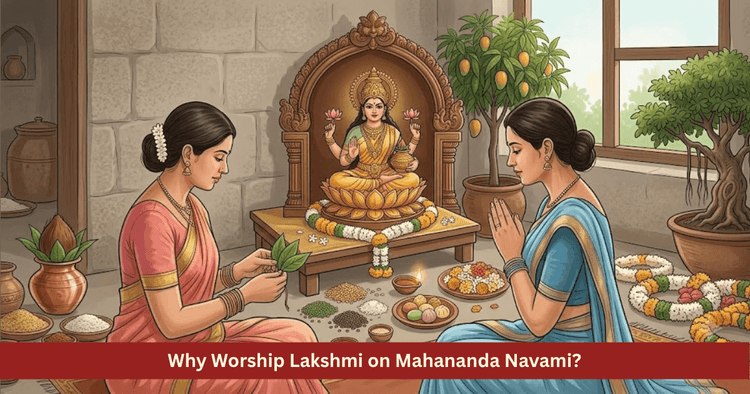
Table of Contents
Date, Worship and Core Rules of Mahananda Navami
The Navami tithi of the bright fortnight of Magha month is called Mahananda Navami. This day is also the concluding day of Magha Gupt Navratri. According to Puranic belief, on this day the most benevolent and peaceful form of Mother Mahalakshmi is worshipped, who drives out Alakshmi, the goddess of poverty and misfortune, from the home and establishes lasting prosperity. In the Gregorian calendar, this tithi usually falls between late January and February.
| Element of the Festival | Details |
|---|---|
| Tithi | Magha Shukla Navami |
| Speciality | The concluding day of Magha Gupt Navratri |
| Principal Deity | Mother Mahalakshmi |
| Central Idea | Driving out Alakshmi and welcoming Lakshmi |
| Principal Acts | Cleaning the home, a lamp at the main door and havan with the Shri Suktam |
| Principal Recitations | The Shri Suktam and the Kanakadhara Stotram |
| Principal Offerings | Lotus or red flowers, kheer, white sweets and lotus seeds |
| Conclusion | The havan and Kanya Pujan of Gupt Navratri |
The Basic Rules of This Day in Brief
- In the morning, clean the entire home well and remove broken, useless and unused items.
- After bathing, wear clean white, yellow or pink clothes.
- Install an idol or picture of Mother Lakshmi on a lotus seat and worship her.
- Recite the Shri Suktam or the Kanakadhara Stotram.
- In the evening, light a lamp of cow's ghee at the main door of the home.
Who Are Lakshmi and Alakshmi?
In the Sanatana tradition, the goddess of prosperity is Mother Lakshmi, the consort of Lord Vishnu. Opposite her, another power is described, called Alakshmi or Jyeshtha. According to Puranic belief, Alakshmi appeared before Lakshmi during the churning of the ocean and so she is regarded as Lakshmi's elder sister.
Alakshmi is the symbol of poverty, strife, laziness, uncleanliness and misfortune. Tradition holds that she dwells in homes where there is filth, where quarrels take place, where people sleep past sunrise, where elders are insulted and where food is disrespected. In contrast, Mother Lakshmi dwells permanently in homes marked by cleanliness, peace, hard work, good conduct and mutual love.
| Where Lakshmi Dwells | Where Alakshmi Dwells |
|---|---|
| A clean and fragrant home | A dirty and disorderly home |
| Families who rise early | Families who sleep late |
| Love and sweet speech | Strife and harsh words |
| Hard work and honesty | Laziness and deceit |
| Respect for food | Waste of food |
| Respect for elders and women | Disrespect for elders and women |
| A lamp at dusk | Darkness at dusk |
This table makes it clear that Lakshmi and Alakshmi are not merely Puranic goddesses but symbols of 2 different ways of living. The true message of Mahananda Navami is to drive the qualities of Alakshmi out of both home and mind and to embrace the qualities of Lakshmi.
The Meaning of the Name Mahananda
The word Mahananda is formed from maha and ananda, meaning supreme bliss. This name shows that the grace of Lakshmi is not limited to wealth. True prosperity is that in which peace, contentment, health and the love of family are present along with wealth. A home that has much wealth but no peace is regarded as the dwelling of Alakshmi, not Lakshmi.
The fact that this day falls at the conclusion of Magha Gupt Navratri is also meaningful. After 9 days of Shakti sadhana, the seeker attains Mahananda, supreme bliss. Among the 10 Mahavidyas, the 10th Mahavidya is Kamala, who is herself a form of Lakshmi. In this way, the sadhana of Gupt Navratri is completed with the blessing of Lakshmi.
The Complete Worship Method of Mahananda Navami
| No. | Stage of Worship | Method |
|---|---|---|
| 1 | Driving Out Alakshmi | In the morning, clean the whole home and remove broken utensils, torn clothes and useless items |
| 2 | Bath | Bathe and wear clean white, yellow or pink clothes |
| 3 | Installation | Spread a red or pink cloth on a wooden seat and install an idol or picture of Mother Lakshmi |
| 4 | Ganesha Worship | First of all, worship Lord Ganesha |
| 5 | Sankalpa | Take a resolve for the removal of poverty from the home and for lasting prosperity |
| 6 | Offerings | Offer lotus or red flowers, kumkum, rice grains, lotus seeds and perfume |
| 7 | Bhog | Offer kheer, white sweets, fox nuts and seasonal fruits |
| 8 | Recitation | Recite the Shri Suktam and the Kanakadhara Stotram |
| 9 | Havan | Offer oblations of ghee, lotus seeds and kheer with the 16 verses of the Shri Suktam |
| 10 | Lamp | In the evening, light a lamp of cow's ghee at the main door |
| 11 | Aarti | Perform the aarti of Mother Lakshmi and distribute prasad |
Havan with the Shri Suktam
The Shri Suktam is a very ancient and powerful hymn to Mother Lakshmi found in the supplementary section of the Rigveda. It begins with "Hiranyavarnam harinim suvarna rajata srajam," in which the goddess is described as golden in colour and wearing garlands of gold and silver. Tradition prescribes a havan with the 16 verses of the Shri Suktam. At the end of each verse, Swaha is spoken and an oblation of ghee, lotus seeds or kheer is offered.
One verse of the Shri Suktam contains a clear prayer for the expulsion of Alakshmi. In it, the seeker prays that Jyeshtha Alakshmi, in the form of hunger, thirst, impurity and poverty, may depart from the home. This is why reciting the Shri Suktam on Mahananda Navami is regarded as especially fruitful.
The Story of the Kanakadhara Stotram
The Kanakadhara Stotram was composed by Adi Shankaracharya. Behind it lies a deeply moving story. In his childhood, Shankaracharya went to the door of a poor Brahmin woman to ask for alms. There was not a single grain of food in her home. Yet she did not want to send the young monk at her door away empty handed. With great hesitation, she gave him the only dried amla, the Indian gooseberry, lying in her home.
Seeing her selfless generosity and her deep poverty, the heart of young Shankara melted. Standing right there, he composed 21 verses in praise of Mother Lakshmi. According to the story, pleased by his hymn, Mother Lakshmi showered golden gooseberries on the home of that poor Brahmin woman. Kanaka means gold and dhara means a stream or shower. This is how the hymn came to be called Kanakadhara.
A deep lesson lies hidden in this story. Lakshmi's grace came to that Brahmin woman because she did not give up the spirit of giving even in poverty. The person who helps others even within limited means finds Lakshmi herself arriving at the door.
Remedies for Freedom from Financial Crisis
For families who have long been struggling with financial hardship, debt and business losses, tradition regards Mahananda Navami as a special opportunity. Fasting on this day and reciting the Kanakadhara Stotram is described as being as fruitful as a life giving herb.
- Lamp at the door: In the evening, light a lamp of cow's ghee at the main door and let it burn into the night.
- Lotus seed rosary: Chant Om Shreem Hreem Shreem Kamale Kamalalaye Praseeda Praseeda Shreem Hreem Shreem Om Mahalakshmyai Namah.
- Kanakadhara recitation: Resolve to recite the Kanakadhara Stotram every day or at least every Friday.
- Worship at the safe: Clean the place where money is kept, draw a swastika there with kumkum and place lotus seeds.
- Kanya Pujan: Feed young girls and give them gifts, regarding them as forms of Lakshmi.
- Charity: Give grain, clothes or items of adornment to a woman in need.
Along with these remedies, it is also necessary to understand a practical truth. Lakshmi is described as restless, meaning she stays only where she is respected. Keeping account of income and expenditure, controlling unnecessary spending, working hard with honesty and restraint in taking loans are all forms of worshipping Lakshmi. Worship steadies the mind and leads to right decisions but no remedy can take the place of hard work and discernment.
Mahananda Navami Through the Lens of Vedic Astrology
In Vedic astrology, the main significators of wealth and prosperity are Venus and Jupiter. The 2nd house of the horoscope is linked with accumulated wealth, the 11th house with income and gains and the 9th house with fortune. When malefic planets influence these houses or their lords, obstacles in saving money, sudden expenses and debt may be seen.
| Concern | Astrological Indication | Remedy on Mahananda Navami |
|---|---|---|
| Money does not stay | Afflicted 2nd house | Havan with the Shri Suktam and worship at the safe |
| Blocks in income | Weak 11th house | Recitation of the Kanakadhara Stotram |
| Burden of debt | Adverse influence of the 6th house | A ghee lamp at the main door in the evening |
| Business losses | Weak Venus or Mercury | Lakshmi mantra japa on a lotus seed rosary |
| Strife at home | Imbalance between the Moon and Venus | Cleaning the home, fragrance and a resolve for sweet speech |
What Should Be Done and Avoided on Mahananda Navami?
| Do | Do Not |
|---|---|
| Clean the entire home | Do not keep broken and useless items at home |
| Light a lamp at the main door in the evening | Do not keep the home dark at dusk |
| Respect women and young girls | Do not insult the women of the home |
| Respect food | Do not waste food |
| Recite the Shri Suktam and Kanakadhara | Avoid strife and harsh words on this day |
| Give charity to those in need | Do not deceive or cheat anyone |
Mahalakshmi Smiling in the Flame of the Lamp
Mahananda Navami teaches that prosperity begins from within, not from outside. When the home is clean, the mind is calm, speech is sweet and the hands are open for both hard work and charity, Lakshmi herself comes to that door and stays. Driving out Alakshmi means not only removing rubbish from the home but also bidding farewell to laziness, jealousy and strife in the mind.
For the family that worships Mother Mahalakshmi with faith on this day, lights a lamp at the main door and resolves to adopt the qualities of Lakshmi in its life, not only wealth but Mahananda, supreme bliss, comes to dwell permanently in that home.
FAQ
When is Mahananda Navami celebrated? Mahananda Navami is celebrated on the Navami tithi of the bright fortnight of Magha month. It is also the concluding day of Magha Gupt Navratri.
Who is worshipped on Mahananda Navami? On this day the benevolent form of Mother Mahalakshmi is worshipped, who removes Alakshmi, the goddess of poverty, from the home and establishes lasting prosperity.
Who is Alakshmi? Alakshmi is the symbol of poverty, strife, laziness and uncleanliness. It is believed that she lives in dirty and quarrelsome homes and departs through cleanliness.
Which recitation should be done on Mahananda Navami? Reciting the Shri Suktam and the Kanakadhara Stotram composed by Adi Shankaracharya is considered especially fruitful on this day. A havan with the 16 verses of the Shri Suktam is also performed.
What should be done on Mahananda Navami to remove financial crisis? Light a lamp of cow's ghee at the main door in the evening, recite the Kanakadhara Stotram and clean the home. Restraint in spending and honest hard work are also essential.
Get your accurate Kundali
Generate KundaliDid you like it?
Author

Aparna Patni (63)
Experience: 20
Consults About: Family Planning, Career
Clients In: Punjab, Haryana, Delhi
Share this article with friends and family
WELCOME TO
ZODIAQ
Right Decisions at the right time with ZODIAQ
