When Does the Sangam Turn to Nectar?
By Pt. Sanjeev Sharma
The Great Prayagraj Bath, Kumbh Tradition and Method
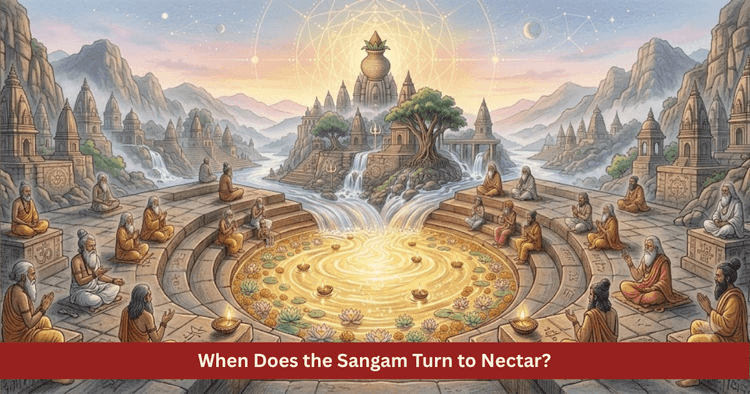
Table of Contents
Key Facts About the Great Prayagraj Bath on Mauni Amavasya
The bath at the Triveni Sangam in Prayagraj, the king of pilgrimage places, on the Amavasya of Magha month, known as Mauni Amavasya, is regarded as the greatest and most meritorious bath of the entire Magha Mela. According to religious belief and popular faith, on this day the water of the Sangam becomes endowed with divine qualities like those of amrit, the nectar of immortality. When the Kumbh or Ardh Kumbh is held, the bath of Mauni Amavasya becomes the most important bath of the whole festival and crores of devotees take the dip together.
| Element of the Bath | Details |
|---|---|
| Tithi | The Amavasya of Magha month |
| Place | The Triveni Sangam at Prayagraj, where the Ganga, the Yamuna and the unseen Saraswati meet |
| Best Time | Brahma Muhurta, which begins about 1 hour 36 minutes before sunrise |
| Method of Bathing | In silence, facing east, with at least 3 dips |
| After the Bath | Solar arghya, ancestral tarpan, charity and darshan of Veni Madhava |
| Principal Bathers | Sannyasis, Naga sadhus, the Akharas, Kalpavasis and householder devotees |
| Alternative at Home | Adding Gangajal to the bathing water and invoking the sacred rivers |
| Principal Donations | Sesame, blankets, grain, jaggery, ghee and clothes |
The exact auspicious time for the bath changes every year according to the start and end of the tithi, so the local Panchang of that year or the announcements of the Mela administration should always be checked.
Why Is Prayagraj Called the King of Tirthas?
India has countless places of pilgrimage but Prayagraj is called the king of them all. According to Puranic belief, at the beginning of creation Brahma performed the first yajna here and so it came to be called Prayag. Pra means first or supreme and yaga means sacrifice. Here the white stream of the Ganga and the dark stream of the Yamuna can be seen meeting and it is believed that the Saraswati river joins them here in hidden form. This meeting of 3 rivers is called the Triveni.
Lord Vishnu is believed to abide here as Veni Madhava to protect the region of Prayag. The Akshayavat, the imperishable banyan tree, also stands here and it is believed that it is not destroyed even at the time of cosmic dissolution. On the bank of the Sangam there is also the famous temple of the reclining Hanuman. Because of all these, Prayagraj is regarded not merely as a city but as a living spiritual region.
How Does the Water of the Sangam Turn to Nectar?
The roots of this belief lie in the story of the churning of the ocean. According to the Puranic story, when the gods and the demons churned the ocean together, the pot of amrit finally appeared. A struggle broke out between the gods and the demons over that pot. During this struggle, a few drops of amrit fell at 4 places on earth: Prayagraj, Haridwar, Ujjain and Nashik. The Kumbh Mela is held at these 4 places.
It is believed that when a special planetary position forms, the presence of that same nectar is felt in the rivers of these places. At Prayagraj, the Kumbh yoga forms when the Sun is in Makara (Capricorn) and Jupiter, the Guru of the gods, is in Vrishabha (Taurus). On Mauni Amavasya the Sun and the Moon are both in Makara, so the bath of this day is regarded as equal to a bath in nectar. During the Kumbh, the bath of this day is called the Amrit Snan or Shahi Snan, the royal bath.
According to another belief, Manu appeared on this day at the beginning of the Satya Yuga. Manu is regarded as the first ancestor of humankind. So this day is also a symbol of the rebirth of human consciousness. The person who takes a dip in the Sangam on this day symbolically washes away old tendencies and begins a new life.
The Difference Between Kumbh, Ardh Kumbh and Magha Mela
| Gathering | Interval | Speciality |
|---|---|---|
| Magha Mela | Every year | Kalpavas and bathing festivals on the bank of the Sangam in Magha month |
| Ardh Kumbh | About 6 years | A vast bathing festival held at Prayagraj and Haridwar |
| Kumbh | About 12 years | A great festival held under a special planetary yoga |
| Maha Kumbh | After 12 Kumbhs, about 144 years | An extremely rare gathering held at Prayagraj |
The Divine Scene on the Bank of the Sangam
The scene at the bank of the Sangam at dawn on Mauni Amavasya is wondrous. Amid bitter cold and fog, in the light of lakhs of lamps, a vast crowd of devotees moves towards the Sangam. During the Kumbh, the Akharas come out in procession. Naga sannyasis, Mahamandaleshwars and saints of various sects bathe in a fixed order. After them, the householder devotees take their dips.
The Kalpavasis who live on the bank of the Sangam for a whole month during Magha bathe with special devotion on this day. Kalpavasis bathe 3 times a day, eat once a day and sleep on the ground. For them, the bath of Mauni Amavasya is the central moment of their entire sadhana.
In this vast gathering, there is no distinction of caste, religion, language or wealth. A king and a beggar take a dip in the same water with the same feeling. This is the greatest beauty of this bath.
The Correct Method of Bathing at the Sangam
Bathing at the Sangam is not merely stepping into the water. It has a set method and following it makes the spiritual fruit of the bath complete.
| Step | Method |
|---|---|
| Sankalpa | On reaching the bank of the Sangam, hold water in your hand and state your name, gotra and resolve to bathe on Mauni Amavasya |
| Silence | Keep silence before and during the bath |
| Entry | Bow to Mother Ganga and enter the water slowly |
| Dips | Face east and take at least 3 dips |
| Arghya | After the bath, take water in cupped hands and offer arghya to the Sun |
| Tarpan | Offer tarpan for the ancestors with water mixed with black sesame |
| Charity | Donate sesame, grain, clothes and dakshina on the bank |
| Darshan | Take darshan of Veni Madhava, the Akshayavat and the reclining Hanuman |
Points to Remember While Bathing
- Do not use soap, shampoo or any chemical substance in the river.
- Do not throw worship materials, plastic or flower bags into the river.
- Spitting or spreading filth in the river is regarded as a grave sin.
- Do not wring out wet clothes into the river after bathing.
- Bathe only at the safe ghats set by the administration.
- The elderly, children and the sick should not stay long in the cold water.
- In the crowd, fix a meeting point with the members of your family.
The river is called a mother. The bath of a person who enters the lap of the mother and soils it can never be complete. Cleanliness is as essential a part of this bath as faith.
How Can Those Who Cannot Reach Prayagraj Bathe at Home?
It is not possible for everyone to reach Prayagraj on Mauni Amavasya. The scriptures show a path for such devotees as well. When the feeling is pure, a bath at home can also give the fruit of a bath at a tirtha.
- Rise during Brahma Muhurta and take the vow of silence.
- Add a little Gangajal to the bathing water. If available, water from the Narmada or any other sacred river may also be added.
- Add a few black sesame seeds to the water.
- Before bathing, invoke the sacred rivers: "Gange cha Yamune chaiva Godavari Saraswati, Narmade Sindhu Kaveri jale asmin sannidhim kuru." It means, "O Ganga, Yamuna, Godavari, Saraswati, Narmada, Sindhu and Kaveri, may you all be present in this water."
- Bathe while meditating on the Triveni Sangam in your mind.
- After the bath, offer arghya to the Sun, offer tarpan to the ancestors and give charity.
The Spiritual Fruit of the Bath
The scriptures describe the glory of bathing at Prayag in Magha month in great detail. It is believed that the sins of many lifetimes of one who bathes at the Sangam in Magha are destroyed and that person gains the path to liberation. On Mauni Amavasya this fruit multiplies many times.
- Cleansing of sin: A bath in sacred water symbolises the purification of both mind and action.
- Satisfaction of the ancestors: Tarpan offered at the Sangam brings special peace to the forefathers.
- The path to liberation: Bathing at the king of tirthas is regarded as a step towards freedom from the cycle of birth and death.
- Purity of mind: Silence and the bath together give deep peace to the mind.
- Collective consciousness: The experience of bathing with crores of people in one spirit lessens a person's ego.
From a modern point of view too, a bath in cold water quickens blood circulation, makes the body alert and refreshes the mind. The cool breeze of dawn, the first rays of the Sun and the flowing water together have a deep positive effect on body and mind. Both faith and experience say that after this bath a person feels light, pure and renewed.
The Astrological Significance of the Great Bath
| Planetary Position | Spiritual Meaning |
|---|---|
| The Sun in Makara | The auspicious period of Uttarayana and growth of inner strength |
| The Moon in Makara | The influence of Saturn's discipline on the mind |
| Conjunction of the Sun and the Moon | The meeting of soul and mind at one point |
| Jupiter in Vrishabha in a Kumbh year | A special yoga of wisdom and stability |
When the planets that signify the soul and the mind are together in the sign of Saturn, this time becomes the most favourable for purifying karma and for self discipline. This is why the bath of this day is called a bath not only of the body but of one's karma.
The Message of Liberation Flowing in the Triveni
The scene at the Sangam on Mauni Amavasya is a mirror of the soul of India. Crores of people arrive at one place in bitter cold without any invitation, drawn only by faith. None of them comes for wealth and none comes for fame. All come with a single wish, that their mind may become pure and their life meaningful.
The meeting of the Ganga, the Yamuna and the Saraswati teaches that true purity comes into life only when the streams of action, devotion and knowledge flow together. For the person who bathes with faith on this day, whether at the Sangam or at home, this water truly becomes nectar, because the nectar lies not in the water but in the feeling with which the dip is taken.
FAQ
What is the significance of the Sangam bath on Mauni Amavasya? It is believed that the water of the Sangam becomes like nectar on this day. Bathing at the Sangam in silence on this day cleanses sin and satisfies the ancestors.
What is the most auspicious time to bathe on Mauni Amavasya? The period from Brahma Muhurta until sunrise is considered the most auspicious. The exact muhurat changes every year, so always check the local Panchang.
Does bathing at home also give the fruit of the Sangam bath? Yes. Bathing in water mixed with Gangajal and black sesame, invoking the sacred rivers and meditating on the Sangam gives merit in keeping with one's faith.
Why is the Mauni Amavasya bath the most important in the Kumbh Mela? On this day the Sun and the Moon are both in Makara, so during the Kumbh this bath is regarded as the most important Amrit Snan.
Whose darshan should be taken after bathing at the Sangam? After the bath it is traditional to take darshan of Lord Veni Madhava, the Akshayavat and the reclining Hanuman. It is believed that the darshan of Veni Madhava completes the pilgrimage.
Get your accurate Kundali
Generate KundaliDid you like it?
Author
Pt. Sanjeev Sharma (63)
Experience: 20
Consults About: Family Planning, Career
Clients In: Punjab, Haryana, Delhi
Share this article with friends and family
WELCOME TO
ZODIAQ
Right Decisions at the right time with ZODIAQ
