Magha Mahatmya According to Padma Purana: Kalpavas and Amrita Snana at Prayagraj Triveni Sangam
By Pt. Suvrat Sharma
Amrita Yoga of Prayag, 21 Rules of Kalpavas And the Spiritual Science of Triveni Snana
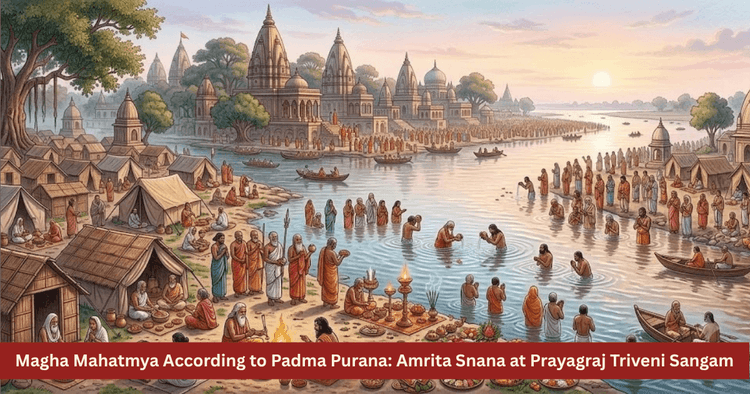
Table of Contents
Within the encyclopedic corpus of the eighteen classical Puranas, the Uttara Khanda of the Padma Purana serves as the foremost textual and metaphysical authority regarding sacred river confluences, seasonal austerities and the science of spiritual purification. In its Magha Mahatmya sections, the venerable sage Vedavyasa proclaims that at Prayagraj-the sovereign of all sacred pilgrim sanctuaries (Tirtharaja)-where the holy Ganga, the deep-blue Yamuna and the subterranean Saraswati unite, the entire celestial hierarchy of thirty-three crore deities, celestial bards, ascetics and the Seven Rishis reside in subtle, energetic form throughout the thirty days of Magha. When the Sun journeys through Capricorn during this sacred month, millions of seekers gather along the alluvial sands of the Triveni Sangam to construct simple thatched huts or canvas tents, undertaking a rigorous, month-long spiritual retreat known as 'Kalpavas'.
Kalpavas is neither a conventional camping retreat nor a routine religious custom; it is a systematic Vedic technology of physical purification, ego-deconstruction and metaphysical communion with the Supreme Consciousness. A practitioner of Kalpavas (Kalpavasi) bathes three times daily in the freezing waters of the Triveni, sleeps directly on the ground upon straw mats, consumes only a single self-cooked sattvic meal a day and strictly adheres to absolute truth in thought, word and deed. The Padma Purana affirms that this profound spiritual discipline burns away accumulated karmic dross across lifetimes, granting the embodied soul complete liberation from the cycle of birth and death. This article provides a comprehensive and authentic guide to the scriptural rules, astronomical dynamics, the 21 inviolable vows and the spiritual fruits of Kalpavas at Prayagraj.
| Kalpavas & Bathing Component | Scriptural Standard and Practice | Astrological & Metaphysical Influence |
|---|---|---|
| Sacred Timeframe | Pausha Purnima to Magha Purnima (One Full Month) | Merit equivalent to one cosmic 'Kalpa' (4.32 billion solar years) |
| Principal Confluence | Prayagraj Triveni Sangam (Ganga, Yamuna, Saraswati) | Harmonization of Ida, Pingala and Sushumna energy channels |
| Primary Bathing Hour | Arunodaya twilight (Brahma Muhurta before sunrise) | Direct charging of Ojas and the crown energy center (Sahasrara) |
| Dietary Discipline | Ekabhukta vrata (Single daily meal of Havishyanna) | Gut purification, metabolic reset and deep mental focus |
| Sleeping Protocol | Ground-sleeping (On kusha grass, straw or a plain blanket) | Balancing the root center (Muladhara) and dissolving bodily ego |
| Presiding Deities | Lord Madhava, Veni Madhava and Mother Ganga | Alleviation of deep-seated ancestral and karmic burdens |
| Code of Conduct | Strict observance of 21 vows, freedom from anger and lust | Total aura restoration and attainment of spiritual liberation |
Magha Mahatmya in Padma Purana: The Amrita Confluence of Prayag
In the dialogue between Sage Bhrigu and King Ayu recorded in the Uttara Khanda of the Padma Purana, the celestial sanctity of Prayag during Magha is expounded in glorious detail. Scriptural narratives recount that during the churning of the primordial ocean of milk (Samudra Manthana), celestial drops of the immortal nectar (Amrita) spilled from the golden vessel held by Lord Dhanvantari, sanctifying four terrestrial sanctuaries, with the Triveni Sangam of Prayagraj being the foremost. During Magha, as the Moon traverses Pushya and Magha constellations and the Sun moves northward in Uttarayana, an extraordinary gravitational and cosmic alignment charges the waters of the Triveni Sangam with subtle rejuvenation properties.
The Padma Purana highlights this profound truth in an immortal verse:
"Even contemplating a journey to Prayag or remembering the holy Ganga with a pure heart during Magha cleanses an individual of sins and unites them with Sri Hari; what then can be said of those who physically immerse themselves in its sanctified waters?"
The gentle river breezes sweeping across the exposed sands carry the subtle spiritual vibrations of countless saints and yogis, uplifting the minds of all who dwell upon the banks of the sacred confluence.
The Metaphysical and Etymological Meaning of Kalpavas
The term 'Kalpavas' is a compound of two foundational Sanskrit roots: 'Kalpa' and 'Vasa'. In classical cosmological chronology, a 'Kalpa' equals one full daytime cycle of Lord Brahma, encompassing 4.32 billion solar years. Traditional treatises state that observing a disciplined residence along the banks of Prayag for one month in Magha yields spiritual merit equivalent to dwelling in celestial realms for an entire cosmic Kalpa.
A second philosophical meaning interprets 'Kalpa' as rejuvenation, transformation or systemic recalibration (Kayakalpa). Just as a raw mineral is smelted in intense fire to yield pure, ductile gold, a seeker subjects their physical body, subtle breath and causal sheath to the austerities of cold river dips, fasting, sensory restraint and meditative silence along the exposed sands. This process purges deep psychological patterns, transforming the transient human vessel into an instrument of spiritual realization.
The 21 Inviolable Classical Vows of Kalpavas
The Padma Purana and the Matsya Purana delineate twenty-one mandatory vows that a Kalpavasi must observe without compromise:
- Unyielding Truthfulness (Satya): Complete avoidance of deceit, falsehood or exaggerated speech in all interactions.
- Non-Violence (Ahimsa): Causing no harm to any living entity through thought, speech or physical action.
- Sensory Restraint (Indriya Nigraha): Firm control over all ten sensory and motor organs.
- Universal Compassion (Sarvabhuta Daya): Active kindness toward the destitute, sick and vulnerable gathered at the confluence.
- Absolute Celibacy (Brahmacharya): Complete physical, verbal and mental celibacy throughout the entire month.
- Thrice-Daily Sacred Baths (Trikala Snana): Immersion in the Triveni waters at dawn, midday and twilight.
- Sleeping on the Ground (Bhoomi Shayana): Resting only upon straw, kusha grass mats or coarse blankets directly on the earth.
- Simple Renounced Attire: Wearing unstitched, plain white or soft yellow cotton fabrics, discarding ornaments.
- Natural Heating Only: Avoiding artificial warmers, relying solely on small dung-cake fires or natural sunlight.
- Single Daily Meal (Ekabhukta): Consuming food strictly once in a twenty-four-hour cycle, during the late afternoon.
- Havishyanna Diet: Eating only boiled, non-spiced grains (aged rice, barley, mung lentils, rock salt and sesame).
- Self-Cooked Meals (Svayampaki): Preparing one's own meal over natural fires without consuming food cooked by others.
- Daily Deva Puja: Dedicated worship of Lord Veni Madhava, Lord Vishnu and Mother Ganga using sacred offerings.
- Daily Scriptural Study and Satsanga: Mandatory daily attendance at discourses on the Srimad Bhagavatam or Ramayana.
- Tulsi Veneration: Installing and nurturing a sacred Tulsi plant outside the thatched hut, offering daily lamps.
- Hospitality to Monks and Guests: Ensuring no wandering ascetic or mendicant leaves the hut without food or shelter.
- Daily Charity (Dana): Distributing food grains, warm clothing, sesame or coins to the needy according to capacity.
- Ancestral Tarpana: Offering water, kusha grass and black sesame seeds daily to departed ancestors at noon.
- Freedom from Anger and Jealousy: Maintaining unshakeable patience, refusing to succumb to irritation or rivalry.
- Prohibition of Gossip and Slander: Strictly avoiding disparaging remarks about others, spiritual paths or ascetics.
- Continuous Chanting (Japa): Constant mental recitation of the sacred Dvadasakshara mantra (Om Namo Bhagavate Vasudevaya) or the Gayatri.
The Bio-Energetic Science of the Triveni Confluence
The convergence of the swift, mineral-rich Ganga, the deep, serene Yamuna and the subtle, subterranean Saraswati is far more than a geographic confluence. In yogic physiology, it mirrors the union of the body's three primary energetic pathways:
- The Yamuna River: Embodies the lunar channel (Ida Nadi), governing the mind, emotional balance and internal stillness.
- The Ganga River: Embodies the solar channel (Pingala Nadi), regulating metabolic fire, physical vitality and executive action.
- The Saraswati River: Embodies the central spiritual channel (Sushumna Nadi), unlocking higher wisdom and deep meditative awareness.
When a practitioner enters the icy water at 4:00 AM, the cold immersion causes rapid peripheral vasoconstriction, driving blood to internal organs, the cardiovascular core and cerebral pathways. Submerging the crown of the head three times stimulates the vagus nerve and aligns the central Sushumna nadi. Classical texts revere this as an 'Amrita Snana' because the interplay of dissolved Himalayan minerals, biological flora and specific angles of morning solar radiation recalibrates the bio-magnetic field (Aura) of the human frame.
Spiritual Fruits: Liberation from the Cycle of Rebirth
According to classical treatises, a seeker who completes the discipline of Kalpavas with devotion burns away millions of lifetimes of physical, verbal and mental transgressions:
- Bodily Transgressions: Misdeeds committed through physical impulses and sensory indulgence.
- Verbal Transgressions: Sins accrued through harsh speech, dishonesty, slander or malicious gossip.
- Mental Transgressions: Negative karma generated through envy, resentment, greed or covert hostility.
All such impressions dissolve just as a heap of dry forest leaves is reduced to ash by a spark of flame. Upon concluding the vows on Magha Purnima, practitioners distribute charitable gifts-including copper vessels filled with sesame, warm woolen shawls, bedding sets, footwear and the traditional gifting of kine (Godana)-to venerable teachers and ascetics. Through these austerities, the seeker attains physical health, unshakeable mental clarity and societal respect in this life, while securing an exalted passage to Vaikuntha upon departure from the physical body.
The Timeless Social and Cultural Message of Kalpavas
Kalpavas embodies the egalitarian and unified spirit of ancient Vedic culture. On the sandy banks of Prayag, kings and mendicants, wealthy industrialists and humble farmers live side by side in identical thatched huts, without distinction of caste, class or worldly status. Along the shores of the Triveni, there are no masters and no servants; all dwell as humble pilgrims at the feet of Lord Madhava.
This tradition conveys the enduring lesson that true peace is not found in excessive material accumulation but in simple living, strict self-restraint, harmony with natural elements and purity of heart. The sacred observance of Kalpavas during Magha offers a proven, time-tested spiritual pathway to transcend worldly illusions and establish an unbroken connection with the divine reality.
FAQ
What is the precise duration of Kalpavas?
Scripturally, the traditional Kalpavas commences with the pre-dawn bath on Pausha Purnima and concludes with the grand bath and charitable offerings on Magha Purnima. Some traditions calculate it from the Sun's ingress into Capricorn (Makar Sankranti) until its entry into Aquarius (Kumbha Sankranti).
Can householders undertake Kalpavas or is it exclusively for ascetics?
Kalpavas is primarily designed for householders. Ascetics live in renunciation year-round, whereas householders step away from domestic affairs for a single month to cleanse the body and mind through monastic simplicity. Married couples can observe Kalpavas together while maintaining strict celibacy.
What is the rule regarding the single daily meal (Ekabhukta)?
A Kalpavasi eats only once every twenty-four hours, typically in the late afternoon. The meal must be self-cooked over natural wood or dung fires, consisting of Havishyanna: boiled aged rice, barley, mung lentils, rock salt and pure cow ghee. Onions, garlic, mustard oil and heavy spices are strictly forbidden.
Can an individual observe Kalpavas at home if they cannot visit Prayagraj?
Yes. If travel is not feasible due to health or duties, one can observe a 'Mental Kalpavas' at home. This is done by waking before dawn, adding a few drops of consecrated Ganga water to the bath, sleeping on a firm floor mat, consuming a single sattvic meal daily and maintaining meditation and scriptural study for the entire month.
What charitable offerings are mandatory at the conclusion of Kalpavas?
On Magha Purnima, it is traditional to donate a copper vessel filled with sesame seeds, warm woolen blankets, footwear, traditional bedding and the symbolic donation of a milk cow (or equivalent charity) to worthy teachers or mendicants to bring the retreat to completion.
Get your accurate Kundali
Generate KundaliDid you like it?
Author
Pt. Suvrat Sharma (63)
Experience: 20
Consults About: Family Planning, Career
Clients In: Punjab, Haryana, Delhi
Share this article with friends and family
WELCOME TO
ZODIAQ
Right Decisions at the right time with ZODIAQ
