Why Is Ratha Saptami the Sun's Birthday?
By Pt. Nilesh Sharma
The 7 Horse Chariot, Achala Saptami and Good Health
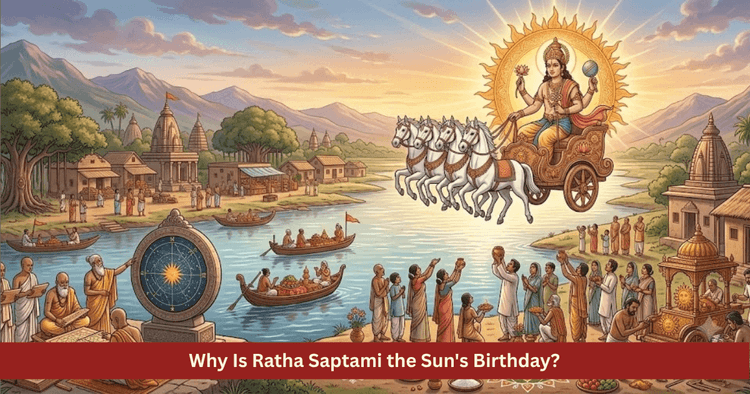
Table of Contents
Date, Sacred Bath and Essence of the Worship of Ratha Saptami
The Saptami tithi of the bright fortnight of Magha month is called Ratha Saptami. It is also known as Achala Saptami, Arogya Saptami, Surya Jayanti and Magha Saptami. If this tithi falls on a Sunday, it is also called Bhanu Saptami, which is regarded as even more auspicious. In the Gregorian calendar, this festival usually falls between late January and February. According to Puranic belief, it was on this sacred tithi that Lord Surya Narayana appeared, mounted on his divine chariot drawn by 7 horses.
| Element of the Festival | Details |
|---|---|
| Tithi | Magha Shukla Saptami |
| Other Names | Achala Saptami, Arogya Saptami, Surya Jayanti, Bhanu Saptami |
| Principal Deity | Lord Surya Narayana |
| Best Time to Bathe | Arunodaya, the time just before sunrise |
| Special Bath | Bathing with 7 leaves of the arka plant |
| Arghya Materials | Water, red sandalwood, rice grains and red flowers in a copper lota |
| Principal Recitations | The Aditya Hridaya Stotram and the 12 names of the Sun |
| Principal Donations | Jaggery, wheat, red cloth, copper and sesame |
| Expected Fruit | Health, long life, radiance and the removal of poverty |
The Basic Rules of This Day
- Rise before sunrise and bathe in a river or at home.
- Add a little Gangajal to the bathing water and, if possible, bathe with arka leaves.
- Offer arghya to the rising Sun from a copper lota.
- Recite the Aditya Hridaya Stotram or the 12 names of the Sun.
- Donate jaggery, wheat and red cloth according to your means.
The Appearance of Surya Dev and the Secret of His Chariot
According to Puranic tradition, Lord Surya is the son of sage Kashyapa and Mother Aditi. Being the son of Aditi, he is called Aditya. It is believed that on Magha Shukla Saptami, Surya Dev mounted his divine golden chariot and began to illuminate the whole world. This is why this day is called Surya Jayanti, the birthday of the Sun.
The description of the Sun's chariot is deeply symbolic. His chariot is said to have one wheel, which symbolises the wheel of time, ever turning. The chariot is drawn by 7 horses and the charioteer is Aruna, the symbol of the red glow of dawn.
| Part of the Chariot | Symbolism |
|---|---|
| One Wheel | The wheel of time, which turns without pause |
| 7 Horses | The 7 Vedic metres, the 7 days of the week and the 7 colours of light |
| Aruna the Charioteer | The red glow of dawn that comes before sunrise |
| Golden Chariot | Radiance, splendour and life force |
Tradition gives the names of the Sun's 7 horses after the 7 Vedic metres: Gayatri, Brihati, Ushnik, Jagati, Trishtubh, Anushtubh and Pankti. This beautiful connection shows that the light of the Sun and the speech of the Vedas are parts of one divine order. From a modern point of view too it is interesting that the white light of the Sun is made up of 7 colours, which can be seen in the rainbow.
It is believed that from Ratha Saptami the Sun drives his chariot towards the north at full speed. Uttarayana has already begun from Makar Sankranti and by Ratha Saptami the days clearly begin to lengthen, warmth returns to the sunshine and the arrival of spring begins to be felt.
The Story of Achala Saptami
The Bhavishya Purana contains a famous story about Achala Saptami. In ancient times there was a woman named Indumati who had not performed any religious act throughout her life. In old age she began to worry about her deeds. She went to sage Vasishtha and asked him for the path to liberation.
Sage Vasishtha advised her to observe the vow of Magha Shukla Saptami. He said that bathing at Arunodaya on this day and then worshipping Surya Dev and giving charity destroys the sins of a lifetime. Indumati observed this vow with faith. Through its power she attained peace and a noble destination. From that time this Saptami came to be called Achala Saptami, the Saptami whose merit remains unmoving and permanent.
The Story of Samba and the Blessing of Health
Another famous story of gaining health through Sun worship is linked with Samba, the son of Lord Shri Krishna. According to the Puranic story, Samba was afflicted with leprosy because of a curse. When the disease did not go away despite many remedies, he performed intense worship of Surya Dev on the bank of the Chandrabhaga river. Through the grace of Surya Dev, he was freed from the disease.
This is why the Sun is called the god of health and Ratha Saptami is called Arogya Saptami. In Odisha, near the Sun Temple of Konark, the famous Chandrabhaga Mela is held on Magha Shukla Saptami, where thousands of devotees bathe at dawn and worship the rising Sun. The Konark Sun Temple is itself built in the shape of the Sun's chariot, with huge stone wheels and horses.
The Complete Worship Method of Ratha Saptami
| Step | Method |
|---|---|
| Arunodaya Bath | Just before sunrise, bathe in a river or at home in water mixed with Gangajal |
| Arka Leaf Bath | If possible, place 7 arka leaves on the body and bathe |
| Clothing | After bathing, wear clean red or saffron clothes |
| Rangoli | Draw a rangoli of the Sun and his chariot with 7 horses in the courtyard or at the shrine |
| Arghya | Put water, red sandalwood, rice grains and a red flower in a copper lota and offer arghya to the rising Sun |
| Mantra | While offering arghya, chant Om Ghrini Suryaya Namah or Om Suryaya Namah |
| Lamp | Light a ghee lamp and perform the aarti of Surya Dev |
| Recitation | Recite the Aditya Hridaya Stotram |
| Bhog | Offer jaggery, kheer of wheat or rice and seasonal fruits |
| Charity | Donate jaggery, wheat, red cloth, a copper vessel and sesame |
The 12 Names of the Sun
In tradition, the 12 names of the Sun are chanted along with Surya Namaskar, the salutation to the Sun. Remembering these names on Ratha Saptami is considered highly auspicious.
| No. | Mantra |
|---|---|
| 1 | Om Mitraya Namah |
| 2 | Om Ravaye Namah |
| 3 | Om Suryaya Namah |
| 4 | Om Bhanave Namah |
| 5 | Om Khagaya Namah |
| 6 | Om Pushne Namah |
| 7 | Om Hiranyagarbhaya Namah |
| 8 | Om Marichaye Namah |
| 9 | Om Adityaya Namah |
| 10 | Om Savitre Namah |
| 11 | Om Arkaya Namah |
| 12 | Om Bhaskaraya Namah |
It is traditional to perform one Surya Namaskar with each name. Those who cannot perform Surya Namaskar can gain merit simply by chanting these names. Beginning a regular practice of Surya Namaskar from Ratha Saptami is also highly beneficial for health.
Ratha Saptami in Different Regions of India
- Tirumala: At Tirumala in Andhra Pradesh, Ratha Saptami is celebrated as a one day Brahmotsavam. On this day the festival image of Lord Venkateswara is taken in procession on 7 different vahanas or divine vehicles, from sunrise until night.
- Konark: In Odisha the Chandrabhaga Mela is held and the Sun is worshipped on the seashore at dawn.
- Maharashtra and Karnataka: A rangoli of the Sun's chariot is drawn in the courtyard and milk is allowed to boil over while facing the Sun, which is regarded as a symbol of prosperity.
- North India: The tradition is to bathe in sacred rivers, offer arghya to the Sun and give charity.
Ratha Saptami Through the Lens of Vedic Astrology
In Vedic astrology, the Sun is called the king of the planets. He signifies the soul, the father, health, bones, eyes, honour, government work and leadership. People whose horoscope has a weak or debilitated Sun or a Sun afflicted by Rahu or Saturn, may experience a lack of confidence, differences with the father, eye troubles, weak bones and obstacles in government work.
The lord of the Saptami tithi is regarded as the Sun himself and in Magha month the Sun is on the auspicious northern journey of Uttarayana. So Ratha Saptami is regarded as the finest day of the year for remedies related to the Sun.
| Concern | Astrological Indication | Remedy on Ratha Saptami |
|---|---|---|
| Lack of confidence | Weak Sun | Arunodaya bath and arghya to the rising Sun |
| Eye troubles | Afflicted Sun or 2nd house | Recitation of the Chakshushopanishad or the 12 names of the Sun |
| Differences with the father | Afflicted 9th house or Sun | The father's blessings and donation of jaggery |
| Obstacles in government work | Weak Sun in the 10th house | Recitation of the Aditya Hridaya Stotram |
| Skin ailments | Imbalance between the Sun and Saturn | Arka leaf bath and Sun worship |
The Link Between Health and Ayurveda
The time of Ratha Saptami is also very important from the point of view of health. At the end of winter, when the rays of the Sun begin to grow strong again, morning sunlight is highly beneficial for the body. Modern science also holds that morning sunlight helps the body produce vitamin D, which is essential for the bones and for immunity.
The Bhavishya Purana and other texts say that Sun worship performed on this day destroys eye diseases, skin diseases and poverty. While embracing these beliefs with faith, one should also remember that serious illness requires the advice and treatment of a qualified doctor. Sun worship is not a substitute for treatment but a supporting path that gives strength to mind and body.
What Should Be Done and Avoided on Ratha Saptami?
| Do | Do Not |
|---|---|
| Bathe before sunrise | Do not sleep past sunrise |
| Offer arghya to the rising Sun | Do not stare directly at the Sun in strong sunlight |
| Recite the Aditya Hridaya Stotram | Avoid anger and pride on this day |
| Donate jaggery, wheat and red cloth | Do not eat meat, alcohol or tamasic food |
| Begin the practice of Surya Namaskar | Do not disrespect your father and elders |
The Light of New Life Riding on 7 Horses
Ratha Saptami is the day when the journey of light reaches its full speed. The chariot of Surya Dev moves across the sky every day without stopping and without tiring and gives life to all of creation. It neither discriminates against anyone nor asks for anything in return. This is the greatest ideal of selfless service.
For the person who bathes at dawn on this day, offers arghya to the rising Sun and resolves to hold its radiance within, a new light of health, inner strength and enthusiasm enters life. The Sun teaches that after every dark night the morning is certain and every morning is a new beginning.
FAQ
When is Ratha Saptami celebrated? Ratha Saptami is celebrated on the Saptami tithi of the bright fortnight of Magha month. In the Gregorian calendar it usually falls between late January and February.
Why is Ratha Saptami called Surya Jayanti? According to Puranic belief, on this day Lord Surya appeared on his divine chariot drawn by 7 horses and began to illuminate the world, so it is called Surya Jayanti.
When should one bathe on Ratha Saptami? Bathing at Arunodaya, the time just before sunrise, is considered most auspicious on Ratha Saptami. If possible, bathe with 7 arka leaves.
What does Achala Saptami mean? Achala means that which is unmoving and permanent. It is believed that the merit of the bath, worship and charity on this Saptami remains permanent, so it is called Achala Saptami.
What should be donated on Ratha Saptami? Donating jaggery, wheat, red cloth, a copper vessel and sesame on Ratha Saptami is considered auspicious. It brings the grace of the Sun and good health.
Get your accurate Kundali
Generate KundaliDid you like it?
Author

Pt. Nilesh Sharma (63)
Experience: 20
Consults About: Family Planning, Career
Clients In: Punjab, Haryana, Delhi
Share this article with friends and family
WELCOME TO
ZODIAQ
Right Decisions at the right time with ZODIAQ
