Why Is Sakat Chauth So Sacred?
By Pt. Amitabh Sharma
Child Protection, Ganesha, Tilkut and the Moon Arghya
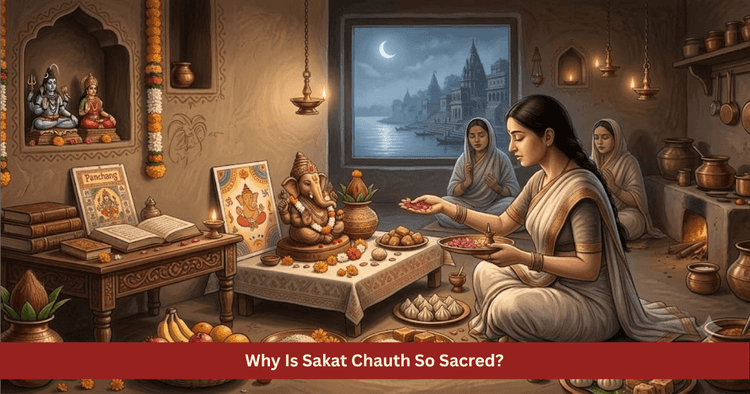
Table of Contents
Date, Rules and Essence of the Sakat Chauth Fast
The Chaturthi tithi of the dark fortnight of Magha month is observed with deep devotion across North and Central India as Sakat Chauth. It is also known as Tilkuta Chauth, Tilkut Chaturthi and Maghi Sankashti Chaturthi. In the Purnimant Panchang this tithi is called Magha Krishna Chaturthi, while in the Amant Panchang it is counted as Paush Krishna Chaturthi. The tithi is the same. Only the naming of the month differs. In the Gregorian calendar, this fast usually falls in January.
This fast is kept mainly by mothers for the long life, good health and protection of their children from the dangers of life. After a waterless fast through the day, Lord Ganesha is worshipped in the evening and at night, after moonrise, the fast is completed by offering arghya, a water oblation, to the Moon.
| Element of the Fast | Details |
|---|---|
| Tithi | Magha Krishna Chaturthi or Paush Krishna Chaturthi in the Amant system |
| Principal Deity | Lord Shri Ganesha and, in folk tradition, Sakat Mata |
| Who Observes It | Mainly mothers, for the protection and long life of their children |
| Nature of the Fast | Waterless or on fruits, from sunrise to moonrise |
| Principal Bhog | Tilkut made of sesame and jaggery, sweet potato and seasonal fruits |
| Principal Recitations | The Sakat Chauth Vrat Katha and the Sankatnashan Ganesh Stotra |
| Completion of the Fast | Breaking the fast after offering arghya to the Moon at moonrise |
| Arghya Materials | Water, raw milk, rice grains, sesame, flowers and durva grass |
The Basic Rules of the Fast in Brief
- After the morning bath, take the resolve of the fast before Lord Ganesha for the protection of your children.
- Keep a waterless fast through the day or follow a fruit diet according to your health.
- In the evening, worship Ganesha, offer tilkut as bhog and listen to the vrat katha.
- When the Moon rises, offer arghya to the Moon and then break the fast by taking the prasad.
- On this day, stay completely away from quarrels, harsh words and tamasic food at home.
The Message of Freedom from Crisis Hidden in the Word Sakat
The word Sakat is regarded as the folk form of sankat, meaning crisis. The very spirit of this fast is the destruction of crises. The word Sankashti carries the same meaning, the tithi that carries a person across suffering. Lord Ganesha is called Vighnaharta, the remover of obstacles and Sankatmochan, the one who frees from crisis. He is the first deity worshipped at the start of any work. When a mother fasts on this day for her child, she is in truth praying to the remover of obstacles that every hurdle be cleared from the path of her child's life.
A Sankashti Chaturthi fast is kept on the Krishna Chaturthi of every month but the Sankashti of Magha month is considered the most important of all the Sankashtis in the year. One reason for this is the season. In the bitter cold of Magha, the health of children faces the greatest risk. In ancient society, this was the time when disease and scarcity were both at their height. At such a time, a mother's prayer, her fast and the prasad of nourishing foods like sesame and jaggery together gave the family both spiritual and physical protection.
In the folk tradition of North India, Sakat Mata is also worshipped on this day. In many homes, an image of Sakat Mata is drawn on the wall or on paper and worshipped. Sakat Mata is regarded as a folk goddess who removes crises and she is remembered along with the worship of Ganesha. This is a fine example of the harmony between scriptural and folk tradition.
What Does the Story of the Potter's Kiln Teach?
The most famous folk tale of Sakat Chauth is linked with a potter and an elderly mother. According to the story, a potter lived in a certain town. Once he set up his kiln to fire pots but however hard he tried, the pots would not bake. In distress, he went to the king. The king asked the royal priest for a remedy. The priest said that each time the kiln was lit, a child would have to be sacrificed. The king ordered that every family in the town would give a child in turn.
After some time, the turn came of an elderly mother who had only one son. By chance, that day was Sakat Chauth. The mother's heart was filled with grief but she did not lose patience. She gave her son a betel nut and a bundle of durva grass blessed for Sakat and told him to keep remembering Sakat Mata while sitting in the kiln. She herself fasted the whole day and kept worshipping Sakat Mata and Ganesha.
The next morning, when the potter opened the kiln, he was astonished. The pots were fully baked and the boy was sitting there safe. Not only that, the children who had been sacrificed earlier were also found alive in the kiln. The news spread through the whole town. The king honoured the mother and from that time the tradition of keeping the Sakat Chauth fast for the protection of children began.
The message of this story is deep. However great a crisis may be, a prayer offered with faith and patience gives the strength to overcome it. The story also shows that the faith of one mother can become the cause of protection not only for her own child but for the whole of society.
The Connection Between Ganesha and the Moon
In the Sankashti Chaturthi fast, offering arghya to the Moon is essential. Behind this lies a beautiful Puranic episode. According to the story, the Moon once mocked Ganesha on seeing his elephant face and large belly. Angered by this, Ganesha cursed the Moon that whoever looked at him would suffer a false accusation. When the Moon begged forgiveness, Ganesha limited the curse. This is why seeing the Moon is considered prohibited on Bhadrapada Shukla Chaturthi.
But on Sankashti Chaturthi, the situation is exactly the reverse. On this day, the fast is not complete without seeing the Moon and offering arghya. There is also a belief that Ganesha placed the Moon on his forehead, which is why one of his names is Bhalachandra, the one who wears the Moon on his brow. The rising Moon on the night of Sankashti is regarded as a symbol of Ganesha's grace. This is why, in the arghya mantra, the Moon is addressed as a reflection of Ganesha.
The Complete Worship Method of Sakat Chauth
| Step | Method |
|---|---|
| Morning Resolve | After bathing, hold water, rice grains and a flower before Ganesha and take the resolve of the fast for the protection of your children |
| Preparation for Worship | Before evening, place a wooden seat at the shrine and install an idol or picture of Ganesha |
| Worship of Sakat Mata | According to folk tradition, draw an image of Sakat Mata and worship her with roli and rice grains |
| Worship of Ganesha | Offer roli, rice grains, durva, red flowers, a sacred thread and a betel nut to Ganesha |
| Bhog | Offer tilkut, sweet potato, jaggery, seasonal fruits and laddoos |
| Story and Recitation | Listen to the Sakat Chauth Vrat Katha and recite the Sankatnashan Ganesh Stotra |
| Aarti | Perform the aarti of Ganesha with a ghee lamp |
| Moon Arghya | Offer arghya to the Moon after moonrise |
| Parana | After the arghya, break the fast by taking tilkut prasad |
The Tradition of Tilkut and the Tilkut Goat
The chief bhog of this fast is tilkut. To make tilkut, roasted sesame and jaggery are pounded together. This is how the day came to be called Tilkuta Chauth. Sesame is associated with Shani Dev and jaggery with Surya Dev. In Magha month the Sun is in Makara, the sign of Saturn, so this union of sesame and jaggery is also highly fitting from an astrological point of view.
In some regions, the shape of a goat is made from tilkut. After the worship, a child of the house or a family member symbolically cuts this shape and it is then distributed as prasad. This custom is seen as a sattvic alternative to animal sacrifice, in which sweetness and prasad take the place of violence. Along with tilkut, offering sweet potato is also a special custom of this day, because sweet potato is a crop of this very season.
Reciting the Sankatnashan Ganesh Stotra
The Sankatnashan Ganesh Stotra is believed to come from the Narada Purana. It begins with this verse: "Pranamya shirasa devam Gauriputram Vinayakam." Its meaning is that, bowing the head to Vinayaka, the son of Gauri, the devotee should remember him daily for the fulfilment of long life, wishes and wealth. This stotra gives 12 names of Lord Ganesha and reciting them is regarded as highly effective for removing crises.
| No. | Name | Meaning |
|---|---|---|
| 1 | Vakratunda | The one with the curved trunk |
| 2 | Ekadanta | The one with a single tusk |
| 3 | Krishnapingaksha | The one with dark and tawny eyes |
| 4 | Gajavaktra | The one with the face of an elephant |
| 5 | Lambodara | The one with the large belly |
| 6 | Vikata | The one of vast and wondrous form |
| 7 | Vighnaraja | The lord of obstacles |
| 8 | Dhumravarna | The one of smoky colour |
| 9 | Bhalachandra | The one who wears the Moon on his forehead |
| 10 | Vinayaka | The supreme leader |
| 11 | Ganapati | The lord of the Ganas |
| 12 | Gajanana | The elephant faced one |
The phalashruti, the stated fruit of the stotra, says that a person who recites these 12 names at morning, noon and evening has no fear of any obstacle. The student gains learning, the one who seeks wealth gains wealth and the one who seeks children is blessed with children. On Sakat Chauth, reciting this stotra at least 3 times during the evening worship is considered auspicious.
The Exact Rules for Offering Arghya to the Moon
Moon arghya is the most important step of this fast. It should therefore be performed with full care and devotion.
- Time of moonrise: Always check the moonrise time in the local Panchang of your city, because it differs from place to place.
- Materials for arghya: Place water, a little raw milk, rice grains, white sesame, white flowers and durva in a lota.
- Direction and posture: Stand facing the Moon, lift the lota with both hands and pour a slow stream of water.
- The arghya mantra: Recite "Gaganarnavamanikya Chandra Dakshayanipate, grihanarghyam maya dattam Ganeshapratirupaka," meaning "O Moon, jewel of the ocean of the sky and consort of the daughters of Daksha, reflection of Ganesha, accept this arghya offered by the devotee." For simplicity, one may chant Om Somaya Namah.
- If it is cloudy: If the sky is cloudy and the Moon is not visible, offering arghya in the direction of the Moon at the moonrise time given in the Panchang is accepted.
- Circumambulation: After the arghya, turn around 3 times where you stand and pray for the happiness of your children.
- Care with the water: To keep the arghya water from falling on your feet, place a vessel beneath or offer the arghya near a bed of plants.
How Should the Fast Be Broken?
After offering arghya, bow to Ganesha and first take the tilkut prasad. After this, the fast is broken with sattvic food. In many families, even after breaking the fast, grain is not eaten that night and only fruits, sweet potato and sweets are taken. This depends on local tradition.
A waterless fast is a difficult austerity. Pregnant women, the sick and elderly mothers should keep the fast with fruits or water, keeping their health in mind. The scriptures regard sincere feeling as supreme and a fast kept by causing harm to the body never pleases the deity.
Sakat Chauth Through the Lens of Vedic Astrology
In Vedic astrology, Lord Ganesha is regarded as the lord of the Chaturthi tithi. The Moon signifies the mind and the mother and the 5th house of the horoscope is linked with children. The arghya offered to the Moon by a mother on Sakat Chauth creates a spiritual bridge between motherhood, the mind and children. In astrological tradition, Ganesha is also regarded as the deity who pacifies the adverse influence of Ketu.
| Concern | Astrological Indication | Remedy on Sakat Chauth |
|---|---|---|
| Worry about a child's health | Afflicted 5th house or its lord | Waterless fast, Ganesha worship and Moon arghya |
| Mental restlessness | Afflicted Moon | Moon arghya and japa of Om Somaya Namah |
| Repeated obstacles in work | Adverse influence of Ketu | Reciting the Sankatnashan Ganesh Stotra 3 times |
| Troubles linked with Saturn | The Sun in Makara under Saturn's influence | Donation of sesame and jaggery |
| Lack of focus in studies | Weak Mercury or 5th house | Offering 21 blades of durva to Ganesha |
What Should Be Done and Avoided on Sakat Chauth?
| Do | Do Not |
|---|---|
| Keep the fast with a resolve for the welfare of your children | Do not indulge in anger or quarrels on the day of the fast |
| Offer durva and tilkut to Ganesha | Do not offer tulsi leaves in Ganesha worship |
| Check the moonrise time in the local Panchang | Do not break the fast before the Moon arghya |
| Donate sesame, jaggery and warm clothes | Stay away from tamasic food and alcohol |
| Choose the rule of the fast according to your health | Do not insist on a waterless fast when unwell |
The custom of not offering tulsi leaves in Ganesha worship is linked with a Puranic story in which Tulsi and Ganesha are said to have cursed each other. For this reason, durva is regarded as the finest offering in the worship of Ganesha.
The Tilkut of a Mother's Love and the Shelter of Ganapati
Sakat Chauth is not merely a fast but a celebration of motherhood. When a mother stays without water through a bitterly cold day and waits for the Moon at night, her entire love is contained in that waiting. The sweetness of tilkut is the taste of that love and the grace of Ganesha is its blessing.
This fast teaches that crises are part of life but they can be overcome through faith, patience and service. The boy who came out of the potter's kiln unharmed is a symbol of the belief that wherever a mother prays, the remover of obstacles Himself stands guard.
FAQ
When is Sakat Chauth celebrated? Sakat Chauth is celebrated on the Chaturthi tithi of the dark fortnight of Magha month. In the Amant Panchang it is called Paush Krishna Chaturthi and it usually falls in January.
How should arghya be offered to the Moon on Sakat Chauth? After moonrise, place water, raw milk, rice grains, sesame, white flowers and durva in a lota, face the Moon, pour slowly and chant Om Somaya Namah.
Why is tilkut offered as bhog on Sakat Chauth? Tilkut is made by pounding sesame and jaggery together. It is nourishing in the cold of Magha and in astrology sesame is linked with Saturn and jaggery with the Sun.
What is the story of Sakat Chauth? According to the folk tale, the only son of an elderly mother was placed in a potter's kiln. Through the power of the mother's Sakat fast, the boy came out safe and the fast became popular from that time.
Can the Sakat Chauth fast be kept with fruits? Yes. Pregnant women, the sick and elderly mothers may keep this fast with fruits or water according to their health, because sincere feeling is what matters most in a fast.
Get your accurate Kundali
Generate KundaliDid you like it?
Author
Pt. Amitabh Sharma (56 Years)
Experience: 20
Consults About: Family Planning, Career
Clients In: Punjab, Haryana, Delhi
Share this article with friends and family
WELCOME TO
ZODIAQ
Right Decisions at the right time with ZODIAQ
