Why Is Sesame Sacred on Shattila Ekadashi?
By Pt. Narendra Sharma
6 Sacred Uses of Sesame and Relief from Saturn
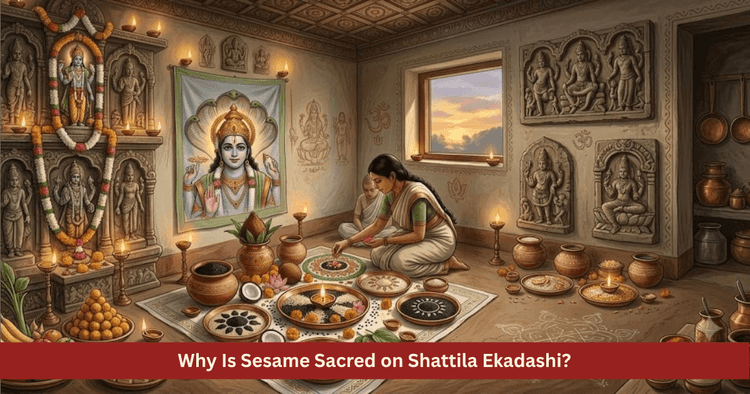
Table of Contents
Date, Fast and the 6 Uses of Sesame on Shattila Ekadashi
The Ekadashi of the dark fortnight of Magha month is called Shattila Ekadashi. In the Purnimant Panchang it is Magha Krishna Ekadashi, while in the Amant Panchang it is counted as Paush Krishna Ekadashi. In the Gregorian calendar this fast usually falls in January. Shat means 6 and tila means sesame. The greatest speciality of this Ekadashi is that sesame is used in 6 special ways on this day and it is because of these 6 uses that it is called Shattila.
| Element of the Fast | Details |
|---|---|
| Tithi | Magha Krishna Ekadashi or Paush Krishna Ekadashi in the Amant system |
| Principal Deity | Lord Vishnu |
| Main Substance | Black and white sesame |
| Nature of the Fast | Without food, on fruits or one sattvic meal |
| Prohibited | Rice, tamasic food and alcohol |
| Principal Donations | Sesame, a vessel filled with sesame, jaggery, blankets and grain |
| Parana | On Dwadashi, at the auspicious time after sunrise |
The 6 Uses of Sesame at a Glance
A well known verse of the scriptural tradition says that the one who bathes with sesame, applies a sesame paste, offers sesame into the sacred fire, offers sesame water, eats sesame and donates sesame performs 6 uses of sesame that destroy sin.
| No. | Use | Method |
|---|---|---|
| 1 | Sesame Bath | Add a few black sesame seeds to the bathing water |
| 2 | Sesame Paste | Grind sesame and apply it to the body as ubtan |
| 3 | Sesame Homa | Offer oblations of sesame and ghee in the name of Lord Vishnu |
| 4 | Tilodaka | Offer sesame water as tarpan to the ancestors or drink it |
| 5 | Sesame Food | Eat sesame preparations according to the rules of the fast |
| 6 | Sesame Charity | Donate sesame, sesame laddoos or a vessel filled with sesame |
Why Is Shattila Ekadashi Considered So Meritorious?
There are 24 Ekadashis in a year and 26 when there is an Adhik Maas, the extra lunar month. Every Ekadashi has its own significance but Shattila Ekadashi could be called the Ekadashi of charity. This fast teaches that fasting and worship become complete only when the spirit of giving is joined to them. Magha is itself the month of charity and the donation of sesame on the first Ekadashi of this month gathers the spirit of the entire month into one point.
The scriptures regard sesame as extremely sacred. According to one Puranic belief, sesame arose from the body of Lord Vishnu. This is why sesame is used in ancestral rites, in the worship of the gods and in the homa. Black sesame is considered especially dear to the ancestors, while white sesame is used more in the worship of the gods. Both may be used on Shattila Ekadashi.
The principal spiritual fruits of this fast are described as follows.
- Cleansing of sin: The 6 uses of sesame symbolise purification at the levels of body, mind and action.
- Gain of food and wealth: According to the vrat katha, the home of one who donates sesame never runs short of food.
- Satisfaction of the ancestors: Tarpan offered with sesame water brings peace to the forefathers.
- Removal of poverty: The spirit of giving removes narrowness of mind and opens the doors of prosperity.
- The path of liberation: The Ekadashi fast strengthens devotion to Vishnu and leads towards liberation.
The Story of the Brahmin Woman and the Secret of Charity
The story of Shattila Ekadashi narrated in the Padma Purana is deeply instructive. In ancient times there lived a Brahmin woman who was a great devotee of Lord Vishnu. She kept vows and fasts regularly and so her body had become pure but she had never donated food to anyone. Lord Vishnu thought that this devotee had purified her body through austerity but without the charity of food she would find no satisfaction in the next world.
To test her, the Lord took the form of a mendicant, came to her door and asked for alms. Instead of giving food, the Brahmin woman dropped a lump of clay into his begging bowl. The Lord took it and went away. Some time later, when the Brahmin woman left her body and reached heaven, she received a beautiful house. But the house was completely empty. There was no grain, no wealth and nothing that gives comfort. There was only a mango tree.
In sorrow, she asked the Lord the reason. The Lord reminded her of the lump of clay and told her that she had received exactly what she had given. Then the Lord told her a remedy. When the celestial women came to meet her, she should ask them for the merit of the Shattila Ekadashi fast. The Brahmin woman did so and observed the Shattila Ekadashi fast according to the rules. Through the power of this fast, her house was filled with grain, wealth and every comfort.
The message of this story is clear. Purifying only one's own body and mind is not enough. Until compassion and giving towards others are joined to spiritual practice, it remains incomplete. What a person gives is what returns to them. The one who gave clay received the emptiness of clay and the one who gave sesame received a full house.
The Complete Method of the Shattila Ekadashi Fast
The Ekadashi fast begins from the evening of the Dashami tithi. On the night of Dashami, eat a sattvic and light meal and keep the resolve of the next day's fast in your mind.
| Time | Observance |
|---|---|
| Dashami Evening | Sattvic food, celibacy and the resolve of the fast in the mind |
| Ekadashi Morning | Bath with sesame water and application of sesame paste |
| Worship | Offer yellow flowers, tulsi leaves, incense, a lamp and naivedya made of sesame to Lord Vishnu |
| Homa | Offer 108 oblations of sesame, ghee and barley with the mantra Om Namo Bhagavate Vasudevaya |
| Tarpan | Offer tarpan to the ancestors with sesame water |
| Charity | Donate sesame, jaggery, blankets, footwear and grain |
| Through the Day | Recitation of the Vishnu Sahasranama, bhajans and listening to the katha |
| Night | Keep vigil if possible and remember the name of the Lord |
| Dwadashi | Feed a Brahmin or a needy person and break the fast at the auspicious time |
List of Worship Materials
- Black and white sesame
- An idol, picture or Shaligram of Lord Vishnu
- Yellow flowers, tulsi leaves and sandalwood paste
- A ghee lamp, incense and camphor
- Sacred wood, ghee and barley for the homa
- Sesame laddoos and seasonal fruits for naivedya
- A vessel filled with sesame, jaggery and warm clothes for donation
Rules of Parana
The Ekadashi fast should be broken only during the Dwadashi tithi. The first part of Dwadashi is called Hari Vasar and according to tradition the fast is not broken during this time. Break the fast only after checking the parana time given in the local Panchang. Feeding a needy person or donating grain before parana is considered auspicious. Taking some sesame preparation at parana is also in keeping with the tradition of this fast.
Sesame, Saturn and Rahu in Vedic Astrology
In Vedic astrology, sesame is regarded as the favourite substance of Shani Dev. Donating black sesame, lighting a sesame oil lamp and offering sesame oil are the most common remedies for Saturn. Black sesame is also connected with Rahu and sesame is used in remedies for the pacification of Rahu and Ketu as well.
In Magha month, the Sun is in Makara, the sign of Saturn. So from an astrological point of view, this entire month is regarded as a time to balance the relationship between Saturn and the Sun. The 6 uses of sesame on Shattila Ekadashi are regarded as a classical and sattvic way of easing troubles linked with Saturn. It is believed that this day is especially favourable for a person going through Saturn's Sade Sati or Dhaiya.
It is important to remember that no remedy works an instant miracle. Remedies steady the mind, give the right direction to action and, when practised with patience, gradually bring positive change to life. Saturn is itself the planet of patience, discipline and service, so its grace too is gained through these very qualities.
| Astrological Condition | Remedy on Shattila Ekadashi |
|---|---|
| Saturn's Sade Sati or Dhaiya | Donating black sesame and lighting a sesame oil lamp in the evening |
| Adverse influence of Rahu | Donating black sesame and blankets |
| Pitru Dosha | Tarpan to the ancestors with sesame water |
| Financial crisis | Donating a vessel filled with sesame and grain |
| Health concerns | Sesame paste and sesame homa |
| Mental restlessness | Reciting the Vishnu Sahasranama and keeping night vigil |
The Scientific and Social Side of Sesame Charity
Magha month falls in Shishira Ritu, the late winter season, when cold and dry winds affect the skin and joints the most. Sesame is rich in natural oil, calcium, iron, magnesium and protein. A sesame paste protects the skin from dryness. Sesame preparations give warmth and energy to the body. The tradition of the sesame bath and sesame paste is in truth a beautiful Ayurvedic way of protecting the body in winter.
The social side of sesame charity is equally important. In ancient society, during the bitter cold of Magha, it was difficult for the poor to find nourishing and warming food. The donation of sesame and jaggery gave them the strength to fight the cold. In this way, Shattila Ekadashi is a fast that joins religion, health and social service together.
What Should Be Done and Avoided on Shattila Ekadashi?
| Do | Do Not |
|---|---|
| Perform the 6 uses of sesame with faith | Do not eat rice on Ekadashi |
| Offer tulsi leaves to Lord Vishnu | Do not pluck tulsi leaves on Ekadashi |
| Give sesame, grain and warm clothes to the needy | Do not donate spoiled or useless items |
| Remember the name of the Lord through the day | Avoid criticism, lies and anger |
| Check the parana time in the local Panchang | Do not break the fast during Hari Vasar |
Plucking tulsi leaves is prohibited on Ekadashi, so tulsi leaves for worship should be plucked on Dashami and kept aside. While donating, one should make sure that the item given is useful and of good quality. The story of the Brahmin woman itself shows how charity given with neglect brings the opposite result.
An Ocean of Merit Within a Single Sesame Seed
A sesame seed looks very small but it holds within it a whole store of oil, nourishment and warmth. Shattila Ekadashi teaches exactly this, that even a small gift, when given with a sincere heart, can bring great change to life. This fast reminds a person that their home is filled in the same measure as they help to fill the homes of others.
For the seeker who bathes with sesame on this day, offers sesame into the sacred fire, gives sesame water to the ancestors and, above all, donates sesame with faith, this Ekadashi does not remain merely a fast. It becomes a sadhana of compassion, purity and devotion that brings light to both this world and the next.
FAQ
When does Shattila Ekadashi fall? Shattila Ekadashi falls on the Ekadashi of the dark fortnight of Magha month. In the Amant Panchang it is called Paush Krishna Ekadashi and it usually falls in January.
What are the 6 uses of sesame on Shattila Ekadashi? A sesame bath, sesame paste, a sesame homa, sesame water offered as tarpan or taken as a drink, eating sesame and donating sesame are the 6 uses on this Ekadashi.
What is the vrat katha of Shattila Ekadashi? According to the Padma Purana, a Brahmin woman gave clay to the Lord who came as a mendicant and so she received an empty house in heaven. Through the Shattila Ekadashi fast, her house was filled with grain and wealth.
Can remedies for Saturn be performed on Shattila Ekadashi? Yes. Sesame is the favourite substance of Saturn. Donating black sesame and lighting a sesame oil lamp on this day are believed to ease troubles linked with Saturn.
When should the Shattila Ekadashi fast be broken? The fast should be broken during the Dwadashi tithi at the auspicious time given in the local Panchang. It is not broken during Hari Vasar, the first part of Dwadashi.
Get your accurate Kundali
Generate KundaliDid you like it?
Author
Pt. Narendra Sharma (63)
Experience: 20
Consults About: Family Planning, Career
Clients In: Punjab, Haryana, Delhi
Share this article with friends and family
WELCOME TO
ZODIAQ
Right Decisions at the right time with ZODIAQ
