Why Is Shiva Worship Essential in Magha?
By Pt. Amitabh Sharma
Rudrabhishek, Mahamrityunjaya Japa and Bilva Leaf Rules
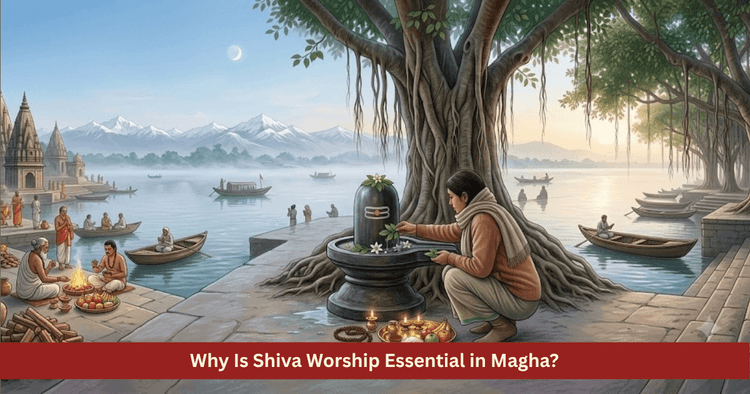
Table of Contents
The Worship of Shiva in Magha Month at a Glance
Although Magha month is regarded mainly as the month of Lord Vishnu and Surya Dev, tradition says that the month is incomplete without the worship of Lord Shiva. One astrological reason is that in Magha month the Sun moves from Makara (Capricorn) towards Kumbha (Aquarius) and both these signs belong to Shani Dev, whom tradition regards as a great devotee of Lord Shiva. On the Mondays and Pradosh days of Magha month, performing Rudrabhishek, the sacred bathing of the Shiva Linga, with water mixed with sesame is regarded as especially fruitful.
| Element of Worship | Details |
|---|---|
| Best Days | The Mondays, Pradosh fasts and monthly Shivaratri of Magha month |
| Vessel for Abhishek | A copper or silver lota |
| Materials for Abhishek | Gangajal, black sesame, a little raw milk and honey |
| Principal Offerings | Bilva leaves, datura, arka flowers, sacred ash and sandalwood |
| Main Mantras | Om Namah Shivaya and the Mahamrityunjaya Mantra |
| Special Ritual | 1.25 lakh japa of the Mahamrityunjaya Mantra |
| Astrological Link | The Sun's transit through the signs of Saturn |
| Expected Fruit | Health, fearlessness, peace of mind and fewer troubles from Saturn |
The Basic Rules of Shiva Worship
- Bathe in the morning, wear clean clothes and offer water to the Shiva Linga.
- Mix black sesame, a little raw milk and honey into the water for abhishek.
- Perform the abhishek slowly while chanting Om Namah Shivaya.
- Keep the rules in mind while offering bilva leaves.
- After worship, go half way around the Shiva Linga and do not step over the water channel.
The Link Between Magha Month and Lord Shiva
In Magha month the Sun moves first through Makara and then, after Kumbh Sankranti, through Kumbha. Both these signs belong to Shani Dev. Tradition holds that Shani Dev attained the position of the god of justice and giver of the fruits of karma through intense penance to Lord Shiva. So Saturn is regarded as a great devotee of Shiva and the worship of Shiva is called the most effective path to freedom from the troubles of Saturn.
Another important fact is that according to the Amant Panchang, Maha Shivaratri falls on Magha Krishna Chaturdashi. In the Purnimant Panchang the same tithi is called Phalguna Krishna Chaturdashi. The tithi is the same. Only the naming of the month differs. In this way the last part of Magha month is also a time of preparation for Shivaratri.
The cold of Magha month is also linked with the worship of Shiva. Lord Shiva dwells on Mount Kailash in the Himalayas. He is the deity of cold and of austerity. Offering water to the Shiva Linga in the bitter cold is regarded as a symbol of austerity and surrender.
The Method of Rudrabhishek with Water Mixed with Sesame
Rudrabhishek means the sacred bathing of the Rudra form of Lord Shiva. It is one of the most powerful methods of Shiva worship. In Magha month, adding black sesame to the water of the abhishek is regarded as especially auspicious, because sesame is dear to Saturn and the influence of Saturn's signs prevails in this month.
| Step | Method |
|---|---|
| Preparation | Take pure water mixed with Gangajal in a copper or silver lota |
| Adding Materials | Mix a few black sesame seeds, a little raw milk and a few drops of honey into the water |
| Sankalpa | Take a resolve for health, peace and freedom from troubles |
| Remembering Ganesha | Remember Lord Ganesha before the worship |
| Abhishek | Slowly bathe the Linga while chanting Om Namah Shivaya or Rudra mantras |
| Pure Water | Finally, bathe the Linga with pure water |
| Adornment | Offer sandalwood paste, sacred ash and rice grains |
| Bilva Leaves | Offer bilva leaves according to the rules |
| Incense and Lamp | Light incense and a ghee lamp and perform aarti |
| Circumambulation | Go half way around the Shiva Linga |
In the elaborate Rudrabhishek, the Rudrashtadhyayi of the Shukla Yajurveda is recited. This is performed by a qualified priest. Householders can themselves perform a simple abhishek with the mantra Om Namah Shivaya, which is regarded as equally fruitful when done with faith.
The Importance of the Mahamrityunjaya Mantra
The Mahamrityunjaya Mantra is a mantra of the Rigveda and is called the mantra that grants victory over death.
"Om Tryambakam Yajamahe Sugandhim Pushtivardhanam, Urvarukamiva Bandhanan Mrityor Mukshiya Maamritat."
The meaning of this mantra is that the seeker worships the 3 eyed Lord Shiva, who is fragrant and nourishes all. The seeker prays that, just as a ripe cucumber falls easily from its vine, they may be freed from the bondage of death but never be separated from amrit, that is liberation.
The beautiful message of this mantra is that instead of fearing death, life should be made so mature that when the time comes, the soul can be freed from its bonds with ease.
The Rule of 1.25 Lakh Japa
In tradition, during serious illness, fear of untimely death or a great crisis, 1.25 lakh japa of the Mahamrityunjaya Mantra is prescribed. This japa is usually performed over several days by qualified priests with a formal resolve and a havan of one tenth is performed at the end. Householders can themselves chant 1 to 11 rounds every day.
Tradition holds that chanting the Mahamrityunjaya Mantra removes the fear of untimely death and protects from illness. In winter, when the risk of serious problems such as heart disease and stroke rises, this mantra gives strength and patience to the mind. But it is absolutely essential to contact a doctor immediately when symptoms of any illness appear. A mantra is not a substitute for medical care but a support for the mind and soul. Symptoms such as chest pain, sudden weakness, difficulty in speaking or a drooping face are signs of an emergency, in which medical help should be sought without delay.
The Rules of Offering Bilva Leaves
The bilva leaf is very dear to Lord Shiva. Tradition gives some special rules for offering bilva leaves.
| Rule | Details |
|---|---|
| Form of the Leaf | A complete bilva leaf with 3 leaflets, called tridala |
| Condition of the Leaf | Do not offer a cut, torn or insect damaged bilva leaf |
| Manner of Offering | Offer it with the smooth side facing the Shiva Linga |
| Stalk | It is traditional to break off the thick part of the stalk before offering |
| Days Not to Pluck | According to tradition, do not pluck bilva leaves on Monday, Chaturthi, Ashtami, Navami, Chaturdashi, Amavasya and Sankranti |
| Reuse | A bilva leaf is not regarded as stale and can be washed and offered again |
| Mantra | Chant Om Namah Shivaya while offering |
The 3 leaflets of the bilva leaf are regarded as symbols of the 3 eyes of Lord Shiva, the 3 prongs of the trident and the 3 gunas, sattva, rajas and tamas.
Shiva Worship in Magha Through the Lens of Vedic Astrology
| Concern | Astrological Indication | Remedy in Magha Month |
|---|---|---|
| Saturn's Sade Sati or Dhaiya | Adverse transit of Saturn | Abhishek with sesame water on Saturday and Pradosh |
| Mental unrest | Afflicted Moon | Abhishek with water mixed with milk on Monday |
| Health concerns | Afflicted ascendant or 6th house | Chanting the Mahamrityunjaya Mantra |
| Fear of untimely death | Afflicted 8th house | 1.25 lakh Mahamrityunjaya japa by a qualified priest |
| Troubles from Rahu and Ketu | Adverse Rahu or Ketu | Water to the Shiva Linga and chanting Om Namah Shivaya |
The Moon rests on the head of Lord Shiva, so worshipping Shiva on Monday is regarded as calming mental troubles linked with the Moon. Saturn is a devotee of Shiva, so worshipping Shiva on Saturday and Shani Pradosh is regarded as reducing the troubles of Saturn.
What Should Be Done and Avoided in Shiva Worship in Magha Month?
| Do | Do Not |
|---|---|
| Perform abhishek with water mixed with sesame | Do not offer tulsi leaves to the Shiva Linga |
| Offer whole and clean bilva leaves | Do not offer the ketaki flower |
| Go half way around the Shiva Linga | Do not step over the water channel to complete a full circle |
| Chant the Mahamrityunjaya Mantra with faith | Do not ignore a doctor when symptoms of illness appear |
| Fast on Mondays and Pradosh | Avoid anger and quarrels on the day of worship |
The Flame of Austerity Burning in the Coolness of the Himalayas
Lord Shiva sits absorbed in meditation on the snowy peaks of the Himalayas. He is the deity of cold and of austerity. In the bitter cold of Magha month, when the seeker offers water mixed with sesame to the Shiva Linga and chants the Mahamrityunjaya Mantra, they take within themselves a part of that same austerity and detachment of Shiva.
For the person who worships Shiva with faith in this month, fear slowly begins to fade from the mind. That person comes to trust that one who has the hand of Mahakala on their head need not fear any crisis. This fearlessness is the greatest blessing of Shiva worship in Magha month.
FAQ
Why is Shiva worship regarded as essential in Magha month? In Magha month the Sun is in Makara and Kumbha, the signs of Saturn and Saturn is regarded as a great devotee of Shiva. So Shiva worship in this month is believed to reduce the troubles of Saturn.
How should Rudrabhishek be performed in Magha month? Mix black sesame, a little raw milk and honey into water with Gangajal in a copper or silver lota and bathe the Shiva Linga while chanting Om Namah Shivaya.
How is the 1.25 lakh japa of the Mahamrityunjaya Mantra performed? This japa is usually performed over several days by qualified priests with a formal resolve, with a havan of one tenth at the end. Householders can chant 1 to 11 rounds daily.
What are the rules for offering bilva leaves? Offer a whole and clean bilva leaf with 3 leaflets, with the smooth side facing the Shiva Linga. Do not offer torn leaves and do not pluck bilva on the prohibited tithis.
Does Maha Shivaratri fall in Magha month? According to the Amant Panchang, Maha Shivaratri falls on Magha Krishna Chaturdashi. In the Purnimant Panchang the same tithi is called Phalguna Krishna Chaturdashi.
Get your accurate Kundali
Generate KundaliDid you like it?
Author
Pt. Amitabh Sharma (56 Years)
Experience: 20
Consults About: Family Planning, Career
Clients In: Punjab, Haryana, Delhi
Share this article with friends and family
WELCOME TO
ZODIAQ
Right Decisions at the right time with ZODIAQ
