Why Is Saraswati Worshipped on Vasant Panchami?
By Aparna Patni
The Goddess of Knowledge, Worship Method and Spring
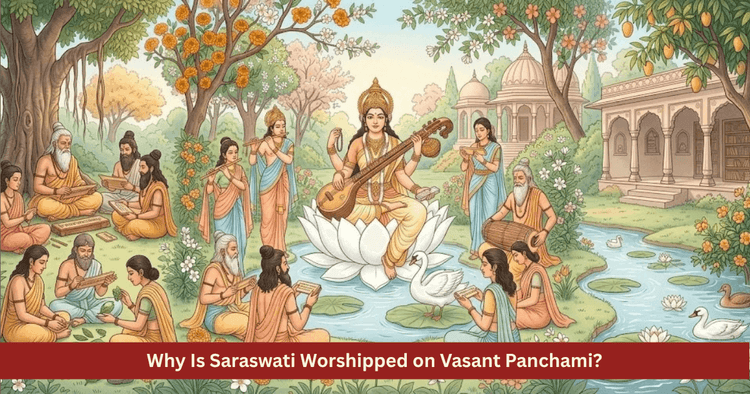
Table of Contents
Date, Worship and Core Rules of Vasant Panchami
The Panchami tithi of the bright fortnight of Magha month is celebrated across India as Vasant Panchami, a festival of knowledge. It is also known as Shri Panchami and Saraswati Puja. In the Gregorian calendar, this festival usually falls between late January and February. On this day Maa Saraswati, the goddess of learning, intellect, speech and music, is worshipped and the arrival of Vasant, the king of seasons, is welcomed.
| Element of the Festival | Details |
|---|---|
| Tithi | Magha Shukla Panchami |
| Principal Deity | Maa Saraswati |
| Best Time for Worship | The forenoon during Panchami tithi, check the exact time in the local Panchang |
| Principal Colours | Yellow and white |
| Principal Offerings | White and yellow flowers, rice grains, sandalwood, books and musical instruments |
| Principal Bhog | Saffron sweet rice, yellow laddoos, jujube berries and seasonal fruits |
| Main Mantra | Om Aim Saraswatyai Namah |
| Special Sanskar | Vidyarambh or Aksharabhyasa, the initiation into learning |
| Significance of the Muhurat | Abujh Muhurat, a self auspicious day for good works |
The Basic Rules of Worship in Brief
- Bathe in the morning and wear yellow or white clothes.
- At the shrine, install an idol or picture of Maa Saraswati on a yellow cloth.
- Place books, pens, musical instruments and study materials near the idol.
- Worship with white and yellow flowers, sandalwood paste, rice grains and saffron.
- Recite the Saraswati Vandana and chant Om Aim Saraswatyai Namah.
How Did Maa Saraswati Appear?
According to Puranic belief, at the beginning of creation Lord Brahma created living beings. But when he looked at his creation, he felt that something was incomplete. The whole world was silent and mute. There was no sound anywhere, no speech and no music. There was life in creation but no expression of consciousness.
Then Brahma took water from his kamandal and sprinkled it on the earth. From that water a divine power appeared. She was a 4 armed goddess. In one hand she held a veena, in the second a book, in the third a rosary and her fourth hand was raised in the gesture of granting boons. Brahma asked her to play the veena. As soon as the Devi touched the strings, sound spread through the whole of creation. Water began to murmur, the wind began to rustle and speech arose in the throats of living beings. This speech was called Vak and because she is the presiding goddess of speech, she came to be called Vagdevi, Veenapani and Sharada.
This story shows symbolically that life is incomplete without knowledge and expression. The power that separates a human being from an animal is speech and discernment. Maa Saraswati is the form of that very power. This is why Vasant Panchami can also be called the birthday of knowledge.
The Meaning of Maa Saraswati's Symbols
| Symbol | Meaning |
|---|---|
| Veena | Art, music and the balance of life's rhythm |
| Book | The Vedas, the scriptures and all knowledge |
| Rosary | Meditation, sadhana and concentration |
| White Garments | Purity, sattva and a clear intellect |
| Swan | Discernment, the ability to separate truth from untruth |
| Lotus | Living in the world while remaining untouched by it |
It is believed that the swan can separate milk from a mixture of milk and water. This is the symbol of discernment. True knowledge is that which teaches a person to distinguish right from wrong.
The Form of Saraswati in the Vedas
In the Rigveda, Saraswati is described both as a sacred river and as a goddess. In a famous mantra she is addressed as "Ambitame Naditame Devitame Saraswati," meaning Saraswati, the best of mothers, the best of rivers and the best of goddesses. In the Vedic age, the sages performed many yajnas and composed Vedic hymns on the banks of the Saraswati river. Over time, Saraswati the river came to be established as the goddess of speech and knowledge.
This change is deeply meaningful. Just as a river flows constantly and gives life wherever it passes, knowledge too flows constantly and enriches every mind it passes through.
Welcoming Vasant, the King of Seasons
Vasant Panchami is regarded as the festival that welcomes Vasant, the king of seasons. The bitter cold of Shishira slowly begins to ease. Yellow mustard flowers begin to sway in the fields, mango trees begin to blossom and the call of the koel begins to be heard. Nature seems to wake from sleep and adorn itself anew.
In the Bhagavad Gita, Lord Shri Krishna describes Himself as spring among the seasons. This is the greatest proof of the excellence of this season. Vasant is the season of creation, beauty and new life. Just as nature sheds its old leaves at this time and puts on new ones, human beings too should leave behind old inertia and embrace new knowledge and new energy.
The Complete Worship Method of Vasant Panchami
| No. | Stage of Worship | Method |
|---|---|---|
| 1 | Bath and Clothing | Bathe in the morning and wear yellow or white clothes |
| 2 | Installation | Spread a yellow cloth on a wooden seat and install an idol or picture of Maa Saraswati |
| 3 | Ganesha Worship | Remember and worship Lord Ganesha before any worship |
| 4 | Kalash | Install a kalash filled with water |
| 5 | Sankalpa | Take a resolve for the purification of learning, intellect and speech |
| 6 | Offerings | Offer white sandalwood, turmeric, saffron, rice grains and yellow and white flowers |
| 7 | Tools of Knowledge | Place books, pens, musical instruments and art materials near the idol and worship them |
| 8 | Bhog | Offer saffron rice, yellow laddoos, jujube berries, carrots and seasonal fruits |
| 9 | Vandana | Recite the Saraswati Vandana |
| 10 | Japa | Chant Om Aim Saraswatyai Namah 108 times |
| 11 | Aarti | Perform aarti with a ghee lamp and distribute prasad |
The Spirit of the Saraswati Vandana
The most famous verse of the Saraswati Vandana begins: "Ya kundendu tushara hara dhavala ya shubhra vastravrita." Its meaning is: she who is as white as the jasmine flower, the moon, snow and a garland of pearls, who is clad in white garments, whose hands are adorned with the veena and who is seated on a white lotus, whom all the gods including Brahma, Vishnu and Mahesh worship, may that Maa Saraswati completely remove the dullness of the seeker's intellect.
The final thought of this vandana is the most important. The seeker does not ask the goddess for wealth or splendour. The only prayer is that the dullness of the intellect be destroyed. This is the true prayer of learning.
Bhog and Prasad
The colour yellow has special importance in the bhog of this day. Sweet rice made with saffron or turmeric, gram flour laddoos, boondi and seasonal fruits are offered. The jujube berry is regarded as the special fruit of this day. In many regions it is the custom to eat the berries of the season only after they have been offered to Maa Saraswati on Vasant Panchami. In Bengal, khichdi and various vegetables are offered as bhog on this day.
Why Are Books and Musical Instruments Worshipped?
On Vasant Panchami, students place their books, artists their instruments and writers their pens at the feet of Maa Saraswati. Behind this lies a beautiful feeling. The tools through which a person gains knowledge and expresses art are also sacred. Honouring them is honouring knowledge.
In the tradition of Bengal and eastern India, books are placed in worship on this day and no studying is done that day. The next day, after the worship, the books are picked up and study begins again with fresh enthusiasm. This tradition teaches that knowledge should be regarded not merely as a thing to be used but as an object of reverence.
Vedic Principles for the Growth of Knowledge
Vasant Panchami is not merely a single day of worship. It is a day to take a resolve for the pursuit of knowledge through the whole year. Tradition describes some simple and effective rules for the growth of knowledge.
- Study in Brahma Muhurta: The time before sunrise is regarded as the best for concentration of the mind.
- Chanting the seed mantra: Chant Om Aim Saraswatyai Namah 11 times every day before studying.
- Respect for the teacher: Learning that begins with the blessing of the guru endures.
- Purity of speech: Harsh and untruthful speech is regarded as an insult to Saraswati.
- Sattvic diet: Light and sattvic food keeps the mind steady and the intellect sharp.
- Regular revision: Regularly revising what has been learnt strengthens memory.
- Sharing knowledge: Knowledge that is shared with others never decreases but grows.
Vasant Panchami Through the Lens of Vedic Astrology
In Vedic astrology, Mercury signifies intellect and speech, Jupiter signifies knowledge and the grace of the guru and Venus signifies art and music. The 5th house of the horoscope is linked with learning and intellect and the 2nd house with speech. The worship of Maa Saraswati on Vasant Panchami is believed to strengthen the auspicious results connected with all these planets and houses.
| Concern | Astrological Indication | Remedy on Vasant Panchami |
|---|---|---|
| Lack of focus in studies | Weak Mercury or afflicted 5th house | Saraswati worship and japa of Om Aim Saraswatyai Namah |
| Weak memory | Afflicted Moon or Mercury | Study in Brahma Muhurta and the Saraswati Vandana |
| Speech defects or stammering | Afflicted 2nd house | The tradition of writing Aim on the tongue with honey |
| Obstacles in higher education | Weak Jupiter | Donating yellow clothes, turmeric and books |
| Progress in art and music | Strength of Venus | Worship of instruments and beginning music practice |
What Should Be Done and Avoided on Vasant Panchami?
| Do | Do Not |
|---|---|
| Wear yellow or white clothes | Avoid wearing black clothes |
| Respect books and musical instruments | Do not touch books with your feet or throw them |
| Begin the education of children | Do not mock or insult anyone |
| Donate books and stationery to poor students | Do not speak harsh or untruthful words |
| Eat sattvic food | Do not eat meat, alcohol or tamasic food |
The Spring of Knowledge Awakening in the Notes of the Veena
Vasant Panchami is the day when nature and consciousness blossom together. Outside, mustard flowers cover the earth in yellow and within, the lamp of knowledge is lit. The notes of Maa Saraswati's veena are a reminder that life is music, in which only the right tension of every string produces a sweet sound. Neither too loose nor too tight.
For the person who worships Maa Saraswati with faith on this day and resolves to pursue knowledge through the whole year, the winter of ignorance slowly begins to melt and the spring of discernment arrives. This is the greatest blessing of this festival.
FAQ
When is Vasant Panchami celebrated? Vasant Panchami is celebrated on the Panchami tithi of the bright fortnight of Magha month. In the Gregorian calendar it usually falls between late January and February.
Why is Maa Saraswati worshipped on Vasant Panchami? According to Puranic belief, Maa Saraswati appeared on this day and her veena filled creation with speech and sound. That is why this day is a celebration of knowledge.
Which mantra should be chanted on Vasant Panchami? Chanting Om Aim Saraswatyai Namah 108 times on this day is considered auspicious. Aim is the seed mantra of Maa Saraswati.
What bhog should be offered on Vasant Panchami? Saffron sweet rice, yellow laddoos, jujube berries and seasonal fruits are offered to Maa Saraswati. Yellow offerings are considered especially auspicious on this day.
Why are books worshipped on Vasant Panchami? Books and musical instruments are the tools of knowledge and art. Worshipping them honours knowledge and brings the blessing of progress in learning.
Get your accurate Kundali
Generate KundaliDid you like it?
Author

Aparna Patni (63)
Experience: 20
Consults About: Family Planning, Career
Clients In: Punjab, Haryana, Delhi
Share this article with friends and family
WELCOME TO
ZODIAQ
Right Decisions at the right time with ZODIAQ
