Why Begin Learning on Vasant Panchami?
By Pt. Amitabh Sharma
Aksharabhyasa, the Abujh Muhurat and Rules for Parents
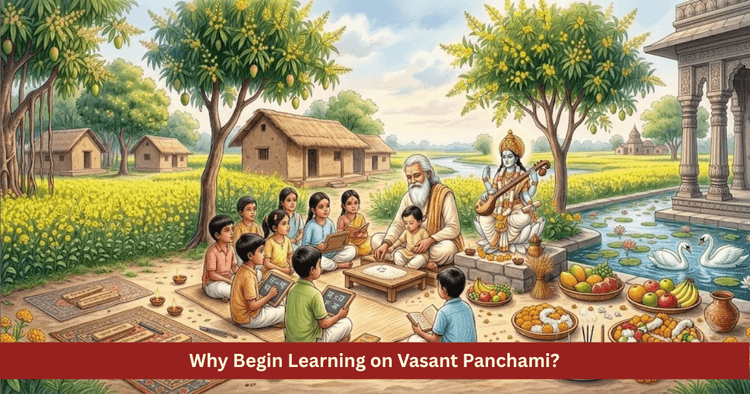
Table of Contents
Date, Age and Basic Method of the Vidyarambh Sanskar
Among the 16 sanskars of Sanatana Dharma, the Vidyarambh Sanskar holds a very important place. It is also known as Aksharabhyasa, Akshararambh and Pati Pujan. It is the sacrament in which a boy or girl is formally introduced to letters and writing for the first time. Magha Shukla Panchami, the day of Vasant Panchami, is regarded as the finest and self auspicious Abujh Muhurat of the year for this sanskar. On this day there is no need to look for a separate muhurat.
| Element of the Sanskar | Details |
|---|---|
| Best Day | Magha Shukla Panchami, that is Vasant Panchami |
| Suitable Age | Usually 3 to 5 years |
| Principal Deities | Lord Ganesha and Maa Saraswati |
| Writing Surface | A plate filled with rice, a slate or a wooden board |
| Writing Tool | A silver stylus, a gold ring or a pomegranate twig |
| First Letter | Om, Shri or Aim |
| Writing on the Tongue | Aim, the seed mantra of Saraswati, written with honey |
| Who Performs It | The guru, a teacher, the grandparents or a learned elder of the family |
| Conclusion | Guru dakshina, distribution of prasad and blessings of the elders |
The Essence of the Sanskar in Brief
- In the morning, bathe the child and dress them in new yellow or white clothes.
- Worship Lord Ganesha and Maa Saraswati.
- The guru or a senior family member sits facing east with the child on their lap.
- Dip a silver stylus or pomegranate twig in honey and write Aim on the child's tongue.
- Holding the child's finger, have them write the first letter on a plate of rice or a slate.
The Place of Vidyarambh Among the 16 Sanskars
In the Sanatana tradition, human life is shaped through sanskars. Sanskar means to purify and to instil good qualities. From conception to the final journey, 16 main sanskars are described. The lists in different texts vary slightly but in the popular list Vidyarambh is regarded as a major sanskar.
| No. | Sanskar | Stage of Life |
|---|---|---|
| 1 | Garbhadhana | The beginning of life |
| 2 | Pumsavana | Protection of the pregnancy |
| 3 | Simantonnayana | Prayer for the mental growth of the unborn child |
| 4 | Jatakarma | Birth |
| 5 | Namakarana | Naming |
| 6 | Nishkramana | First outing from the home |
| 7 | Annaprashana | First feeding of grain |
| 8 | Chudakarma | First haircut |
| 9 | Karnavedha | Ear piercing |
| 10 | Vidyarambh | Beginning of learning letters |
| 11 | Upanayana | Sacred thread and going to the guru |
| 12 | Vedarambha | Beginning of Vedic study |
| 13 | Keshanta | The rite of adolescence |
| 14 | Samavartana | Returning home after completing education |
| 15 | Vivaha | Entering household life through marriage |
| 16 | Antyeshti | The last rites |
This list makes it clear that Vidyarambh is the point where the child's life turns from merely physical growth towards intellectual growth. This is why it can be called the sanskar that sets the direction of life.
Why Was Vasant Panchami Chosen?
Vasant Panchami is regarded as the day of Maa Saraswati's appearance. What better day could there be for beginning learning than the day on which the goddess of knowledge herself appeared? Tradition regards this day as an Abujh Muhurat. Abujh means that which does not need to be searched for or examined. Such days are so auspicious in themselves that there is no need to consult the Panchang for any good work on them.
From the point of view of the season too, this time is fitting. Spring is the season of new creation. Just as new shoots burst forth on the trees, the first sprout of knowledge bursts forth in the child's mind. The enthusiasm that comes into nature as the inertia of winter ends should also be present at the beginning of a child's education.
It is worth noting that in some regions of India, especially Kerala and South India, Vidyarambh is also performed with great enthusiasm on Vijayadashami. Both days are linked with the worship of the Devi and both are regarded as excellent for beginning learning. Either day may be chosen according to regional and family tradition.
The Authentic Method of the Vidyarambh Sanskar
| Step | Method |
|---|---|
| Preparation | Clean the place of worship, spread a yellow cloth and install an idol or picture of Maa Saraswati and Ganesha |
| The Child's Bath | Bathe the child, dress them in new yellow or white clothes and apply a tilak of turmeric or sandalwood |
| Ganesha Worship | Worship Ganesha, the remover of obstacles and pray for an education free from obstacles |
| Saraswati Worship | Offer yellow flowers, rice grains, sandalwood and yellow bhog to Maa Saraswati |
| Sankalpa | The parents take the resolve of Vidyarambh in the child's name |
| Seating | The guru or senior member sits facing east and takes the child on their lap |
| Writing on the Tongue | Dip a silver stylus or pomegranate twig in honey and write Aim on the child's tongue |
| First Letter | Holding the child's right index finger, have them write Om, Shri or the first letter of their language in the plate of rice |
| Worship of Books | Have the child worship a new book and pen with their own hands |
| Blessings | Have the child touch the feet of the guru, parents and elders |
| Dakshina | Offer dakshina, clothes or a book to the guru |
| Prasad | Distribute prasad among all who are present |
The Meaning of Writing Aim on the Tongue
Aim is the seed mantra of Maa Saraswati. Bija or seed, means the subtle sound in which the entire power of the deity is contained, just as a whole tree is contained within a tiny seed. The tongue is the organ of speech. When Aim is written on the tongue with honey, the prayer is that the child's speech may be sweet, truthful and full of knowledge. Honey is the symbol of sweetness and silver of purity and coolness.
The Meaning of Writing in a Plate of Rice
Rice grains are called akshat, meaning that which is never broken or destroyed. The first letter written on akshat symbolises the wish that the child's knowledge may be imperishable and never lost. Writing on grain also teaches that knowledge and the nourishment of life are connected with each other.
The Benefits of the Sanskar
Tradition holds that performing the Vidyarambh Sanskar according to the rules brings many benefits to the child.
- Clarity of speech: Writing the seed mantra on the tongue symbolises the wish for clear and sweet speech.
- Memory: The grace of Maa Saraswati brings the blessing of a sharp memory.
- Reverence for education: When education begins with worship and celebration, respect for study is born in the child's mind.
- Respect for the teacher: Learning the first letter while seated on the guru's lap instils lifelong respect for the teacher.
- Family culture: Performed in the presence of the whole family, this sanskar connects the child with their tradition.
From a psychological point of view too, this sanskar is extremely important. The feeling that first becomes attached to education in a child's mind lasts for a long time. If education begins with fear and pressure, the child runs away from study. But if it begins with love, celebration and blessings, education becomes a source of joy.
Essential Rules for Parents
| Do | Do Not |
|---|---|
| Involve the child in the sanskar with a happy mind | Do not force a crying or tired child |
| Keep the amount of honey very small | Do not give honey to an infant under 1 year of age |
| Use a clean and safe writing tool | Do not use any sharp or unsafe object |
| Honour the guru or learned elder | Do not turn the sanskar into a mere show |
| Create an atmosphere of study at home after the sanskar | Do not become indifferent to the child's education afterwards |
Vidyarambh is not a single day's event. It is a resolve that the parents will remain attentive to their child's education throughout life. After the sanskar, respect for books at home, regular storytelling and answering the child's questions with patience are what bring the true fruit of this sanskar.
Vidyarambh Through the Lens of Vedic Astrology
In Vedic astrology, the 4th house of the horoscope is linked with early education, the 5th house with intellect and learning and the 2nd house with speech. Mercury signifies intellect and writing, while Jupiter signifies knowledge and the guru. In ordinary circumstances, the days of Mercury, Jupiter and Venus, an auspicious nakshatra and an auspicious tithi are chosen for Vidyarambh. Because Vasant Panchami is regarded as an Abujh Muhurat, a separate check of all these is not considered necessary on this day.
| Astrological Element | Connection | Importance in the Sanskar |
|---|---|---|
| 4th House | Early education | The foundation of learning |
| 5th House | Intellect and learning | The capacity to absorb knowledge |
| 2nd House | Speech | Clarity of expression |
| Mercury | Writing, calculation and intellect | Knowledge of letters |
| Jupiter | The guru and knowledge | Grace of the teacher and discernment |
A Life Lit by the First Lamp of Letters
The Vidyarambh Sanskar is the moment when a tiny hand forms a letter for the first time. That letter is small but the possibilities of an entire life are hidden within it. Just as thousands of lamps can be lit from one lamp, countless flames of knowledge can be kindled from that first letter.
Performed with the blessings of Maa Saraswati on Vasant Panchami, this sanskar does not merely teach the child to read and write. It teaches that knowledge is sacred, that the guru is worthy of worship and that learning is a celebration. Parents who understand this spirit and begin their child's education in this way give the child the greatest gift of life.
FAQ
At what age should the Vidyarambh Sanskar be performed? The Vidyarambh Sanskar is usually performed between the ages of 3 and 5, when the child begins to be ready to learn letters.
Why is Vasant Panchami considered an Abujh Muhurat for Vidyarambh? Vasant Panchami is the day of Maa Saraswati's appearance, so it is regarded as a self auspicious day and there is no need to look for a separate muhurat on it.
What is written on the child's tongue during Vidyarambh? A silver stylus or pomegranate twig is dipped in honey and Aim, the seed mantra of Maa Saraswati, is written on the child's tongue.
Where is the first letter written during Vidyarambh? Holding the child's finger, the first letter is written on a plate filled with rice, a slate or a wooden board and it is usually Om or Shri.
Can Vidyarambh be performed only on Vasant Panchami? No. In some regions Vidyarambh is also performed on Vijayadashami. According to family tradition, the sanskar can be performed on other days after choosing an auspicious muhurat.
Get your accurate Kundali
Generate KundaliDid you like it?
Author
Pt. Amitabh Sharma (56 Years)
Experience: 20
Consults About: Family Planning, Career
Clients In: Punjab, Haryana, Delhi
Share this article with friends and family
WELCOME TO
ZODIAQ
Right Decisions at the right time with ZODIAQ
