How Will Akhuratha Sankashti Remove Hardships?
By Aparna Patni
Aghan Sankashti Lore, 21 Durva Rituals, Moon Arghya And Remedies
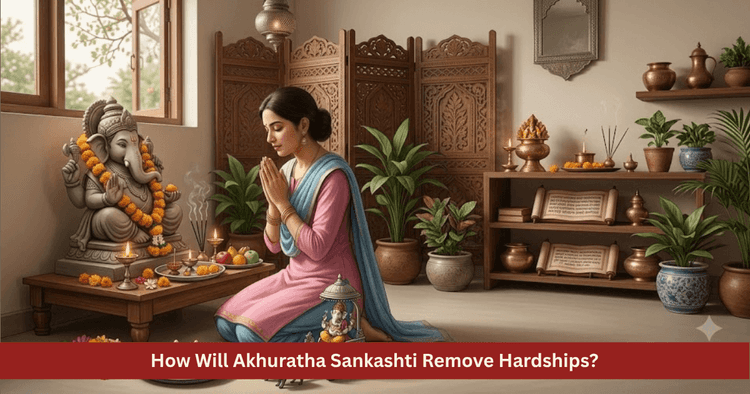
Table of Contents
Foundational Framework and Scriptural Rules of Akhuratha Sankashti
According to the classical Sanatana calendar, the sacred fourth day of the waning moon in the month of Margashirsha is universally celebrated by the venerable name of Akhuratha Sankashti Chaturthi. The term Sankashti literally signifies that auspicious celestial date which completely uproots lingering distress and when it arrives during the holy month of Aghan, its spiritual potency multiplies infinitely. The title Akhuratha is an intricate synthesis of two ancient terms, wherein Akhu denotes the agile mouse and Ratha designates the divine chariot or vehicle. Upon this blessed tithi, seekers venerate the unique cosmic form of Lord Sri Ganesha seated upon his mouse vehicle. With the arrival of the cold winter season, as tamasic heaviness, mental lethargy and physical stiffness gradually accumulate within human physiology and nature, this spiritual discipline implants vibrant life energy and sharp intellect within the soul.
| Worship Dimension | Classical Injunction Details |
|---|---|
| Niyam | Vidhan |
| Presiding Tithi | Margashirsha Krishna Paksha Chaturthi |
| Fasting Discipline | Complete waterless fast or pure fruit diet, concluded upon moonrise |
| Presiding Divine Form | Lord Ganesha seated upon his vehicle the sacred mouse |
| Primary Worship Articles | 21 sacred durva grass blades, modakas, white sesame, jaggery, red flowers |
| Moon Oblation Medium | Pure water mixed with raw milk, unbroken rice and white sandalwood |
| Foundational Chants | Om Gam Ganapataye Namah or Om Ekadantaya Vidmahe Vakratundaya Dhimahi |
| Core Spiritual Fruits | Complete eradication of visible and invisible hurdles, mental clarity |
A seeker undertaking this sacred vow must rise before dawn during Brahma Muhurta, leaving the bed with a pure mind. After completing thorough domestic cleanliness, one should purify the self with water infused with holy Ganga water and don clean red or yellow garments. During the first watch of the day, sit facing the eastern or northern quadrant to formally state the mental resolve for the fast before Lord Ganesha. Exercising disciplined speech, preserving unblemished mental purity and exhibiting compassionate gentleness throughout the day are the vital internal vows of this observance. At night, when the planetary Moon rises in the sky, offering an oblation of consecrated water blended with raw milk and unbroken rice formally completes this great spiritual austerity.
Sacred Lore of Akhuratha Sankashti and Its Inner Essence
The ancient verses of the Ganesha Purana and Mudgala Purana elaborate upon a glorious and transformative chronicle linked directly with Akhuratha Sankashti Chaturthi. In ancient ages, when an arrogant demon named Matsarasura unleashed devastating torment across the three realms, the frightened deities rushed to seek refuge at the lotus feet of Lord Shiva and Mother Parvati. Matsarasura was the living embodiment of bitter jealousy, envy and toxic malice who had extracted a formidable boon from Lord Brahma through severe austerities, rendering him invulnerable to ordinary celestial weaponry.
Hearing the agonized prayers of the gods, the beloved son of Mother Parvati manifested in the magnificent form of Akhuratha upon the counsel of Lord Sadashiva. Akhu, the tiny mouse, symbolizes the restless, creeping darkness and petty gnawing tendencies of the uncontrolled lower human senses. By effortlessly subduing this erratic mouse and transforming it into his divine vehicle, Lord Ganesha delivered an eternal truth: human consciousness cannot experience transcendental reality until it masters its own restless senses and slays the inner demon of bitter envy. Armed with his sharp axe and mystical noose, Lord Lambodara vanquished Matsarasura, restoring cosmic peace across the universe. The glorious day this victory manifested was the auspicious fourth tithi of the waning fortnight in Margashirsha, establishing an unbroken tradition of worshipping Akhuratha Sankashti Chaturthi.
Overcoming Winter Lethargy and Awakening Sharp Intellect
During November and December, as cold currents sweep through the sacred month of Aghan, the cognitive functioning of the human brain often experiences sudden sluggishness and physical lethargy. Both classical Ayurveda and the sciences of yoga affirm that the natural elevation of Kapha and Vata humors during winter dulls decisive intellectual clarity and scattered mental focus.
Lord Ganesha is the absolute sovereign deity of wisdom, discrimination, retentive memory and all spiritual perfections. Fasting on Akhuratha Sankashti grants therapeutic rest to the bodily digestive fire, redirecting subtle vital currents upward from the physical stomach toward the cerebral faculties. When a seeker engages in the unbroken repetition of the primary seed chants of Ganesha on this day, the subtle nadis converging at the Ajna and Sahasrara chakras expand effortlessly. This practice strengthens memory retention for students, awakens deep creative inspiration for scholars and writers and sharpens strategic foresight for corporate leaders. As the dark clouds of mental dullness dissolve, the individual accomplishes everyday responsibilities with doubled speed and joy.
Esoteric and Ayurvedic Secrets of Offering 21 Blades of Durva
Presenting sacred durva grass to Lord Ganesha is celebrated across all Vedic rituals, yet offering exactly 21 blades of durva on Akhuratha Sankashti holds unique esoteric and physiological significance. Scriptural chronicles recount that when Lord Ganesha swallowed the fierce demon Analasura, a blazing, agonizing fire erupted within his divine stomach. To cool this unbearable cosmic heat, sage Kashyapa gathered 21 fresh blades of durva and placed them upon the crown of Ganesha, soothing the burning agony instantaneously.
Durva is never an ordinary green grass but rather a miraculous botanical specimen saturated with pure rejuvenating nectar. Its deep root network penetrates deep into the soil to absorb terrestrial vitality, while its tender shoots capture subtle solar radiation with extraordinary efficiency. On Akhuratha Sankashti, 21 distinct twin knots of durva are gathered and offered upon the feet and head of Lord Ganesha while chanting specific holy names:
- Om Ganadhipaya Namah and Om Umaputraya Namah
- Om Vighnanashanaya Namah and Om Vinayakaya Namah
- Om Ishaputraya Namah and Om Sarvasiddhipradaya Namah
- Om Ekadantaya Namah and Om Ibhavaktraya Namah
- Om Mushakavahanaya Namah and Om Kumaragurave Namah
These 21 sacred blades symbolize the conscious surrender of the 21 foundational components of human anatomy: the five great elements, the five sensory faculties, the five motor organs, the five vital life breaths and the single sovereign mind. When a seeker lays these dimensions at the feet of the remover of obstacles, all internal toxic heat and burning emotional anxieties are pacified just as the venom of Analasura was extinguished.
Spiritual Power of Chanting the Sankat Nashan Ganesha Stotram
Extracted from the venerable Narada Purana, the sacred Sankat Nashan Ganesha Stotram stands as an incomparable, self perfecting hymn that dissolves towering worldly obstacles into dust when recited on Sankashti. Composed by the divine sage Narada, this hymn glorifies twelve transcendental names of Lord Ganesha, establishing an impenetrable armor of divine light around the auric field of the seeker.
To chant this hymn properly, sit facing the eastern horizon before the image of Lord Ganesha, keeping a clean lamp of pure cow ghee burning steadily. The twelve sanctified names enumerated in the text are Sumukha, Ekadanta, Kapila, Gajakarnaka, Lambodara, Vikata, Vighnanasha, Vinayaka, Dhumraketu, Ganadhyaksha, Bhalachandra and Gajanana. Reciting these twelve sacred vibrations three times with devotion grants effortless learning, wealth, progeny and ultimate liberation. Individuals whose finished endeavors crumble unexpectedly at the eleventh hour, who face chronic commercial losses or whose homes suffer under persistent unexplainable anxieties should chant this stotram at least 11 times on Akhuratha Sankashti. The sonic resonance generated by this prayer incinerates subtle Vastu flaws, flooding the domestic dwelling with serene peace.
Astronomical Importance of Lunar Oblations and Emotional Balance
The most critical and indispensable culmination of the Sankashti Chaturthi fast is the nocturnal presentation of the sacred water oblation to the rising Moon. In classical Vedic astrology, the planetary Moon is celebrated as the absolute governor of human emotions and mental equilibrium. On the fourth lunar tithi, the tidal currents and gravitational geometry of the Moon stir the water element within the human subconscious mind. For this reason, the ancient sages strictly instructed devotees to avoid staring directly at the bare Moon, directing them instead to view its luminous reflection through a cascading stream of consecrated water.
When the Moon ascends the eastern sky on Akhuratha Sankashti, prepare a clean offering vessel filled with sacred Ganga water, raw cow milk, unbroken white rice, vermilion and fragrant white flowers. Raising both hands high above the brow, pour the offering in an unbroken stream while gazing at the lunar disc through the water. While pouring, repeat the sacred chant Om Som Somaya Namah or Om Ksheeraputraya Vidmahe Amritatattwaya Dhimahi Tanno Somah Prachodayat. This ritual calms emotional instability, clears melancholic grief and completely heals natal lunar afflictions in the horoscope. To maintain sanctity, ensure the consecrated water falls safely into a broad basin or clean flower bed without splashing upon your feet.
Planetary Remediation and Philosophical Meaning of the Mouse
In traditional Vedic astrology, Lord Ganesha reigns as the supreme presiding deity of the lunar node Ketu, which governs spiritual liberation, detachment, esoteric knowledge and sudden unexpected disasters. Furthermore, planet Mercury, the celestial lord of communicative speech and practical commerce, is deeply fortified through sincere devotion to Ganesha. When a seeker observes the Akhuratha Sankashti of Margashirsha, malefic planetary distress generated by Mercury, Ketu and Rahu naturally settles into harmonious peace.
The mouse vehicle of Lord Ganesha is never a simplistic mythical embellishment but rather a profound allegorical mirror of human psychology. The tiny rodent thrives in dark subterranean holes, slowly gnawing through valuable possessions and destroying structures from within. In precisely this manner, unchecked subconscious desires, lingering cynicism and hidden doubts quietly gnaw away at human willpower and accumulated spiritual merit. By mounting the mouse, Lord Ganesha demonstrates that refined spiritual intellect must fearlessly ride upon and master these unruly, destructive impulses. When an individual achieves mastery over scattered sensory wanderings, the state of Akhuratha perfection is attained in life.
Potent Astrological Remedies and Remedies of Akhuratha Chaturthi
Specific esoteric remedies performed on this sacred date of Margashirsha possess the unique capability to realign the life path of a devotee. These time tested practices must be executed with deep reverence and quiet discretion.
- Removal of Commercial Roadblocks: Mix unpolished white sesame seeds with natural unrefined jaggery to form sacred tilkut. Place 21 blades of durva upon it, present it before Lord Ganesha and feed it to a sacred cow the next morning to dissolve business stagnation.
- Deliverance from Debt and Wealth Manifestation: Write the sacred seed mantra Om Gam Ganapataye Namah upon a clean sheet of red birch bark using a pomegranate twig and fragrant eightfold ink, placing it at Ganesha's feet before preserving it within your financial safe.
- Intellectual Acuity and Health for Children: Present five fresh modakas prepared from roasted gram flour to Lord Ganesha, feeding one sanctified modaka to your child to sharpen retentive memory and banish evil eye influences.
- Pacification of Domestic Bitterness: Take nine fresh leaves of the sacred Shami tree, apply an auspicious mark of pure turmeric to each and offer them to Ganesha to heal chronic domestic friction within days.
These classical disciplines dispel poverty from the household, establishing an unbroken reign of tranquility, prosperity and cosmic security.
Step-by-Step Ritual Sequence for Akhuratha Sankashti Vow
To harvest the full spiritual fruits of this sacred observance, one must faithfully adhere to the traditional ceremonial procedures. Following the early morning bath, drape a clean wooden altar with unblemished red or yellow silk cloth, installing a consecrated image or idol of Lord Ganesha seated upon his mouse vehicle. Place a sacred copper water pitcher before the deity, adorning its rim with mango leaves and a water filled coconut.
Kindle a pure cow ghee lamp alongside fragrant natural incense sticks. Symbolically bathe the deity using holy water, panchamrita and clean fragrant water once more. Adorn the murti with pure vermilion, sandalwood paste, unbroken rice and vibrant red flowers, placing the 21 blades of durva gently upon his brow. Present fresh modakas, tilkut and seasonal fruits as the sacred food offering. Recite the Sankat Nashan Ganesha Stotram with devotion, concluding with the traditional waving of the camphor flame. Maintain an unblemished fast through the daylight hours, breaking the vow only after presenting the sacred oblation to the Moon upon moonrise. An observance completed with this devotion throughout Aghan incinerates all earthly grief, steering the soul toward ultimate liberation.
FAQ
In which Hindu month is Akhuratha Sankashti Chaturthi observed? Akhuratha Sankashti Chaturthi is observed annually during the Krishna Paksha fourth lunar tithi of the holy month of Margashirsha or Aghan.
What is the classical and literal meaning of the word Akhuratha? In the sacred name Akhuratha, Akhu signifies the mouse and Ratha denotes the chariot, representing Lord Ganesha who rides upon the mouse.
Why is viewing the Moon and offering oblations essential on Sankashti Chaturthi? The Moon governs the emotional mind and its gravitational tides run high on Chaturthi, making the water offering vital for emotional stability and fast completion.
What is the deeper significance of presenting 21 blades of durva to Lord Ganesha? The 21 durva blades symbolize the total surrender of the 21 foundational components of human anatomy, soothing internal anxieties and removing all obstacles.
Which sacred hymn is most meritorious to recite on Akhuratha Sankashti? Reciting the sacred Sankat Nashan Ganesha Stotram from the Narada Purana is universally acknowledged as the most effective prayer to dispel all life crises.
Get your accurate Kundali
Generate KundaliDid you like it?
Author

Aparna Patni (63)
Experience: 20
Consults About: Family Planning, Career
Clients In: Punjab, Haryana, Delhi
Share this article with friends and family
WELCOME TO
ZODIAQ
Right Decisions at the right time with ZODIAQ
