What Is The Kaal Bhairav Jayanti Secret?
By Pt. Nilesh Sharma
Sacred Advent Of Kashi Kotwal Midnight Worship And Liberation From Fear
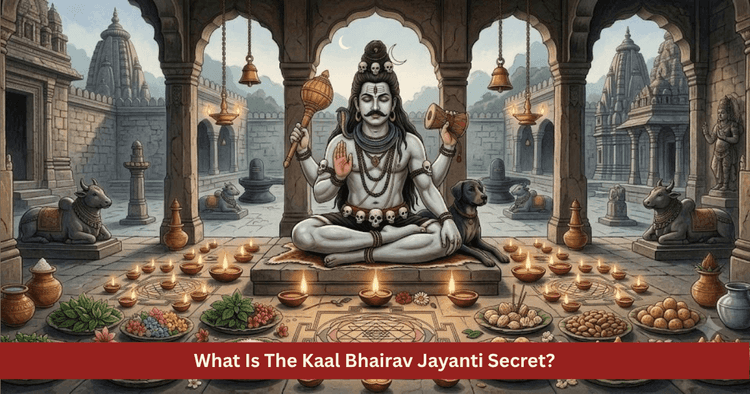
Table of Contents
Kaal Bhairav Jayanti Muhurat And Sacred Rituals
According to the sacred Vedic calendar the appearance day of Lord Kaal Bhairav who is the most fierce and righteous manifestation of Lord Shiva is celebrated on the eighth lunar day of the dark fortnight in the month of Margashirsha. Classical scriptures honor this sanctified tithi as Kaal Bhairav Ashtami or Bhairavashtami. Within esoteric Tantra traditions this night is revered as a Maha Ratri possessing supreme transformative power. When an individual suffers from irrational fear, relentless hostility from rivals, chronic afflictions, negative subtle disturbances or the terrifying danger of untimely demise, spiritual disciplines conducted on this auspicious date bestow complete fearlessness. Performing worship during the Nishita Kaal which is the midnight window carries exceptional merit.
| Ritual Factor | Scriptural Directives And Observances | Sacred Results Attained |
|---|---|---|
| Sacred Tithi And Paksha | Margashirsha Krishna Paksha Ashtami | Total eradication of fear and time afflictions |
| Principal Worship Period | Nishita Kaal midnight window 11:40 PM to 12:35 AM | Mastery over mantra science and negative energies |
| Presiding Divine Form | Lord Kaal Bhairav incarnation of Lord Shiva | Averting untimely demise and receiving justice |
| Sacred Animal Mount | The black dog vehicle of Bhairav | Pacification of Rahu Ketu and receiving grace |
| Consecrated Food Offerings | Black gram fritters, sweet jaggery flatbreads and oil | Dissolution of poverty and peace from Saturn trials |
| Potent Seed Mantra | Om Bham Bhairavaya Namah or Batuka Bhairav Mantra | Immediate alleviation of calamities and misfortunes |
To begin the sacred discipline of Kaal Bhairav Jayanti the spiritual practitioner must bathe in pure water during twilight or late evening and wear clean garments of deep red or black color. Sitting facing the southern direction during this worship is considered essential because the south is the cosmic quadrant of time and death.
- Place a clean wooden pedestal on the altar and cover it with a pure black or red silk cloth
- Install the sacred image of Lord Shiva and Baba Kaal Bhairav and ignite a large four faced lamp filled with mustard oil
- Fill an earthen or copper bowl with mustard oil, adding black sesame seeds, black gram beans and a clean iron nail
- Offer red sandalwood paste, vermilion, unbroken rice grains, sacred bilva leaves and black datura flowers with deep reverence
- Consecrate food offerings composed of black gram fritters, sweet wheat cakes or flatbreads sweetened with raw jaggery
- Recite the potent seed mantra of Bhairav at least 108 times or eleven rounds using a rosary of rudraksha beads
- Following the recitation chant the renowned Kaalbhairavashtakam composed by Adi Shankaracharya in a clear resonant voice
- Offer the consecrated sweet flatbreads coated with mustard oil or black gram preparations to a black dog with humility
- Abstain completely from intoxicants, animal flesh, untruthful speech, domestic arguments and mistreating any living being
Observing this comprehensive spiritual discipline faithfully consumes lower negative tendencies within human awareness. Fearlessness enters the mind and formidable worldly obstacles disperse like dry straw before divine grace.
Fifth Head Of Brahma And Kaal Bhairav Advent
The Shatarudra Samhita of the Shiva Purana and the Kashi Khanda of the Skanda Purana record a profound cosmic narrative detailing the advent of Lord Kaal Bhairav. In ancient times on the sacred summit of Mount Sumeru venerable sages, gods and celestial beings assembled to resolve an ultimate philosophical question. The assembly sought to know who among the divine powers represents the primeval origin, uncreated source and supreme reality of creation. Driven by pride the four headed creator Brahma declared that he was the supreme architect of the cosmos and should be adored above all.
Lord Vishnu objected gently, stating that the preserver of life who sustains the cosmic order is the primary cause. When the dispute remained unresolved the four sacred Vedas namely the Rigveda, Yajurveda, Samaveda and Atharvaveda were called upon to bear witness. The four Vedas proclaimed in one voice that the supreme reality beyond birth and death who commands dissolution and grace is none other than Mahadeva Shiva.
Hearing this declaration the fifth head of Brahma blazed with false pride. That fifth mouth began uttering disrespectful, insulting and harsh words directed at Lord Shiva. At that very moment an infinite pillar of blazing cosmic light manifested in the midst of the gathering.
Lord Shiva perceived that the arrogance of Brahma had transgressed all bounds of cosmic propriety. From the third eye of Shiva between his eyebrows a terrifying flame of righteous fury burst forth. From that cosmic fire manifested a colossal, dark complexioned, wide eyed warrior holding a trident and a staff of justice.
- Lord Shiva addressed the newly emerged divine form, declaring that because he is the master of time his name shall be Kaal Bhairav
- Shiva endowed him with the power to wander fearlessly across the three worlds and hold time under his control
- Mahadeva commanded him to establish righteous order and administer justice to wrongdoers
- Acting upon the subtle direction of Shiva, Kaal Bhairav severed the arrogant fifth head of Brahma using the tip of his little fingernail
- The moment the head was severed the pride of Brahma dissolved and he began praising Lord Shiva with trembling humility
This cosmic event demonstrates that no matter how elevated worldly learning or status appears, false ego cannot stand before universal law and cosmic time.
Release From Sin And Supreme Kotwal Of Kashi
Following the severing of the fifth head of Brahma a severe challenge confronted Lord Kaal Bhairav. Although Brahma had committed a serious transgression, he was the foremost scholar of the Vedas. Consequently the horrific personification of the sin of slaying a learned being surrounded Kaal Bhairav. This sin assumed the shape of a terrifying dark woman who pursued him relentlessly. Furthermore the severed skull of Brahma adhered firmly to the left palm of Kaal Bhairav, refusing to detach regardless of any effort.
Kaal Bhairav approached Lord Shiva for guidance. Smiling with compassion Mahadeva explained that this drama was orchestrated to teach humanity the unerring consequence of action. Shiva instructed Bhairav to take the vow of a wandering ascetic, carrying the skull as an alms bowl across all sacred pilgrimage centers in the three worlds. The lord revealed that when he arrived at the supreme holy city the sin would release him and the skull would detach naturally.
Lord Kaal Bhairav journeyed across mountains, forests, sacred rivers and hermitages throughout the universe. He visited Prayagraj, Badrikashram, Pushkar and Naimisharanya yet the skull remained attached to his hand. At last when he crossed the sacred threshold of the holy city of Kashi, a magnificent miracle occurred.
The moment he entered Kashi the dark shadow of sin shrieked in terror and sank into the netherworld. At that very spot the skull fell away from his hand, striking the earth. The sacred spot where this event transpired is worshipped to this day as Kapal Mochan Tirtha.
- Lord Shiva appeared in his luminous glory and embraced Kaal Bhairav with boundless affection
- Mahadeva declared that Kashi is his sacred forest of bliss and Kaal Bhairav shall serve as its sovereign guardian
- Shiva appointed Kaal Bhairav as the supreme judicial magistrate celebrated as the Kotwal of Kashi
- The lord established that Bhairav alone would maintain the record of merits and sins of every soul dwelling in Kashi
- The pilgrimage of any seeker to Kashi remains incomplete until they pay humble homage at the shrine of Kaal Bhairav
Lord Kaal Bhairav assumed governance of the sacred city. For souls departing their physical vessels in Kashi he administers the Bhairavi Yatana which is a concentrated moment of spiritual purification that cleanses past karmic debts instantly to grant liberation.
How Does Bhairav Pacify Rahu Ketu And Saturn?
In the analytical doctrines of Vedic astrology the divine archetype of Lord Kaal Bhairav holds exceptional significance. Across the planetary hierarchy Kaal Bhairav governs the shadow planet Rahu, the spiritual liberator Ketu and the dispenser of karma Saturn. Rahu represents the head of the cosmic serpent signifying illusion, obsessive desires, sudden shocks and deep fears, while Ketu signifies the tail representing detachment, subtle forces and past karmic baggage.
Simultaneously Saturn is the slow moving planet of justice testing human integrity through trials such as Sade Sati and Dhaiya. Because Lord Kaal Bhairav is the supreme commander of cosmic law, Saturn, Rahu and Ketu execute their roles under his divine command.
| Astrological Factor | Spiritual Influence Of Bhairav Worship | Remedial Solution Granted |
|---|---|---|
| Rahu Afflictions | Mental delusions, obsessions, poisons and phobias | Four faced lamp and mantra japa stabilize the mind |
| Ketu Afflictions | Unexplained afflictions, occult fears and alienation | Feeding black dogs enhances spiritual insight |
| Saturn Sade Sati | Protracted delays, social setbacks and fatigue | Mustard oil charity and Kaalbhairavashtakam bring peace |
| Eighth House Flaws | Fear of untimely death, accidents and chronic illness | Contemplation of the Mahakaal form provides armor |
| Twelfth House Flaws | Confinement, severe financial penalties and heavy losses | Bhairav worship grants victory over hidden adversaries |
In Vedic astrology the black dog is honored as the sacred mount of Lord Bhairav. A canine possesses sharp sensitivity capable of detecting invisible subtle disturbances, negative astral impressions and approaching hazards through instinct.
- Offering sweet flatbreads seasoned with mustard oil or jaggery to a black dog on Bhairav Ashtami pacifies malefic Rahu and Ketu
- For individuals whose birth charts contain Kalasarpa yoga or eclipse afflictions observing this festival acts as a healing remedy
- Burning pure guggul incense before Lord Bhairav neutralizes harmful influences occupying the eighth house of longevity
- Donating black gram and black sesame seeds at a Bhairav temple on Saturdays softens the stern gaze of Saturn
- Seekers who chant the Kaalbhairavashtakam daily develop a luminous energetic field that repels malevolent energies
This classical astrological discipline demonstrates that the adoration of Bhairav is not a frightening ritual, but an enlightened science for purifying human awareness and harmonizing planetary vibrations.
Maha Ratri Tantric Cleansing And Untimely Death Remedy
In classical Tantric science four sacred nights are celebrated as supreme windows for spiritual awakening, including Kaal Ratri on Diwali, Maha Ratri on Shivaratri, Moha Ratri on Janmashtami and Veera Ratri or Bhairav Ratri on Kaal Bhairav Ashtami. During the midnight hours of Margashirsha Krishna Ashtami the subtle flow of cosmic time slows down, making mantra chanting, internal contemplation and sacred yantra consecration immensely fruitful.
The name Kaal Bhairav unites two significant words where Kaal signifies time and mortality while Bhairav denotes the fearsome reality that destroys all fear. Lord Dattatreya explains in esoteric treatises that those who squander time meet the harsh discipline of nature, whereas those who honor time and engage in spiritual discipline receive protection from the lord of time himself.
Untimely demise is considered a severe tragedy where an individual departs the physical body prematurely due to accidents, violence or sudden ailments. Such departed souls wander in distress until their appointed time arrives.
- Chanting the sacred prayer Om Kaalabhairavaya Namah 108 times at midnight while offering water averts premature death
- The sacred ash adorning the body of Lord Bhairav reminds seekers that the material world is impermanent
- The skull cup held in his hand symbolizes the surrender of human ego and the dissolution of pointless mental clutter
- The garland of skulls adorning his chest indicates that he stands outside the boundaries of mortal time
- Meditating upon Bhairav at midnight awakens the brow center, liberating the seeker from mortal dread
When Adi Shankaracharya entered deep meditation at Manikarnika Ghat in Kashi he was blessed with the direct vision of Lord Kaal Bhairav. Following that transcendent realization he composed the eight verses of the Kaalbhairavashtakam, celebrating Bhairav as the guardian of righteousness and the giver of liberation.
Victory Over Time And The Light Of Fearlessness
The sacred advent of Lord Kaal Bhairav delivers the timeless lesson that personal arrogance is the most destructive adversary of human life. Even an exalted creator like Brahma was humbled by the divine justice of Bhairav when pride clouded his discernment. This divine descent reminds us never to harbor vanity over temporary accomplishments, wealth or intellectual skill.
While the external form of Bhairav appears terrifying to wrongdoers, his inner nature is filled with tenderness toward devoted seekers. He assumes a fierce form solely to shatter the terrors that torment his children. Just as a watchful father holds a firm staff to protect his young child from predators in the dark, Baba Kaal Bhairav stands with his staff of justice to shield his devotees from mortality, chronic disease and malevolent currents.
During the sacred festival of Kaal Bhairav Jayanti humanity must set aside complacency, fear and internal impurities to surrender at the feet of the lord. When an individual respects the passage of time and walks steadfastly upon the path of virtue, no worldly storm can shake their resolve. Remembering Lord Kaal Bhairav carries the soul across the ocean of worldly illusions, guiding the human spirit toward absolute fearlessness, inner peace and the radiant light of liberation.
FAQ
On which day and month is Kaal Bhairav Jayanti observed? Kaal Bhairav Jayanti is observed with reverence every year on the eighth lunar day of the dark fortnight in the month of Margashirsha.
Why did Lord Shiva assume the incarnation of Kaal Bhairav? Lord Shiva manifested from his third eye as Kaal Bhairav to subdue the pride of Brahma and establish cosmic righteousness.
Why is Lord Kaal Bhairav revered as the Kotwal of Kashi? Lord Kaal Bhairav is called the Kotwal of Kashi because Lord Shiva appointed him as the supreme guardian and judicial protector of the holy city.
What is the spiritual merit of feeding a black dog on this festival? The black dog is the sacred mount of Lord Bhairav, and feeding it pacifies the adverse planetary influences of Rahu, Ketu and Saturn.
What blessings come from reciting the Kaalbhairavashtakam? Reciting the Kaalbhairavashtakam removes the fear of untimely death, dissolves past sins and frees human consciousness from worldly suffering.
Get your accurate Kundali
Generate KundaliDid you like it?
Author

Pt. Nilesh Sharma (63)
Experience: 20
Consults About: Family Planning, Career
Clients In: Punjab, Haryana, Delhi
Share this article with friends and family
WELCOME TO
ZODIAQ
Right Decisions at the right time with ZODIAQ
