What Is The Margashirsha Time Cycle?
By Pt. Sanjeev Sharma
Understand The Astronomical Alignment Of Margashirsha Across The Gregorian Calendar
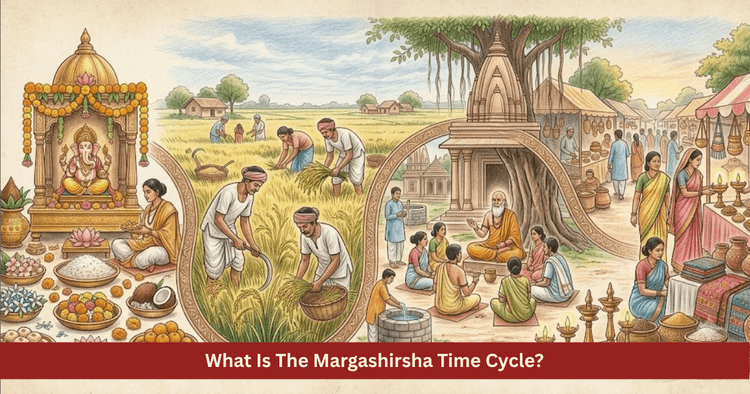
Table of Contents
Cosmic Calculations And The Margashirsha Time Schedule
Within the sacred Vedic tradition the movement of cosmic time is determined by the precise astronomical relationship between the Sun and the Moon. The 9th month of the Hindu lunar year known as Margashirsha and popularly called Agahan holds immense significance for its spiritual nature and astronomical alignment. This sanctified period falls across the transition between November and December in the Gregorian calendar. When the Sun enters the concluding phase of its southern journey and nature shifts from autumn into the coolness of early winter, this divine month begins. Engaging in spiritual disciplines during this season grants profound mental stillness and inner illumination. Understanding the principal dates, Gregorian calendar alignments and scriptural guidelines is essential for every earnest spiritual seeker.
| Astrological Factor | Vedic Directive And Time Alignment |
|---|---|
| Hindu Calendar Position | 9th month of the lunar year marking early winter |
| Gregorian Calendar Window | Spanning 30 days generally between 15 November and 25 December |
| Calendar Calculation Split | Purnimanta system in North India and Amavasyanta in South and West India |
| Presiding Deities | Lord Krishna, Lord Vishnu, Chandra the Moon and Devaguru Brihaspati |
| Significant Observances | Kalabhairav Ashtami, Utpanna Ekadashi, Vivah Panchami and Mokshada Ekadashi |
| Daily Spiritual Practice | Pre dawn river bath, sacred conch worship, Gita recitation and charity |
With the arrival of the month of Margashirsha the atmosphere fills with tranquil satvic energy. Scriptural tradition advises rising daily before sunrise during the quiet hours of Brahma Muhurta to bathe in consecrated river waters or clean domestic water infused with holy river water.
- Consecrate a sacred conch with clean water every morning to bathe the divine icon of Lord Krishna
- Ignite an earthen or copper lamp filled with pure sesame oil or cow ghee near the sacred tulsi altar
- Recite the 10th or 11th chapter of the sacred Bhagavad Gita with unwavering devotion every day
- Observe a disciplined fast on Thursdays while performing dedicated worship of Lord Vishnu and Mahalakshmi
- Distribute protective warm clothing, blankets, sesame seeds, raw jaggery and cooked grains to indigent individuals
- Abstain completely from impure food, alcoholic beverages, garlic, onions, daytime slumber and malicious speech
Observing this demanding discipline strengthens natural physical immunity and eliminates chronic emotional turmoil. This sacred seasonal window lifts the human consciousness above material trivialities, guiding the soul toward self discovery and enduring serenity.
What Distinguishes The Purnimanta And Amavasyanta Systems?
Across different cultural geographies of India the Hindu calendar follows two distinct methods of lunar calculation designated as Purnimanta and Amavasyanta. In northern states including Uttar Pradesh, Bihar, Rajasthan, Madhya Pradesh, Haryana and Punjab the Purnimanta calendar is observed. Under this traditional method a lunar month culminates on the full moon day and the subsequent month begins immediately on the first day of the dark fortnight following Kartik Purnima. Consequently the month of Margashirsha commences around the second or third week of November in the civil calendar.
Conversely in southern states such as Karnataka, Andhra Pradesh, Tamil Nadu, Kerala and western regions like Maharashtra and Gujarat the Amavasyanta system prevails. Under this method the lunar cycle begins on the day following the new moon which is the first day of the bright fortnight. This arrangement implies that when North India completes the dark half of Margashirsha and embarks upon the bright half, southern and western regions mark the first day of their month of Margashirsha.
Although this technical divergence creates a visible interval of 15 days between the two frameworks, every major religious celebration falling within the bright fortnight is observed on the identical astronomical day across the entire subcontinent. Festivals such as Mokshada Ekadashi and Vivah Panchami are observed universally on the exact same date. The Purnimanta system charts the passage of time from fullness to fullness, whereas the Amavasyanta system measures time from one new moon to the next.
Mathematical Harmonization Of Solar And Lunar Years
The Gregorian calendar operates on a solar framework based on the 365.2422 days required by the Earth to complete a single orbital revolution around the Sun. In contrast the Vedic lunar calendar tracks the visible phases of the Moon. A complete synodic lunar cycle spans approximately 29.53 days, resulting in a 12 month lunar year of roughly 354.36 days.
This astronomical reality creates an annual discrepancy of roughly 11 days between the solar cycle and the lunar cycle. If this cumulative difference remained uncorrected, traditional Hindu festivals would drift across entirely unrelated agricultural seasons over the decades. Vedic astronomers resolved this challenge through an intercalary month known as Adhika Masa or Purushottam Masa. Occurring once every 32 months and 16 days, this added lunar cycle realigns the lunar calendar with the seasons and the solar year.
Because of this sophisticated calculation the month of Margashirsha does not begin on the same Gregorian date each year. In certain years it commences near 12 November, while in other years it begins closer to 25 November. The month concludes between 12 December and 26 December on the auspicious day of Margashirsha Purnima. This shifting calendar window demonstrates how Vedic astrology remains in complete harmony with subtle cosmic rhythms and environmental changes.
What Is The Astrological Meaning Of Dhanu Sankranti?
During the concluding half of the month of Margashirsha an important astronomical ingress occurs known in classical Vedic astrology as Dhanu Sankranti. When the Sun departs from the water sign of Scorpio to enter the fiery sign of Sagittarius governed by Jupiter, the period of Dhanu Kharmas begins. This celestial transit generally takes place on 15 December or 16 December of the Gregorian calendar.
In classical astrological doctrine the Sun signifies the inner soul, vitality, dignity and temporal authority, whereas Devaguru Brihaspati rules spiritual righteousness, deep intellect, moral wisdom and the guidance of preceptors. When the Sun enters the sign of his preceptor, he tempers his scorching heat to adopt an attitude of reverent discipleship. This energetic shift pauses external material ambitions across the earth, awakening intense spiritual introspection and sacred learning.
- Celebratory worldly rites such as marriages, hair cutting ceremonies and new enterprise launches are paused for 30 days
- Spiritual practices including scriptural chanting, listening to sacred lore, fire rituals and pilgrimages yield manifold benefits
- Chanting the Vishnu Sahasranama during this transit mitigates the afflictions of weak placements of the Sun and Jupiter
- Dhanu Sankranti establishes the preliminary spiritual foundation for the northern solar journey known as Uttarayana
- Seekers who practice disciplined contemplation and control mundane desires easily secure the grace of noble preceptors
Vedic astrology clarifies that Kharmas is not an inauspicious phase, but a sacred interlude designed for detaching from material pursuits and surrendering to divine contemplation.
Seasonal Health And Daily Spiritual Life In Hemanta
In Ayurvedic science and Vedic lifestyle the month of Margashirsha serves as the gateway to the early winter season of Hemanta. As the month progresses, cool breezes cause the innate digestive fire known as Jatharagni to concentrate and burn with immense power. Classical texts like the Charaka Samhita record that when atmospheric temperatures drop, biological heat remains preserved within the body, making digestive capability remarkably robust.
If the human body is denied substantial and unctuous nourishment during this season, that intense internal fire begins to consume bodily tissues. Therefore ancient sages laid down specific nutritional guidelines for the month of Agahan. Consuming foods that are warming, unctuous and sweet provides vital nourishment and prevents biological depletion.
- Massage the body daily with pure sesame oil or mustard oil before bathing to pacify the vata humor
- Emphasize nutrient dense seasonal foods such as unrefined jaggery, black sesame seeds, peanuts, pure cow ghee and millets
- Avoid cold refrigerated drinks, yogurt, radishes and stale food items late at night to prevent respiratory afflictions
- Bask in gentle early morning sunlight to strengthen the skeletal framework and absorb natural vitality
- Begin each morning with physical ablutions in lukewarm water followed by offering water to the Sun from a clean copper vessel
These physiological regulations do not merely nourish the physical frame, for a sound physical vehicle serves as the foundation for an unshakeable mind. When the physical body is healthy and balanced, the spiritual seeker can engage in deep meditation and mantra repetition without bodily distraction.
The Eternal Flow Of Consciousness Across Cosmic Time
The alignment of Margashirsha across November and December reminds humanity that time is not merely a sequence of numerical dates recorded upon printed calendars. Cosmic time is the vast living presence of the divine, constantly moving yet eternally unmoving. In the sacred Bhagavad Gita Lord Krishna declares that he is time itself, sustaining and directing the movement of all creation.
When the cool mornings of November and December announce the arrival of this sacred month, nature invites us to pause our outward hurry. Just as a farmer gathers ripe grain into the shelter of his granary, human beings must gather their scattered thoughts to abide in the sanctuary of the inner soul. The time cycle of Margashirsha provides an opportunity for self discipline, compassionate charity and spiritual devotion that illuminates human life with lasting peace.
FAQ
Which Gregorian months coincide with the month of Agahan? The month of Agahan generally begins in the middle of November and concludes during the middle or final week of December.
What is the core difference between Purnimanta and Amavasyanta calendars? The Purnimanta month ends on the full moon day and is followed in North India, while the Amavasyanta month ends on the new moon day and is observed in South and West India.
Why are celebratory marriages paused during the later half of Agahan? When the Sun enters the sign of Sagittarius in late Agahan, the period of Kharmas begins during which worldly celebrations pause to prioritize spiritual practices.
Why is Margashirsha revered as the direct embodiment of Lord Krishna? In the 10th chapter of the Bhagavad Gita Lord Krishna states that among all months he is Margashirsha, establishing it as his direct divine presence.
Which sacred deities are primarily worshipped during the month of Agahan? Devoted seekers worship Lord Krishna, Lord Vishnu, the sacred Dakshinavarti conch, the Moon and Devaguru Brihaspati for spiritual and material wellbeing.
Get your accurate Kundali
Generate KundaliDid you like it?
Author

Pt. Sanjeev Sharma (63)
Experience: 20
Consults About: Family Planning, Career
Clients In: Punjab, Haryana, Delhi
Share this article with friends and family
WELCOME TO
ZODIAQ
Right Decisions at the right time with ZODIAQ
