The Future of Agro-Panchang - Blending Tradition with Technology
By Aparna Patni
Integration of Digital Agriculture and Climate-Smart Farming
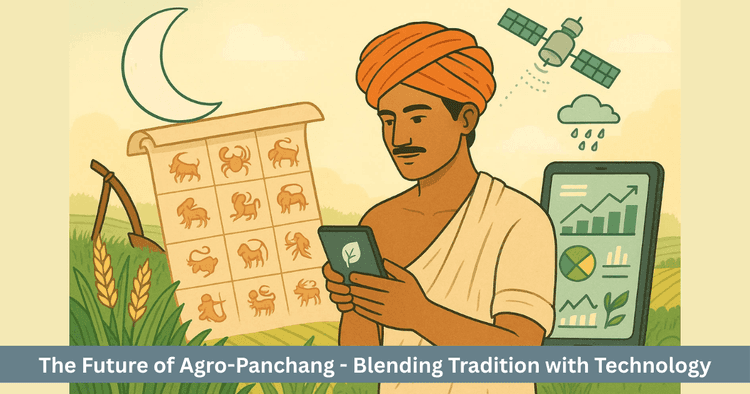
Table of Contents
This article is based on moon sign. To find your moon sign, check the position of the Moon at the time of your birth. The moon sign is the zodiac sign in which the Moon was positioned at birth.
The future of the Agro-Panchang, the traditional Indian agricultural almanac, lies in a powerful synthesis of ancient wisdom and modern technology. As climate change disrupts traditional farming cycles, a new generation of digital Krishi Panchangs is emerging, blending the holistic, nature-centric approach of Vedic agriculture with the precision of data-driven technology to create a more resilient and productive farming future.
The Vision: A Climate-Smart, Hyperlocal Almanac
The traditional Krishi Panchang, based on astronomical observations, has guided farmers for centuries on the best times for sowing, planting and harvesting. however its generalized, region-level advisories are becoming less reliable in the face of erratic monsoons and unpredictable weather patterns.
The future vision is to transform the Panchang into a "climate-smart" tool that is both forward-looking and hyperlocal. This is being achieved by integrating its foundational principles with a suite of modern agricultural technologies:
Precision Weather Forecasting
Instead of relying solely on historical astronomical patterns, the new Agro-Panchang incorporates real-time and predictive weather data from satellite imagery and ground-based sensors. This allows for more accurate rainfall prediction and temperature forecasts, enabling farmers to make better-informed decisions.
AI and Machine Learning
Artificial intelligence is being used to analyze vast datasets, including soil health, moisture levels, historical crop performance and long-term climate models. This data can be used to generate highly customized advisories, suggesting optimal sowing dates and crop choices down to the individual farm level.
IoT and Sensor Technology
Internet of Things devices, such as soil sensors, can provide real-time information on nutrient and moisture levels. When this data is integrated with the Panchang's guidance on auspicious timings, it creates a powerful tool for precision agriculture, ensuring that resources like water and fertilizers are used at the most effective times.
Mobile Technology
The widespread adoption of smartphones in rural India has made it possible to deliver these sophisticated advisories directly into the hands of farmers. Mobile apps can provide daily updates, personalized alerts and a user-friendly interface that translates complex data into actionable insights.
Table: From Traditional to Tech-Enhanced
| Feature | Traditional Krishi Panchang | Future Agro-Panchang (Digital) |
|---|---|---|
| Data Source | Astronomical tables (Surya Siddhanta) | Real-time satellite data, weather models, soil sensors |
| Advisory Scope | Regional, generalized | Hyperlocal, farm-specific |
| Methodology | Based on fixed celestial cycles | Dynamic, AI-driven predictive analytics |
| Focus | Auspicious timings (muhurats) | Integrated crop management (timing, inputs, risk) |
| Delivery | Printed almanacs, oral tradition | Mobile apps, SMS alerts, digital platforms |
The Synergy of Old and New
The goal of this technological integration is not to replace the ancient wisdom of the Panchang but to enhance it. The Panchang provides a holistic framework that considers the subtle energetic influences of the cosmos, a dimension often missing from purely scientific models. It encourages a form of agriculture that is attuned to the rhythms of nature, promoting soil health and biodiversity.
When this time-tested wisdom is combined with the precision of modern technology, the result is a powerful system of "precision agriculture" that is both productive and sustainable. This blend can:
Increase Climate Resilience
By providing more accurate weather forecasts and guidance on climate-resilient crops, the tech-enhanced Panchang can help farmers mitigate the risks of drought, floods and extreme weather.
Boost Productivity
By optimizing the timing of agricultural activities and the use of resources, it can lead to higher crop yields and better economic outcomes for farmers.
Promote Sustainability
By encouraging natural farming methods and reducing the reliance on chemical inputs, it can contribute to a healthier environment.
Tech Mahindra's Panchang Intelligence
Tech Mahindra's Panchang Intelligence system demonstrated that Panchang principles apply globally, achieving 70-80% rainfall prediction accuracy across 40 years of rainfall data from 20+ international locations. This validates accuracy comparable to modern weather forecasting while enabling one-year-in-advance predictions.
This suggests potential for international dissemination to regions lacking advanced meteorological infrastructure, enabling developing nations to access sophisticated agricultural guidance through Panchang-based systems.
Current Applications
E-Krishi Panchang Apps
Developed by Indira Gandhi Agricultural University in Chhattisgarh, the e-Krishi Panchang app provides farmers with daily agricultural advice, weather forecasts, farming methods and auspicious day information.
Digital Agriculture Mission
India's Digital Agriculture Mission (Rs 2,817 crore budget) now incorporates technology-enabled Panchang systems into official agricultural advisory infrastructure, with expectations that 60-70% of farmers will use digital platforms by 2030.
Key Future Priorities
Hyperlocal Microzone Calendars
Replace district-wide advisories with taluk/village-level micro-calendars reflecting ridge-valley rainfall contrasts, canal schedules and groundwater status, updated every 1-2 weeks based on incoming weather and farmer feedback.
Twin-Trigger Decision Engine
Open sowing/transplant windows only when soil moisture and 3-5 day wet spells are forecast, then use auspicious mini-muhurats (tithi-nakshatra-yoga-karana combinations) to fine-tune planting times.
Dynamic Crop Recommendations
If seasonal forecasts suggest delay/deficit rainfall, pivot to short-duration, drought/heat-tolerant varieties; if heavy-rain risk rises, switch to flood-tolerant crops through automated advisories.
Frequently Asked Questions
Question 1: How is digital Agro-Panchang different from traditional Krishi Panchang?
Digital Agro-Panchang uses real-time satellite data, weather models and AI for precise, hyperlocal farm-level advice, while traditional Panchang provides only generalized regional guidance based on astronomical calculations.
Question 2: Is the e-Krishi Panchang app actually helping farmers in practice?
Yes, e-Krishi Panchang apps deliver 15-20% crop yield increases and 30% pesticide reduction, plus improved soil health through precision timing and climate-smart crop selection.
Question 3: How does climate change affect Panchang-based advice?
Modern digital systems handle climate change through predictive forecasting, recommending climate-resilient crops and adaptive strategies; India experienced 94% average rainfall in 2023 demonstrating system resilience.
Question 4: Can small farmers use digital Panchang for tiny landholdings?
Yes, IoT sensors, soil data and mobile apps provide hyperlocal advice for farms of all sizes; India's Digital Agriculture Mission specifically targets smallholder farmers nationwide.
Question 5: Will this system achieve widespread adoption by 2030?
Yes, projections indicate 60-70% of farmers will use digital platforms by 2030, with active promotion by national and state governments and existing successful pilot programs across multiple states.
Get your accurate Kundali
Generate KundaliDid you like it?
Author

Aparna Patni (63)
Experience: 20
Consults About: Family Planning, Career
Clients In: Punjab, Haryana, Delhi
Share this article with friends and family
WELCOME TO
ZODIAQ
Right Decisions at the right time with ZODIAQ
