Why Do Auspicious Ceremonies Halt During Kharmas?
By Pt. Suvrat Sharma
Kharmas Secrets, Dhanu Sankranti, Prohibitions And Spiritual Remedies
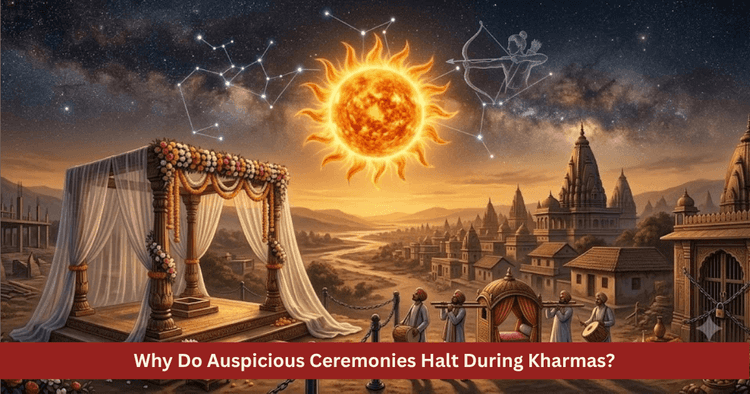
Table of Contents
Calendrical Framework and Astronomical Context of Dhanu Sankranti
According to the classical doctrines of Vedic astronomical computation, a major portion of the sacred month of Paush falls under a distinct celestial and metaphysical phase scripturally designated as 'Kharmas' or 'Dhanurmas'. Reckoned through the Gregorian solar calendar, this specific period generally commences annually around December 15 or 16 and continues unbroken until January 14 or 15, culminating at the grand astronomical festival of Makar Sankranti. The exact celestial moment when the visible solar deity, Lord Surya Narayana, concludes his transit through the watery Martian sign of Scorpio and steps into the fiery, dual sign of Sagittarius (Dhanu), governed by Deva Guru Jupiter, is celebrated as 'Dhanu Sankranti'.
The occurrence of Dhanu Sankranti immediately activates the classical scriptural injunctions of Kharmas across the terrestrial plane for a full solar month. Throughout this sensitive window, traditional Hindu society observes a complete suspension of major external, worldly auspicious ceremonies (Mangalik Karya)-including weddings, betrothals, laying foundations for new homes, housewarming rites (Griha Pravesha), tonsure ceremonies (Mundan), sacred thread investitures (Upanayana) and the launching of new commercial enterprises. While popular imagination sometimes misinterprets this pause as an inauspicious or negative omen, deep contemplation of Vedic astrology and scriptural compendiums proves that this period is never inauspicious; rather, it is a sanctified transition designed to halt outward physical vanity, turning human consciousness inward toward spiritual study, divine contemplation and righteous self discipline.
| Calendrical & Astrological Dimension | Classical Position & Scriptural Definition | Cosmic & Metaphysical Influence |
|---|---|---|
| Niyam | Vidhan | Vidhan |
| Month Sequence | Paush Month (10th month of Sanatana calendar) | Period of worldly pause and profound spiritual study |
| Solar Ingress Event | Dhanu Sankranti (Sun enters Sagittarius) | Sacred convergence of celestial fire and divine wisdom |
| Temporal Duration | Dec 15/16 through Jan 14/15 (until Makar Sankranti) | The quietest and most introspective month of the solar cycle |
| Zodiacal Association | Sagittarius (Dhanu), 9th zodiac sign (Dual, Fire) | Softening of physical solar heat, expansion of sattva |
| Prohibited Undertakings | Weddings, betrothals, housewarmings, tonsures | Conscious restraint upon worldly vanity and material desire |
| Commended Disciplines | Naming rites, initiation into learning, japa, pilgrimage | Intellectual purification, spiritual elevation, ancestral peace |
| Presiding Solar Deity | Bhaga Aditya | Awakening of spiritual opulence, inner vitality, willpower |
| Prescribed Nutritional Code | Warm, unctuous meals, sesame, jaggery, hot khichdi | Balancing internal digestive fire, harmonizing winter humors |
Kharmas reminds humanity that human life is not meant exclusively for external social displays, celebratory banquets and sensory indulgence. Periodic withdrawal from worldly distractions to introspect upon one's spiritual roots is an absolute necessity for inner evolution. When the Sun enters the residence of his spiritual preceptor, Jupiter, it becomes the righteous duty of the disciple to quiet personal ego, sitting with humility at the preceptor's feet to assimilate higher spiritual wisdom.
Astrological and Cosmic Mechanics: Sun Softening in the House of Jupiter
In classical Vedic astrology, the Sun is revered as the king of the planetary council, the natural significator of the immortal soul (Atma), administrative authority, societal honor and the direct physical source of terrestrial vitality. Conversely, Deva Guru Jupiter reigns as the supreme celestial preceptor of cosmic wisdom, pure righteousness (Dharma), intellectual discernment, marital longevity, progeny and divine benevolence. When the Sun transits through Sagittarius-an expansive, fiery sign owned by Jupiter-a profound metaphysical alchemy takes place across the cosmos.
Scriptural wisdom affirms that before one's spiritual preceptor, the worldly authority and fiery ego of the disciple naturally soften into respectful silence. While transiting Sagittarius, the Sun surrenders his aggressive, outward physical heat to the tranquil, spiritual aura of Jupiter. This astrological conjunction is classically termed the 'Guru-Aditya Sambandha'. Because Jupiter's cosmic attention becomes absorbed in welcoming and mentoring the Sun, the external beneficence that Jupiter normally projects to nourish worldly affairs-most notably the vital 'Guru Bala' (strength of Jupiter) essential for sanctifying marital unions-temporarily subsides.
| Celestial Factor | Standard Planetary Domain | Dynamic Manifestation in Sagittarius Transit | Direct Consequence on Worldly Affairs |
|---|---|---|---|
| Niyam | Vidhan | Vidhan | Vidhan |
| Lord Surya (Sun) | Soul, sovereignty, physical heat, ego | Rendered sattvic, quiet and deeply introspective | Worldly vanity loses vigor; spiritual hunger awakens |
| Deva Guru Jupiter | Wisdom, marriage, progeny, expansion | Absorbed in spiritual hospitality; external grace subdued | Temporary absence of Guru Bala in wedding charts |
| Sagittarius (Dhanu) | Dharma, philosophy, dual nature, fire | Inspires higher contemplation; subdues materialism | Worldly pursuits encounter obstacles; sadhana bears fruit |
| Terrestrial Climate | Deep winter cold, minimal solar radiation | Steep temperature drops, accumulation of cold dampness | Biological energy turns inward; outer activity slows |
Sagittarius represents the natural ninth house of the cosmic wheel (Kalapurusha), governing divine righteousness, pilgrimage, philosophy and fortune. When the Sun illuminates the ninth house, human consciousness is naturally drawn away from trivial material attachments toward philosophical inquiry. If an individual attempts to pursue outward material ambitions-such as marriage or domestic construction-during this window, the necessary protective grace of Jupiter is lacking. For this reason, ancient seers designated this period as unsuited for external social celebrations but ideal for internal spiritual realization.
Scriptural Mythology and the Allegorical Origin of 'Kharmas'
Within classical Puranic literature, particularly the Bhavishya Purana and the Saura Purana, an allegorical narrative illustrates the origin of the name 'Kharmas'. This sacred legend conveys deep truths regarding cosmic balance and the unconditional compassion of the Sun God.
According to sacred lore, Lord Surya traverses the celestial expanse upon a magnificent golden chariot drawn by seven radiant steeds, which symbolize the seven colors of visible light and the seven foundational Vedic poetic meters (such as Gayatri, Trishtubh and Jagati). The chariot of the Sun is bound by cosmic law never to halt, for if the solar chariot were to stop for even a single moment, universal time would freeze, seasonal cycles would collapse and terrestrial life would dissolve into darkness. Having run without pause across the heavens for months, the seven celestial horses become exhausted, parched with thirst and foam begins to drip from their mouths as the chariot approaches the month of Paush.
- The Weary Steeds and the Sacred Lake: Seeing his horses trembling with fatigue, Lord Surya is moved by deep parental compassion. He desires to offer them cool water and rest beside a celestial lake, yet the cosmic law forbids halting his chariot completely.
- Harnessing the Donkeys (Khar): Grazing near the shores of the lake were two wild donkeys ('Khar'). To grant his horses an opportunity to rest without halting cosmic time, Lord Surya unharnessed the seven horses and yoked the two donkeys to his celestial chariot.
- The Deceleration of Solar Velocity: Because the donkey is naturally plodding, slow and suited for heavy burdens rather than swift flight, the speed of the solar chariot decelerated immediately. For an entire solar month, the Sun travelled at a sluggish pace across the skies.
- Nomenclature of 'Kharmas': Because the celestial chariot was propelled by donkeys (Khar), this month long interval was designated as 'Kharmas'. When the Sun reaches the boundary of Capricorn on Makar Sankranti, he unyokes the donkeys, re-harnessing his revitalized seven horses, who leap forward into the northern skies with renewed brilliance.
The philosophical essence of this allegory is profound. The seven swift horses represent the human senses and mental faculties, while the donkey symbolizes physical resting, patience and deliberate slowing down. In the month of Poos, cosmic nature slows its pace, ambient warmth subsides and the universe enters a period of quiet hibernation. This story teaches humanity that pausing the hectic race of life to restore biological and mental reserves is a fundamental law of cosmic nature.
Prohibited Worldly Undertakings: What to Avoid and Scriptural Injunctions
Authoritative compendiums of Vedic liturgical law, including the Nirnaya Sindhu, Dharma Sindhu and Muhurta Chintamani, strictly prohibit specific social and domestic sacraments during Kharmas. These prohibitions are grounded in subtle energetic realities and generational preservation rather than arbitrary superstition.
| Prohibited Auspicious Rites | Scriptural Reason for Prohibition | Potential Adversities Warned in Texts |
|---|---|---|
| Niyam | Vidhan | Vidhan |
| Sacred Matrimony (Vivaha) | Absence of supportive Guru Bala and Venusian harmony | Discord in marriage, instability, lack of mutual joy |
| Betrothals & Formal Engagements | Deficient auspicious solar-jupiter energy for commitments | Unexpected ruptures in alliances, delayed nuptials |
| Foundation Laying of Homes | Weakened solar vitality essential for architectural stability | Construction stalls, financial drainage, structural flaws |
| Housewarming (Griha Pravesha) | Inability to establish positive stable energies in deep cold | Persistent domestic strife, health complications |
| Tonsure Rites (Mundan) | Delicate balance of infant prana during winter peak | Vulnerability to respiratory illness, cognitive fatigue |
| Sacred Thread Investiture | Absence of combined solar and jupiter radiance for Gayatri | Distraction in spiritual learning, lack of focus |
| Launch of New Commercial Firms | Jupiter's outward commercial grace withdrawn into contemplation | Stagnant capital, debt accumulation, partner mistrust |
In traditional marriage calculations, the blessing of Jupiter is indispensable, as Jupiter governs the longevity of marital harmony, mutual respect and healthy progeny. Because Jupiter's outward protective radiance remains subdued during Kharmas, marriages solemnized during this period are deprived of this cosmic umbrella.
Similarly, performing a housewarming ceremony requires harmonious solar and environmental warmth to consecrate the domestic hearth. When the Sun travels low on the southern horizon amidst dense fog and cold dampness, stabilizing positive life force within a new structure is difficult. Therefore, rather than initiating new physical structures, this period is meant to consolidate existing foundations.
Commended Spiritual Disciplines: What is Permitted and Highly Fruitful
It is an erroneous assumption that all human activity ceases during Kharmas. Classical lawbooks distinguish between 'Kamya Karma' (actions undertaken for personal material gain, sensory joy and social prestige) and 'Nitya-Naimittika Karma' (daily spiritual duties, emergency obligations and devotional practices). While Kamya ceremonies are paused, devotional and inward practices are not only permitted but yield spiritual merits magnified manifold.
- Naming Ceremonies (Namakarana): Consecrating an infant's name is a vital duty that cannot be indefinitely postponed. Performing the Namakarana during Kharmas is scripturally approved and auspicious.
- Initiation into Learning (Vidyarambha): Introducing a child to the alphabet and higher study is considered exceptionally blessed, as the Sun resides in the intellectual sign of Jupiter.
- Unbroken Daily Devotions (Nitya Upasana): Morning prayers, Gayatri japa, offering water to the Sun and serving the holy Tulsi plant must continue without interruption.
- Study of the Srimad Bhagavatam and Gita: Kharmas is hailed as the premier period for listening to the Srimad Bhagavatam. Contemplating the transcendental sports of Lord Krishna guides the soul toward spiritual liberation.
- Pilgrimage and Holy Confluence Baths: Bathing in sanctified waters at Prayagraj, Haridwar, Kashi and Gangasagar yields spiritual fruits equivalent to performing royal sacrifices.
- Healing Rituals and Medical Interventions: For chronic illnesses, initiating Ayurvedic therapies, performing Mahamrityunjaya japa, or reciting the Surya Kavacha is deeply efficacious.
- Ancestral Rites (Shraddha and Tarpana): Offering water and sesame oblations to departed ancestors during this month brings deep satisfaction to forebears, dissolving inherited generational blockages.
Kharmas is an alchemical furnace for the human soul. Just as raw gold must endure intense heat to emerge as pure ornament, human consciousness must step away from worldly vanity into the furnace of self restraint to reveal its divine nature.
Vaishnava Traditions in Dhanurmas: The Glory of Thiruppavai
While the northern plains observe Kharmas as a period of quiet contemplative stillness, southern Bharat celebrates this window as 'Dhanurmas'-a vibrant festival of unalloyed Vaishnava devotion. Across the sacred temples of Tamil Nadu andhra Pradesh, Karnataka and Kerala, this month is dedicated to intense devotional service to Lord Ranganatha, Lord Venkateshwara and the saint-poetess Andal (Goda Devi).
Within the sacred lineage of the twelve Alwar saints, Mother Andal-the sole female mystic-observed an intense spiritual vow during Dhanurmas to attain Lord Ranganatha as her eternal divine consort. Rising before dawn each day, she composed thirty devotional verses (Pashurams) known collectively as the 'Thiruppavai', which remain a crown jewel of devotional literature.
| Vaishnava Sadhana Aspect | Liturgical Observance & Method | Metaphysical & Social Significance |
|---|---|---|
| Niyam | Vidhan | Vidhan |
| Recitation of Thiruppavai | Chanting one Pashuram daily before dawn in temples | Total surrender of the individual soul to the Divine |
| Dawn Worship (Ushakkala Puja) | Consecrating deities prior to morning sunrise | Overcoming physical sloth, elevating internal sattva |
| Offering of Ven Pongal | Consecrating warm rice, lentils, black pepper and ghee | Nutritional protection, communal distribution of prana |
| Goda Kalyanam Celebration | Divine wedding of Andal and Ranganatha at month's end | The supreme spiritual union of the devotee with God |
| Sacred Morning Dips | Maiden girls bathing in holy rivers at dawn | Marital harmony, character purity, cultural awakening |
Throughout Dhanurmas, courtyards in southern India are adorned with geometric floor patterns (Kolam) crafted from natural rice flour. Temples open their portals at 4:00 AM, welcoming devotees with the blowing of conch shells, the ringing of bells and the fragrance of steaming Ven Pongal. This living tradition demonstrates that Kharmas is not a season of sorrow or stagnation but a celebration of selfless love, surrender and divine absorption.
Scientific and Psychological Rationale Behind the Winter Pause
Vedic traditions reflect an intimate harmony between environmental science, human psychology and physiology. The ancient sages formulated the restrictive codes of Kharmas with profound concern for social welfare and biological health.
During late December and early January, the northern hemisphere endures severe winter frost, dense fog and bone-chilling cold waves. Environmental conditions are hostile to large-scale outdoor gatherings. Permitting lavish celebrations during this period would impose severe biological and practical strains upon society.
- Protecting the Health of Guests: Traveling across distances during severe cold waves is hazardous. Exposing elderly relatives and infants to freezing winter drafts invites respiratory infections, hypothermia and cardiovascular distress.
- Resource Preservation and Hygiene: Managing food preparation and personal hygiene for hundreds of wedding guests during severe cold and dense fog presents immense logistical challenges.
- Alleviating Psychological Stress: The physical exhaustion and sleep deprivation associated with organizing grand weddings elevates blood pressure during cold weather. The pause of Kharmas allows families to remain safely sheltered at home.
- Biological Conservation of Prana: Ayurveda notes that the human body naturally gathers its thermal and pranic vitality inward during deep winter. Wandering outdoors in hectic pursuits dissipates vital immune reserves. Sheltering quietly at home with warm nutrition fortifies health for the year ahead.
Thus, the prohibitions of Kharmas function as a societal shield, protecting human communities from seasonal ailments and natural hardships.
Time-Tested Astrological Remedies for Kharmas
By implementing simple, authentic Vedic remedies during the quiet days of Kharmas, an individual can pacify planetary afflictions, inviting peace, vitality and prosperity into the home.
- Daily Copper Pitcher Solar Oblation: Rise during Brahma Muhurta, filling a clean copper vessel with water, vermilion, unbroken rice, jaggery and red flowers. Offer this to the rising sun while chanting 'Om Suryaya Namah' or 'Om Bhagaya Namah' to strengthen the natal Sun.
- Charity of Yellow Articles for Jupiter: Propitiate Deva Guru Jupiter by donating split chickpeas, turmeric, gram flour sweets, yellow garments and sacred scriptures to a scholar or deserving student on Thursdays.
- Feeding Sacred Cows: Every morning, reserve the first freshly prepared wheat bread, enriching it with pure cow ghee, dark jaggery and black sesame seeds before feeding it to a cow to harmonize the Sun, Jupiter and Saturn.
- Service to the Peepal Tree: Pour clean water at the base of an ancient Peepal tree on Saturdays or the new moon day, kindling an unrefined mustard oil lamp at dusk to dispel ancestral afflictions and subterranean fears.
- Chanting the Vishnu Sahasranama: Seated quietly before the sacred Tulsi plant, recite the thousand transcendental names of Lord Vishnu to dissolve architectural Vastu defects and domestic friction.
- Warm Charity to the Destitute: Providing heavy woolen blankets, sturdy footwear and hot wholesome meals to shivering individuals surviving upon open streets constitutes direct worship of the Supreme Lord.
These noble disciplines burn away accumulated past life impressions, filling the practitioner's heart with serenity and spiritual power.
From Kharmas to Makar Sankranti: The Dawn of Ascending Light
The sacred interval of Kharmas culminates on January 14 or 15 at that celestial moment when the Sun concludes his transit through Sagittarius, crossing the threshold into the Saturnian sign of Capricorn (Makara). Celebrated across Bharat as 'Makar Sankranti', this astronomical ingress marks the formal commencement of Uttarayana-the daytime of the gods.
A month of contemplative silence, scriptural study and self restraint prepares human consciousness to greet the returning light of Uttarayana. Just as a radiant dawn follows the stillness of the night, joyous social celebrations, weddings and domestic milestones resume across society with renewed vitality once Kharmas concludes.
Kharmas delivers an eternal lesson: pausing is as essential to existence as moving forward. Without the night, the beauty of day cannot be perceived; without the winter cold, the warmth of the sun cannot be appreciated; and without the quietude of spiritual sadhana, external celebration remains empty noise. An individual who embraces the divine discipline of Kharmas discovers a life illuminated by the perfect balance of righteousness, prosperity, noble purpose and spiritual liberation.
FAQ
When does Kharmas begin and end each year and what is its astronomical cause? Kharmas occurs annually from December 15-16 through January 14-15 (Makar Sankranti), triggered when the Sun enters the zodiac sign of Sagittarius.
Why are weddings and housewarming ceremonies prohibited during Kharmas? When the Sun enters Jupiter's sign, Jupiter's outward protective vitality softens, temporarily withdrawing the 'Guru Bala' essential for sanctifying marital harmony and domestic stability.
Can naming ceremonies and first food feeding rites for infants be performed in Kharmas? Yes, Namakarana and Annaprashana are essential developmental duties and are scripturally permitted and auspicious during Kharmas.
What is the mythological allegory behind the name 'Kharmas'? According to sacred lore, Lord Surya hitched two donkeys ('Khar') to his chariot to allow his exhausted horses to rest, slowing the solar pace and giving the month its name.
Which spiritual practices are most meritorious during the month of Kharmas? Listening to the Srimad Bhagavatam, reciting the Bhagavad Gita, offering copper pot water oblations to the Sun, chanting the Gayatri Mantra and taking holy pilgrimage baths yield supreme merit.
Get your accurate Kundali
Generate KundaliDid you like it?
Author
Pt. Suvrat Sharma (63)
Experience: 20
Consults About: Family Planning, Career
Clients In: Punjab, Haryana, Delhi
Share this article with friends and family
WELCOME TO
ZODIAQ
Right Decisions at the right time with ZODIAQ
