What Is The Significance Of Guru Gobind Singh Jayanti?
By Aparna Patni
Paush Shukla Saptami, Prakash Parv, Khalsa Creation And Sahibzada Martyrdom
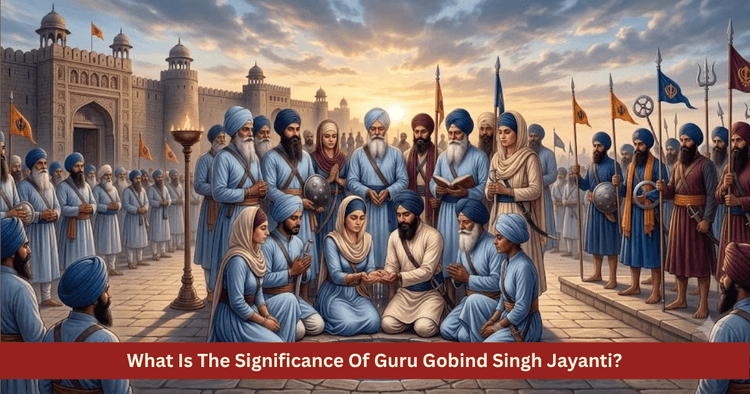
Table of Contents
Paush Shukla Saptami and the Divine Prakash Parv of the Tenth Master
According to the classical doctrines of the Vedic panchang and Sanatana chronological computation, the Saptami (seventh lunar date) of the waxing fortnight (Shukla Paksha) in the month of Paush represents one of the most luminous, spiritually charged and revolutionary milestones in the history of human civilization. Upon this sanctified date, the tenth master of the Sikh lineage, the creator of the Khalsa Panth and the supreme archetype of the saint-soldier, Sri Guru Gobind Singh Ji, manifested upon the earth at historic Patna Sahib in Bihar. Within the Sikh tradition, this blessed occasion is celebrated across the globe with boundless reverence, liturgical majesty and joy as 'Prakash Parv' (the Festival of Divine Light). This winter date marks far more than a conventional hagiographical anniversary; it embodies the awakening of human dignity, religious sovereignty, armed resistance against tyranny and the living synthesis of mystical devotion and martial valor.
During an era when the Indian subcontinent was engulfed in the dark shadows of Mughal imperial atrocities, forced religious conversions and psychological subjugation, the advent of Guru Gobind Singh Ji shone forth like a spiritual sun. He systematically dismantled the collective despair, cowardice and fatalism that paralyzed society. He proved that true spirituality is never confined to passive contemplation within mountain caves but demands that a righteous soul draw the sword to confront oppressive tyrants in defense of suffering humanity.
| Historical & Spiritual Dimension | Classical Setting & Injunction Details | Societal & Civilizational Impact |
|---|---|---|
| Sacred Date of Advent | Paush Shukla Paksha Saptami | Awakening of martial courage and righteous consciousness |
| Consecrated Birthplace | Takht Sri Harmandir Ji, Patna Sahib (Bihar) | Spiritual bridge uniting the eastern and northern subcontinent |
| Revered Parents | Ninth Guru Sri Tegh Bahadur Ji & Mata Gujri Ji | Unbroken lineage of ascetic penance and supreme sacrifice |
| Foundational Creation | Creation of the Khalsa Panth (Baisakhi 1699) | Annihilation of caste hierarchies, armed self-defense |
| Supreme Epithets | Saint-Soldier, Sarbans Dani, Dashmesh Pita | Sublime synthesis of intense bhakti and sovereign shakti |
| Core Liturgical Practices | Akhand Path, Nagar Kirtan, Prabhat Pheri, Langar | Universal equality, community service, scriptural praise |
| Concluding Guru Lineage | Bestowing eternal guruship upon Guru Granth Sahib | Cessation of mortal gurus, installation of the living Word |
| Immortal Spiritual Proclamation | Chirion se main baaz ladaun, sawa lakh se ek ladaun | Transmission of indomitable courage and absolute fearlessness |
The life of the Tenth Master demonstrates that when all peaceful negotiations fail, drawing the sword in defense of righteousness becomes a sacred and dharmic obligation. The celebration of Paush Shukla Saptami serves as a timeless call to cast aside internal fear and stand unyielding upon the path of truth.
Early Manifestation at Patna Sahib and Youthful Feats
Guru Gobind Singh Ji was born on December 22, 1666 (Paush Shukla Saptami, Samvat 1723) along the banks of the sacred river Ganga in Patna. In his childhood, he was addressed as 'Gobind Rai'. Prior to his birth, his revered father, the ninth master Guru Tegh Bahadur Ji, was traversing northeastern regions (Assam and Bengal) to organize communities and sustain spiritual righteousness. Young Gobind Rai spent his formative early years in Patna.
From his earliest days, his persona displayed divine spiritual radiance intertwined with natural martial authority. Rather than engaging in frivolous play, he gathered young companions along the banks of the Ganga, dividing them into mock regiments to master tactical archery, equestrian movement and the siege of mock fortresses.
- The Vision of Pir Bhikhan Shah: At the moment of the child's birth, the celebrated Muslim Sufi mystic Pir Bhikhan Shah of Punjab bowed toward the east during his daily prayers. When questioned by disciples, he revealed that a divine celestial light had manifested in the east. Traveling to Patna, the pir placed two earthen bowls before the infant-one symbolizing Hinduism, the other Islam. Smiling with serenity, child Gobind Rai rested his small hands simultaneously upon both vessels, revealing that he manifested not for a narrow dogma but for the universal defense of human dignity.
- The Discarded Golden Bangles in the Ganga: When his mother adorned his wrists with valuable gold bangles, the young child threw one into the depths of the river Ganga. When asked where the ornament had fallen, he cast the second bangle into the river, pointing out the spot. Through this playful act, he revealed that physical gold and mundane wealth are transient, whereas the spiritual luminescence of the soul is eternal.
- The Realization of Pandit Shiv Dutt: A scholar named Pandit Shiv Dutt sat daily along the Ganga seeking visions of Lord Rama and Lord Krishna, yet his heart remained unfulfilled. When child Gobind Rai approached and the scholar opened his eyes, he beheld the four-armed transcendental vision of Rama and Krishna radiating from the child. The scholar bowed in surrender before the young master.
Having inspired society across the plains of Bihar, the young master journeyed with his family in 1671 to Anandpur Sahib in Punjab, which became the epic center of civilizational renewal.
The Cry of the Kashmiri Pandits and the Supreme Sacrifice of a Father
The latter half of the seventeenth century was a dark epoch for the Indian subcontinent. Upon the imperial throne of Delhi sat the fanatic Mughal emperor Aurangzeb, whose policy sought the total subjugation and forced conversion of non-Islamic populations. In Kashmir, the imperial governor Iftikhar Khan launched a campaign of persecution against the Kashmiri Pandits, presenting them with an ultimatum: embrace conversion or face systematic execution.
Desperate and defenseless, a delegation of Kashmiri scholars led by Pandit Kripa Ram Dutt sought sanctuary at Anandpur Sahib before the ninth master, Guru Tegh Bahadur Ji, begging for the preservation of their sacred faith, scriptural heritage and cultural identity.
- The Deep Contemplation of Guru Tegh Bahadur: Hearing their agony, Guru Tegh Bahadur Ji sat in solemn reflection. He observed that a thick shroud of fear had paralyzed the national psyche and that awakening the soul of the people required the conscious self-sacrifice of an enlightened spiritual master.
- The Bold Declaration of Nine-Year-Old Gobind Rai: Standing in the royal assembly, nine-year-old Gobind Rai addressed his father: "O revered father! Who in this world is more pure, noble and spiritually exalted than you? For the preservation of the Kashmiri Pandits and the eternal freedom of faith, there can be no sacrifice greater than your own."
- Acceptance of the Sacred Destiny: Hearing these words from his young son, Guru Tegh Bahadur's heart swelled with pride. He knew that the boy was fully prepared to lead the nation. The Guru instructed the delegation to convey to Aurangzeb that if Guru Tegh Bahadur could be persuaded to embrace conversion, the entire community would follow.
- The Martyrdom at Chandni Chowk: On November 11, 1675, at Chandni Chowk in Delhi, Guru Tegh Bahadur Ji was publicly beheaded by imperial decree for defending the freedom of conscience, the sacred tilak and the sacred thread. Witnessing this supreme martyrdom of his father at the age of nine, Gobind Rai transformed national sorrow into a mighty spiritual and martial resolve.
Creation of the Khalsa Panth: Transmuting Sparrows into Hawks
Following his father's martyrdom, Guru Gobind Singh Ji realized that moral discourses and passive prayers alone could not stay the hand of armed tyranny. Without the capacity for self-defense, moral dignity and martial strength, a disarmed populace would fall prey to relentless oppressors.
On Baisakhi in 1699, at Anandpur Sahib, an assembly gathered that changed the course of history. Before eighty thousand seekers, Guru Gobind Singh Ji stepped onto the dais with a naked sword, declaring: "My sword thirsts for a head! Is there any among this assembly ready to lay down life for righteousness and the Guru?"
| The Panj Pyare | Original Name and Social Background | Metaphysical & Societal Essence |
|---|---|---|
| Bhai Daya Singh | Daya Ram (Khatri lineage from Lahore) | The first foundational pillar of dharma is compassion |
| Bhai Dharam Singh | Dharam Chand (Jat agriculturalist from Hastinapur) | The second foundation of life is righteous duty |
| Bhai Himmat Singh | Himmat Rai (Water-carrier community from Puri, Odisha) | The third prerequisite of struggle is indomitable courage |
| Bhai Mokham Singh | Mokham Chand (Tailor community from Dwarka, Gujarat) | The fourth pillar of society is noble self-discipline |
| Bhai Sahib Singh | Sahib Chand (Barber community from Bidar, Karnataka) | The fifth pillar of self-realization is sovereign dignity |
One by one, five volunteers offered their heads. Leading them into a secluded tent, the Guru returned each time with a blood-stained blade, testing the resolve of the congregation. Finally, he brought forth the five volunteers, robed in saffron garments. In an iron vessel, he blended water from the Sutlej with sweet confections added by Mata Jito Ji, stirring it with a double-edged steel sword (Khanda) while reciting sacred hymns to prepare 'Amrit' (the nectar of immortality).
Administering this nectar to the five, he designated them the 'Panj Pyare' (Five Beloved Ones), conferring upon them the surname 'Singh' (Lion). In an unprecedented act of humility, the Guru then knelt before them, requesting: "Initiate me into the Khalsa just as I have initiated you." This historic transformation dissolved the barrier between master and disciple, celebrated in the phrase: 'Waho Waho Gobind Singh Aape Gur Chela'.
Through the Khalsa Panth, the Guru infused martial valor into communities marginalized for centuries, enabling them to shatter imperial armies. He declared:
Sawa lakh se ek ladaun, chirion son main baaz tadaun.
Tabai Gobind Singh naam kahaun.
(When I enable a single individual to triumph against a hundred and twenty-five thousand and transform sparrows into hawks, then alone do I bear the name Gobind Singh.)
Every member of the Khalsa was bound to five articles of faith (Kesh, Kanga, Kara, Kachhera, Kirpan), embodying purity, hygiene, moral restraint, spiritual discipline and the sovereign right to armed defense.
The Battle of Chamkaur and the Martyrdom of the Four Sahibzadas
The life of Guru Gobind Singh Ji reflects a dedication to sacrifice unparalleled in world history. For the preservation of human freedom and righteousness, he surrendered his father, mother and all four sons. For this reason, Sikh history honors him as 'Sarbans Dani' (the supreme donor of all he possessed).
In December 1704, after imperial Mughal forces and allied hill chieftains laid siege to the fortress of Anandpur Sahib for months, swearing false oaths upon the Quran and the sacred cow to guarantee safe passage, the Guru evacuated the fort. Traitorous imperial forces attacked the retreating Sikhs along the flooded banks of the Sarsa river, scattering the Guru's family.
1. The Unequal Epic of Chamkaur
Guru Gobind Singh Ji, his two elder sons-Baba Ajit Singh (aged seventeen) and Baba Jujhar Singh (aged fourteen)-and forty hungry Sikhs took shelter in a modest mud-walled compound at Chamkaur. Outside stood an imperial host numbering nearly a million troops. In the annals of military history, the resistance of forty warriors against an overwhelming army stands alone.
- The Martyrdom of Baba Ajit Singh: The eldest son sought his father's blessing to enter the field. The Guru armed his son with his own hands and sent him forth. Ajit Singh fought like a lion, felling scores of foes before achieving martyrdom.
- The Valor of Baba Jujhar Singh: Beholding his brother's fall, fourteen-year-old Jujhar Singh asked to enter the fray. The Guru embraced his second son and dispatched him into the storm. Jujhar Singh fought with valor before embracing martyrdom.
- Seeing both sons fall, Guru Gobind Singh Ji raised his hands toward the heavens in gratitude, declaring: "O Lord! That which belonged to thee has been returned with honor; I have kept the faith unblemished."
2. The Immurement of the Younger Sahibzadas at Sirhind
Concurrently, the Guru's mother, Mata Gujri Ji and his two younger sons-Baba Zorawar Singh (aged nine) and Baba Fateh Singh (aged seven)-were betrayed by a domestic servant and handed over to Wazir Khan, the governor of Sirhind. They were imprisoned in an open, freezing stone watchtower (Thanda Burj) in the heart of winter.
- Brought before the court and offered wealth, titles and life in exchange for renouncing their faith, the young boys answered with the battle cry: 'Jo Bole So Nihal, Sat Sri Akal'.
- The governor ordered the children immured alive within a brick wall. When the masonry collapsed around their necks, they remained steadfast and were subsequently executed. Hearing the news of their martyrdom in the freezing tower, Mata Gujri Ji breathed her last in deep meditation.
When Sikhs wept at the loss of his four young sons, Guru Gobind Singh Ji pointed toward the assembled warriors, proclaiming words that echo across the ages:
In putran ke sees par, vaar diye sut chaar.
Chaar mue to kya bhaya, jeevat kai hazaar.
(Over the heads of these beloved sons, I have sacrificed my four. What does it matter that four have died, when thousands live on?)
Liturgical Observances: Akhand Path, Nagar Kirtan and Seva
On Paush Shukla Saptami, the celebration of Prakash Parv is observed with deep spiritual discipline and joy across historical gurdwaras and households globally.
1. Concluding the Sri Akhand Path Sahib
Forty-eight hours prior to the festival, an unbroken, continuous recitation (Akhand Path) of the entire Sri Guru Granth Sahib Ji commences. On the morning of Paush Shukla Saptami, this 1,430-page recitation concludes with deep reverence. Devotees gather in the dawn stillness to absorb the sacred hymns.
2. Grand Nagar Kirtan and the Panj Pyare
Expansive religious processions (Nagar Kirtan) move through major cities, led by five initiated Sikhs (Panj Pyare) bearing unsheathed steel swords and dressed in traditional saffron robes.
- The holy scripture, Sri Guru Granth Sahib Ji, is seated upon a golden palanquin adorned with fresh blossoms.
- Devotees sweep the path clean with brooms and scatter flower petals before the palanquin.
- Youth display the martial art of 'Gatka', demonstrating defensive swordplay and athletic balance.
| Prakash Parv Observance | Traditional Liturgical Method | Spiritual & Social Manifestation |
|---|---|---|
| Prabhat Pheri | Pre-dawn processions singing sacred hymns | Purification of the heart, spreading early morning sattva |
| Shabad Kirtan | Reciting 'Deh Shiva Bar Mohe Ehai' in assembly | Awakening courage, conquering fear and fatalism |
| Guru Ka Langar | Serving free meals to all regardless of caste or creed | Elimination of social disparity, practicing humility |
| Ardas | Concluding corporate prayer for universal welfare | Surrendering personal ego, invoking divine grace |
The Dasam Granth: Classical Literature of the Tenth Master
Guru Gobind Singh Ji was an accomplished linguist, philosopher and poet, mastering Sanskrit, Persian, Braj Bhasha, Punjabi and Arabic. Fifty-two classical poets and scholars resided permanently within his literary court at Anandpur. Through sacred literature, he revitalized the dormant soul of the nation.
His extensive writings are preserved within the monumental 'Dasam Granth'.
- Jaap Sahib: A rhythmic hymn glorifying the formless, unmanifest and eternal nature of the Supreme Divine, composed in sophisticated classical meters.
- Akal Ustat: Proclaiming universal human kinship, he wrote the immortal verse: "Manas ki jaat sabhai ekai pehchanbo" (Recognize the entire human race as one unified family), rejecting distinctions of caste, color or creed.
- Chandi Charitra and Var Sri Bhagauti Ji: Masterpieces composed in Braj Bhasha celebrating the martial valor of Mother Durga slaying demonic forces, designed to awaken heroic courage within the human spirit. The opening lines of the Sikh prayer ("Pritham Bhagauti simar kai Guru Nanak lai dhiyai") were composed by Guru Gobind Singh Ji.
- Zafarnama (The Epistle of Victory): A historic letter composed in classical Persian verse, dispatched by the Guru to the emperor Aurangzeb from the forests of Dina Kangar following the siege of Chamkaur. In this text, the Guru rebuked the emperor for his moral cowardice, religious hypocrisy and betrayal of sacred oaths. The letter shook Aurangzeb's conscience, plunging him into a terminal decline. In this text, the Guru articulated an enduring ethical principle:
Chun kar az hameh heelate dar guzashat.
Halal ast burdan ba shamshir dast.
(When all peaceful avenues for resolving a dispute have been exhausted, it is righteous and lawful to draw the sword.)
Establishing the 'Shabad Guru' and the Eternal Guruship
Guru Gobind Singh Ji's enduring civilizational gift was the formal conclusion of the line of mortal gurus and the establishment of the 'Shabad Guru'. On October 7, 1708, at Nanded in Maharashtra, prior to his departure from the physical plane, he assembled the Sikhs, declaring that no mortal human being would ever hold the title of Guru.
Placing five copper coins and a coconut before the Adi Granth, he bowed in veneration, transferring spiritual authority to the scripture. He proclaimed:
Agya bhai Akal ki tabai chalayo Panth.
Sab sikhan ko hukum hai Guru manyo Granth.
Guru Granth ji manyo pargat Guran ki deh.
Jo Prabh ko milbo chahe khoj shabad mein leh.
(By the mandate of the Timeless Lord, this path was established. Every Sikh is commanded to accept the Granth as the living Guru. Regard the Guru Granth as the manifest body of the Masters. Whoever yearns to behold the Divine, seek Him within the living Word.)
By establishing the living Word as the Guru, he freed society from spiritual exploitation, anchoring human consciousness in divine wisdom.
Enduring Relevance of the Tenth Master's Teachings Today
In an era challenged by moral confusion, consumerism, anxiety, religious polarization and the erosion of ethical values, the life of Guru Gobind Singh Ji serves as an enduring compass.
The Tenth Master teaches us:
- Never Bow to Injustice: Regardless of the odds, preserve the courage to walk the path of truth and justice alone.
- Harmonize Devotion with Strength: Pure spirituality without strength can lead to passivity, while strength without spiritual grounding leads to tyranny. True character unites devotion (the rosary) with strength (the sword).
- Uphold Universal Equality: Reject all social divisions based upon birth, caste, gender or race.
- Cultivate Selfless Sacrifice: Stand ready to surrender personal comfort in service to the nation, righteousness and suffering humanity.
On this blessed Prakash Parv of Paush Shukla Saptami, let us bow before the memory of Sri Guru Gobind Singh Ji, immerse ourselves in his sacred writings and dedicate our lives to building a fearless, just and compassionate society.
FAQ
On which specific lunar date and at what location was Guru Gobind Singh Ji born? Guru Gobind Singh Ji was born on Paush Shukla Saptami (December 22, 1666) in the historic city of Patna Sahib, Bihar.
Why is this sacred festival celebrated worldwide as 'Prakash Parv'? It is called Prakash Parv (the Festival of Light) because the advent of the Tenth Master brought the light of spiritual wisdom, fearlessness and moral dignity to a society shrouded in darkness.
When and why was the Khalsa Panth established by Guru Gobind Singh Ji? The Khalsa Panth was established on Baisakhi in 1699 at Anandpur Sahib to eradicate caste divisions, defend religious freedom and resist imperial oppression through armed discipline.
Why is Guru Gobind Singh Ji revered by the title 'Sarbans Dani'? He is revered as Sarbans Dani (the supreme donor) because he sacrificed his father, mother and all four sons for the preservation of truth, faith and human dignity.
What is the historical significance of the 'Zafarnama'? The Zafarnama is a Persian epistle written by Guru Gobind Singh Ji to the Mughal emperor Aurangzeb, confronting him over his moral failures and affirming the ethical necessity of armed resistance against tyranny.
Get your accurate Kundali
Generate KundaliDid you like it?
Author

Aparna Patni (63)
Experience: 20
Consults About: Family Planning, Career
Clients In: Punjab, Haryana, Delhi
Share this article with friends and family
WELCOME TO
ZODIAQ
Right Decisions at the right time with ZODIAQ
