How to Worship Fire Deity on Lohri?
By Pt. Amitabh Sharma
New Harvest Offerings, Dulla Bhatti Legend And Astronomical Secrets
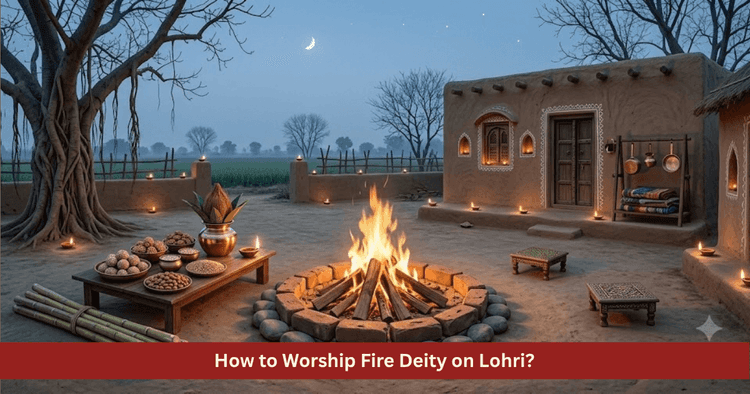
Table of Contents
The sanctified folk festival of Lohri is recognized across classical Vedic time calculation and North Indian folk traditions as a profoundly radiant, energetic, majestic and communal celebration of gratitude celebrated during the concluding days of Pausha month, precisely one day prior to Makar Sankranti on the evening of January 13 across Punjab, Haryana, Delhi, Himachal Pradesh and adjacent territories with immense reverence, devotion and enthusiasm. From an astronomical vantage point, this vibrant observance is far more than a simple community gathering; it announces the concluding frontier of peak winter cold, the final fleeting moments of the southern path of the Sun known as Dakshinayana and the glorious arrival of the sacred northern transit termed Uttarayana. On this sanctified twilight, one of the longest, coldest and most demanding nights of the annual seasonal cycle reaches its completion, after which a visible shift occurs across the path of the celestial solar rays, causing daylight hours to lengthen gradually while sunlight turns noticeably sharper, warmer and infused with invigorating life force for all living creatures. Within ancient Vedic traditions and scriptural treatises, this grand seasonal festival is never reduced to casual merrymaking; it represents an authentic sacrificial rite honoring the Fire Deity Lord Agni, the water lord Varuna, Lord Surya and Mother Earth through the reverent presentation of the first harvest, an oblation that purifies personal consciousness and the physical environment at the same time.
Within the agrarian rural framework of India, the celebration of Lohri stands as the living embodiment of the arrival of the winter Rabi crop, seen in undulating emerald fields of wheat and barley swaying in the cool breeze, golden carpets of yellow mustard blossoms spreading toward the horizon and abundant harvests of sweet sugarcane. When dedicated cultivators witness fresh juice, golden jaggery boiled from crushed winter cane, clean sesame seeds, crunchy peanuts and ripe popping corn gathered within their storehouses through strenuous seasonal labor, their hearts overflow with humble devotion before cosmic benevolence. It remains an ancient, unbroken tenet of Vedic culture that human beings must never consume any freshly harvested food from the earth for personal nourishment without first offering its pristine initial portion to the manifest fire deity, Lord Agni. The sacred bonfire kindled under open skies during Lohri serves as that pure, subtle vehicle that conveys human devotion, surrender and gratitude directly to the governing forces of the universe. The foundational components, scriptural practices, sacrificial substances and traditional folk heritage of this festival appear systematically detailed in the table below.
| Lohri Festival Component | Classical and Folk Standard | Astrological and Seasonal Importance |
|---|---|---|
| Sacred Date and Timing | Concluding day of Pausha (Every January 13 evening) | Astronomical threshold directly preceding the entry of the Sun into Capricorn |
| Presiding Divine Manifestations | Lord Agni, Lord Surya and Vegetation Spirits | Eliminating cold weather phlegmatic humors and welcoming solar vigor |
| Prescribed Worship Space | Open domestic courtyard, rooftop or public square | Direct spatial balancing of fire, earth and air elements beneath the open sky |
| Dedicated Sacrificial Articles | Sesame, jaggery, crisp rewri, gajak, peanuts and popped corn | Presenting first crops to the divine and kindling metabolic heat for winter |
| Primary Folk Rite | Seven clockwise circumambulations with traditional chants | Dissolving personal lack, sickness, jealousy and lingering environmental negativity |
| Core Cultural Expressions | Bhangra, Giddha dances, rhythmic dhol and folk ballads | Shared community joy, release of mental stress and social cohesion |
| Primary Celebrants | Newly wedded couples and newborn infants | Family lineage continuity, physical longevity, health and marital stability |
What Is the Astronomical Science Underlying Lohri?
According to the subtle principles of Vedic astrology and modern solar physics, when the Sun prepares to transition from its southern path to commence its northern celestial journey due to the axial tilt of the earth, that critical orbital threshold is known as Uttarayana. The night of Lohri represents the final winter night immediately preceding this solar turning point, arriving while the Sun completes its final degrees through the sign of Sagittarius. At this seasonal juncture in the northern hemisphere, nighttime shadows remain thick and the surrounding air carries a dry, biting cold that pushes the bodily humors of wind and phlegm to their most elevated levels within the human constitution. When families and neighbors gather outdoors around an ample fire of seasoned logs, the radiant warmth purges the stagnant, damp air and warms the immediate surroundings.
The fragrant vapors rising from burning sesame seeds, raw jaggery, crisp sweet confections, pure cow clarified butter and natural country camphor spread throughout the immediate atmosphere, neutralizing seasonal bacteria, viruses and mold spores lingering in cold air. This ancient community practice functions as an effective seasonal remedy that lifts winter melancholy, physical lethargy and mental fatigue, replacing them with fresh vitality, enthusiasm and productive energy. Within classical Vedic philosophy, Lord Agni is revered as the visible physical manifestation of the Sun on earth. Worshipping the sacred flame at night honors the foundational solar vitality and warmth that nourishes the botanical world and sustains human life through the changing seasons.
What Is the Legend of Dulla Bhatti and Social Unity?
The lore of Lohri remains intimately intertwined with the historical legacy of the medieval folk hero Dulla Bhatti, without whose remembrance no traditional melody of this festival feels complete. Authentic historical records indicate that Dulla Bhatti originally named Abdullah Bhatti, was a brave, noble and chivalrous leader during the reign of the Mughal emperor Akbar, defending the dignity of struggling peasants and vulnerable families against oppressive feudal lords and corrupt officials. During that turbulent era, certain predatory landlords abducted young daughters of impoverished households to sell them into forced servitude in foreign markets. Dulla Bhatti confronted these feudal oppressors, rescued the abducted maidens and provided them with paternal shelter, care and protection.
The moving story of the two orphaned sisters, Sundari and Mundari, is sung with affection across households to this day. When a predatory landlord sought to force them into captivity and threatened their elderly guardian, Dulla Bhatti confronted the tyrant and brought the young maidens to safety within the forest. Building a sacred bonfire under the night sky, he arranged their marriages to honorable suitors with complete social and spiritual dignity. Having no elaborate wealth in the forest, Dulla Bhatti placed a small measure of natural sugar and raw sesame seeds into the lap of each bride, fulfilling the sacred role of giving them away with his own hands. For this reason, whenever youth and children visit neighborhood homes to collect Lohri offerings, they sing verses honoring Dulla Bhatti and the rescued maiden Sundari Mundariye. This enduring story reminds society that defending the vulnerable, honoring womanhood and uniting diverse communities above dogmatic barriers constitutes the spiritual and human essence of Lohri.
What Is the Ritual Protocol for Lohri Fire Worship?
At twilight as the Sun sets in the west on the evening of Lohri, dry cow dung cakes, mature mango wood, sacred palash branches and dried sesame stalks are stacked within open courtyards, rooftops or clean neighborhood squares to form a circular hearth. A piece of pure country camphor and clean clarified butter are placed in the center to light the sacred blaze. As the fire leaps upward, participants invoke Lord Varuna and Lord Agni. The elder members of the family carry a copper urn filled with clean water, pouring a thin unbroken stream around the hearth as an offering of reverence and an energetic boundary of protection.
After this opening ceremony, participants take handfuls of clean black and white sesame seeds, raw jaggery, crisp rewri, sweet confections, unshelled roasted peanuts and popped corn kernels to cast into the leaping flames with reverence. Classical texts describe Agni as Havyavaha, the divine transporter that converts material oblations into subtle atmospheric nutrients for the cosmos. While offering these grains, participants chant the ancient traditional blessing requesting honor and prosperity to enter the dwelling while scarcity and discord depart. The gathering then circumambulates the fire seven times in a clockwise direction, praying for family health, domestic peace, the welfare of children and abundant grain reserves. Before the embers cool, celebrants warm their palms over the embers and touch their faces and foreheads, easing winter joint pain and physical sluggishness.
What Are the 5 Vital Observances for Welfare on Lohri?
To invite auspiciousness and fortune during this seasonal threshold, five classical observances have been practiced across generations with outstanding results.
-
Circumambulation and blessings for newly wedded couples: Couples who wedded during the preceding year celebrate their inaugural Lohri with joy. Wearing new traditional garments and ornaments, the bride and groom circle the blazing hearth seven times, offering sesame seeds and sweet confections into the flames. Following the circumambulation, family elders bestow blessings for enduring loyalty, domestic peace and healthy progeny upon the couple.
-
Consecration rites for newborn children: When an infant is born into a household, the initial Lohri celebration is observed with great festivities. The child is carried in the mother's lap near the glowing hearth to absorb the gentle warmth of the consecrated flames. Tradition maintains that the purifying warmth and sesame smoke protect the infant from malicious environmental glances, building vitality and physical immunity against seasonal ailments.
-
Charity of black sesame seeds and winter grain porridge: Charitable acts performed on the eve of Makar Sankranti generate abundant spiritual merit. On this day, one should donate black sesame seeds, unprocessed jaggery, raw peanuts, whole black lentils and thick woolen blankets to underprivileged and elderly individuals. This practice softens the astrological pressure of Saturn and Rahu, removing financial barriers and shielding the household from sudden adversities.
-
Vigorous rhythmic dancing to folk drums: Men participate in Bhangra while women perform traditional Giddha dances around the Lohri fire. Far from simple entertainment, these rhythmic movements release mental stress, tension and muscular stiffness accumulated during cold winter weeks. The resonance of the folk dhol drives away melancholy, invigorating the collective consciousness with optimism and brotherhood.
-
Wholesome nutritional consumption for winter strength: On the evening of Lohri and the following morning of Makar Sankranti, families consume cornmeal flatbreads, spiced mustard greens, fresh white butter, sesame seed sweets, sugarcane rice pudding and roasted peanuts. Classical Ayurveda affirms that these hot, nutrient dense dishes stoke the digestive fire, support intestinal health and fortify the human constitution for the upcoming spring transition.
How Does Lohri Strengthen Community Bonds and Harmony?
Lohri displays the true heart of Indian cultural philosophy, where narrow partitions and individual self absorption melt away into shared celebration. Around this sacred fire, divisions of social hierarchy, ancestral caste and economic status disappear. Entire neighborhood communities assemble around a common hearth, sharing roasted peanuts and sweet rewri from common platters while singing age old folk ballads. If unresolved grievances or domestic misunderstandings exist between neighbors or kin, embracing one another before the sacred flames of Lohri dissolves that lingering bitterness completely.
This celebration reminds individuals that human life thrives through collective joy and mutual support rather than cold isolation. When young children go from door to door in cheerful groups singing traditional Lohri verses, every householder welcomes them with warm hospitality, offering sweets, grains and small tokens of currency. This folk custom plants seeds of cultural reverence, family values and community responsibility within young minds. Lohri serves as an enduring thread of affection and mutual trust that preserves social balance across generations.
What Is the Spiritual Code of the Lohri Fire?
Vedic metaphysics reveals that elemental fire remains the one force in creation that never retains impurities. Whatever substance is cast into flames is transformed into a pure, radiant and subtle energetic form. The leaping flames of Lohri deliver the timeless truth that human beings must surrender ego, comparison, pettiness and unhealed resentments into the fire of self transformation. Just as a farmer surrenders the first fruits of his hard work to the cosmic fire before celebrating, every spiritual seeker must offer their internal negativity to make room for compassion, generosity and humble service. When a society embraces the selfless philosophy of Lohri, prejudice and despair cannot survive. May the sacred fire of Lord Agni illuminate every home with health, abundance, peace and unshakeable community unity.
FAQ
Why is Lohri celebrated specifically on January 13 every year? Lohri is calculated according to the solar calendar and falls on the final day of Pausha month, directly preceding Makar Sankranti. Because the Sun typically enters the constellation of Capricorn on January 14, Lohri is observed consistently on January 13 as the seasonal farewell to the winter chill.
Which articles are mandatory to offer into the sacred Lohri fire? The traditional offerings for the Lohri fire consist of items derived from the new winter harvest, including sesame seeds, raw jaggery, crisp rewri, sweet gajak, roasted peanuts and popped corn kernels. Pure cow clarified butter and fragrant camphor are also used to purify the fire.
Why is the Lohri fire circumambulation vital for newlyweds? Performing seven circumambulations around the Lohri fire allows newly married couples to receive radiant warmth, stability and purification for their marital bond. Taking the sacred fire as a witness renews their mutual devotion, family loyalty and mutual harmony for the years ahead.
Why is the folklore of Dulla Bhatti commemorated in Lohri ballads? During the medieval period, Dulla Bhatti protected vulnerable young maidens from corrupt feudal captors and arranged their marriages with honor using the sacred Lohri fire as his witness. His selfless heroism, courage and defense of righteousness are remembered with gratitude in traditional Lohri songs.
How many times should one circumambulate the fire and what words are recited? The sacred fire should be circumambulated seven times in a clockwise direction. While offering sesame seeds and peanuts into the fire, participants voice traditional blessings requesting honor and prosperity to enter the home while want, sickness and discord depart forever.
Get your accurate Kundali
Generate KundaliDid you like it?
Author
Pt. Amitabh Sharma (56 Years)
Experience: 20
Consults About: Family Planning, Career
Clients In: Punjab, Haryana, Delhi
Share this article with friends and family
WELCOME TO
ZODIAQ
Right Decisions at the right time with ZODIAQ
