Why Is The Paush Khichdi Feast Essential?
By Pt. Amitabh Sharma
Nine Planets Peace, Sun-Saturn Harmony, Gorakhnath Lore And Ayurvedic Science
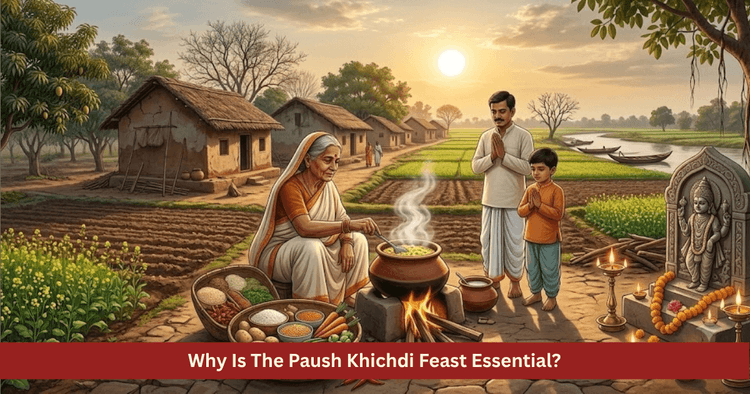
Table of Contents
Classical and Astrological Context of the Paush Khichdi Feast
According to the Vedic doctrines of Sanatana cosmological computation, the sacred month of Paush is recognized as the most introspective, energy-conserving and astronomically sensitive period of the entire annual cycle. During this delicate seasonal junction marking the formal departure of early winter (Hemanta) and the onset of deep winter (Shishira), ambient atmospheric temperatures plummet to their annual minimums. In response to these harsh conditions, the traditional culture of the Indian subcontinent preserves an extraordinary, sacred and therapeutically potent dietary ritual known as the 'Khichdi Maha-Bhog' or 'Khichdi Prasadi'. While modern perceptions often reduce khichdi to a humble, bland dish suited merely for convalescence, an exhaustive study of Vedic astrology, Ayurveda and the Dharma Shastras reveals that this culinary preparation operates as a supreme cosmic remedy capable of harmonizing all nine planetary forces simultaneously.
Particularly on every Saturday of Paush, on Paush Amavasya and during the auspicious festival of Makar Sankranti, classical scriptures mandate the preparation, consecration and extensive charity of khichdi. Prepared with newly harvested rice, unpolished black split lentils (urad dal), black sesame seeds, pure indigenous cow ghee, fresh ginger, raw turmeric and seasonal greens, this meal carries deep astrological significance. During this seasonal window, the planetary Sun transits the sign of Sagittarius and steps toward Capricorn, the celestial domicile of his son Saturn. The natural metaphysical tension and severe elemental friction between the fiery Sun and the airy, disciplinary Saturn are pacified and transformed into mutual balance through the medium of this nourishing culinary offering.
| Astrological & Nutritional Dimension | Classical Component & Method | Cosmic & Biological Manifestation |
|---|---|---|
| Primary Calendar Window | Entire month of Paush, especially Saturdays & Sankranti | Pacifying winter humors and harmonizing nine planets |
| Foundational Grain Base | Newly reaped raw rice and split black lentils | Harmonious union of Moon, Venus and Saturn energies |
| Essential Thermal Elements | Pure indigenous cow ghee, dark jaggery, black sesame | Simultaneous appeasement of Sun, Jupiter and Saturn |
| Therapeutic Digestive Spices | Fresh ginger, pure asafoetida, cumin, turmeric, pepper | Rekindling digestive fire, clearing phlegm and wind |
| Primary Deity Invocations | Lord Surya Narayana, Lord Shani Deva, Lord Vishnu | Removal of fear of untimely death, uprooting poverty |
| Societal & Spiritual Injunction | Feeding scholars, distributing warm meals to the poor | Dissolution of ancestral karmic debts, spiritual liberation |
| Classical Ayurvedic Quality | Tridosha balancing, unctuous, fortifying, easily absorbed | Intestinal detoxification, lubricating joints, vitality |
When this consecrated food offering simmers over a slow flame in traditional vessels of copper or brass, the five primordial cosmic elements-Earth, Water, Fire, Air and Space-align in precise, life-sustaining proportions. Consequently, partaking of and donating khichdi during Paush is far more than a physical act of eating; it functions as an advanced Vedic discipline designed to purify the subtle energetic sheath and the physical body alike.
Astrological Anatomy of Khichdi: An Entire Cosmos on a Plate
In classical Vedic astrology, every grain, botanical spice, fat and vegetable bears a direct, unbroken correspondence to the subtle energetic radiation of the nine planetary deities. A metaphysical examination of the ingredients comprising the traditional winter khichdi reveals that the complete planetary council is seated within a single serving. Cooking these components together into a harmonious whole causes afflicted, antagonistic planetary placements in a native's horoscope to soften their disciplinary aspects, working in benevolent alignment.
| Khichdi Ingredient | Governing Celestial Deity | Elemental Nature & Color | Astrological & Karmic Manifestation |
|---|---|---|---|
| Newly Harvested Rice | The Moon & Venus | Water element, cooling white | Calms emotional turbulence, bestows mental peace and luxury |
| Split Black Lentils (Urad) | Lord Shani (Saturn) | Air & Earth elements, deep dark | Dissolves Sade Sati, Dhaiya and heavy karmic burdens |
| Pure Indigenous Cow Ghee | The Sun & Deva Guru Jupiter | Fire & Radiance, golden hue | Enhances vital aura, ocular brilliance, wisdom and ojas |
| Fresh Seasonal Greens | Planet Mercury (Budha) | Earth & Water elements, vibrant green | Sharpens analytical intellect, eloquence and commercial trade |
| Fresh Ground Turmeric | Deva Guru Jupiter (Brihaspati) | Space element, radiant yellow | Accelerates spiritual evolution, auspicious fortune, blood purity |
| Fresh Ginger & Asafoetida | Planet Mars & Ketu | Fire element, sharp & pungent | Ignites physical courage, balances circulation, clears psychic blocks |
| Black Sesame Seeds | Saturn & Rahu | Air element, protective dark | Banishes unexplained dread, phobias and negative energy |
| Natural Rock or Sea Salt | The Moon & The Sun | Taste essence, balancing agent | Regulates systemic fluid tides and cellular osmotic pressure |
When an individual partakes of this balanced preparation during Paush or serves it with reverence to a hungry wanderer, all nine planetary forces in the birth chart receive simultaneous appeasement. Compared to purchasing costly gemstones or organizing prolonged sacrificial rites, offering this consecrated meal is an accessible, profound and scripturally authorized remedy.
Reconciling Sun and Saturn: Transforming Parental Conflict into Harmony
Among the most complex allegories within Vedic cosmic lore is the relationship between the Sun and his son Saturn. The Sun represents the immortal soul, sovereignty, outward administrative authority, radiant light and personal ego. Saturn embodies karmic accountability, ascetic detachment, subterranean darkness and impartial justice. Born of the Sun's shadowy consort Chhaya, Saturn shares an ancient ideological polarity with his radiant father. In natal horoscopy, mutual aspects or tight conjunctions between the Sun and Saturn frequently manifest as painful ideological divides between father and son, skeletal frailty, chronic eye disorders and legal impediments.
During the month of Paush, as the Sun concludes his transit through Sagittarius and enters the realm of Capricorn, the presentation of this consecrated food offering serves as a celestial balm to dissolve friction between father and son.
- Metaphysical Union of Rice and Lentils: Classical scriptures identify white rice as the cool nectar of the Sun and Moon, whereas black lentils represent the living body of Saturn. Blending these two grains within a single boiling cauldron symbolizes the reunion of the cosmic soul (Sun) with righteous action (Saturn).
- The Mediating Grace of Ghee: When generous quantities of pure cow ghee are folded into the lentils and rice, the unctuous grace of the ghee (governed by the Sun and Jupiter) soothes the dry, cold and harsh attributes of Saturn.
- Domestic Reconciliation: In homes burdened by prolonged disputes between father and son, protracted litigation over ancestral land or chronic domestic friction, sharing this sanctified meal together on Saturdays throughout Paush dissolves misunderstandings, restoring familial warmth.
This meal delivers a profound philosophical lesson: no matter how sharp the differences between two opposing forces, folding in the golden ghee of selfless love, mutual sacrifice and compassionate service can transform cosmic friction into enduring harmony.
The Legacy of Guru Gorakhnath and the Sacred Origin of the Festival
The celebration of the winter khichdi festival carries an inspiring historical and spiritual link to Mahayogi Guru Gorakhnath, the revered founder of the Nath ascetic tradition. At the historic Gorakhnath Temple in Gorakhpur, Uttar Pradesh, the massive annual Khichdi Fair spanning from Paush through Makar Sankranti stands as one of the world's most remarkable spiritual gatherings.
During the medieval era, when external invaders launched campaigns against the civilizational fabric of Bharat, ascetic warrior monks (Nath Yogis) led by Guru Gorakhnath engaged in armed resistance to defend sacred shrines and vulnerable communities.
- Nutritional Challenges During Warfare: Engaged in prolonged guerrilla campaigns, the yogic defenders rarely found adequate time to prepare elaborate meals. Cooking flatbreads and lentils separately required valuable hours, often forcing the warrior monks to march into battle on empty stomachs, which compromised their physical stamina.
- The Divine Strategy of Guru Gorakhnath: Witnessing this tactical challenge, Guru Gorakhnath instructed the ascetics to pool all available provisions-raw rice, split black lentils and whatever wild forest greens they had gathered-into a single massive iron cauldron, simmering them together over an open fire.
- The Emergence of the Miracle Meal: The resulting dish was prepared swiftly, tasted delicious and provided sustained, concentrated energy to the physical frame. Guru Gorakhnath named this preparation 'Khichdi'. Sustained by this nutrient-dense sustenance, the yogic defenders recovered their physical vigor, repelling invading forces.
- The Living Pilgrimage of Gorakhpur: According to traditional lore, Guru Gorakhnath journeyed from the sacred flames of Jwala Ji in Himachal Pradesh to settle in Gorakhpur during this very season. The local populace welcomed the saint by presenting offerings of raw rice and lentils. To this day, millions of pilgrims travel to Gorakhpur throughout Paush to offer raw grains at the sanctum of Guru Gorakhnath, seeking his blessings for health and spiritual strength.
Ayurvedic and Physiological Science of Winter Nutrition
In the Sutrasthana of the Charaka Samhita, the ancient Ayurvedic master classifies 'Krishara' (the classical Sanskrit designation for khichdi) as the crown jewel among therapeutic, easily assimilable diets. Masters Charaka and Vagbhata maintain that whenever the human biological vessel experiences environmental stress, convalescence or seasonal transitions, there is no restorative food superior to properly tempered khichdi.
During the intense winter cold of Paush, cutaneous pores across the skin constrict to prevent internal heat loss, gathering thermal energy inward to ignite the digestive fire (Jatharagni). however atmospheric dryness and severe cold waves simultaneously aggravate systemic Vata and Kapha humors.
| Anatomical System | Common Winter Debility | Therapeutic Action of Khichdi |
|---|---|---|
| Gastrointestinal Tract | Sluggish elimination, painful bloating, constipation | Soluble and insoluble fibers gently cleanse intestinal walls |
| Musculoskeletal Framework | Loss of synovial fluid, painful winter arthritis | Black lentils and cow ghee preserve joint lubrication |
| Respiratory System | Cold-induced mucus accumulation, chest congestion | Dry ginger, black pepper and asafoetida dissolve phlegm |
| Circulatory System | Peripheral vasoconstriction, sluggish blood flow | Sesame oil and ghee maintain arterial flexibility and warmth |
| Immune Defenses | Vulnerability to seasonal viral infections and flu | Curcumin from turmeric and antioxidants from greens bolster immunity |
From a biochemical standpoint, khichdi represents a 'Complete Protein'. Plant grains like rice are naturally deficient in the essential amino acid lysine while rich in methionine. Conversely, legumes like black lentils are rich in lysine but lack methionine. Cooking rice and lentils together creates a complementary amino acid profile, supplying the human body with all nine essential amino acids required for cellular repair. For a vegetarian society, this preparation stands as an accessible, cost-effective method to preserve muscle mass against winter wasting.
The Four Essential Accompaniments of Traditional Khichdi
Traditional culture preserves an ancient, well-known folk adage across northern India:
Khichdi ke hain chaar yaar.
Dahi, papad, ghee aur achaar.
(Khichdi possesses four inseparable companions: curd, roasted crispbread, pure ghee and spicy pickle.)
This saying reflects functional nutritional science rather than mere culinary preference. These four accompaniments optimize the bioavailability and assimilation of the nutrients contained within the main dish.
- Pure Indigenous Cow Ghee: Khichdi remains incomplete without a generous topping of ghee. Melting over steaming hot rice and lentils, pure cow ghee lowers the glycemic index of the meal, preventing rapid blood sugar spikes. It coats the gastrointestinal mucosa, promoting effortless peristalsis.
- Fresh Curd or Spiced Buttermilk: Curd introduces billions of live beneficial probiotics, nourishing the gut microbiome. The cooling, soothing nature of curd balances the natural heating potency of black lentils, preventing excess bile (Pitta) accumulation.
- Roasted Lentil Papad: Seasoned with crushed black pepper, cumin and asafoetida, the crisp texture of roasted papad stimulates salivary glands. Chewing the crispbread activates digestive enzymes, ensuring efficient gastrointestinal breakdown.
- Digestive Lemon or Mango Pickle: The natural organic acids and tart flavors present in traditionally fermented pickles stimulate gastric secretions, sharpening the appetite. These sour notes prompt the liver to release bile, assisting in the digestion of dense plant proteins.
Classical Rules and Spiritual Merits of Khichdi Charity
In the Dharma Shastras, gifting wholesome food during the harsh cold of Paush is praised as the highest form of charity (Mahadana). In the Anushasana Parva of the Mahabharata, the venerable grandsire Bhishma instructs Yudhishthira that an individual who gifts food donates life itself, because food sustains the breath of all living creatures.
Executing this charity on Saturdays during Paush or on Makar Sankranti follows a time-honored scriptural protocol:
- Offering Raw Provisions (Seedha): Charity may be rendered either as prepared hot meals or as raw, uncooked ingredients. Assemble newly harvested rice, unpolished black lentils, a jar of pure cow ghee, a knot of raw turmeric, whole mineral salt, seasonal vegetables (cauliflower, green peas, potatoes) and dark jaggery within a clean cloth or brass platter. This offering is traditionally known as 'Khichdi ka Seedha'.
- The Solemn Vow (Sankalpa): Hold pure water, unbroken rice grains and black sesame seeds in your right palm, facing the southern horizon. Call upon your ancestral lineage (Gotra) and departed ancestors, declaring: "I offer this sacred khichdi charity for the pacification of all nine planets, the satisfaction of my ancestors and the alleviation of past karmic demerits."
- Presenting to Worthy Recipients: Present these raw provisions to a virtuous Vedic scholar, an impoverished mendicant or an orphanage.
- Distributing Piping Hot Meals: Walking through winter nights to distribute steaming hot bowls of freshly cooked khichdi to laborers shivering outside hospitals, near railway terminals and in open shelters is regarded as direct service to Lord Narayana.
Ancient traditions affirm that an individual who provides warm khichdi to the hungry during the winter cold of Paush shields their household from financial and agricultural poverty for seven generations, freeing the soul from fear at the hour of transition.
Modern Misconceptions Versus Scientific Reality
In contemporary urban society, younger generations sometimes dismiss khichdi as dull, unappealing food reserved exclusively for the sick. Understanding the historical reality dispels these misconceptions:
- Misconception 1: Khichdi is only meant for invalids.
Reality: Historically, khichdi was enjoyed in royal palaces as well as forest hermitages. In the 'Ain-i-Akbari', court historian Abu'l-Fazl records that Emperor Akbar regularly savored thirty distinct gourmet varieties of nutrient-rich khichdi prepared with delicate aromatics. It supplies the physical frame with sustained energy without causing digestive heaviness. - Misconception 2: Black lentils are excessively heavy and provoke severe indigestion.
Reality: Consumed alone in large portions, black lentils can be heavy to digest. however when balanced with rice and tempered with fresh ginger, asafoetida, fennel and cumin, the dish becomes light, gentle and nourishing for the digestive tract. - Misconception 3: Consuming khichdi on Saturdays is an arbitrary superstition.
Reality: Saturday is governed by Saturn, the planetary ruler of the nervous system and the bodily air humor (Vata). After a week of consuming diverse, heavy foods, partaking of warm, unctuous khichdi on Saturday gives the digestive system an opportunity to reset, detoxifying the body for the week ahead.
Holistic Transformation and the Philosophical Message of Khichdi
The sacred winter tradition of the Paush Khichdi Feast extends beyond physical nourishment and planetary peace, offering an enduring lesson in living wisdom.
Khichdi reveals that diversity within unity is the foundation of cosmic harmony. Grains of white rice, dark split lentils, vibrant green vegetables, golden turmeric and fiery spices carry distinct colors, textures and properties. Yet, when simmered together over a gentle flame, they surrender their isolated individual identities to create a fragrant, delicious and life-sustaining whole.
Similarly, when human beings of diverse temperaments, backgrounds and abilities come together in the warmth of mutual love, selfless service and spiritual understanding, society transforms into a harmonious, beautiful and resilient community.
During this sacred month of Paush, let us prepare this wholesome consecrated meal within our homes, offer it with devotion to the Divine and our departed ancestors, distribute it to the hungry and destitute and welcome the grace of the planetary council into our lives.
FAQ
On which specific days of Paush month is the consumption and donation of khichdi most recommended? Consuming and donating khichdi is especially meritorious on every Saturday of Paush, on Paush Amavasya (new moon) and on the festival of Makar Sankranti.
Which celestial planets are connected to the rice and black lentils used in khichdi? White rice is governed by the Moon and Venus, representing emotional calm and prosperity, while unpolished black split lentils are ruled by Lord Shani (Saturn).
How does partaking of khichdi harmonize the natural astrological conflict between the Sun and Saturn? Khichdi combines black lentils (Saturn) with rice and pure cow ghee (Sun and Jupiter); cooking them together softens Saturn's harshness, establishing astrological balance.
What is the historical origin of the Khichdi Festival celebrated at the Gorakhnath Temple? During medieval campaigns, Mahayogi Guru Gorakhnath instructed warrior monks to boil rice, lentils and greens together in a single pot to prepare a swift, fortifying meal.
What are the primary Ayurvedic health benefits of eating khichdi during deep winter? It provides complete plant-based protein, cleanses the digestive tract and utilizes warming spices like ginger, asafoetida and sesame to soothe aggravated Vata and Kapha humors.
Get your accurate Kundali
Generate KundaliDid you like it?
Author
Pt. Amitabh Sharma (56 Years)
Experience: 20
Consults About: Family Planning, Career
Clients In: Punjab, Haryana, Delhi
Share this article with friends and family
WELCOME TO
ZODIAQ
Right Decisions at the right time with ZODIAQ
