What Is The Mystery Of Paush Month?
By Pt. Narendra Sharma
Pushya Nakshatra, Saturn-Jupiter Synthesis, Astronomy And Purnima
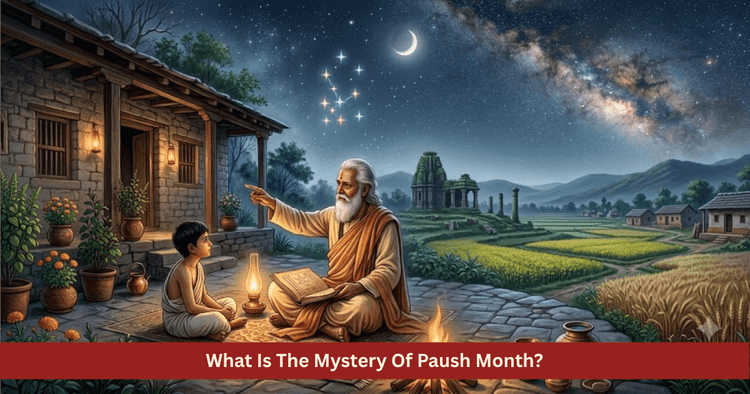
Table of Contents
Classical Foundations and Astronomical Mathematics of Paush Nomenclature
Within the profound tradition of Vedic time reckoning, the methodology of naming calendar months is anchored in precise, celestial and mathematical sciences. According to the nakshatra based calculation system of the Sanatana Panchanga, the nomenclature of any lunar month is determined by a specific astronomical event: the exact asterism in which the Moon achieves full illumination on the Purnima (full moon) tithi. The names of all twelve months of the year are derived from this timeless principle. When the month of Margashirsha concludes and the Moon, traversing the cycle of twenty-seven lunar mansions, conjuncts with Pushya Nakshatra to attain its complete spherical brilliance, the entire month is scripturally designated as 'Paush Masa'.
| Calendrical Element | Classical Alignment and Description | Cosmic and Spiritual Influence |
|---|---|---|
| Niyam | Vidhan | Vidhan |
| Month Nomenclature | Paush Month (commonly called Poos) | The tenth highly sanctified period of the annual cycle |
| Foundational Asterism | Pushya Nakshatra (8th Asterism) | The undisputed king and sovereign of all 27 nakshatras |
| Planetary Ruler of Asterism | Lord Shani (Saturn) | Discipline, asceticism, stability and karmic purification |
| Presiding Deity of Asterism | Deva Guru Brihaspati (Jupiter) | Supreme wisdom, nourishment, discernment and intellect |
| Full Moon Occurrence | Moon's complete transit in Pushya | Deep emotional tranquility and mental nourishment |
| Elemental Synthesis | Water (Moon), Earth/Air (Saturn), Space (Jupiter) | Pacification of mental restlessness, deep spiritual focus |
| Primary Spiritual Direction | North-East (Ishanya) and Eastern Horizon | Divine grace, acquisition of wisdom and self realization |
| Presiding Solar Deity | Bhaga Aditya | Elevation of glory, vital aura, physical health and vigor |
In Vedic astrology, Pushya is enumerated as the eighth asterism. The etymological root of 'Pushya' is derived from the Sanskrit verbal root 'Push', which signifies 'to nourish', 'to foster', 'to augment', or 'to make strong'. Just as maternal milk provides holistic sustenance to a newborn infant to establish robust physical stamina, Pushya Nakshatra radiates biological and metaphysical nourishment to the entire living cosmos. When the Moon is bathed in the nourishing rays of this asterism on Paush Purnima, a steady stream of spiritual nectar pours across terrestrial waters, flora and the human subconscious mind.
Cosmic Morphology and Vedic Symbology of Pushya Nakshatra
From the perspective of observational astronomy, Pushya Nakshatra spans from 3 degrees 20 minutes to 16 degrees 40 minutes within the tropical sign of Cancer. In the night sky, it appears as an exquisite and radiant constellation composed of three stars, identified in modern astrophysics as Delta, Gamma and Theta Cancri. The ancient Vedic seers, through heightened spiritual intuition, mapped this starry cluster and associated its geometric configuration with the udder of a sacred cow or a fully blossomed lotus flower.
- The Cow's Udder Symbol: This sacred symbol represents the terrestrial manifestation of Kamadhenu, the wish-fulfilling cow that continuously yields nourishing divine milk. It indicates that during the month of Paush, nature unveils its deepest reserves of sustenance.
- The Blossomed Lotus Symbol: This imagery signifies the awakening of higher consciousness, beauty and intellectual expansion. Amidst the physical severity of winter cold, the inner heart of the practitioner blossoms into softness, purity and fragrance.
- The Sacred Arrow or Circle: In specific tantric compendiums, Pushya is depicted as a protective perimeter that deflects disruptive psychic intrusions, fortifying the practitioner's auric field.
Pushya is classically addressed as 'Tishya', which translates as 'intensely auspicious', 'benevolent' and 'bestower of boundless fortune'. In the hymns of the Rigveda, Pushya is exalted as the direct energetic embodiment of Brihaspati. When the Moon resides in its domicile of Cancer and attains absolute fullness through Pushya, this conjunction becomes the most potent celestial window for profound introspective meditation.
Saturn and Jupiter: The Sacred Confluence of Karma and Wisdom
The most distinguished astrological dimension of Paush month lies in its dual celestial rulership. According to traditional astrological mathematics, the planetary sovereign of Pushya Nakshatra is Saturn, while its presiding celestial deity is Jupiter. In Vedic metaphysics, the relationship between Saturn and Jupiter represents the sublime union of righteous action and profound wisdom, rigorous penance and divine grace, austere detachment and boundless expansion.
Saturn governs cosmic time, righteous accountability, patience, justice, one-pointed concentration and ascetic penance. It strips away mundane illusions and grounds human awareness in spiritual truth. Conversely, Jupiter is the absolute dispenser of transcendental knowledge, spiritual sciences, righteousness, divine expansion, forgiveness and unconditional benevolence. When these two cosmic streams merge through Pushya Nakshatra during Paush, a balanced spiritual crucible is established where the apparent division between selfless action and higher knowledge dissolves completely.
| Planetary Force | Astrological Domain | Practical Manifestation in Paush |
|---|---|---|
| Niyam | Vidhan | Vidhan |
| Ruler: Saturn | Karma, justice, detachment, penance, fortitude | Stability in spiritual disciplines, eradication of sloth |
| Presiding Deity: Jupiter | Wisdom, intellect, dharma, nourishment, higher insight | Acquisition of sacred knowledge, righteous living |
| Conjunction Result | Convergence of Karma Yoga and Jnana Yoga | Realization of the True Self through detached action |
| Psychological Impact | Anchored, unshakeable mental equanimity | Complete freedom from depression and inner wandering |
When the austere discipline of Saturn is softened by the compassionate nectar of Jupiter, the practitioner's ego dissolves into humble surrender. This explains why classical texts maintain that any scriptural study, mantra japa, spiritual austerity, or charitable act performed during Paush never goes unrewarded. Saturn grants permanent stability to the accrued merit, while Jupiter infuses it with transcendental grace.
Lunar Mechanics and Subtle Influence on the Human Subconscious
In the worldview of the Vedas, the Moon is the sovereign ruler of the human mind: 'Chandrama Manaso Jatah'. More than seventy percent of the human biological frame is composed of the fluid water element and the equilibrium of terrestrial fluids is directly governed by the gravitational mechanics and light phases of the Moon. When the Moon aligns with Pushya Nakshatra in the month of Paush, a remarkable transformation ripples through the human subconscious.
Cancer is the Moon's own sign, where its emotional currents are exceptionally stable, pure and deep. When the Moon resides in its celestial home alongside Pushya, erratic emotional restlessness, anxiety, insomnia and subterranean fears settle into stillness. Pushya Nakshatra imparts a protective maternal warmth and grounded psychological stability to the lunar rays.
- Alleviation of Winter Melancholy: The shorter daylight hours and diminished sunlight of deep winter often trigger seasonal affective gloom; the tranquil rays of the Pushya Moon dissipate this emotional heaviness.
- Single-Pointed Concentration: Guided by Saturn's stabilizing influence within Pushya, the wandering mind ceases its distractions, making deep meditation effortless for students and yogic practitioners.
- Awakening of Empathy and Compassion: The nurturing nature of the Moon stirs profound universal compassion within the human heart, inspiring individuals to engage in selfless service and feed the hungry.
Self-realization occurs only when the reflective surface of the mind becomes entirely still. The Moon of Paush provides that crystal-clear lake of consciousness in which the soul observes its divine identity without distortion.
Glories of Paush Purnima and the Science of Sacred Bathing
Paush Purnima marks the supreme spiritual zenith of this entire sacred month. On this day, as the Moon ascends the eastern horizon fully adorned with all sixteen divine digits within Pushya Nakshatra, terrestrial waters experience a subtle energetic transformation. Classical traditions maintain that on this sacred full moon, celestial deities and the presiding energies of all holy rivers infuse the terrestrial waters of Bharat.
At the Triveni Sangam in Prayagraj, Paush Purnima marks the formal commencement of the world-renowned Magh Mela and the austere month-long discipline of 'Kalpavas'. Millions of renunciates, yogic adepts and devoted householders take a solemn vow to dwell in simple thatched huts upon the sandy banks of the holy confluence of Ganga, Yamuna and invisible Saraswati.
- The Vow of Kalpavas: Kalpavas signifies biological rejuvenation and spiritual rebirth. Spanning from Paush Purnima to Magh Purnima, this discipline calls for complete celibacy, truthful speech, three daily holy dips and single-meal daily sustenance, freeing the soul from worldly entanglements.
- Pilgrimage to Kashi and Gangasagar: Taking a holy bath at the Dashashwamedh Ghat in Varanasi or at the ocean confluence of Gangasagar on this full moon yields spiritual merits surpassing an Ashvamedha Yajna, healing stubborn physical ailments.
- Lunar Oblation and Adoration: Presenting a nocturnal water offering mixed with raw milk, unbroken rice and white sandalwood to the rising Pushya Moon strengthens the natal Moon in one's birth chart, banishing domestic discord and financial anxiety.
Bathing in sanctified waters on this date does not merely cleanse the physical body; it washes away residual impressions of past life transgressions, rendering the inner mind pure and radiant.
Acquisition of Sacred Wisdom and Mantra Initiation in Paush
Because Pushya Nakshatra is presided over by Deva Guru Brihaspati, the month of Paush is scripturally revered as the most auspicious period for pursuing higher philosophical knowledge, sacred sciences and mantra initiation. Classical treatises affirm that any field of study commenced under the auspices of Pushya Nakshatra is never forgotten, blossoming into lifelong wisdom.
For academic researchers, spiritual seekers and students, this month functions as a celestial catalyst. The stillness of the winter climate combined with the expansive power of Pushya heightens the cognitive retention of the human intellect.
- Guru Diksha and Mantra Disciplines: Receiving sacred initiation from an enlightened master or undertaking an intensive chanting discipline of the Gayatri Mahamantra during Paush opens the doorway to direct spiritual insight.
- Contemplation of Sacred Texts: Immersing oneself in the daily study of the Shrimad Bhagavad Gita, Upanishads and the Ramayana clarifies intellect and illuminates one's worldly duty.
- Creative and Philosophical Writing: Authors, philosophers and scientific researchers who initiate creative works during Pushya Nakshatra in this month attain enduring renown and lasting intellectual breakthroughs.
The grace of Jupiter ensures that intellectual mastery never degenerates into pride, channeling knowledge into humility, discernment and compassionate service to humanity.
Prescribed Charity, Chanting Protocols and Spiritual Disciplines
Pushya Nakshatra and the month of Paush are universally recognized as yielding inexhaustible spiritual merits. Even the smallest selfless offering rendered with a pure heart during this period returns magnified manifold. Spiritual disciplines that harmonize the energetic vibrations of both Saturn and Jupiter are exceptionally potent during this month.
- Worship of Gold and Copper: Purchasing or consecrating pure gold during Pushya Nakshatra is regarded as exceptionally auspicious, as gold conducts the energy of Jupiter. Concurrently, revering copper vessels to worship the Sun god invites radiant vitality.
- Donation of Black Sesame and Jaggery: Black sesame seeds embody the disciplinary energy of Saturn, while natural jaggery carries the solar fire. Gifting these substances pacifies internal winter wind humors, pleases departed ancestors and calms difficult planetary transits.
- Charity of Educational Materials: Gifting books, writing instruments and study materials to underprivileged students pleases Jupiter, blessing the donor with profound eloquence and wisdom.
- Distribution of Warm Clothing and Food: Providing heavy woolen blankets, footwear and hot nourishing meals to destitute individuals shivering in the winter chill constitutes direct devotional service to Lord Narayana.
On an internal level, practitioners should wake during Brahma Muhurta to recite the sacred Gayatri Mantra, the Mahamrityunjaya Mantra, or the five-syllabled Shiva mantra. This steady discipline establishes an impenetrable auric shield around the physical body, deflecting all malevolent energies.
Holistic Spiritual Rejuvenation Through Paush Observance
The month of Paush is far more than an ordinary page on a calendar; it is a profound cosmic message directing humanity toward inner discipline, higher wisdom and compassionate living. When the nourishing life force of Pushya Nakshatra, the rigorous accountability of Saturn, the boundless wisdom of Jupiter and the serene coolness of the Moon converge within an individual's consciousness, living reality is elevated.
This month reminds us that just as Pushya Nakshatra nurtures the universe despite the biting cold of deep winter, we must preserve the flame of faith, patience and knowledge within our hearts amidst life's harshest trials. An individual who comprehends this astronomical and metaphysical mystery and aligns daily conduct with these cosmic rhythms is liberated from earthly anxieties, entering that transcendent state of peace, strength and divine bliss.
FAQ
Why is this specific month named 'Paush' in the Vedic calendar? The month is named Paush because on its Purnima (full moon) tithi, the Moon conjuncts with Pushya Nakshatra, the king of all twenty-seven asterisms.
Who are the planetary ruler and presiding deity of Pushya Nakshatra? The planetary ruler of Pushya is Lord Shani (Saturn) and its presiding celestial deity is Deva Guru Brihaspati (Jupiter).
What spiritual benefits emerge from the union of Saturn and Jupiter in this month? Saturn grants discipline, patience and ascetic focus, while Jupiter provides transcendental knowledge and nourishment, making any sadhana performed during this month unfailingly fruitful.
Which prominent pilgrimage festival commences on the full moon of Paush? The historic month-long discipline of Kalpavas and the annual Magh Mela formally inaugurate on Paush Purnima at the sacred Triveni Sangam in Prayagraj.
How does meditating upon the Moon during Paush benefit mental health? Because the Moon resides in its domicile of Cancer within nourishing Pushya, it pacifies mental restlessness, dispels seasonal depression and establishes deep emotional tranquility.
Get your accurate Kundali
Generate KundaliDid you like it?
Author

Pt. Narendra Sharma (63)
Experience: 20
Consults About: Family Planning, Career
Clients In: Punjab, Haryana, Delhi
Share this article with friends and family
WELCOME TO
ZODIAQ
Right Decisions at the right time with ZODIAQ
