What Is The Significance Of Paush Purnima And Shakambhari Jayanti?
By Pt. Sanjeev Sharma
Annapurna Darshan, Pushkar Bath, Satyanarayana Katha And Moon Libation
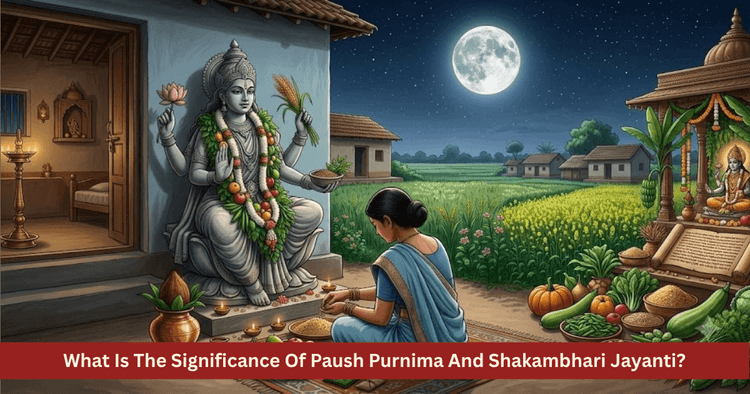
Table of Contents
Classical Framework and Sacred Setting of Paush Purnima
According to the ancient Vedic doctrines of Sanatana chronological computation, the concluding lunar date of the waxing fortnight (Shukla Paksha) in the month of Paush is universally venerated as 'Paush Purnima'. This sacred date is celebrated as one of the most spiritually charged, luminous and astronomically potent days across the entire annual cycle. Upon this blessed full moon, the divine appearance festival of Mother Jagadamba in her botanical manifestation, renowned as 'Shakambhari Jayanti', is celebrated across the Indian subcontinent with profound devotion and joy. Paush Purnima represents far more than the conclusion of a monthly lunar cycle; it embodies the spiritual fulfillment of the deep winter austerities, self-discipline and agricultural gratitude observed throughout the month of Paush.
On this auspicious night, the Moon shines adorned with all sixteen divine digits (Kalas), positioned under the nourishing cosmic influence of 'Pushya Nakshatra', the undisputed emperor of all twenty-seven lunar mansions. The celestial conjunction of the full Moon within its natural planetary domain brings down an abundant cascade of subtle divine nectar across terrestrial waters, botanical kingdoms and the human subconscious mind. Authoritative scriptural treatises, including the Matsya Purana and Skanda Purana, proclaim that observing holy river ablutions, listening to the sacred Satyanarayana Vrat Katha, beholding Mother Annapurna in Kashi and offering raw milk libations to the full Moon on this day uproots accumulated past-life sins, seasonal depression, physical debilities and poverty from the household.
| Observance Dimension | Classical Injunction and Liturgical Protocol | Spiritual & Practical Manifestation |
|---|---|---|
| Presiding Lunar Date | Paush Shukla Paksha Purnima (Full Moon) | Deep mental equanimity, freedom from fear, triumph |
| Sovereign Divine Appearance | Mother Shakambhari Jayanti (Shatakshi Advent) | Deliverance from food scarcity, robust health, wealth |
| Cosmic Astrological Conjunction | Full Moon conjunct Pushya Nakshatra in Cancer | Cellular nourishment, emotional grounding, vital ojas |
| Supreme Pilgrimage Centers | Kashi (Annapurna Temple), Pushkar Lake, Prayagraj | Merit equal to Ashvamedha Yajna, spiritual liberation |
| Primary Deity Rites | Satyanarayana Katha, Raw Milk Shiva Abhishekam | Domestic harmony, architectural Vastu cleansing, grace |
| Consecrated Food Bounty | 60 seasonal green vegetables, roots, fruits, kheer | Balancing internal humors, eliminating malnutrition |
| Lunar Water Libation Media | Water, raw cow milk, unbroken rice in silver vessel | Remediation of insomnia, eye strain, anxiety and blood flaws |
| Recommended Charitable Gifts | Black sesame, dark jaggery, warm woolens, grains | Pacification of nine planets, ancestral peace, lasting merit |
Even the simplest righteous act performed during the sacred window of Paush Purnima yields spiritual fruits magnified a thousandfold. This day provides a golden opportunity to harmonize individual consciousness with nature, return to timeless spiritual roots and express profound gratitude for the life-giving gifts of food and water.
Mother Annapurna in Kashi and the Sacred Botanical Feast
In the eternal cosmic city of Kashi (Varanasi), the city of Lord Shiva, the spiritual celebrations of Paush Purnima reach their supreme zenith. At the renowned Shri Annapurna Temple, an extraordinary festival known as the 'Shaka Utsava' (The Sacred Festival of Botanical Greens) is observed on this auspicious date. Ancient mythological annals record that when an agonizing drought parched the earth and living beings cried out in hunger, Mother Parvati manifested as Annapurna and Shakambhari, bringing forth nourishing vegetables and grains directly from her divine form.
On this day in Kashi, the golden idol and central sanctum of Mother Annapurna are adorned with mountains of fresh seasonal green vegetables, indigenous roots and vibrant fruits. The entire temple interior is transformed into a fragrant green paradise.
- Alms to Lord Vishwanath: The Kashi Khanda relates that Lord Shiva himself assumed the form of a humble mendicant before Mother Annapurna, extending his hands to receive food to preserve creation and soothe the hunger of time. Sincere devotees beholding Mother Annapurna in Kashi on Paush Purnima are blessed with homes that never encounter scarcity of food or wealth.
- The Divine Offering of Greens: The sanctum is filled with gourds, spinach, fenugreek, winter greens, carrots, radishes, cauliflowers, bell peppers, wild tubers and winter fruits. Following the rituals, this entire bounty is distributed to pilgrims, seekers and the destitute as sanctified Mahaprasada.
- Uprooting Generational Poverty: Gを知ing Mother Annapurna on this date dissolves lingering ancestral poverty, ensuring steady success and abundance in one's worldly profession.
The Sacred Bath at Pushkar Lake: Theological and Elemental Lore
Situated near Ajmer in Rajasthan, the holy site of 'Pushkar Raj' is venerated across Sanatana culture as the supreme king of all pilgrimages (Tirtharaja). According to the Srishti Khanda of the Padma Purana, Lord Brahma chose Pushkar as the sole terrestrial site to perform his primordial cosmic fire sacrifice. The spiritual merits accrued from taking a holy bath in Pushkar Lake on Paush Purnima are celebrated as boundless.
Sacred traditions maintain that during Brahma Muhurta on Paush Purnima, Lord Brahma, thirty-three categories of celestial divinities and the subtle spiritual currents of all sacred rivers reside within the waters of Pushkar.
| Sacred Pilgrimage Confluence | Scriptural Heritage and Sacred Background | Tangible Spiritual & Physical Fruit |
|---|---|---|
| Sacred Pushkar Lake | Primordial sacrificial altar of Brahma and fallen lotus | Dissolution of three existential sorrows (Adhyatmika, etc.) |
| Prayagraj Confluence | Official commencement of Kalpavas at Ganga-Yamuna | Merit surpassing the execution of a thousand royal sacrifices |
| Dashashwamedh Ghat, Kashi | Perpetual sanctuary of Lord Vishwanath and Annapurna | Ancestral liberation, attainment of moksha, physical vitality |
| Gangasagar Ocean Confluence | Redemption of King Sagara's sixty thousand cursed sons | Total liberation from the cyclical wheel of mortal rebirth |
Before stepping into the waters of Pushkar, hold kusha grass and black sesame seeds in your palms to offer respectful libations to celestial deities, ancient seers and departed ancestors. This practice clears the path toward the realm of Brahma, granting lasting peace to generations of forebears.
Astronomical Science of Pushya Nakshatra and the Sixteen Lunar Digits
The night of Paush Purnima is an extraordinary cosmic alignment observed across astronomy and human physiology. On this full moon, the lunar orb reaches its closest annual orbital proximity to earth, radiating pure, unobstructed white light. Pushya Nakshatra is celebrated across Vedic astrology as the most nourishing, stable and nectar-bestowing asterism among all twenty-seven lunar mansions.
The Rigveda reveals that Pushya Nakshatra embodies the direct spiritual presence of Deva Guru Jupiter, while governed by the disciplinary stability of Saturn. When the Moon shines fully adorned with all sixteen divine digits through Pushya, the subtle pranic potency coursing through terrestrial vegetation, medicinal plants and water sources increases significantly.
- Balancing Human Neurochemistry and the Water Element: The human body and cerebral tissues are composed of more than seventy percent water. On the night of the full moon, strong lunar gravitational and bioelectromagnetic fields interact directly with human neural transmitters. The stabilizing influence of Pushya calms emotional volatility, hysteria, chronic stress and deep seated melancholia.
- Enhancing Herbal Therapeutics: Classical Ayurveda notes that herbal remedies, botanical infusions and milk kheer placed beneath the open night sky during this alignment absorb subtle rejuvenating properties. Consuming this energized nourishment revitalizes the immune system.
- Emotional Grounding and Willpower: The Moon is the natural governor of the human subconscious (Chandrama Manaso Jatah). Meditating upon the full moon in Pushya Nakshatra dissolves mental chatter, awakening sharp intuitive discernment and emotional stability.
The Sacred Satyanarayana Vrata Katha and Altar Protocols
Performing the worship and reciting the sacred narrative of Lord Satyanarayana on Paush Purnima is an uplifting domestic tradition across Sanatana households. Recorded in the Reva Khanda of the Skanda Purana, this sacred observance reminds humanity that in the age of Kali, steadfast devotion to truth and chanting the holy names of God serve as the supreme spiritual sacrifice.
Altar Assembly and Canopy Construction
Rise at dawn to complete bodily ablutions. Consecrate the domestic prayer area, setting up a raised wooden altar covered with fresh yellow silk. Secure four straight banana tree stalks at the four corners of the platform, creating a traditional sacred canopy. Form an eight-petaled lotus pattern with unbroken rice at the center, placing a copper or brass water pitcher upon it. Fill the vessel with clean water, mango leaves, a betel nut and a thread-wound coconut resting on its rim. Seat the sacred Shaligram stone or an idol of Lord Satyanarayana alongside Mother Lakshmi before the pitcher.
The Sacred Confection: Sapada Bhakshya (Panjiri and Panchamrita)
Scriptural rules prescribe preparing the consecrated offering (Sapada Bhakshya) using ingredients measured in the precise traditional ratio of one and a quarter:
- Lightly roast one and a quarter measures of whole wheat flour in pure cow ghee, blending it with one and a quarter measures of unrefined raw sugar candy powder.
- Mix sliced bananas, chopped dried fruits (almonds, cashews, raisins, lotus seeds) and an abundance of fresh Tulsi leaves into this sweet panjiri.
- Prepare the sacred five nectars (Panchamrita) utilizing raw indigenous cow milk, fresh curd, pure ghee, raw honey and natural sugar.
| Liturgical Phase | Prescribed Scriptural Procedure | Spiritual & Metaphysical Objective |
|---|---|---|
| First | Foot-Washing & Purification | Cleansing the feet of the Divine with rose-infused water |
| Second | Five Nectars & Saffron Bath | Consecrating Lord Shaligram, washing away karmic demerits |
| Third | Offering Yellow Silk & Thread | Embracing pure consciousness, moral discipline, spiritual aura |
| Fourth | Sandalwood & Fresh Tulsi | Cooling the deity's forehead with fragrant sandalwood paste |
| Fifth | Study of Five Sacred Chapters | Deep contemplation of truth, dissolving doubt and fear |
| Sixth | Presenting Consecrated Bounty | Invoking fulfillment, domestic sweetness and lasting grace |
| Seventh | Illumination & Conch Resonances | Dispelling ignorance and welcoming auspicious energies |
Following the conclusion of the five chapters, wave burning camphor before the altar and share the panjiri and charanamrita with all assembled seekers. Observing this sacred narrative on Paush Purnima resolves long-standing commercial and domestic challenges.
Raw Milk Shiva Abhishekam: Freedom from Subconscious Distress
Adoring Lord Shiva on Paush Purnima holds profound transformative power. Lord Shiva bears the crescent Moon upon his matted locks, celebrated throughout the universe as 'Chandrashekhara'. If an individual's birth chart suffers from a debilitated Moon, an eclipse affliction involving the lunar nodes or if one struggles with chronic insomnia, phobias and severe anxiety, executing a dedicated milk abhishekam on this day brings deep relief.
- Raw Cow Milk Rudrabhishekam: Visit an ancient Shiva shrine during morning hours. Fill a clean pitcher fashioned from silver, brass or bronze with fresh, unboiled milk from an indigenous cow. Mix in consecrated Ganga water, powdered rock candy, white sandalwood paste and a pinch of black sesame seeds.
- Reciting the Mahamrityunjaya Mantra: Pour a fine, continuous stream of this milk mixture over the Shiva lingam, chanting 'Om Namah Shivaya' or the Mahamrityunjaya Mantra with steady concentration.
- Offering Bael Leaves and Unbroken Rice: Adorn the consecrated lingam with eleven intact bael leaves and unbroken white rice grains, praying to Lord Shiva to calm all subconscious anxieties and mental turbulence.
This sacred abhishekam cools the central nervous system, soothes mental stress and neutralizes difficult lunar afflictions within the horoscope.
Scientific Protocols and Health Benefits of the Lunar Water Libation
During the night of Paush Purnima, when the full moon reaches its celestial midpoint in the sky (generally between 8:00 PM and 10:00 PM), presenting a consecrated water offering to the Moon serves as a therapeutic and calming discipline.
Preparation of the Lunar Offering
Fill a clean vessel of pure silver or bronze with fresh drinking water, combining five sacred ingredients:
- Raw Indigenous Cow Milk: Two spoonfuls of milk to conduct cooling, maternal lunar vitality.
- Unbroken Rice Grains (Akshata): Symbolizing mental stability and holistic wholeness.
- White Sandalwood Paste or Camphor: Providing mental cooling and aromatic purity.
- Fragrant White Blossoms: Fresh jasmine, white oleander or mogra flowers.
- A Few Crystals of Rock Sugar: Infusing sweetness and steady physical vitality.
Liturgical Libation Procedure
Standing beneath the open sky on a terrace, lawn or open balcony, face the glowing Moon. Raise both arms above the crown of your head, tilting the vessel slowly to pour an unbroken stream of water. With relaxed, open eyes, gaze steadily upon the radiant disc of the full moon through the cascading liquid.
While offering the libation, chant the sacred lunar mantra three times:
Om Ksheeraputraya Vidmahe Amritatattvaya Dhimahi Tanno Chandrah Prachodayat.
Om Som Somaya Namah.
Ocular and Neurological Health Benefits
- Sharpening Optical Vision: Gazing upon the soft lunar rays through the cascading stream of milk and water soothes micro-capillaries within the eyes, relieving digital eye strain, chronic dryness and optical fatigue.
- Healing Insomnia and Headaches: Following the libation, gather a few droplets of the water from the basin with your ring finger, gently touching them to your closed eyelids, your third eye center and your throat. This practice balances melatonin production, welcoming deep and restorative sleep.
- Harmonizing Female Endocrine Cycles: Because the Moon governs the biological fluid tides and menstrual rhythms, sitting beneath the direct rays of the full moon for fifteen to twenty minutes helps soothe hormonal imbalances and reproductive irregularities naturally.
Infallible Charities and Meritorious Deeds of Paush Purnima
Classical scriptures celebrate Paush Purnima as a premier day for charitable giving. Occurring at the height of deep winter, distributing warm, nourishing gifts generates enduring spiritual merits that bless future generations.
- Charity of Black Sesame and Jaggery: Presenting one and a quarter measures of black sesame seeds and dark jaggery to a temple or deserving wanderer pacifies afflictions of both the Sun and Saturn.
- Distribution of Warm Woolen Blankets: Gifting heavy woolen blankets, warm clothing and sturdy footwear to individuals surviving outdoors or in shelters is direct service to Lord Narayana.
- Donating Rice and Fresh Milk: To fortify the natal Moon in one's birth chart, donate newly harvested rice, fresh cow milk and white cotton garments to an elderly woman or virtuous scholar.
- Community Food Distribution: Organizing or contributing to a community feast of hot khichdi, seasonal winter vegetables and puffed breads ensures the domestic pantry remains blessed with abundance.
When offering charity, hold the humble inner awareness that all resources belong to the Supreme Creator and that we are merely instruments of divine compassion.
Universal Wholeness and the Dawn of Renewed Life
The sacred festival of Paush Purnima invites humanity to live in seamless harmony with cosmic nature, the Divine and our own inner spirit. This sacred day teaches us that just as the full moon illuminates the dark winter night with tranquil white radiance without discrimination, we must illuminate our lives with compassion, equanimity, generosity and selfless love.
The appearance day of Mother Shakambhari reminds us that the green, living mantle of the earth is the sacred foundation of our existence. Treating food and water with reverence, relieving the hunger of suffering creatures and walking the path of truth embody the true heart of Paush Purnima. An individual who honors these sacred practices, listens to the Satyanarayana Katha, takes a holy bath and offers prayers to the full moon steps into the coming year blessed with robust health, steady prosperity, deep mental peace and spiritual radiance.
FAQ
Which divine appearance is celebrated worldwide on the full moon of Paush? The sacred appearance festival of Mother Jagadamba in her botanical manifestation, celebrated as Shakambhari Jayanti, is observed on Paush Purnima.
What unique traditional celebration takes place at the Annapurna Temple in Kashi on this day? A magnificent Shaka Utsava is celebrated, during which the sanctum and the deity are decorated with mountains of fresh seasonal green vegetables and fruits.
What specific physiological and ocular benefits come from offering libations to the Moon? Gazing upon the Moon through the stream of milk and water soothes eye strain, balances melatonin production, dispels insomnia and settles mental stress.
Which special confection is prepared for the Satyanarayana worship on Paush Purnima? A sweet panjiri prepared with whole wheat flour roasted in cow ghee, mixed with raw sugar, sliced bananas, dried fruits and Tulsi leaves is offered as Sapada Bhakshya.
What is the scriptural significance of taking a sacred bath at Pushkar on Paush Purnima? Taking a dawn bath in Pushkar Lake on this date washes away accumulated sins and bestows spiritual merits equivalent to performing the Ashvamedha Yajna.
Get your accurate Kundali
Generate KundaliDid you like it?
Author

Pt. Sanjeev Sharma (63)
Experience: 20
Consults About: Family Planning, Career
Clients In: Punjab, Haryana, Delhi
Share this article with friends and family
WELCOME TO
ZODIAQ
Right Decisions at the right time with ZODIAQ
