How Is Pongal Celebrated in South India?
By Pt. Narendra Sharma
Four Day Pongal, Mattu Pongal Traditions And Sabarimala Makaravilakku
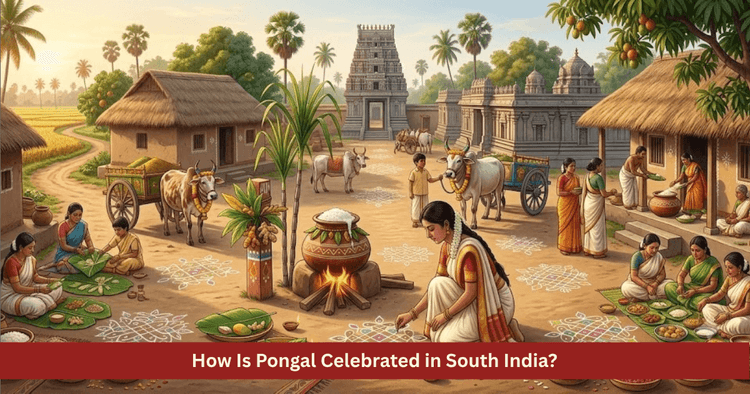
Table of Contents
At the deeply sacred celestial juncture of Pausha month when the supreme solar deity Lord Surya completes the final degrees of his winter orbit through the zodiac sign of Sagittarius to step into the celestial mansion of Capricorn, the grand astronomical turning point of seasonal renewal, solar resurgence and agrarian festivity emerges simultaneously across the sanctified soil of the Indian subcontinent. That exact celestial transit celebrated across the expansive river plains of North India under the names of Makar Sankranti or Maghi with deep reverence, sacred river immersions and generous distributions of grain porridge manifests across the expansive territories of South India, especially across the verdant landscapes of Tamil Nadu, Kerala andhra Pradesh and Karnataka, with unmatched cultural majesty, millennia old farming traditions and profound philosophical insight. Within the ancient cultural heritage of Tamil Nadu where classical Dravidian and Vedic values blend seamlessly, this supreme celebration commences on the inaugural day of Thai, the most auspicious month of the Tamil calendar, continuing as a four day communal harvest festival known as Pongal with unbounded joy, collective devotion and genuine social unity. Within the classical vocabulary of the Tamil language, the term Pongal carries the literal and metaphysical meaning of boiling over, rising to the brim or overflowing with abundance, serving as the visible living emblem of freshly harvested agricultural produce, the sweet dairy prosperity of cattle and the continuous expansion of domestic serenity and material ease.
On that identical sacred twilight of celestial transit as the Sun prepares to settle along the western horizon, hundreds of thousands of devout pilgrims assemble along the banks of the sacred Pampa River amidst the dense Sahyadri mountain ranges of Kerala at the world renowned forest shrine of Sabarimala, standing reverently before the sanctum of Lord Dharma Shasta Swami Ayyappa to behold the appearance of the celestial Makara Jyoti star in the sky and the three successive flashes of the sacred light known as Makaravilakku manifested atop the remote forest peak of Ponnambalamedu to complete their long spiritual penance. Extending from the Himalayan foothills in the north down to the coastal fringes of the Indian Ocean in the south, this enduring Vedic civilization provides undeniable historical evidence that beneath superficial variations in dialect, cuisine, costume and regional folklore, the inner soul of India remains anchored in the worship of nature, collective expressions of humble gratitude before universal elements and single minded devotion to the supreme solar deity across every generation. The complete foundational elements, scriptural guidelines, dedicated sacred confections and unique communal traditions of this four day southern festival appear comprehensively detailed in the table below.
| Pongal Observance Day | Tamil Designation and Timing | Presiding Divinity and Natural Element | Primary Ritual and Dedicated Offering |
|---|---|---|---|
| First Day | Bhogi Pongal (Concluding day of Pausha) | Lord Indra (Ruler of Rains and Rainclouds) | Burning broken and obsolete domestic articles in fire and spatial purification |
| Second Day | Surya Pongal (Inaugural day of Thai month) | Lord Surya (Supreme Lord of Radiance and Fire) | Boiling fresh sweet rice in an earthen pot outdoors until it overflows with joy |
| Third Day | Mattu Pongal (Day following Sankranti) | Nandishwara and Cattle (Livestock and Earth) | Adorning working cattle, ceremonial worship, camphor waving and Jallikattu |
| Fourth Day | Kaanum Pongal (Family Reunion and Kinship) | Lineage Ancestors and Kin (Family and Society) | Placing colored rice balls upon fresh turmeric leaves and seeking elder blessings |
| Sabarimala Feast | Makaravilakku (Makar Sankranti Twilight) | Lord Dharma Shasta Swami Ayyappa | Witnessing the divine light on Ponnambalamedu and completing Mandalam vows |
What Is the Classical Structure of Four Day Pongal?
Across the sacred soil of Tamil Nadu, Pongal is never approached as an ordinary secular holiday; it represents an authentic four day spiritual discipline designed to honor the five fundamental building blocks of nature, namely earth, water, fire, air and ether. Every sequential day possesses its own distinct philosophical, ecological and social mandate, guiding human consciousness toward living in balanced communion with surrounding living entities and the broader environment.
The opening day is celebrated as Bhogi Pongal, dedicated entirely to Lord Indra, the sovereign celestial guardian presiding over nourishing rains and seasonal showers. On this day, farming families bow before the feet of Lord Indra to offer heartfelt gratitude for timely downpours that nurtured their standing grain fields. The central social custom of this day is celebrated as Bhogi Kottu, during which household members gather all broken, damaged, useless and worn out domestic articles from their premises, bringing them outside at dawn to consume them inside a roaring wood fire kindled at neighborhood intersections. The deeper spiritual lesson of this scriptural practice requires the seeker to burn away accumulated psychological bitterness, chronic grievances, physical laziness and negative tendencies, thereby welcoming pure intentions and fresh awareness into the heart. Living quarters are whitewashed with natural lime and doorsteps are decorated with intricate geometric drawings known as Kolam, crafted using freshly ground dry rice flour and natural mineral powders.
The second day is celebrated as Surya Pongal or Perum Pongal, representing the spiritual heart and central pillar of the entire four day celebration. This holy day is dedicated completely to the visible solar deity Lord Surya, the sole physical manifestation of universal vitality. Household women rise before dawn to complete cleansing ablutions, dressing in traditional silk sarees before constructing an outdoor clay cooking hearth in the open courtyard facing toward the true east. An unblemished clay pot or burnished brass urn is wrapped around its neck with raw turmeric roots and fresh ginger leaves using a sanctified yellow cord. Within that sacred vessel, pure cow milk, freshly harvested rice grains, unrefined golden jaggery, crushed cardamom, fragrant nutmeg, split cashews fried in clarified butter and sweet raisins are cooked gently over seasoned wood embers. The exact moment the sweet mixture boils over the rim of the pot on all sides, family members sound conch shells while voicing the joyous exclamation of Pongalo Pongal. This boiling over is celebrated as an auspicious sign indicating that food, honor, health and domestic peace will continuously overflow throughout the coming year. Known formally as Sakkarai Pongal, this sweet dish is placed upon fresh banana leaves and offered first to Lord Surya with humble prayers.
What Are the Folk Traditions of Mattu and Kaanum Pongal?
The third sacred day of the festival is known as Mattu Pongal, marking a profoundly affectionate occasion dedicated to honoring working cattle and draft oxen, the indispensable foundations of Indian agrarian society. Within rural communities, cattle are revered as holy embodiments of Lord Shiva's mount Nandishwara and cherished members of the family rather than simple beasts of burden. At dawn on this day, bulls, cows and calves are guided to rivers, irrigation canals and clean ponds for a refreshing bath. Afterward, their pointed horns are filed smooth and painted in bright natural colors, their necks adorned with ringing brass bells and fresh marigold garlands and their broad foreheads anointed with sandalwood paste, vermilion and golden turmeric. Household members wave camphor lamps before the cattle, feeding them generous portions of sweet Sakkarai Pongal, green grass and juicy stalks of sugarcane. In historic rural centers of Tamil Nadu such as Madurai and Alanganallur, this day witnesses the staging of the ancient sport called Jallikattu, wherein courageous young men attempt to embrace the humps of sprinting indigenous bulls to retrieve prize pouches secured to their horns, an event honoring valor, agrarian vitality and ancient reverence for the bull.
The fourth and concluding day of the grand festival is known as Kaanum Pongal. Within the Tamil linguistic heritage, the term Kaanum translates as to view, to visit or to reconnect. This date represents a sacred occasion for reinforcing societal cohesion, renewing family bonds and showing active compassion toward surrounding wildlife. On this morning, women assemble outdoors to place small round balls of colored cooked rice upon fresh, unblemished turmeric leaves, offering them to crows, wild birds and small animals. The underlying spiritual prayer behind this ritual asks that household lineages remain united in unbreakable solidarity, just like flocks of feeding birds. Following this offering, families dress in their finest apparel to travel to the homes of elders, mentors and relatives, touching their feet for blessings and exchanging sweet gifts to strengthen domestic love and community goodwill.
What Is the Secret of Sabarimala Makaravilakku?
Deep inside the protected evergreen forests of Kerala along the banks of the sacred Pampa River, the day of Makar Sankranti witnesses an extraordinary convergence of cosmic and spiritual energy at the renowned forest shrine of Sabarimala. To behold the divine presence of Lord Dharma Shasta Swami Ayyappa on this holy date, hundreds of thousands of pilgrims arrive after observing the rigorous 41 day spiritual discipline known as the Mandalam Vratam. Throughout this demanding discipline, seekers wear plain black or deep blue garments, walk barefoot upon the earth, preserve strict celibacy and consume only light vegetarian meals. Balancing the sacred Irumudi pouch packed with pure ghee filled coconuts and prayer materials upon their heads, devotees ascend the holy eighteen gold plated steps leading to the inner sanctuary of the deity.
As the Sun descends toward the western horizon on the evening of Makar Sankranti, the consecrated murti of Lord Ayyappa is adorned with the sacred golden regalia termed Thiruvabharanam, brought in ceremonial procession from the royal palace of Pandalam. At that exact moment, a brilliant celestial star known as Makara Jyoti becomes visible in the twilight sky. Immediately following this cosmic appearance, a sacred flame known as Makaravilakku flashes three successive times upon the remote forest peak of Ponnambalamedu across the valley. The moment this holy flame illuminates the distant ridge, the surrounding valleys and mountain slopes reverberate with the collective thunderous chant of Swamiye Saranam Ayyappa. This profound vision reminds the seeker that only through unwavering self discipline and the complete dissolution of the ego can the human soul unite with the supreme light of cosmic consciousness.
What Are the 5 Vital Spiritual and Vastu Codes of Southern Sankranti?
The traditional observances of South Indian Sankranti hold several refined architectural and lifestyle principles that bring health, peace and spiritual balance into the home.
-
Neutralizing spatial heaviness with rice flour kolams: Throughout the days of Pongal, the front entrance and doorstep are decorated with elaborate geometrical drawings crafted exclusively from dry, unboiled rice flour. According to classical Vastu Shastra, natural rice powder absorbs stagnant, heavy air currents attempting to pass over the threshold. Furthermore, it provides food for foraging ants and small insects, fulfilling the classical householder duty of sustaining non human creatures.
-
Culinary preparation in earthenware and brass: Cooking the sacred food on Surya Pongal requires fresh unglazed clay pots or untarnished vessels of copper and brass. Classical Ayurveda and traditional medicine confirm that food cooked slowly over natural wood fires inside unglazed clay retains all essential trace minerals, strengthening bodily immunity during the sensitive winter seasonal transition.
-
Binding fresh turmeric and ginger around vessels: Fastening raw turmeric rhizomes and ginger stalks around the neck of the cooking pot acts as more than an aesthetic marker. These powerful medicinal roots emit natural volatile compounds into the immediate air, neutralizing airborne bacteria and infusing the cooking area with energetic purity.
-
Circumambulating sacred cattle for ancestral peace: Walking clockwise three times around a mother cow on Mattu Pongal while feeding her fresh green grass and unprocessed jaggery softens challenging planetary combinations across a birth chart. In particular, this compassionate act brings profound peace to ancestral spirits, safeguarding the family lineage from untimely adversities.
-
Cultivating internal surrender and mutual forgiveness: Alongside burning worn out physical materials during Bhogi, one must release accumulated bitterness, envy and irritation lingering within the heart. Entering a new solar cycle with an unburdened and forgiving mind constitutes the genuine essence of solar transit worship.
What Is the Core Unity Linking North and South Traditions?
When one examines the cultural landscape of the Indian subcontinent with an objective eye, it becomes obvious that despite regional expressions, an unbroken internal unity binds these traditions together. The bonfire of Lohri in Punjab, the bath rituals and sesame offerings of Uttar Pradesh and Bihar, the Magh Bihu harvest fires of Assam, the colorful boiling over of Pongal in Tamil Nadu and the forest fires of Makaravilakku in Kerala share identical philosophical foundations. In the northern plains along the sacred banks of the Ganga, offerings of sesame seeds and jaggery are consigned to flames and waters; in the southern valleys watered by the Kaveri and Pampa, the sweet Sakkarai Pongal preparation is cooked and distributed with reverence. While northern pilgrims present warm lentils and rice as charitable offerings, southern celebrants distribute newly harvested rice cooked with pulses to all strata of society.
This holy festival weaves the entire nation into a seamless spiritual fabric. It demonstrates that the cultural diversity of India is never a division; it represents its most magnificent spiritual strength. When an agrarian family in Tamil Nadu bows before the morning Sun upon observing their sweet milk boiling over, their inner devotion beats in identical resonance with the cultivator in northern India who immerses himself within the holy river, raising his copper vessel toward the morning solar rays. This internal oneness represents the eternal life force of Vedic culture that has endured undisturbed across thousands of years.
What Is the Eternal Lesson of Nature Worship?
The celebrations of Pongal and Makar Sankranti represent far more than routine festive gatherings; they serve as a gentle call inviting humanity back into harmony with its foundational roots. In an industrial era where human life has grown disconnected from the living earth, this sacred season reminds us that our survival rests entirely upon soil, clean water, radiant sunlight, pure atmosphere and the gentle service of domesticated animals who sustain us without complaint. True progress and lasting peace remain unattainable until we learn to bow with reverence before Mother Earth, Lord Surya and our surrounding ecosystem. The milk overflowing from the neck of the Pongal pot urges our hearts to overflow with loving compassion, unselfish charity and continuous devotion. May the golden radiance of this solar transit burn away the darkness of ignorance, guiding us steadily along the path of truth, righteous conduct and universal brotherhood.
FAQ
How many days is the festival of Pongal celebrated in Tamil Nadu? The festival of Pongal is celebrated continuously across four sequential days in Tamil Nadu. The first day is known as Bhogi Pongal, the second as Surya Pongal, the third as Mattu Pongal and the fourth and final day as Kaanum Pongal.
Why do celebrants shout Pongalo Pongal during Surya Pongal? The joyous exclamation of Pongalo Pongal is voiced by family members the moment the sweet milk and rice concoction boils over the rim of the new clay vessel in the open courtyard. This overflowing symbolizes a heartfelt prayer that the home may always overflow with food grains, wealth, health and domestic peace throughout the coming year.
Why are cows and working oxen worshipped on Mattu Pongal? In classical Indian agriculture, cattle and working oxen are revered as holy embodiments of divine grace and vital partners in sustaining human existence. To express gratitude for their tireless service in ploughing fields and producing dairy nourishment throughout the year, cattle are washed, decorated, worshipped and treated to sweet delicacies on Mattu Pongal.
What is the spiritual significance of witnessing Makaravilakku at Sabarimala? The sacred flame of Makaravilakku appearing on the evening of Makar Sankranti atop the forest peak of Ponnambalamedu is worshipped by devotees as the radiant manifestation of Lord Ayyappa. Experiencing this divine darshan after observing 41 days of strict ascetic disciplines is believed to dissolve past karmic burdens and bestow spiritual liberation.
Why are intricate Kolam patterns drawn at home entrances during Pongal? Kolam designs drawn upon thresholds using natural white rice powder welcome Goddess Mahalakshmi and positive energies into the dwelling. Additionally, this ancient practice serves as a compassionate offering providing food to ants and small insects, fulfilling an important scriptural duty of charity toward all living creatures.
Get your accurate Kundali
Generate KundaliDid you like it?
Author
Pt. Narendra Sharma (63)
Experience: 20
Consults About: Family Planning, Career
Clients In: Punjab, Haryana, Delhi
Share this article with friends and family
WELCOME TO
ZODIAQ
Right Decisions at the right time with ZODIAQ
