How Will Saphala Ekadashi Resolve Stalled Works?
By Pt. Abhishek Sharma
Achyuta Worship, Sacred Lore, Night Vigil And Remedial Rites
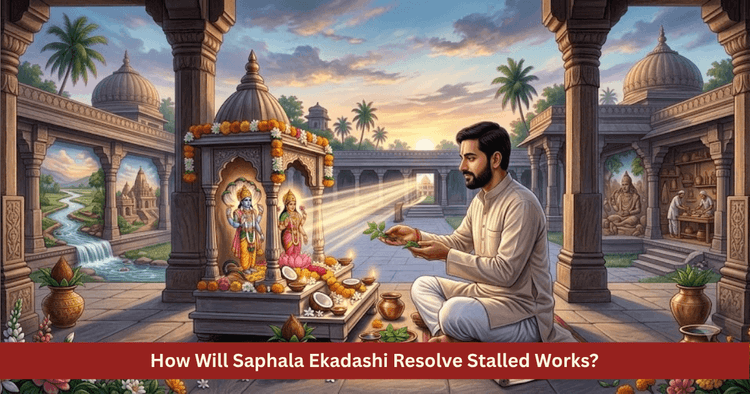
Table of Contents
Classical Framework and Sacred Injunctions of Saphala Ekadashi
Within the ancient and classical Ekadashi traditions of the Sanatana lineage, the sacred lunar date falling during the dark fortnight of the month of Paush is universally venerated as 'Saphala Ekadashi'. As its evocative Sanskrit name directly reveals, this auspicious observance is celebrated as the absolute bestower of complete fruition, triumphant accomplishment and divine fortune across all spheres of human existence. In the Uttara Khanda of the sacred Padma Purana, a profound dialogue between Lord Sri Krishna and Dharmaraja Yudhishthira outlines the supreme spiritual efficacy of this observance. When an individual encounters persistent obstacles, stagnant commercial undertakings or familial crises, observing the sacred vow of Saphala Ekadashi burns away the karmic impediments accumulated across previous incarnations.
Upon this sanctified date, humanity renders dedicated worship to the divine 'Achyuta' manifestation of Lord Sri Vishnu. The sacred epithet Achyuta signifies that Supreme Reality which never deviates from its essential transcendental nature and which never permits surrendered souls to slide into spiritual or material ruin. Observed during deep winter when atmospheric currents naturally facilitate internal contemplation, this observance anchors the practitioner's inner resolve with unyielding stability.
| Observance Dimension | Classical Injunction and Liturgical Protocol | Spiritual & Worldly Manifestation |
|---|---|---|
| Niyam | Vidhan | Vidhan |
| Presiding Lunar Tithi | Paush Krishna Paksha Ekadashi | Smooth resolution of stalled endeavors and rise of fortune |
| Presiding Sovereign Form | Lord Sri Vishnu (Manifested as Achyuta) | Unshakable stability, deliverance from crisis and salvation |
| Primary Vow Discipline | Complete waterless fast or pure fruit regimen | Physiological detoxification, digestive rest, mental focus |
| Essential Offering Substances | Uncut coconut, betel nut, whole cloves, fresh pomegranate, Tulsi | Harmonization of five elements, dissolution of poverty |
| Prescribed Incense & Light | Continuous cow ghee lamp, aromatic guggul & camphor | Purification of Vastu, elimination of psychic darkness |
| Nocturnal Vigil Observance | All night vigil, continuous kirtan, mantra recitation | Spiritual merit surpassing millennia of rigorous austerities |
| Breaking the Fast (Parana) | Dwadashi tithi following dawn in auspicious hours | Vow completion, remission of transgressions, Vaikuntha |
The formal discipline of Saphala Ekadashi commences on the evening of Dashami tithi. The practitioner partakes of a light, sattvic meal and maintains celibacy. On the morning of Ekadashi, one rises during Brahma Muhurta, cleanses the physical vessel with fresh water and dons unblemished garments of yellow or white. Standing before Lord Achyuta facing the eastern or northern quadrant, the practitioner states the formal spiritual resolution. True fasting transcends mere physical abstinence from food; it demands the conscious withdrawal of the senses from mundane distractions to anchor them at the lotus feet of the Divine.
The Sacred Legend of Saphala Ekadashi from the Padma Purana
The Padma Purana preserves a deeply moving and transformative legend illustrating the boundless grace of Saphala Ekadashi. In ancient times, King Mahishman reigned over the prosperous city of Champavati. He had four sons, of whom the eldest, Lumpaka, was exceptionally wicked, depraved and destructive. Lumpaka engaged continuously in severe vices, squandering royal wealth on prostitutes, alcohol and gambling, while incessantly defaming righteous sages and the deities.
Observing that his eldest son was incorrigible, King Mahishman banished him from the royal domain. Cast out by kin and society, Lumpaka retreated into deep forests. During daylight hours, he slaughtered innocent woodland creatures for food and under the cover of night, he plundered the homes of destitute citizens in the city. The forest where he dwelled housed a monumental, ancient Peepal (Ashwattha) tree, an abode beloved to Lord Vishnu. Lumpaka took shelter beneath the roots of this sacred tree.
- The Freezing Cold of Paush Krishna Paksha: On the night of Dashami in the dark fortnight of Paush, severe winter cold and biting drafts caused Lumpaka to shiver violently. Deprived of adequate clothing, he collapsed into unconsciousness, hovering on the verge of physical death.
- Involuntary Fasting on Ekadashi: When the sun rose on Saphala Ekadashi, Lumpaka lay motionless until midday. Reviving slowly, his limbs remained stiff, cold and paralyzed with fatigue, rendering him incapable of hunting.
- The Offering of Forest Fruits: Overwhelmed by hunger, he crawled across the forest floor, gathering fallen wild fruits. Returning to the roots of the Peepal tree at dusk, his throat constricted with grief, preventing him from consuming the food. Weeping bitterly, he placed the fruits at the base of the sacred tree, praying: May these fruits be accepted by Lord Vishnu; let the Divine preserve this fallen wretch.
- Continuous Nocturnal Vigil: Throughout that freezing night, intense cold and hunger denied him sleep. He remained awake until dawn, crying aloud the names of the Divine. Thus, entirely unaware, he completed a waterless fast, an offering of fresh fruits and a continuous night vigil on Saphala Ekadashi.
Lord Achyuta was moved by this surrender. Through the merit of Saphala Ekadashi, the accumulated karmic transgressions of Lumpaka's past lifetimes were incinerated in an instant. At dawn on Dwadashi, a celestial voice resounded and a divine horse manifested before him. Through divine grace, his intellect became sattvic, his body assumed a radiant golden aura and he returned to his father's palace. King Mahishman, observing this transformation, entrusted the kingdom to his care. Lumpaka ruled with righteousness, ultimately ascending to the transcendental abode of Lord Vishnu.
Prescribed Worship Protocols for Lord Achyuta
Classical treatises delineate a precise ritual sequence for worshipping Lord Achyuta on Saphala Ekadashi. Given the deep winter season, the liturgical substances presented emphasize warming, nourishing and protective botanical properties.
Consecrate the domestic prayer altar with holy Ganga water, covering a raised wooden platform with pristine yellow silk cloth. Revere the sacred idol of Lord Vishnu and Mother Lakshmi or consecrate a sacred Shaligram stone. Position a clean copper or brass pitcher filled with water, betel nut and unbroken rice in the northeast corner of the platform, placing a consecrated coconut upon its rim.
| Sequence | Liturgical Step | Scriptural Substances Utilized | Spiritual & Energetic Purpose |
|---|---|---|---|
| Niyam | Vidhan | Vidhan | Vidhan |
| First | Foot Washing & Welcome | Sanctified water, sandalwood, holy Tulsi | Purifying the altar, offering absolute hospitality |
| Second | Five Nectars Ablution | Cow milk, curd, ghee, honey and raw sugar | Purifying gross and subtle energetic fields |
| Third | Sacred Vestments | Radiant yellow silk garments and sacred thread | Anchoring cosmic order and moral discipline |
| Fourth | Anointing & Scent | Gopi-chandan, white sandalwood, vermilion | Cooling the Ajna chakra, centering mental currents |
| Fifth | Consecrated Fruits | Uncut coconut, fresh pomegranate, wild citron | Fruition of noble actions, removal of stagnation |
| Sixth | Aromatic Offerings | Intact whole cloves, betel nut, nutmeg, cardamom | Purification of speech, magnetic presence, planetary peace |
| Seventh | Illumination & Incense | Pure cow ghee lamp with multiple wicks, guggul | Dispelling ignorance, awakening divine awareness |
Offer fresh Tulsi leaves and yellow marigolds to the deity. Classical traditions emphasize that Lord Vishnu never partakes of an offering lacking holy Tulsi. Throughout the liturgy, repeat the transcendental chants 'Om Namo Bhagavate Vasudevaya' or 'Om Achyutaya Namah'.
Present seasonal fruits, fresh butter with rock sugar candy and sattvic winter confections as consecrated food offerings. Conclude the service by waving burning camphor before the altar, sounding the sacred conch shell to purify the surrounding space.
Time-Tested Remedies to Dissolve Misfortune and Resolve Blockages
Saphala Ekadashi serves as an extraordinary spiritual opportunity for individuals whose critical undertakings stall unexpectedly, who endure prolonged commercial losses or who struggle against chronic worldly crises. Classical Puranic wisdom outlines specific remedial practices to clear karmic stagnation on this day.
- Consecrated Coconut Remedy: Take a fresh, intact coconut containing water. Bind it with sacred red threads (moli) and mark an auspicious swastika upon its shell using vermilion paste. Seated before Lord Achyuta, chant 'Om Achyutaya Namah' 108 times, holding the mental prayer for the resolution of your endeavor. Offer this coconut at a traditional Vishnu shrine or release it into a flowing freshwater stream. This remedy resolves lingering legal and commercial gridlocks.
- Service to the Sacred Peepal Tree: Because the Ashwattha tree figures prominently in the scriptural lore of this fast, pour water blended with raw cow milk and black sesame seeds at the base of an ancient Peepal tree at noon. At dusk, kindle a four-faced lamp filled with pure mustard or sesame oil at its base, performing eleven clockwise circumambulations to appease ancestral and planetary afflictions.
- Offering Pomegranates and Whole Cloves: To revive stagnant commercial trade, offer a ripe red pomegranate and seven unbroken cloves to Lord Achyuta. Following the worship, wrap the cloves in a clean red cloth, depositing them within your commercial cash safe to prevent financial depletion and attract steady patrons.
- Recitation of the Tulsi Hymn: At dusk, kindle a pure cow ghee lamp beside the domestic Tulsi sanctuary, reciting the eight transcendental names of Tulsi eleven times to dissolve architectural Vastu defects and restore harmony.
These classical disciplines infuse the practitioner's biofield with unshakable confidence, enabling one to navigate earthly challenges with equanimity.
The Subtle Yogic Science of the All-Night Vigil
Vedic scriptures declare that the spiritual fruits of an Ekadashi observance remain incomplete without an all-night vigil. The nocturnal vigil undertaken on Saphala Ekadashi is celebrated as the 'Mahajagarana'. In the Padma Purana, Lord Sri Krishna reveals that the spiritual merit accrued from millennia of grueling forest austerities or the gifting of countless cows is attained effortlessly through this single night vigil.
From a yogic perspective, nocturnal hours are governed by tamasic inertia. During deep winter, human physiology seeks refuge in heavy sleep and physical torpor. When an earnest seeker overcomes this biological sluggishness through conscious willpower, vital life prana ascends from the base Muladhara chakra toward the crown Sahasrara center.
| Nocturnal Watch | Temporal Window | Prescribed Liturgical Activity | Subtle Spiritual & Mental Fruit |
|---|---|---|---|
| Niyam | Vidhan | Vidhan | Vidhan |
| First Watch | 8:00 PM to 11:00 PM | Vishnu Sahasranama & Bhagavad Gita study | Purification of speech, mental serenity, focus |
| Second Watch | 11:00 PM to 2:00 AM | Achyutashtakam & twelve-syllable mantra japa | Awakening of heart center, eradication of fear |
| Third Watch | 2:00 AM to 4:00 AM | Silent meditation and breath awareness | Activation of the third eye, intuitive foresight |
| Fourth Watch | 4:00 AM to 6:00 AM | Dawn Mangala Arati, solar hymns, adoration | Annihilation of karmic debt, radiant physical ojas |
The nocturnal vigil must never be squandered on idle worldly conversations or digital distractions. The seeker should remain absorbed in chanting the holy names of God. When performed collectively with traditional acoustic bells, these sonic vibrations eliminate environmental negativity, establishing an impenetrable armor of divine light around the home.
Canonical Rules for Concluding the Fast on Dwadashi
The full spiritual fruits of Saphala Ekadashi are realized only when the concluding feast (Parana) is observed in strict accordance with scriptural timelines. Breaching canonical rules during fast-breaking diminishes the accumulated spiritual merit.
On Dwadashi morning, rise before sunrise, complete bodily ablutions and perform a brief worship of Lord Achyuta, presenting fresh vegetarian offerings. The fast must always be broken outside the window of 'Harivasara', which constitutes the opening quarter of Dwadashi tithi.
- Feeding Virtuous Souls and the Destitute: Prior to personal consumption, provide a wholesome meal or uncooked provisions to a virtuous scholar or an impoverished wanderer.
- Dedicating Portions to Nature and Animals: Reserve the first portion of the prepared meal for a sacred cow, the second for birds and the third for animals.
- Selecting the Fast-Breaking Medium: Conclude the fast by partaking of sanctified Tulsi leaves, drops of sacred foot nectar (Charanamrita) or a piece of Indian gooseberry (Amla) before consuming grains.
- Nutritional Discipline: Maintain a strict avoidance of onions, garlic, heavy lentils and intoxicants on Dwadashi, favoring easily digestible preparations to protect the digestive tract following fasting.
A practitioner who completes the observance of Saphala Ekadashi through this methodology witnesses the dissolution of towering obstacles, enjoying worldly prosperity and ultimately attaining the supreme spiritual realm.
FAQ
To which manifestation of Lord Vishnu is Saphala Ekadashi dedicated? Saphala Ekadashi is dedicated to the 'Achyuta' manifestation of Lord Vishnu, the supreme protector who never allows surrendered devotees to falter.
What is the deeper meaning behind the name 'Saphala Ekadashi'? The term Saphala signifies complete success; this observance is celebrated for resolving stubborn roadblocks and transforming misfortune into success.
Which specific fruits must be presented during the worship on this day? Scriptures prescribe presenting whole coconuts, fresh pomegranates, betel nuts, whole cloves and wild citrons to Lord Achyuta.
Why is an all-night vigil emphasized on Saphala Ekadashi? The Padma Purana affirms that maintaining an all-night vigil yields spiritual merits surpassing thousands of years of penance and countless charitable gifts.
How and when should the fast of Saphala Ekadashi be concluded? The fast must be concluded on Dwadashi morning after the expiration of Harivasara, breaking the vow with sanctified Tulsi water after feeding the needy.
Get your accurate Kundali
Generate KundaliDid you like it?
Author

Pt. Abhishek Sharma (63)
Experience: 20
Consults About: Family Planning, Career
Clients In: Punjab, Haryana, Delhi
Share this article with friends and family
WELCOME TO
ZODIAQ
Right Decisions at the right time with ZODIAQ
