How To Protect The Holy Tulsi From Winter Frost in Paush Month?
By Pt. Narendra Sharma
Frost Protection, Chunari Rules, Midday Watering And Astrological Insights
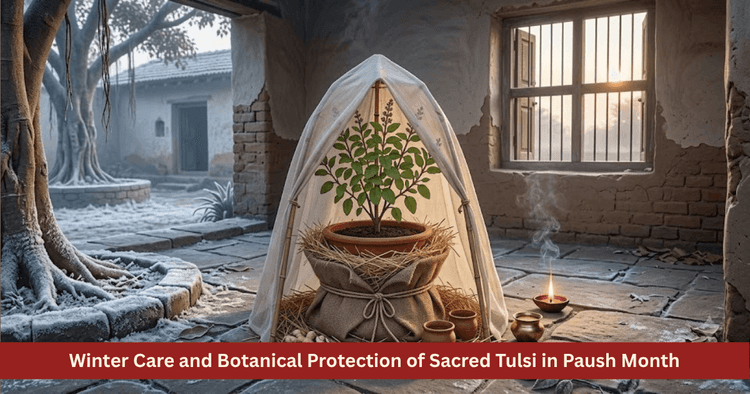
Table of Contents
1. The Winter Solstice Junction, Frost Inversion and Tulsi's Vulnerability
According to the classical doctrines of Sanatana chronological computation and the Vedic calendar, the sacred month of Paush (spanning mid-December through mid-January) marks a critical seasonal junction between late autumn (Hemanta) and deep winter (Shishira). During this window, ambient environmental temperatures collapse, blanketing northern India and river plains in dense fog, severe frost inversion and biting northwesterly winds. Within Sanatana sacred traditions, the holy Tulsi plant (revered as Vrinda Devi) enshrined within household courtyards is honored not merely as an ordinary botanical shrub but as the living consort of Lord Sri Hari Vishnu and the energetic anchor of domestic harmony and prosperity.
During this severe seasonal transition, when ambient temperatures drop between 2 and 5 degrees Celsius, sacred Tulsi plants in many households begin to wither, turn black or desiccate. Scriptural compendiums, including the Padma Purana, Skanda Purana and Garuda Purana, warn that the unexplained withering of a household Tulsi plant indicates domestic disharmony, unexpected financial strain and the astrological affliction of Mercury (Budha) and Jupiter (Brihaspati). therefore providing dedicated botanical and liturgical care for the sacred Tulsi during Paush is a vital responsibility for the household.
| Conservation & Astrological Dimension | Classical Setting & Injunction Details | Botanical & Environmental Manifestation |
|---|---|---|
| Critical Risk Window | Entire month of Paush (Mid-December to Mid-January) | Rupture of plant cell walls, chlorophyll degradation |
| Primary Atmospheric Threat | Extreme frost inversion, freezing drafts, low humidity | Freezing of sap within xylem and phloem vessels |
| Corresponding Planetary Influences | Planet Mercury (Greenery, Trade) & Jupiter (Wisdom) | Commercial slowdowns, communication gaps, domestic strain |
| Primary Protective Covering | Clean crimson, saffron or yellow cotton cloth (Chunari) | Shielding delicate leaf tissues from direct ice crystals |
| Optimal Watering Schedule | Exclusively before midday (between 10:00 AM and 12:00 PM) | Preventing fungal root-rot and soil oversaturation |
| Twilight Protective Ritual | Kindling a pure cow ghee lamp near the base of the pot | Generating subtle thermal energy and supporting the micro-climate |
| Restorative Herbal Nutrition | Diluted raw cow milk, wood ash and raw turmeric powder | Organic defense against aphids, fungal molds and chill |
2. The Microscopic Plant Physiology of Winter Frost Damage
Examined through plant physiology and botanical science, holy Tulsi (Ocimum tenuiflorum / Ocimum sanctum) is inherently a tropical and sub-tropical aromatic shrub. Its biological systems are naturally adapted to warm, sunny and moderately humid environments.
When nocturnal winter temperatures drop near the freezing threshold during Paush, the plant experiences specific physiological stresses:
- Intracellular Ice Formation and Cell Wall Rupture: The delicate foliage of Tulsi contains approximately 85 to 90 percent water. Under freezing temperatures, this cellular water crystallizes into ice. Because water expands upon freezing, sharp ice crystals puncture the microscopic cell walls from within. When the morning sun melts these crystals, the cellular structure collapses, leaving the leaves limp and blackened.
- Fungal Root-Rot (Rhizoctonia & Fusarium): When well-meaning householders pour cold water into the soil on freezing mornings, moisture lingers around the root ball. Because evaporation rates are low in winter, saturated soil deprives roots of oxygen, leading to fungal rot and root decay.
- Inhibition of Photosynthesis: A layer of frost on the leaves blocks sunlight from reaching chloroplasts within the leaf tissue, halting the production of carbohydrates and starving the plant of nutrients.
3. Astrological Dynamics: Mercury, Jupiter and Domestic Harmony
In classical Vedic astrology, the Tulsi plant is linked to Mercury (governing commerce, analytical intellect, speech and botanical vitality) and Jupiter (governing spiritual wisdom, domestic fortune and progeny). It operates as an energetic barometer for the household.
- Affliction of Planet Mercury: If the Tulsi plant withers during winter, the native's horoscope may reflect a weakened Mercury, manifesting as commercial stagnation, communication breakdowns and mental fatigue.
- Withdrawal of Jupiterian Grace: Revered as 'Harivallabha' (the beloved of Lord Vishnu), a deteriorating Tulsi plant suggests an imbalance in domestic sattva. Financial waste and delays in auspicious family endeavors often follow.
- Absorbing Environmental Stress: Sacred lore also notes that when adverse influences approach a household, the sacred plant acts as a spiritual buffer, absorbing environmental and emotional stress to protect the family.
4. Classical Fabric Coverings: The Ritual and Practical Use of the Chunari
Covering the sacred Tulsi before nightfall during Paush is a time-tested practice that balances practical horticulture with devotional care.
| Protective Protocol | Traditional Liturgical Method | Functional Botanical Rationale |
|---|---|---|
| Optimal Covering Hour | Roughly thirty minutes prior to dusk (Godhuli Vela) | Shielding leaves from freezing night dew and frost crystals |
| Optimal Uncovering Hour | Between 9:00 AM and 10:00 AM (once the sun has risen) | Ensuring access to morning sunlight and fresh air circulation |
| Color and Fabric Selection | Clean, unstitched red, yellow or saffron cotton fabric | These colors retain warmth without suffocating the plant |
| Strictly Prohibited Materials | Black textiles, heavy synthetics or direct plastic sheets | Non-porous plastics trap moisture, encouraging rot |
Step-by-Step Canopy Construction
Insert four slender bamboo stakes or clean wooden dowels vertically into the corners of the planter, extending four to six inches above the plant's crown. Drape a clean red or saffron cotton cloth over these stakes, securing it like a canopy. Avoid draping heavy cloth directly upon the foliage; maintaining a gap of two to three inches between the fabric and leaves allows necessary air circulation while keeping frost off the foliage.
5. Winter Watering Protocols: Essential Guidelines
Watering guidelines during winter differ fundamentally from summer routines. Applying cold water at the wrong hour can damage the root system.
- Strict Midday Timing: Never water the Tulsi plant before dawn or during the freezing morning hours. Water exclusively between 10:00 AM and 12:00 PM, once ambient temperatures have risen and the planter has received morning sun.
- Water Volume and Temperature: Avoid using cold tap water; use lukewarm or room-temperature water. Water lightly, ensuring the soil remains moist without becoming waterlogged or muddy.
- Restorative Raw Cow Milk Solution: Once or twice weekly (ideally on Thursdays or Fridays), mix two tablespoons of raw, unpasteurized cow milk into a small pitcher of lukewarm water and pour it at the base of the plant. This natural solution feeds beneficial soil microbes, strengthens roots against the cold and provides gentle systemic nourishment.
- Fasting Days for Watering: Following classical tradition, refrain from watering or plucking leaves on Sundays, Ekadashi tithis and during solar or lunar eclipses. These days are reserved as sacred rest periods for the plant.
6. Twilight Lamp Offerings: Thermal Protection and Microclimate
Lighting a lamp near the Tulsi plant at dusk combines practical thermal care with evening prayer.
- Pure Cow Ghee Lamp: Immediately following sunset, kindle a lamp filled with pure cow ghee in an earthen, brass or copper holder near the base of the pot. A ghee flame raises ambient temperatures by two to three degrees Celsius in its immediate vicinity, providing gentle warmth against cold drafts.
- Atmospheric Purification: Burning pure ghee releases natural aromatic compounds that purify the surrounding air, supporting an optimal microclimate for the plant overnight.
- Safe Placement: Position the lamp along the outer rim of the planter or a few inches away on the ground. Never place an open flame directly beneath the leaves, as direct heat can scorch the foliage.
7. Natural Plant Nutrients: Wood Ash, Turmeric and Pruning Manjari
Avoid synthetic chemical fertilizers during deep winter, as the plant's resting metabolism cannot process concentrated salts. Traditional, natural amendments provide effective support:
- Pure Wood Ash (Cow Dung Cake Ash): Natural ash derived from dried cow dung cakes or clean firewood provides valuable winter nutrition. Dust a handful of sifted ash over the soil once every two weeks, scattering a light veil over the leaves as well. Rich in potassium and phosphorus, wood ash acts as an organic anti-freeze for the root zone while deterring winter pests.
- Turmeric Powder Solution: If you observe white aphids, mealybugs or powdery mildew on the leaves, dissolve half a teaspoon of pure turmeric powder in one liter of lukewarm water and mist the foliage gently on a sunny morning. Turmeric functions as a natural antifungal and antimicrobial agent, helping restore leaf health.
- Pruning Seed Heads (Manjari): If the plant has produced an abundance of dry seed spikes (manjari), trim them away using clean, sharp pruning shears. Classical tradition views overgrown seed heads as an energetic burden on the plant; removing them redirects energy into leaf preservation and root strength.
FAQ
What is the single most effective way to protect the sacred Tulsi from winter frost? Draping a light crimson or saffron cotton cloth canopy over the plant before sunset and watering it only with lukewarm water during sunny midday hours offers the best protection.
What is the ideal time of day to water the Tulsi plant during deep winter? Water exclusively between 10:00 AM and 12:00 PM once the sun has warmed the air; morning or evening watering can freeze the root ball and trigger rot.
What are the botanical benefits of applying wood ash to the Tulsi planter in winter? Wood ash supplies potassium to fortify cell walls against frost, balances soil acidity and serves as an organic deterrent against white aphids and winter fungal molds.
Why should dry seed spikes (manjari) be pruned from the plant during Paush? Allowing dry seed heads to remain consumes vital energy that the plant needs for winter survival; trimming them encourages healthy leaf retention and root resilience.
What does a withering Tulsi plant signify in Vedic astrology? A withering Tulsi plant suggests an imbalance in Mercury (governing trade and analytical clarity) and Jupiter (governing fortune and wisdom), indicating a need to restore harmony within the home.
Get your accurate Kundali
Generate KundaliDid you like it?
Author

Pt. Narendra Sharma (63)
Experience: 20
Consults About: Family Planning, Career
Clients In: Punjab, Haryana, Delhi
Share this article with friends and family
WELCOME TO
ZODIAQ
Right Decisions at the right time with ZODIAQ
