What Is The Spiritual Mystery Of Amalaki Ekadashi?
By Aparna Patni
Worship Of Gooseberry Tree As Lord Vishnu And Immortality
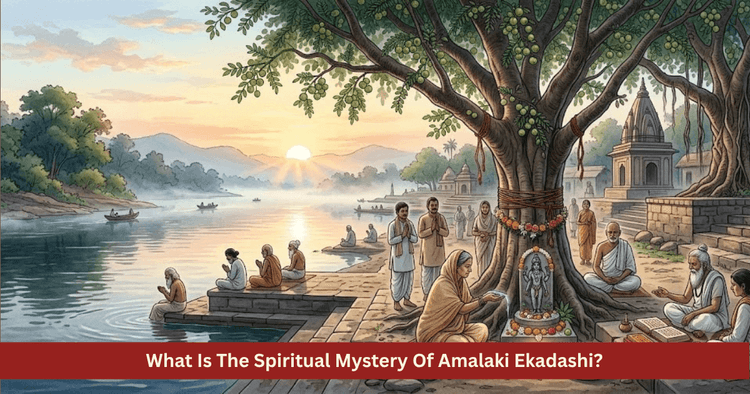
Table of Contents
Panchang Description And The Liturgical Framework Of Sacred Tree Worship
The eleventh lunar day of the bright fortnight in the month of Phalguna is designated across the sacred Vedic calendar as Amalaki Ekadashi. The classical Sanskrit term amalaki identifies the sacred gooseberry tree, traditionally revered as dhatri, the universal sustainer. This holy day marks the harmonious junction where departing late winter chill yields completely to the radiant blooming of early spring. Among all lunar observances across the annual cycle, Amalaki Ekadashi holds an exalted position because the object of primary ritual adoration is not an inanimate icon carved from stone or metal but a living sacred tree worshiped directly as the arboreal manifestation of Lord Vishnu. Classical scriptures including the Padma Purana and the Brahmanda Purana explicitly declare that the profound spiritual merits derived from performing hundreds of Vajapeya sacrifices or gifting thousands of indigenous cows are naturally secured through the sincere observance of this single sacred fast.
| Panchang Component | Classical Description |
|---|---|
| Month and Fortnight | Phalguna Month, Shukla Paksha |
| Sacred Tithi | Shukla Paksha Ekadashi Tithi |
| Presiding Divine Principles | Lord Sri Hari Vishnu, Lakshmi Narayana and Dhatri Tree |
| Constellation Conjunction | Auspicious alignment with Pushya or Punarvasu Nakshatra |
| Primary Spiritual Rites | Sixteen step tree worship, seven circumambulations, fast |
| Prescribed Offerings | Ripe gooseberry fruits, five nectars, tulsi leaves, sesame |
| Bestowed Spiritual Fruit | Dissolution of accumulated karma, vitality, divine liberation |
To assimilate the entire spiritual and physiological fruit of Amalaki Ekadashi, every spiritual seeker must maintain disciplined scriptural observances commencing from the eve of the tenth lunar day.
- Partaking in a light, satvic meal on the evening of the tenth lunar day while observing complete physical and mental celibacy.
- Awakening before sunrise during Brahma Muhurta, bathing in cool water consecrated with pure gooseberry juice and sacred Ganga drops.
- Dressing in clean yellow garments at the family altar, taking a formal vow to observe an absolute or satvic fruit fast.
- Approaching a mature gooseberry tree growing in clean soil, purifying the surrounding ground with consecrated water.
- Pouring a libation of pure water, raw cow milk, vermilion, unbroken rice grains and yellow blossoms at the root of the sacred tree.
- Winding an unbroken raw cotton thread seven times clockwise around the trunk while continuously chanting Om Namo Bhagavate Vasudevaya.
- Kindling a clarified butter lamp fueled by cow ghee beneath the branches, studying the Vishnu Sahasranama or the sacred narrative of the day.
- Guarding the mind against abrasive speech, envy, angry outbursts, falsehood and lethargy throughout the daylight hours.
- Maintaining a devotional vigil of sacred chanting through the night, concluding the fast on the twelfth lunar day following formal charity.
The Celestial Genesis Of The Gooseberry Tree From The Tears Of Brahma
The Brahmanda Purana and the Uttara Khanda of the Padma Purana preserve an inspiring cosmological account detailing the appearance of the sacred gooseberry tree. When the entire universe lay submerged beneath the waters of cosmic dissolution, the Supreme Lord Sri Hari Vishnu rested upon the serpent couch of Ananta in mystic slumber. As the dawn of universal recreation drew near, an effulgent thousand petaled lotus manifested from the lotus navel of Lord Vishnu. Upon that celestial bloom appeared the four faced creator, Lord Brahma, the embodiment of Vedic wisdom.
Entrusted with the monumental responsibility of universal creation, Lord Brahma felt deep curiosity regarding the primal foundation of reality and the supreme source of his own existence. Desiring to locate his origin, Brahma descended along the interior channels of the lotus stem for thousands of years, yet failed to perceive the subterranean limits of that cosmic stem. Returning to the summit of the lotus blossom, Brahma sat in deep meditation, executing unwavering austerities directed toward the Supreme Person for millennia.
Pleased by this steady surrender, Lord Vishnu revealed his transcendental four armed form adorned with the conch, mace, discus and lotus blossom. Beholding that magnificent, radiant and compassionate form, the heart of Brahma swelled with boundless joy. Streams of ecstatic tears flowed continuously from his eyes. As those sacred tears touched the sanctified ground beneath the lotus, an exquisite, life sustaining and deeply therapeutic tree sprouted instantly from the earth.
Gazing upon that celestial growth, Lord Vishnu spoke with a gentle smile: "O Brahma, this sacred tree born from your tears of pure devotion will reign as the sovereign among all botanical species, known as amalaki or dhatri. This tree shall remain identical to my personal transcendental presence. Beholding it, touching its bark, remembering its virtues and partaking of its fruit will instantly dissolve the accumulated karmic debts gathered across countless physical transmigrations." For this reason, adoring the gooseberry tree on Amalaki Ekadashi is celebrated as the direct adoration of Lord Vishnu.
The Celestial Pantheon Residing Within The Sacred Dhatri Tree
In authentic Vedic philosophy, the natural world and transcendental divinity are never viewed as divided realities. The sacred gooseberry tree is revered as the living abode of the entire celestial pantheon. Classical treatises record that no other arboreal species upon the terrestrial plane anchors divine cosmic frequencies to the degree demonstrated by the holy amalaki tree.
| Section of the Sacred Tree | Residing Divine Frequency | Nature of Elemental Cosmic Power | Bestowed Spiritual Benefit |
|---|---|---|---|
| Root Base and Foundation | Lord Sri Hari Vishnu | Sustaining and preserving cosmic energy | Purification of deep ancestral debts |
| Central Trunk Column | Lord Mahadeva Shiva | Dissolution, asceticism and rejuvenation | Protection from untimely death and longevity |
| Extended Branches and Twigs | Four Faced Brahma and Seers | Creative intellect and scriptural wisdom | Expansion of discernment and intellect |
| Delicate Foliage and Leaves | The Entire Assembly of Deities | Microcosmic harmony and serene peace | Lineage protection and household grace |
| Fragrant Blossoms | Prajapatis and Wind Deities | Dynamic motion and ethical work ethics | Success in trade and righteous vocation |
| Sacred Nectarine Fruit | Goddess Mahalakshmi Herself | Boundless opulence, beauty and vitality | Worldly affluence, radiant aura, liberation |
When a practitioner sits beneath the shade of the gooseberry tree on Amalaki Ekadashi, that individual enters the protective aura of the Trinity alongside the entire celestial hierarchy. Circumambulating the living trunk clears psychic disturbances from the human biofield, infusing the mental vessel with vibrant satvic light.
The Hunter In The Forest And The Hidden Mystery Of Accidental Merit
The sacred discourse between King Mandhata and the venerable Sage Vashistha contains an instructive historical narrative illustrating the power of Amalaki Ekadashi. In ancient eras flourished the virtuous and prosperous realm of Vaidisha, governed by the righteous monarch Chaitraratha. Within this kingdom, atheism, extreme poverty and unrighteous conduct were unknown. On the eleventh day of the bright fortnight of Phalguna, the king journeyed with his citizens to the banks of a river, where they assembled beneath a massive gooseberry tree, installed a consecrated urn and maintained an all night devotional vigil.
During the midnight hours, an impoverished, exhausted and violent hunter arrived at the perimeter of the gathering. His life had been spent slaughtering forest animals for survival. Drawn by the illuminated lamps, the resonance of conches and the assembly of devotees, he concealed himself quietly behind the foliage. Driven by hunger, he resolved to wait until dawn in the hope of securing leftover food offerings. Because of this circumstance, he endured an unintentional fast throughout the day and by listening to the continuous chanting and sacred stories, he completed an unintentional nocturnal vigil.
Following the departure of the pilgrims at sunrise, the hunter consumed simple food and went his way. Years later, having lived his natural lifespan, the hunter died. Due to the uncalculated spiritual merit generated by that single night of accidental fasting and vigil before the sacred gooseberry tree, he was reborn as a mighty, noble and prosperous king named Vasuratha.
On one occasion, while pursuing game in a deep jungle, King Vasuratha lost his way and fell into an exhausted sleep beneath a forest canopy. A band of fierce marauders discovered the resting monarch and attacked him with sharp javelins, spears and axes. Miraculously, every lethal blade turned into fragrant flower petals upon making contact with the king's skin. In that instant, an effulgent divine form manifested directly from the chest of the king, swiftly annihilating the demonic attackers. When the monarch awakened, a celestial voice echoed from the skies: "O King, you were protected from death by the divine potency of the Amalaki Ekadashi vow observed unintentionally in your previous life." This sacred narrative proves that if an accidental observance can construct such an impenetrable armor, the rewards attained by a seeker who observes this discipline with conscious faith remain beyond measure.
Ayurvedic, Biochemical And Rejuvenative Science Of Gooseberry
The sacred observances of Sanatana Dharma are never detached from physiological and empirical realities. The classical medical treatise Charaka Samhita, within the Rasayana section of the Chikitsa Sthana, honors the gooseberry fruit as the supreme rejuvenative botanical substance in existence. The classical term rasayana denotes an organic formulation that nourishes all seven primary physical tissues plasma, blood, muscle, adipose, bone, bone marrow and reproductive essence preserving youthful cellular integrity while preventing chronic disease.
The seasonal junction of Phalguna demands precise physiological attention. The excessive bodily kapha dosha accumulated during cold winter months begins to melt rapidly under the warming rays of the spring sun. This biological liquefaction dampens the digestive fire, leading to the accumulation of toxic metabolic waste. The gooseberry is unique among terrestrial fruits because it contains five of the six classical tastes sweet, sour, pungent, bitter and astringent with only the salty taste absent. Because of this comprehensive taste profile, it simultaneously balances all three physiological humors: vata, pitta and kapha.
| Chemical and Botanical Principle | Biological Action in Human Body | Classical Health Benefit |
|---|---|---|
| Concentrated Natural Vitamin C | Proliferation of white blood cells | Enhanced immunity against infections |
| Powerful Polyphenols and Tannins | Neutralization of cellular free radicals | Retardation of aging and cellular renewal |
| High Astringent and Bitter Tastes | Purification of stomach and liver tissues | Expulsion of melted kapha and strong digestion |
| Rich Bioavailable Iron and Minerals | Accelerated synthesis of hemoglobin | Elimination of anemia and radiant skin |
| Gentle Metabolic Stimulant | Optimal secretion of digestive enzymes | Smooth assimilation and relief from stagnation |
Ancient seers established the custom of consuming gooseberry, bathing with water infused with its essence and distributing the fruit on Amalaki Ekadashi so that the human organism could undergo deep cellular detoxification during this seasonal transition. Modern clinical investigations confirm that fresh gooseberries contain twenty times the vitamin C concentration found in citrus fruits, bound to protective tannins that prevent degradation even under high temperatures. Thus, Amalaki Ekadashi safeguards physiological vitality while elevating spiritual consciousness.
Classical Sixteen Step Adoration And Tree Circumambulation Protocol
To secure the comprehensive fruits of Amalaki Ekadashi, ancient liturgical manuals outline a precise ceremony to be performed directly beneath a living gooseberry tree situated in clean surroundings.
- Following the morning purification bath, cleanse the earth beneath the gooseberry tree using consecrated river water or pure cow dung wash.
- Construct an unblemished ritual altar facing the eastern quadrant, draping the platform with yellow silk fabric before installing a holy urn.
- Fill the urn with pure water, adding an areca nut, unbroken turmeric root, durva grass, a silver coin and sacred leaves.
- Place a clean plate atop the urn, installing a consecrated icon of Lord Lakshmi Narayana upon that raised base.
- Invoke Lord Ganesha first to clear obstacles, subsequently initiating the sixteen step adoration of Lord Vishnu and the holy tree.
- Pour a stream of raw unboiled cow milk and sacred water over the roots, applying yellow sandalwood paste and floral essences to the bark.
- Offer yellow blossoms, holy basil foliage, seasonal fruits and fresh gooseberries before the altar with deep reverence.
- Hold an unbroken raw cotton cord, circumambulating the sacred tree trunk seven times in a clockwise direction with steady footsteps.
- Recite the classical formula Om Dhatryai Namah or the sovereign mantra Om Namo Bhagavate Vasudevaya continuously during the circumambulation.
- Conclude the ceremony by waving lighted wicks of cow ghee and natural camphor, listening attentively to the sacred narrative of the day.
- On the subsequent twelfth lunar day, repeat brief morning prayers, distribute wholesome food and gifts to worthy recipients and conclude the fast.
The Path To Spiritual Liberation And Transcendental Immortality
Amalaki Ekadashi extends far beyond worldly boons, serving as a celestial pathway guiding human consciousness from physical mortality to spiritual liberation. Classical scriptures revere the sacred gooseberry tree as dhatri, meaning the divine mother who nourishes her children without expectation. Just as an affectionate mother absorbs difficulties to provide nourishment for her offspring, the gooseberry tree imparts physical health and longevity to humanity without discrimination.
This sacred day demonstrates that genuine spirituality thrives through harmonious communion with the natural world. When human society honors nature rather than exploiting its resources, nature functions as a wish fulfilling tree, satisfying all legitimate needs. The disciplines observed on Phalguna Shukla Ekadashi cleanse the human heart of greed, lust and personal ego, replacing them with selfless service and pure devotion. An aspirant who observes this vow with an unblemished heart enjoys radiant health and prosperity in this physical existence, ultimately attaining liberation in the transcendental realm of Lord Vishnu.
FAQ
By what other prominent name is Amalaki Ekadashi known?
Across diverse regions of India, Amalaki Ekadashi is celebrated as Amla Ekadashi, while in the holy city of Kashi it is observed as Rangbhari Ekadashi.
Why is the gooseberry tree worshiped on this lunar day?
The gooseberry tree sprouted from the ecstatic devotional tears of Lord Brahma, housing the living presence of the Trinity and the entire celestial pantheon.
Is consuming the gooseberry fruit permitted on this fast?
Yes, consuming gooseberry, bathing in water infused with its extract and distributing the fruit is considered meritorious and health giving on this date.
How many circumambulations of the gooseberry tree are prescribed?
Scriptural manuals mandate seven clockwise circumambulations around the sacred trunk while winding an unbroken raw cotton cord.
What ancient sacrifice yields merit equivalent to this single fast?
The Padma Purana states that observing Amalaki Ekadashi with pure faith yields spiritual merits equal to performing one hundred grand Vajapeya sacrifices.
Get your accurate Kundali
Generate KundaliDid you like it?
Author

Aparna Patni (63)
Experience: 20
Consults About: Family Planning, Career
Clients In: Punjab, Haryana, Delhi
Share this article with friends and family
WELCOME TO
ZODIAQ
Right Decisions at the right time with ZODIAQ
