What Is The Mystery Of Barsana Lathmar Holi?
By Aparna Patni
Colors Of Divine Love Between Radha Krishna And Cowherd Maidens
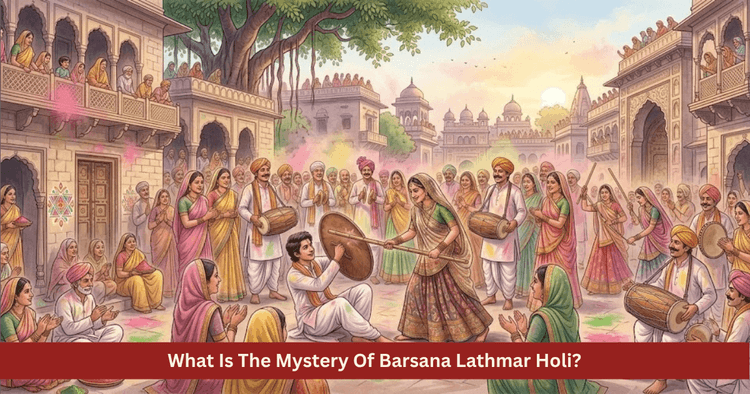
Table of Contents
Panchang Description And The Liturgical Schedule Of Barsana
On the ninth lunar day of the bright fortnight in the month of Phalguna, the world renowned festival of Lathmar Holi is celebrated with deep devotion and sacred joy within the historic village of Barsana in the Braj region. According to the traditional Vedic calendar, this lunar date represents the pinnacle of spring festivities in the sacred abode of Sri Radha Rani, the daughter of King Vrishabhanu. Within sacred Braj culture, this is far from a secular pastime; it is the living continuation of the 5000 year old pastime enacted by Lord Sri Krishna and Sri Radha Rani alongside their cowherd companions. On this holy day, the male participants from Nandgaon, representing the cowherd companions of Krishna, arrive at the Sriji Temple in Barsana to raise their flag and shower colors, where the women of Barsana, representing the companions of Radha, welcome them with rhythmic strikes from decorated wooden batons.
| Panchang Component | Classical Description |
|---|---|
| Month and Fortnight | Phalguna Month, Shukla Paksha |
| Sacred Tithi | Shukla Paksha Navami Tithi |
| Principal Seat of Celebration | Sriji Temple (Ladli Ji Abode), Barsana, Mathura |
| Primary Participants | Cowherd Men of Nandgaon and Cowherd Women of Barsana |
| Form of Observance | Affectionate baton strikes, shield defense, traditional singing |
| Primary Colors Utilized | Natural extract of palash blossoms, pure abir and gulal |
| Bestowed Spiritual Fruit | Dissolution of ego, attainment of divine love, liberation |
To witness the divine grace of Barsana Lathmar Holi and absorb its sanctity, an aspirant must maintain traditional decorum and spiritual discipline.
- Rising before sunrise during Brahma Muhurta, bathing in sacred waters and dressing in clean yellow or white cotton garments.
- Eliminating all sensual thoughts from the mind, anchoring consciousness in pure selfless devotional sentiment.
- Visiting the Sriji Temple in Barsana to offer natural fragrant powders and sandalwood paste at the lotus feet of Sri Radha Rani.
- Listening reverently to the traditional spring ballads and philosophical songs chanted by the assembled elders.
- Regarding the women of Barsana with deep reverence as the living manifestations of the divine companions of Radha.
- Refraining strictly from synthetic, toxic and commercial chemicals, utilizing only organic extracts derived from palash blossoms.
- Chanting the holy name of Radha continuously while anointing one's forehead with the sanctified dust of Braj.
- Standing as an observant witness during the late afternoon to absorb the spiritual ecstasy unfolding in the Rangeeli Gali.
The 5000 Year Sacred Lore Of Radha And Krishna
The classical Sanskrit texts Shrimad Bhagavatam, Garga Samhita and the Patala Khanda of the Padma Purana provide an elaborate historical account of the origin of Lathmar Holi. During the Dvapara era, Lord Sri Krishna journeyed from Nandgaon to Barsana accompanied by his companions, including Sridama, Subala and Mansukha. Their intent was to shower colors upon Sri Radha Rani and her companions Lalita, Vishakha and Chitra, engaging in playful celebration.
When Lord Krishna cast fragrant powders upon Radha Rani, the milkmaids of Barsana assumed a loving defensive posture. To counter the playful intrusion, Radha and her companions took up wooden batons to drive away Krishna and his companions. Caught off guard, the cowherd boys of Nandgaon raised their leather and metal shields to deflect the raining blows. The milkmaids struck the shields in affectionate joy while the cowherd boys knelt, laughing beneath their defenses. When certain companions were caught, the maidens dressed them playfully in feminine robes, marking their faces with collyrium and making them dance. This pastime continues to be celebrated in Barsana upon the ninth lunar day of Phalguna.
Living Traditions, Structural Code and Shield Defense Protocols
Participation in the Lathmar Holi of Barsana is strictly governed by ancestral tradition. The celebration is reserved exclusively for the men of Nandgaon and the married women of Barsana. The male participants are addressed as Huriyaras, while the women are addressed as Huriyarins.
- On the preceding eighth lunar day of Phalguna, a traditional messenger departs from Barsana carrying herbal colors and an official invitation to Nandgaon.
- On the morning of Navami, the men of Nandgaon tie massive protective turbans upon their heads, secure thick sashes around their waists and carry heavy shields as they walk toward Barsana.
- Arriving at the sacred Pili Pokhar water reservoir outside Barsana, they rest, adjust their turbans and partake in cooling herbal almond drinks.
- They ascend to the grand Sriji Temple, where both communities sit in opposing assemblies to sing traditional philosophical verses celebrating the dialogue between Radha and Krishna.
- In the late afternoon, the gathering moves down into the narrow, cobbled lane known as Rangeeli Gali, where the dynamic celebration commences.
- The veiled women of Barsana swing heavy wooden batons with both hands, striking down upon the shields of the kneeling men.
- The men of Nandgaon absorb the blows upon their raised shields without retaliating, maintaining a joyful posture throughout the demonstration.
- If a man loses his shield or falls, he is playfully detained, dressed in colorful garments and made to dance before being released.
| Festival Phase | Geographic Location | Implements and Materials | Spiritual and Traditional Disposition |
|---|---|---|---|
| Sacred Invitation | Nandgaon Temple | Herbal powders, betel leaf, scroll | Auspicious summons of divine love |
| Preparation of Shield | Pili Pokhar, Barsana | Heavy turbans, sashes, shields | Heroic composure and defensive discipline |
| Traditional Chanting | Sriji Temple Altar | Drums, hand cymbals, sacred verses | Poetic dialogue of divine surrender |
| Primary Baton Play | Rangeeli Gali, Barsana | Seasoned wooden staves, shields | Dissolution of ego beneath divine authority |
Preparation Of Organic Palash Extract And Sacred Herbal Powders
The defining attribute of Barsana Lathmar Holi is its commitment to botanical purity. Commercial and toxic synthetic pigments are strictly forbidden from the sacred precincts. Preparations commence weeks prior to the festival date.
The principal liquid dye is extracted exclusively from the fiery orange blossoms of the palash tree, commonly known as the flame of the forest. Fresh blossoms harvested from surrounding woodlands are boiled in massive copper and brass cauldrons. Mixing natural lime, turmeric and saffron into the cooled extract produces a fragrant saffron orange hue. This botanical liquid purges atmospheric impurities and shields human dermal layers against seasonal heat. Concurrently, herbal powders are ground from pure arrowroot flour and dried palash petals. When tons of this natural abir rise above the narrow lanes of Barsana, the entire sky becomes wrapped in an effulgent crimson mist.
Metaphysical Meaning: The Strike Of Divine Love And Egolessness
From a philosophical perspective, the Lathmar Holi of Barsana conveys a deep spiritual truth. In secular human society, masculinity is often associated with physical dominance, worldly authority and pride, whereas femininity is viewed through physical vulnerability. However, upon the sanctified soil of Barsana, the primal feminine divine power (Radha) is elevated above the masculine witness consciousness (Krishna). Within Braj it is celebrated that Krishna dwells within the heart of Radha and Radha within Krishna.
When the robust men of Nandgaon kneel humbly before the women of Barsana, absorbing the force of their wooden batons, the visual act represents the absolute surrender of bodily pride. The descending staff does not strike with violence; it strikes with the sovereign authority of divine love. When an individual soul learns to receive the refining discipline of the divine energy of Sri Radha Rani, the internal knots of pride, arrogance and anger shatter completely. This sacred celebration demonstrates that the Supreme Divine cannot be captured through intellectual scholarship or brute strength but is attained through unreserved humility, pure affection and unconditional surrender.
FAQ
On which lunar date is Barsana Lathmar Holi celebrated?
It is celebrated annually with great devotional splendor on the ninth lunar day of the bright fortnight in the month of Phalguna.
Who are the active participants in this baton festival?
The men of Nandgaon visit Barsana as the cowherd companions of Krishna, while the married women of Barsana represent the divine companions of Radha.
Which botanical species provides the primary dye for this festival?
The natural saffron dye is prepared exclusively by boiling the fresh blossoms of the palash tree, blended with turmeric, lime and saffron.
How do the men defend themselves against the wooden staves?
The men wear massive padded turbans upon their heads and kneel on the ground, absorbing the descending strikes upon heavy metal or leather shields.
What is the core spiritual lesson of Barsana Lathmar Holi?
It signifies the complete surrender of masculine bodily ego before the sovereign power of divine love embodied by Sri Radha Rani.
Get your accurate Kundali
Generate KundaliDid you like it?
Author

Aparna Patni (63)
Experience: 20
Consults About: Family Planning, Career
Clients In: Punjab, Haryana, Delhi
Share this article with friends and family
WELCOME TO
ZODIAQ
Right Decisions at the right time with ZODIAQ
