What Is The Mystery Of Chaitanya Jayanti?
By Pt. Suvrat Sharma
Advent Of Gaurahari On Phalguna Purnima And Chanting Movement
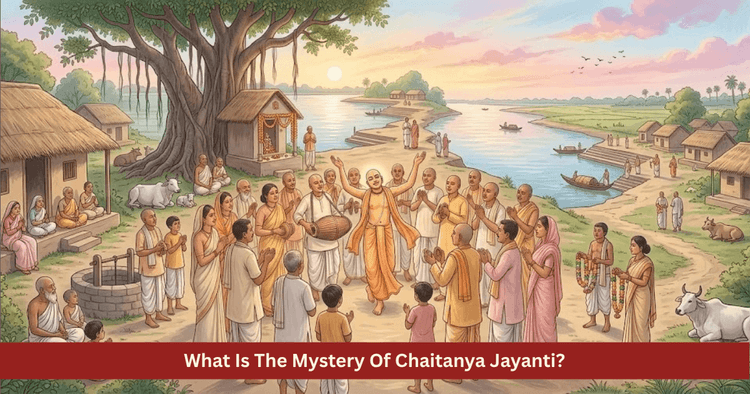
Table of Contents
Panchang Description And The Sacred Advent On Gaura Purnima
The full moon day of the bright fortnight in the month of Phalguna represents a transformative golden date across the history of the Sanatana devotional movement. Upon this sacred night in the year 1486 of the Common Era, within the revered seat of classical scholarship at Navadvipa in the Nadia district of West Bengal, Lord Sri Chaitanya Mahaprabhu made his appearance. He was the divine founder of the Gaudiya Vaishnava tradition and the unified descent of Sri Radha and Sri Krishna. Across the globe, Vaishnava assemblies, particularly practitioners of the Gaudiya school and the International Society for Krishna Consciousness, celebrate this holy day as the festival of Gaura Purnima. Because his physical complexion radiated with the luster of molten gold, he was hailed as Gaurahari and Gauranga. Having appeared beneath the shelter of a sacred neem tree, his mother affectionately named him Nimai, while his ancestral name was Vishwambhara.
| Panchang Component | Classical Description |
|---|---|
| Month and Fortnight | Phalguna Month, Shukla Paksha |
| Sacred Tithi | Shukla Paksha Purnima Tithi |
| Historical Era | 1407 Shaka Era corresponding to 18 February 1486 CE |
| Moment of Descent | Twilight moonrise concurrent with total lunar eclipse |
| Sacred Advent Seat | Navadvipa Dhama, Mayapur, West Bengal |
| Childhood Names | Nimai, Vishwambhara, Gaurahari and Gauranga |
| Devout Parents | Mother Shachi Devi and revered father Jagannatha Mishra |
| Primary Spiritual Path | Congregational chanting movement and ecstatic divine love |
| Bestowed Spiritual Fruit | Destruction of ignorance, heart purification, pure bhakti |
To assimilate the transcendental devotion of Lord Chaitanya on Gaura Purnima, a spiritual seeker must observe rigorous scriptural conduct from dawn onward.
- Awakening before sunrise during Brahma Muhurta, bathing in cool water consecrated with sacred river drops and applying holy Vaishnava marks.
- Marking the twelve prescribed upper bodily locations with vertical marks using unblemished Gopi sandalwood paste.
- Lighting a clarified butter lamp fueled by indigenous cow ghee before the holy icons of Lord Chaitanya and Lord Nityananda.
- Adorning the sacred icons with fragrant blossoms, fresh tulsi leaves and sandalwood paste while presenting offerings of sweet butter.
- Maintaining an unbroken diurnal fast relying solely upon water or unboiled cow milk while chanting the holy names continuously.
- Completing at least 64 rounds of the supreme formula: Hare Krishna Hare Krishna Krishna Krishna Hare Hare, Hare Rama Hare Rama Rama Rama Hare Hare.
- Eliminating all malice, personal ego, abrasive speech and sectarian prejudice regarding philosophies or individuals from the heart.
- Participating in congregational chanting at dusk, singing the holy names accompanied by clay drums and hand cymbals.
- Bathing the deity of Lord Gaurahari with the five sacred nectars at moonrise, concluding the fast with consecrated satvic food.
Astronomical Conjunction Of Lunar Eclipse And Universal Congregational Singing
During the twilight hour when Lord Chaitanya appeared, an extraordinary astronomical event unfolded across the celestial sphere. A total lunar eclipse enveloped the Indian subcontinent on that full moon night of Phalguna. In accordance with sacred Vedic ordinances, routine secular duties and ritual sacrifices pause during the sensitive shadow phase of an eclipse, prompting the populace to gather along sacred rivers to cleanse the spirit through continuous recitation of divine names.
As the lunar orb became obscured by the shadow of the earth, millions of seekers stood along the holy banks of the sacred Ganga in Navadvipa. Raising both arms skyward, the crowds chanted Hari Bol and the holy names of Narayana with resounding devotion. In that very instant, as all cardinal directions echoed with the resonance of the divine names, the effulgent child was born within the humble cottage of Mother Shachi.
Enlightened scholars observed that the Supreme Lord induced humanity to chant the divine names without calculation at the exact moment of his arrival. Observing the obscured moon, learned astrologers predicted that this child would outshine the blemishes of the lunar orb, fulfilling his name Vishwambhara by sustaining creation through transcendental love rather than mere material nourishment.
The Nondual Synthesis Of Radha And Krishna In Gauranga
According to Gaudiya Vaishnava metaphysics, Lord Sri Chaitanya Mahaprabhu was neither an ordinary ascetic philosopher nor a simple moral reformer. He was Lord Sri Krishna, the master of Vraja, descending with the internal emotional mood and bodily luster of Sri Radha Rani. In the opening chapters of the Chaitanya Charitamrita, Srila Krishnadasa Kaviraja Goswami articulates this esoteric philosophy with precision.
Following the pastimes of the Dvapara era, three deep longings lingered unfulfilled within the mind of Lord Krishna. First, to comprehend the nature of the selfless love through which Sri Radha Rani experienced transcendental joy in his presence. Second, to understand the unique sweetness residing within his own divine form that enchanted Radha so completely. Third, to experience directly the ecstasy that Radha felt while tasting his divine love. To realize these three inner mysteries, Lord Krishna assumed the molten golden complexion and the devotional ecstasy of Sri Radha, appearing upon earth as Chaitanya Mahaprabhu. Thus, the external form of Lord Gauranga is Sri Radha, while his internal soul is Lord Sri Krishna. When he wept in divine ecstasy during congregational chanting, his desperate calls for Krishna revealed the pinnacle of separation experienced by Radha.
| Metaphysical Reality | Dvapara Yuga Conception | Golden Avatar Conception | Transcendental Realization |
|---|---|---|---|
| Internal Consciousness | Lord Sri Krishna | Absolute Krishna Reality | Foundation of all cosmic existence |
| External Bodily Luster | Dark blue monsoon cloud | Molten golden complexion | Radiant physical aura of Sri Radha |
| Emotional Disposition | The Supreme Enjoyer | The Surrendered Devotee | Supreme mood of selfless love |
| Instrument of Deliverance | Flute playing and dance | Clay drums and holy singing | Bestowing unreserved divine grace |
The Congregational Chanting Movement And The Social Transformation
Fifteenth century India was troubled by severe social fragmentation, rigid caste prejudices, dry intellectual scholasticism and external political oppression. Sacred spirituality had become confined to elite scholars, where ordinary human beings were denied access to devotional contemplation through the threat of complex rules. In that dark hour, Lord Chaitanya inaugurated a peaceful yet radical spiritual revolution through the congregational chanting of the holy names.
Mahaprabhu popularized the supreme sixteen word formula preserved within the Kali Santarana Upanishad:
Hare Krishna Hare Krishna Krishna Krishna Hare Hare. Hare Rama Hare Rama Rama Rama Hare Hare.
He proclaimed that in this iron age of Kali, difficult physical austerities, complex fire offerings and dry intellectual debates hold no efficacy. Chanting the holy names of the Supreme with devotion remains the sole and universal means for crossing the ocean of material transmigration. Lord Chaitanya dissolved artificial social boundaries with a single stroke. He appointed Haridasa Thakura, born into a non-Hindu lineage, as the master of the holy name, while directing elite ministers like Rupa Goswami and Sanatana Goswami to embrace ascetic detachment and rebuild the sacred realm of Vrindavan.
When Chand Kazi, the local governor of Navadvipa, prohibited public singing and ordered the destruction of sacred drums, Lord Chaitanya organized the earliest recorded mass civil disobedience movement. Leading hundreds of thousands of citizens carrying blazing torches through the streets, he encircled the governor's palace with sound. Overwhelmed by the spiritual presence of Mahaprabhu, Chand Kazi fell weeping at his feet, rescinding the ban and promising state protection for congregational chanting.
The Eight Stanzas Of Shikshashtakam And The Ladder Of Devotion
Throughout his manifest existence, Lord Chaitanya composed no extensive philosophical volumes. He authored only eight Sanskrit verses, revered across the world as the Shikshashtakam. These eight stanzas present a complete metaphysical science detailing the gradual elevation of human consciousness toward unalloyed divine love.
- The opening verse declares that congregational chanting cleanses the dust gathered across lifetimes upon the mirror of the heart, extinguishing the blazing fire of material existence.
- The second verse expresses deep humility, observing that while the Supreme Lord has invested all transcendental potencies within his diverse names, human misfortune prevents spontaneous attraction to them.
- The third verse establishes the quintessential character of a spiritual practitioner: one must chant the holy name continuously in a humble state of mind, considering oneself lower than a blade of grass, more tolerant than a tree, devoid of all desire for personal honor and ever ready to offer respect to others.
- The fourth verse renounces worldly desires, affirming that the soul seeks neither temporal wealth, followers, beautiful companions, nor salvation, desiring solely unmotivated loving service life after life.
- The fifth and sixth verses describe the existential longing of the soul, yearning for the day when tears flow, the voice chokes and physical hairs stand erect upon pronouncing the divine syllables.
- The seventh and eighth verses articulate the ultimate mood of separation experienced by Radha, where a single moment of separation from the Lord feels like an endless age of sorrow.
The Concluding Pastimes At Jagannatha Puri And Ecstatic Trance
Following his formal acceptance of the monastic order, Lord Chaitanya established his residence at the sacred coastal city of Jagannatha Puri in Odisha. Residing within a small chamber known as the Gambhira, he spent the concluding 18 years of his manifest pastimes in profound states of divine ecstasy. Beholding the sacred icon of Lord Jagannatha within the temple, he merged repeatedly into deep spiritual trances.
Standing behind the pillar of Garuda, his tears flowed with such intensity that the sacred stone column began to soften. Gazing upon the blue expanse of the ocean, he mistook the waves for the sacred Yamuna river, running into the waters in transcendental longing. During the annual chariot festival, when he danced before the towering chariot of Lord Jagannatha, vast crowds felt that an ocean of divine love had broken all cosmic barriers. His life demonstrates that genuine love is not an abstract theory, it is a living, conscious reality that binds the mortal soul to the Supreme.
FAQ
What is the significance of the festival of Gaura Purnima?
Gaura Purnima commemorates the divine appearance day of Lord Sri Chaitanya Mahaprabhu, celebrated on the full moon day of Phalguna across the world.
Why is Lord Chaitanya addressed as Gauranga or Nimai?
He is named Gauranga due to his complexion resembling molten gold and called Nimai because he took birth beneath the boughs of a protective neem tree.
What is the metaphysical identity of Lord Chaitanya in Vaishnava philosophy?
He is Lord Sri Krishna who descended assuming the golden physical luster and the supreme emotional disposition of Sri Radha Rani.
Which verse of the Shikshashtakam outlines the ideal attitude of a seeker?
The third verse, advising the aspirant to be more humble than a blade of grass and more tolerant than a tree while chanting the holy names, is paramount.
What did Lord Chaitanya prescribe as the supreme spiritual path for the current age?
He declared that congregational singing of the Hare Krishna maha mantra without offense is the single universal means for attaining spiritual liberation.
Get your accurate Kundali
Generate KundaliDid you like it?
Author
Pt. Suvrat Sharma (63)
Experience: 20
Consults About: Family Planning, Career
Clients In: Punjab, Haryana, Delhi
Share this article with friends and family
WELCOME TO
ZODIAQ
Right Decisions at the right time with ZODIAQ
