What Is The Mythological Mystery Of Holashtak?
By Pt. Nilesh Sharma
Suspension Of Sixteen Sacraments From Phalguna Ashtami
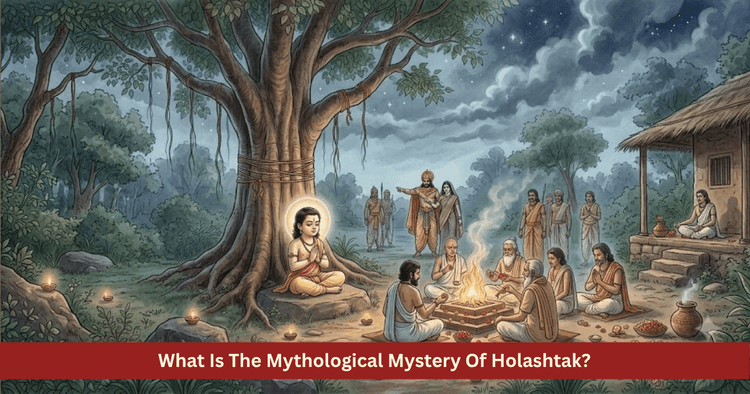
Table of Contents
Panchang Description And The Scriptural Prohibition Of Rites
The distinct eight day temporal span commencing from the eighth lunar day of the bright fortnight in the month of Phalguna and culminating upon the sacred full moon night of Holika Dahan is designated across the Vedic calendar as Holashtak. The terminology Holashtak originates from the conjunction of Holi and Ashtak, denoting the preceding eight days of the color festival. Within authentic Sanatana traditions, this period is recognized as deeply sensitive, agitated and strictly prohibitive for initiating auspicious temporal activities. Across these eight consecutive days, the performance of the sixteen foundational human life rites, including sacred wedlock, name giving ceremonies, tonsure rites, investiture of the holy thread and ear piercing rites, is held in total abeyance. Concurrently, housewarmings, commercial partnerships, property acquisitions and the purchase of precious assets are completely avoided.
| Panchang Component | Classical Description |
|---|---|
| Month and Fortnight | Phalguna Month, Shukla Paksha |
| Temporal Span | From Shukla Ashtami to Purnima, spanning eight days |
| Presiding Divine Principles | Lord Narasimha, Devotee Prahlada and Lord Shiva |
| Environmental State | Agitated, sensitive, with a surging fiery energetic current |
| Prohibited Undertakings | Sixteen sacraments, housewarmings, weddings, business launch |
| Prescribed Observances | Chanting, austere reflection, Maha Mrityunjaya recitation, charity |
| Bestowed Spiritual Fruit | Immunity from negative vibrations and purification of soul power |
To navigate this sensitive window and remain insulated against inauspicious environmental currents, a spiritual seeker must incorporate disciplined scriptural observances into daily living.
- Rising before the break of dawn during Brahma Muhurta, bathing in cool water consecrated with sacred Ganga drops.
- Refraining from executing binding contracts, matrimonial engagements, nuptial vows or domestic housewarming rituals.
- Directing contemplation toward the fierce Narasimha manifestation of Lord Narayana, chanting the sacred formula Om Namo Bhagavate Vasudevaya continuously.
- Reciting the supreme Maha Mrityunjaya mantra of Lord Mahadeva at least 108 times daily with undivided focus.
- Maintaining a continuous clarified butter lamp fueled by indigenous cow ghee at the family altar.
- Guarding the mind against harboring malice, abrasive utterances, outbursts of fury and domestic conflicts.
- Distributing wholesome satvic grains, clean garments and pure water to destitute and suffering living entities.
- Lighting a clarified butter lamp near the sacred Tulsi plant at dusk, performing respectful circumambulation.
The Tyranny Of Hiranyakashipu And The Unshakeable Surrender Of Prahlada
The classical foundation of the eight days of Holashtak is linked directly to the unshakeable devotion of the young seeker Prahlada and the cruel persecutions mounted by his demonic father, King Hiranyakashipu. The Shrimad Bhagavata Mahapurana and the Vishnu Purana describe how Hiranyakashipu performed severe penances to secure a cosmic boon from Lord Brahma, ensuring that death could not reach him by day or by night, inside or outside the dwelling, through human agency or animal form, nor through any physical weapon forged by mortal hands. Blinded by the intoxication of supreme temporal authority, he proclaimed himself the sole sovereign deity of the cosmos, decreeing execution for any subject who dared worship Lord Vishnu.
However, born within his palace, Prince Prahlada displayed an unshakeable love for Lord Narayana from his infancy. Hiranyakashipu utilized every measure of persuasion and threat to divert the boy's attention, yet Prahlada remained rooted in transcendental contemplation. Infuriated, Hiranyakashipu initiated a relentless eight day campaign of torment against his son, commencing on the eighth lunar day of the bright fortnight of Phalguna.
- On the eighth lunar day, Prahlada was cast into a subterranean dungeon filled with lethal serpents, yet through the power of the divine name, the serpents formed an ornamental garland around him.
- On the ninth lunar day, deadly poison was administered to him, yet through the grace of Lord Vishnu, the venom transformed into sweet life sustaining nectar.
- On the tenth lunar day, he was placed beneath the trampling feet of rogue elephants, yet the beasts bowed low before him in reverence.
- On the eleventh lunar day, he was cast from the summit of a steep precipice, yet the compassionate wind currents and invisible divine hands caught him gently in midair.
- On the twelfth lunar day, he was immersed in cauldrons of boiling oil, yet the scalding liquid turned delightfully cool like liquid sandalwood paste.
- On the thirteenth lunar day, sorcerous demons hurled mystical phantom weapons at him, yet no blade could penetrate the subtle armor of his devotion.
- On the fourteenth lunar day, he was locked in the cages of starved, ravenous predators, yet the beasts lay meekly at his feet.
- On the full moon day, Hiranyakashipu's sister Holika, who possessed an immunity to fire, seated Prahlada upon a pyre while wrapping herself in her mystical shawl.
Through the surrender of Prahlada, the Lord altered the properties of the physical elements. Consumed by her own deceit, Holika burned to ashes within the blaze, while Prahlada emerged radiant, singing the sacred names of the Supreme. Because an innocent soul suffered intense cruelty across these eight days, the entire macrocosm remained deeply distressed and agitated. For this reason, nature continues to carry a subtle tremor of inauspiciousness during this period.
The Burning Of Kamadeva And The Awakening Of Cosmic Dispassion
Beyond the Vaishnava account of Prahlada, a profound Shaivite metaphysical narrative is tied to the observance of Holashtak. The Shiva Mahapurana articulates that following the self immolation of Mother Sati, Lord Mahadeva plunged into deep meditative stillness. During this cosmic withdrawal, the demon Taraka terrorized the universe. Taraka could be vanquished only by a radiant warrior born of the seed of Lord Shiva.
Prompted by the celestial deities, Kamadeva, the divine lord of desire, took upon himself the perilous task of dissolving the ascetic meditation of Shiva. Commencing on the eighth lunar day of the bright fortnight of Phalguna, Kamadeva directed his flowery arrows of longing toward the heart of the Lord for eight continuous days. Finally, on the full moon day, as Kamadeva released his sovereign arrow of enchantment, the meditative contemplation of Shiva broke. Outraged by this disruption, Mahadeva opened his third eye.
The fire erupting from that visionary center reduced Kamadeva to a heap of lifeless ash. With the destruction of Kamadeva, the essential principles of affection, beauty and attraction disappeared from the world, plunging existence into mourning. Kamadeva's devoted consort, Goddess Rati, wept inconsolably, imploring Lord Shiva for the restoration of her partner. Moved by her grief, Lord Shiva granted the benediction that Kamadeva would take birth during the Dvapara era as Pradyumna, the son of Lord Krishna. These eight days represent the annihilation of raw lust and the emergence of pure ascetic dispassion. While the cosmic principle of desire is undergoing dissolution, initiating new worldly partnerships or matrimonial ties runs contrary to scriptural wisdom.
Logical Grounds For Suspending Auspicious Undertakings During Holashtak
Authentic Sanatana Dharma is grounded upon exact natural and astronomical observations. Suspending worldly celebrations during Holashtak rests upon three distinct pillars of classical wisdom.
| Foundational Ground | Classical And Natural Rationale | Observable Human Consequence |
|---|---|---|
| Mythological Basis | Eight day torment of Prahlada and Kamadeva's destruction | Subtle presence of agitation and distress in nature |
| Environmental Basis | Transition from late winter chill to rapid spring heat | Aggravation of biological kapha and seasonal weakness |
| Psychological Basis | Decreased mental focus and unstable decision making | Heightened risk of failure in new business contracts |
A wedding represents the sacred coming together of ancestral lineages, demanding mental stillness and positive environmental currents. Entering into such a serious bond while nature is experiencing deep seasonal agitation is considered unadvisable. Similarly, dedicating a new residence requires serene atmospheric conditions to invite lasting household peace. therefore ancient sages established the rule of suspending secular celebrations during these eight days, redirecting human energy toward inner purification and divine contemplation.
Scriptural Regimens For Protective Contemplation And Spiritual Austerities
While worldly celebrations are halted during Holashtak, this period is considered an exceptional window for inward spiritual practices, mantra chanting, yogic disciplines and contemplative austerities. Classical treatises declare that when subtle negative currents are active in the environment, even modest spiritual effort yields a hundredfold divine fruit.
- Chanting the supreme Maha Mrityunjaya mantra systematically for eleven rounds daily removes the fear of sudden accidents and untimely dissolution.
- Chanting the potent seed formula of Lord Narasimha dissolves adversarial conspiracies, providing spiritual protection.
- Studying the sacred verses of the Devi Mahatmya or reciting the Sri Sukta systematically removes persistent financial distress and household difficulties.
- Purifying the home atmosphere throughout Holashtak by burning pure guggulu, aromatic benzoin and camphor in cow ghee clears architectural blemishes and lingering psychic heaviness.
- Reading the Vishnu Sahasranama and the Sankat Mochan Hanuman Ashtak strengthens the nervous system and deepens unwavering self confidence.
Holashtak reminds human consciousness that continual forward movement in external worldly affairs must be balanced with quiet reflection. This eight day pause allows an individual to evaluate the trajectory of life. Purifying the mind through disciplined sadhana during this period prepares the seeker to stand before the sanctified embers of Holika Dahan, entering the upcoming New Year in Chaitra with renewed vitality and peace.
FAQ
What is the exact temporal duration of Holashtak?
Holashtak commences on the eighth lunar day of the bright fortnight in the month of Phalguna and concludes upon the full moon night of Holika Dahan, spanning eight days.
Why are marriages and secular ventures prohibited during Holashtak?
Nature is held to be agitated due to the torments endured by Prahlada and the burning of Kamadeva, causing worldly ventures initiated during this period to encounter instability.
Which sixteen classical life rites are suspended during this interval?
All sixteen life rites, including wedlock, naming of infants, tonsure rites, thread investiture and ear piercing ceremonies, remain suspended.
Which deities should be contemplated during Holashtak for spiritual protection?
Dedicated prayers offered to the protective Lord Narasimha, Lord Mahadeva Shiva and Lord Hanuman grant complete immunity from negative influences.
Can an individual execute mantra recitations and spiritual penances during Holashtak?
Yes, while worldly celebrations are suspended, Holashtak is regarded as an exceptionally potent period for mantra chanting, meditation, fire offerings and inner purification.
Get your accurate Kundali
Generate KundaliDid you like it?
Author

Pt. Nilesh Sharma (63)
Experience: 20
Consults About: Family Planning, Career
Clients In: Punjab, Haryana, Delhi
Share this article with friends and family
WELCOME TO
ZODIAQ
Right Decisions at the right time with ZODIAQ
