What Is The Mystery Of Lakshmi Jayanti?
By Pt. Sanjeev Sharma
Advent Of Mahalakshmi From Milk Ocean And Prosperity Rites
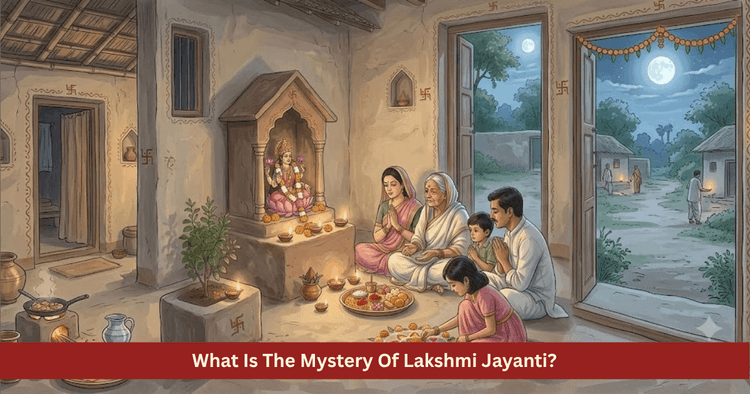
Table of Contents
Panchang Description And The Advent Of Mahalakshmi On Phalguna Purnima
While widespread popular custom associates the adoration of Goddess Lakshmi predominantly with the night of Kartika Amavasya during Deepavali, authentic references across Vedic collections, the Linga Purana and the Matsya Purana affirm that the primal advent day of Goddess Mahalakshmi, the sovereign ruler of abundance, beauty, opulence and fortune, is the full moon day of the month of Phalguna. Within the classical calendar tradition, this holy date is venerated as Lakshmi Jayanti. It was upon this sacred day, during the churning of the primordial ocean of milk by celestial deities and demonic legions, that Mother Mahalakshmi manifested from the fathomless depths as the supreme crest jewel among the fourteen divine treasures, seated upon a blossomed white lotus and displaying the sign of fearlessness.
| Panchang Component | Classical Description |
|---|---|
| Month and Fortnight | Phalguna Month, Shukla Paksha |
| Sacred Tithi | Purnima Tithi prevailing across day and night |
| Presiding Divine Principle | Supreme Mother Mahalakshmi and Lord Sri Hari Vishnu |
| Source of Emergence | The crowning treasure of the fourteen churned ocean gems |
| Primary Spiritual Rites | Recitation of Sri Sukta, Kanakadhara Stotra, midnight rites |
| Prescribed Offerings | Sweet lotus seed pudding, sugar drops, pomegranates, lotus seeds |
| Bestowed Spiritual Fruit | Dissolution of chronic poverty, enduring wealth, fortune |
To secure the unwavering presence of Goddess Mahalakshmi and eliminate impoverishment from the household lineage on Lakshmi Jayanti, a spiritual seeker must observe strict scriptural conduct from dawn onward.
- Awakening before sunrise during Brahma Muhurta, bathing in cool water consecrated with sacred river drops and unboiled cow milk.
- Wearing clean red or pink unstitched silk vestments and sanctifying the altar space utilizing sacred river water.
- Placing an unblemished wooden platform draped in scarlet silk upon the altar, shaping a mound of unbroken rice grains into an eight petaled lotus.
- Installing the unified holy icon of Mother Mahalakshmi and Lord Narayana forged of gold, silver or brass upon that consecrated base.
- Kindling an unbroken four wick lamp fueled by pure cow clarified butter alongside a secondary lamp fueled by sesame oil.
- Offering fresh lotus blossoms, rosaries of lotus seeds, rose petals, natural floral perfume and white sandalwood paste with deep surrender.
- Maintaining an unbroken diurnal fast while chanting the sacred formula Om Shreem Hreem Kleem Shreem Namah continuously within the mind.
- Refraining strictly from day sleep, abrasive speech, angry outbursts and domestic disputes throughout the daylight hours.
- Sitting in quiet contemplation during the midnight hours to recite the Sri Sukta, Lakshmi Sukta and Kanakadhara Stotra at least 16 times.
- Offering sweet milk porridge prepared with lotus seeds at the conclusion of the rite, subsequently feeding 7 young maidens with respect.
The Churning Of The Milk Ocean And The Selection Of Sri Hari
The eighth canto of the Shrimad Bhagavata Mahapurana preserves a profound cosmological narrative detailing the divine appearance of Mother Mahalakshmi. When celestial sovereignty and fortune vanished into the ocean depths due to the arrogance of Indra and the severe curse of Sage Durvasa, the deities were stripped of their divine luster. Guided by the counsel of Lord Sri Hari Vishnu, the gods and demons united to churn the ocean of milk, utilizing Mount Mandara as the churning rod and the serpent king Vasuki as the churning cord.
Following the emergence of the lethal poison, the wish fulfilling cow, the celestial steed and the divine elephant, the churning reached its metaphysical zenith. On the full moon of Phalguna, a radiant divine maiden emerged from the frothing waves, seated upon a thousand petaled lotus bloom. Effulgent golden light radiated from her transcendental form. The guardian elephants of the cardinal directions gathered sacred waters in golden pitchers, pouring celestial streams over the Goddess.
Beholding her unmatched beauty, the assembled devas, celestial musicians and titans burned with desire to possess her hand. Yet Mother Mahalakshmi disregarded physical strength, celestial titles and outward beauty. Gazing across creation, she perceived that Lord Sri Hari Vishnu alone is the unblemished repository of all transcendental virtues, free from lust, wrath and pride, functioning as the selfless guardian of existence. Smiling gently, Mother Mahalakshmi cast her fragrant garland of parijata blossoms around the neck of Lord Narayana. This celestial union proves that the grace of Lakshmi resides permanently only where righteousness, truth, restraint and divine awareness prevail.
The Kanakadhara Stotra And The Miraculous Compassion Of Adi Shankara
Reciting the Kanakadhara Stotra, composed by the illustrious master Adi Shankaracharya, on Lakshmi Jayanti completely eradicates misfortune from human destiny. The historical origin of this sacred hymn is deeply moving. During his childhood, while walking from door to door seeking daily alms as an ascetic student, young Shankara arrived before a dilapidated, impoverished hut, uttering the traditional call for alms.
Within that shelter lived an impoverished elderly brahmin woman who lacked even a single grain of food. She had endured hunger for days, yet turning away an ascetic student from her threshold empty handed was contrary to her moral duty. Searching her empty dwelling, she located only a single dried, withered gooseberry fruit. With deep humility and eyes filled with tears, she placed that dried fruit into the begging bowl of the young renunciant.
Beholding this supreme selflessness and unshakeable reverence from a starving soul, the heart of young Shankara melted with compassion. Folding his hands and gazing upward, he spontaneously composed 21 melodious, meter perfect verses in praise of Mother Mahalakshmi, celebrated across history as the Kanakadhara Stotra.
Moved by that selfless prayer, Mother Mahalakshmi manifested in the celestial skies. The Goddess remarked: "O child, this woman performed no acts of charity in her past incarnations; therefore destiny has ordained severe poverty for her in this life." Young Shankara argued with humility: "O Mother, though she may have given nothing in past lives, in this birth she has surrendered the last morsel of food remaining in her possession to an ascetic. This single act of selfless charity is sufficient to burn away all past deficiencies." Highly pleased by the logic of Shankara, Mother Mahalakshmi showered thousands of gooseberry fruits forged of solid gold into that humble dwelling. Reciting the Kanakadhara Stotra on Lakshmi Jayanti opens locked gateways of fortune.
| Spiritual Discipline | Prescribed Execution Protocol | Ritual Medium and Rosary | Attained Spiritual Benefit |
|---|---|---|---|
| Kanakadhara Recitation | 16 recitations with melodious sound | Clarified butter lamp lit steadily | Relief from debt and sudden abundance |
| Sri Sukta Fire Oblation | 16 oblations matching the verses | Lotus seeds, sweet porridge, ghee | Commercial prosperity and domestic grace |
| Mahalakshmi Seed Mantra | 11 rounds or 1188 repetitions | Consecrated lotus seed rosary | Complete destruction of ancient poverty |
| Ashta Lakshmi Hymn | 3 recitations at dawn and dusk | Fresh crimson roses and lotus flowers | Fixed property, vehicle grace, honor |
The Secret Midnight Wealth Mantra And Liturgical Discipline
Within esoteric treatises, the midnight hour of Phalguna Purnima is celebrated as a rare window for the realization of prosperity mantras. Ancient texts record that a practitioner who executes sadhana during the Nishita Kala window, spanning between 11:45 PM and 12:40 AM, ensures an inexhaustible flow of resources within the home.
Sit upon a red woolen mat facing northward during the midnight hour. Install a consecrated Sri Yantra within a clean silver or copper platter before the altar. Anoint the geometric mandala with raw milk, saffron and red sandalwood paste. Using a rosary of consecrated lotus seeds, chant the following secret formula for a minimum of 11 rounds:
Om Shreem Hreem Kleem Tribhuvana Mahalakshmyai Asmakam Daridryam Nashaya Nashaya Prachuram Dhanam Dehi Dehi Kleem Hreem Shreem Om.
While chanting, maintain unshakeable inner confidence that Mother Mahalakshmi is actively purging all lack, scarcity and debt from your lineage. Conclude the discipline by offering 108 fire oblations of cow clarified butter, lotus seeds and dried lotus nuts into the sacred flame. This observance burns away subtle vibrations of poverty from the domestic aura.
Five Authentic Astrological Remedies For Securing Enduring Prosperity
If financial resources enter your possession only to drain away rapidly through unexpected crises, observing the following classical remedies on Lakshmi Jayanti secures lasting stability.
- Place 7 yellow cowrie shells and 7 Gomati chakras within a copper dish, mark them with saffron paste and recite the Sri Sukta. Wrap these articles in yellow silk and place the bundle within the domestic vault.
- Fill a right spiraling conch shell with pure river water and saffron, bathing the joint icons of Lord Narayana and Mother Lakshmi. Sprinkle the residual water throughout the rooms of the home to pacify architectural stress.
- Wrap a whole coconut in red sacred thread, apply vermilion paste and offer it before Mother Lakshmi before suspending it above the main entrance of the business establishment.
- Feed a virtuous married woman sweet milk porridge, offering her a scarlet silk garment and the 16 emblems of bridal adornment with reverence.
- Because Mother Lakshmi resides subtly within the peepal tree, pour sweet milk at the roots of the tree at sunset, lighting 7 four wick lamps of cow clarified butter.
The Ethical Philosophy Of Wealth And Righteous Abundance
Lakshmi Jayanti delivers the profound truth that within Sanatana Dharma, material abundance is never considered an obstacle to spiritual attainment. Among the four universal human goals righteousness, wealth, lawful desire and liberation wealth occupies the essential second position immediately following righteousness. This indicates that temporal resources must be gathered and managed strictly within the boundaries of moral law. Wealth secured through deceit, exploitation, falsehood and injustice inevitably brings psychological torment, physical disease and familial ruin.
Mother Mahalakshmi is termed Chanchala, signifying the transient nature of material resources. However, when wealth is directed toward noble charity, alleviating the suffering of the poor, disseminating spiritual wisdom and serving divine causes, the transient Goddess establishes herself within the household as Sthira Lakshmi, the enduring bestower of peace. Lakshmi Jayanti calls upon humanity to purify the heart like the milk ocean, rendering it tranquil, transparent and devoted, so that Mother Mahalakshmi may take her eternal seat upon the lotus of the human soul.
FAQ
On which lunar date is the sacred festival of Lakshmi Jayanti observed?
Lakshmi Jayanti is observed annually with great scriptural reverence on the full moon day of the bright fortnight in the month of Phalguna.
How did Mother Mahalakshmi manifest in the material universe?
She appeared from the ocean of milk during the churning by the gods and titans on Phalguna Purnima, emerging as the crowning jewel among the fourteen treasures.
Which classical hymn is considered most potent on Lakshmi Jayanti?
Reciting the Kanakadhara Stotra composed by Adi Shankaracharya and the ancient Vedic Sri Sukta yields the swiftest relief from financial distress.
What spiritual merits are secured through the Kanakadhara Stotra?
Reciting this stotra dismantles chronic poverty, eliminates long standing debts and unblocks channels of lawful material prosperity.
What remedy ensures that wealth remains stable within the home?
Preserving 7 yellow cowrie shells and Gomati chakras wrapped in yellow silk within the cash safe and offering oblations through a right spiraling conch establishes stability.
Get your accurate Kundali
Generate KundaliDid you like it?
Author

Pt. Sanjeev Sharma (63)
Experience: 20
Consults About: Family Planning, Career
Clients In: Punjab, Haryana, Delhi
Share this article with friends and family
WELCOME TO
ZODIAQ
Right Decisions at the right time with ZODIAQ
