What Is The Mystery Of Meena Sankranti?
By Pt. Amitabh Sharma
Solar Ingress Into Pisces And Advent Of The Second Kharmas
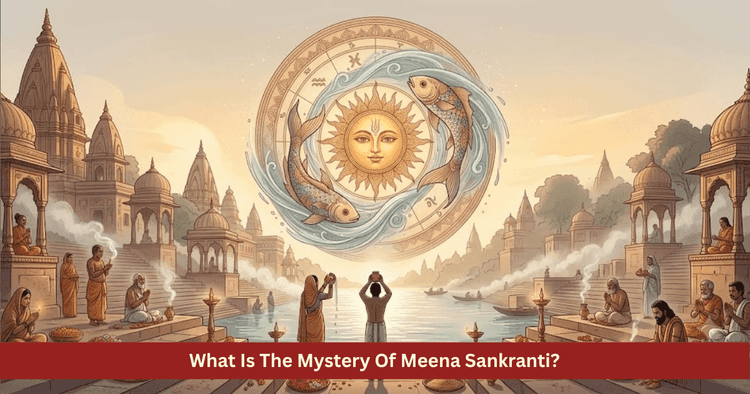
Table of Contents
Panchang Description And The Celestial Transition Of Meena Sankranti
In the computational architecture of Vedic astronomy, a Sankranti identifies the precise moment when Surya Deva, the monarch among planetary bodies and the cosmic signifier of the soul, departs from one zodiacal sign to cross into the subsequent sign. During the concluding portion of the month of Phalguna, when the radiant Sun leaves the fixed airy domain of Aquarius, ruled by his son Saturn, to enter the dual water sign of Pisces, ruled by the preceptor of the gods, Jupiter, this celestial passage is designated across the sacred calendar as Meena Sankranti. According to the classical Vedic calendar, this marks the twelfth and concluding solar transit of the entire annual cycle. Following this month long sojourn in Pisces, Surya Deva enters Aries to inaugurate the sacred solar New Year. In the civil calendar, this transit transpires annually around 14 or 15 March.
| Panchang Component | Classical Description |
|---|---|
| Month and Fortnight | Phalguna Month, Shukla Paksha Conjunction |
| Astronomical Phenomenon | Surya Deva transiting from Aquarius into Pisces |
| Nature of the Transit | The twelfth and culminating solar transit of the year |
| Planetary Dynamics | Leaving the domain of Saturn to enter the house of Jupiter |
| Temporal Consequence | Initiation of the second Kharmas lasting thirty days |
| Sacred River Sites | Haridwar, Prayagraj Sangam, Kashi, Ujjain Shipra banks |
| Bestowed Spiritual Fruit | Purification of the soul, ancestral peace, karma dissolution |
To assimilate the fruits of the auspicious periods of this transit and pacify planetary afflictions, an aspirant must maintain disciplined scriptural observances from the early morning hours onward.
- Awakening before dawn during Brahma Muhurta to bathe in sacred river currents or clean domestic water consecrated with drops of holy Ganga currents.
- Chanting the solar seed formula Om Ghrini Suryaya Namah or the Gayatri mantra continuously with inward stillness during ablutions.
- Holding a pure copper vessel filled with water, kumkum, unbroken rice grains, yellow sandalwood and red blossoms to offer three water oblations to the Sun.
- Circumambulating clockwise three times on the spot following the oblation to honor the cosmic authority of Surya Deva.
- Chanting the classical formulas dedicated to Jupiter and Surya Deva at least 108 times with undivided attention.
- Maintaining a complete fast or relying solely upon wholesome fresh fruits during the auspicious and supreme merit phases of the transit.
- Distributing split chickpeas, raw turmeric roots, unstitched yellow garments, jaggery, copper vessels and sesame seeds to ascetics and the needy.
- Refraining strictly from inaugurating worldly ceremonies such as marriages, new housewarmings or binding commercial contracts.
The Initiation Of The Second Kharmas And The Prohibition Of Sacraments
The occurrence of Meena Sankranti inaugurates the second Kharmas of the year, popular known across traditional culture as Malmas. A solar year witnesses two distinct Kharmas periods: the first transpires when the Sun crosses into the fiery Jupiterian sign of Sagittarius during December and January, while the second unfolds when the Sun journeys through the watery Jupiterian sign of Pisces during March and April. This restrictive status prevails unbroken until Surya Deva enters Aries to attain his state of deep exaltation.
Authoritative digests of Vedic law, including the Nirnaya Sindhu and the Dharma Sindhu, explicitly mandate that the solar month spanning Meena Sankranti to Mesha Sankranti remains entirely prohibitive for the execution of the sixteen foundational life sacraments and worldly expansions. Across this thirty day window, the following activities pause completely:
- Solemnizing the sacramental rites of wedlock between bride and groom.
- Entering newly constructed residential dwellings, commercial spaces or newly purchased homes.
- Conducting tonsure ceremonies, formal initiation into education and the sacred investiture of the holy thread.
- Inaugurating commercial stores, manufacturing plants, corporate enterprises or new partnership contracts.
- Executing property deeds for land, registering real estate acquisitions or purchasing motor vehicles.
- Laying foundational stones for wells, water reservoirs, civic projects or executing temple consecrations.
| Worldly Undertaking | Classical Reason for Prohibition | Foreseen Astrological Complication |
|---|---|---|
| Nuptial Ceremony | Diminution of Jupiterian brilliance under solar proximity | Lack of domestic joy and marital separation |
| Housewarming Rites | Inward withdrawal of structural architectural energies | Domestic unrest, illness and financial leaks |
| New Commercial Venture | Distorted commercial discrimination and loss of fortune | Capital depletion and disputes among partners |
| Tonsure and Thread Investiture | Inability of subtle biological channels to hold sacramental force | Obstacles in intellectual growth and character |
The Astronomical And Mythological Foundation Of Kharmas
The genesis of Kharmas is articulated across classical puranic literature through an allegorical narrative rich with astronomical meaning. The celestial chariot of Surya Deva is drawn by seven divine horses, symbolizing the seven distinct rays of the solar spectrum and the seven days of the weekly cycle. Moving continuously without pause across the heavens, Surya Deva sustains the operational wheel of cosmic time. Ancient lore recounts that due to this relentless movement across aeons, the horses of the solar chariot once experienced profound exhaustion and burning thirst.
Moved by boundless compassion for his steeds, Surya Deva guided the chariot toward the cool waters of a celestial lake to allow them to drink. However, halting the chariot of the Sun would have caused the immediate collapse of the cosmic time cycle. To allow his horses to rest without violating cosmic order, Surya Deva unyoked the horses by the water's edge, temporarily harnessing two wandering wild donkeys, designated in Sanskrit as khara, to pull the celestial chariot.
The physical gait of donkeys is slow, erratic and sluggish in comparison to swift stallions. The moment the donkeys were harnessed, the speed of the solar chariot slowed down, causing its brilliance to become dim and subdued. Surya Deva completed a full month of celestial traversal utilizing those slow creatures, which led to this thirty day interval being celebrated across history as Kharmas. Once that solar month concluded, Surya Deva reharnessed his celestial steeds, stepping forth with restored vigor and luminous brilliance. Astrologically, this narrative reflects the subdued solar radiation and the delicate seasonal transition of the vernal equinox, where nature requires an interval of regenerative rest.
Computational Astronomy Of Auspicious Transit Windows
In classical Vedic computational astronomy, the exact moment of a planetary transit is measured with mathematical precision. The discrete second when the solar center intersects the mathematical border of the new sign is designated as the Sankranti transit moment. The specific segments of time preceding and succeeding this crossing point are celebrated as the Auspicious Window and the Supreme Merit Window. Spiritual oblations, river baths and acts of charity performed during these windows yield thousands of times greater spiritual merit than on routine days.
The classical divisions of this temporal transition are preserved in traditional treatises:
- The standard rule dictates that the Auspicious Window of Meena Sankranti extends for 16 ghatis prior to and 16 ghatis following the transit moment. Because a ghati comprises 24 civil minutes, this window spans approximately 6 hours and 24 minutes.
- The period of 8 ghatis immediately preceding and 8 ghatis immediately following the exact transit moment is designated as the Supreme Merit Window, spanning roughly 3 hours and 12 minutes.
- Should the transit occur following sunset or during the midnight hours, the prescribed merit window shifts to the opening half of the subsequent day until midday.
- Immersing oneself three times in living river currents, presenting gold, donating arable land or distributing wholesome grains during the Supreme Merit Window cleanses the soul of physical, verbal and mental transgressions accumulated across lifetimes.
Sacred River Ablutions, Ancestral Oblations And Charitable Protocols
Being the culminating solar transit of the annual cycle, Meena Sankranti is revered as a monumental day for offering ancestral oblations and dissolving deep rooted negative impressions. The Bhavishya Purana records that an individual who bathes at the confluence of the Triveni Sangam in Prayagraj, at Har Ki Pauri in Haridwar or at the sacred Manikarnika Ghat in Kashi on Meena Sankranti secures the spiritual fruits of an Ashvamedha sacrifice.
Seekers unable to travel to distant pilgrimage centers may execute the following authentic discipline at home:
- Blend a portion of sacred Ganga water, black sesame seeds and a pinch of ground turmeric into cool domestic bath water.
- Facing southward following the purification bath, mix water, raw milk, black sesame seeds and kusha grass in a copper vessel, pouring three consecutive libations over the thumb for ancestors.
- Sit before the morning Sun, chanting the luminous verses of the Aditya Hridaya Stotra three times with clear pronunciation.
- Repeat the classical seed mantra dedicated to Jupiter, Om Brim Brihaspataye Namah, for at least 3 rounds upon a wooden rosary.
- Place split chickpeas, raw jaggery, whole turmeric roots, a clean sacred thread and modest coins upon a bronze or copper platter, donating them to a learned scholar with formal water libations.
- Visit a cow shelter to feed raw jaggery and soaked chickpeas directly to an indigenous cow, gently caressing her back to seek blessings.
The Transcendental Purpose Of Worldly Rest And Spiritual Contemplation
Modern human awareness often misinterprets Kharmas as an inauspicious or negative interval, which is an error of perception. Within the authentic Vedic worldview, no segment of time is inherently malevolent. Kharmas may represent a necessary pause for secular pursuits and temporal self indulgence, yet for inward spiritual contemplation, meditation, scriptural study and divine surrender, it represents the most exalted window of the year.
The Sun is the cosmic soul, while Jupiter is the cosmic preceptor of divine wisdom. When the soul crosses into the spiritual watery realm of Pisces, human energy must not dissipate through external pursuits but should turn inward to discover the inner Self. This month long pause reminds humanity that accumulating material assets, building houses and celebrating worldly unions do not represent the final goal of existence. The soul yearns for the direct perception of the Divine. Aspirants who study the Bhagavad Gita and the Shrimad Bhagavatam daily throughout Kharmas purify their inner awareness like refined gold. This month prepares human consciousness to greet the sacred Vedic New Year and the celebrations of Chaitra Navratri with vitality and peace.
FAQ
What is the defining astronomical event of Meena Sankranti?
Meena Sankranti occurs when Surya Deva concludes his traversal of Aquarius to enter the sign of Pisces, ruled by Jupiter.
Which calendar period commences with the arrival of Meena Sankranti?
Meena Sankranti inaugurates the second Kharmas of the year, persisting for approximately thirty days until the Sun transits into Aries.
Which worldly undertakings are suspended throughout Kharmas?
All sixteen life sacraments, including weddings, housewarmings, tonsure rites, thread investitures and launching business enterprises, pause completely.
Which charitable donations are most meritorious on Meena Sankranti?
Because Pisces is governed by Jupiter, donating unstitched yellow garments, split chickpeas, raw turmeric, jaggery, brass items and gold yields supreme merits.
Is spiritual contemplation and mantra recitation permitted during Kharmas?
Yes, while worldly celebrations are suspended, Kharmas is regarded as an ideal window for meditation, scriptural study, pilgrimage baths and mantra chanting.
Get your accurate Kundali
Generate KundaliDid you like it?
Author
Pt. Amitabh Sharma (56 Years)
Experience: 20
Consults About: Family Planning, Career
Clients In: Punjab, Haryana, Delhi
Share this article with friends and family
WELCOME TO
ZODIAQ
Right Decisions at the right time with ZODIAQ
