How Does Phag Sadhana Awaken The Anahata Chakra?
By Pt. Suvrat Sharma
Awakening The Heart Center Through Spring Ballads And Music Therapy
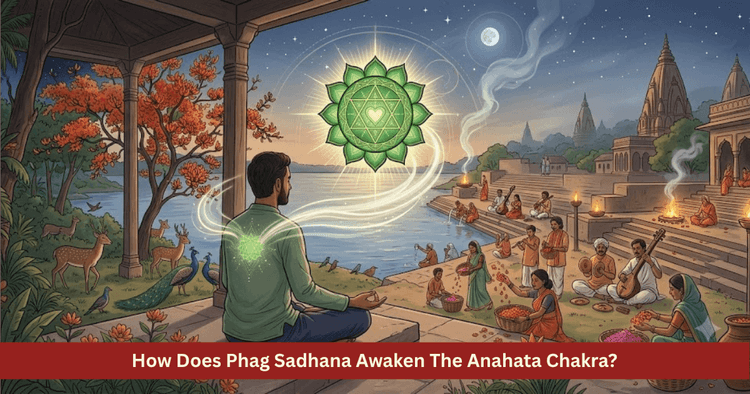
Table of Contents
Panchang Description And The Spring Hymnody Traditions Of Braj And Awadh
According to the classical Vedic calendar, the month of Phalguna represents the most melodious, emotionally rich and aesthetically sublime temporal window of the entire annual cycle. Across the forty continuous days extending from Vasant Panchami to the opening lunar day of Chaitra, sacred pilgrimage domains of northern India-most notably the Braj region (Mathura, Vrindavan, Barsana, Nandgaon), Awadh (Ayodhya) and Mithila (Janakpur)-resound with unbroken streams of traditional Phag, Dhamar and Hori compositions. In the computational Vedic calendar, this junction is far more than an ecological transition into spring; it serves as an activated sonic altar where classical raga structures, traditional folk rhythms and pure devotion unite to liberate human consciousness from physical attachments.
The Samaveda proclaims that adoring the Supreme through melodious metric hymns constitutes the highest among spiritual austerities. The chanting of Phag ballads is not mere secular folk amusement; it represents an advanced, precise and scientific methodology of Bhakti Yoga. When a spiritual practitioner sings these sacred verses, the acoustic frequencies resonating from the vocal apparatus align smoothly with universal cosmic vibrations.
| Astrological and Musical Factor | Classical Scriptural Description |
|---|---|
| Calendar and Fortnight Window | Phalguna Month, Conjunction of Bright and Dark Fortnights |
| Primary Classical Musical Modes | Dhamar Tala, Raga Kafi, Raga Pilu, Raga Khamaj, Hori Verses |
| Presiding Sovereign Divinities | Divine Couple Sri Radha Krishna and Lord Sri Sita Rama |
| Traditional Acoustic Instruments | Pakhawaj, Mridanga, Dholak, Hand Cymbals, Tambourine |
| Activated Energy Vortex | Anahata Chakra (Twelve Petaled Lotus of the Heart Center) |
| Dominant Devotional Moods | Madhurya (Sweet Conjugal), Sakhya (Fraternal), Vatsalya |
| Bestowed Spiritual Fruit | Piercing Heart Knots, Relief from Despair, Pure Bhakti |
To assimilate the comprehensive spiritual, neurological and yogic fruits of Phag sadhana, an aspirant must observe rigorous scriptural conduct and musical decorum from dawn onward.
- Awakening before sunrise during Brahma Muhurta, bathing in cool water consecrated with sacred river drops and wearing pristine white or yellow unstitched cotton garments.
- Kindling an unbroken lamp fueled by indigenous cow clarified butter before the icons of Sri Radha Krishna or Sri Sita Rama at the domestic altar.
- Offering unadulterated organic crimson powders, pure white abir and fragrant sandalwood paste at the lotus feet of the deities prior to singing.
- Chanting the sacred formula Om Nada Brahmane Namah eleven times to stabilize the breath and vocal cords before initiating devotional singing.
- Renouncing completely all vulgar, double meaning, commercialized and distorted modern pop songs from the sanctuary.
- Singing exclusively the classical verses realized in deep contemplative trances by great saints including Surdas, Raskhan, Swami Haridas and Mirabai.
- Concentrating inward mental awareness continuously upon the physical center of the chest at the heart chakra throughout the practice.
- Guarding the mind against abrasive utterances, interpersonal jealousy and sensual cravings, dwelling solely within unconditional love for the Divine.
- Participating in collective evening singing at twilight, rejoicing to the rhythmic tempo of traditional drums and hand cymbals.
Metaphysical Nature Of Anahata Chakra And Cosmic Sonic Geometry
Within yogic anatomy and tantric treatises, the human energetic matrix is sustained by seven primary subtle vortexes known as chakras. The fourth among these is designated as the Anahata Chakra, situated directly along the spinal axis adjacent to the physical cardiac chamber. The Sanskrit term anahata translates literally to the unstruck sound, signifying the continuous celestial vibration that resonates without the physical collision of two material objects. This chakra governs the cosmic air element, energized by its classical seed formula Yam (YAM). It manifests as an effulgent twelve petaled golden lotus, functioning as the eternal meeting sanctuary between the individual mortal soul and the Supreme Consciousness.
In ordinary worldly human beings, the Anahata Chakra remains tightly constricted and blocked by layers of jealousy, resentment, existential dread, doubt, possessive attachment and ancient emotional trauma. When the heart center remains closed, an individual suffers from chronic clinical depression, psychological alienation, emotional cynicism and cardiovascular tension.
| Structural Dimension of Heart Center | Classical Tantric Description | Somatic and Physiological Regulation |
|---|---|---|
| Anatomical Location | Central Thoracic Cavity (Cardiac Axis) | Cardiovascular, Respiratory System, Thymus Gland |
| Number of Lotus Petals | Twelve Petals (Dwadasha Dala) | Regulating Twelve Subconscious Mental Modifications |
| Cosmic Seed Syllable | Sacred Syllable 'Yam' (Air Carrier) | Balancing Inward Breath and Subtle Pranic Currents |
| Geometric Yantra Formation | Interlocking Hexagram of Two Triangles | Perfect Union of Shiva (Ascending) and Shakti (Descending) |
| Presiding Sovereign Powers | Lord Ishana Shiva and Goddess Kakini | Awakening Serenity, Fearlessness and Unconditional Love |
When an aspirant sings traditional Phag compositions set to Raga Kafi or the fourteen beat Dhamar rhythm during Phalguna, subtle electromagnetic sound waves penetrate the thoracic cavity. These acoustic waves break the psychological knots obstructing the cardiac core. As the twelve petals of the Anahata Chakra open, selfish cravings and irrational dread dissolve, filling the consciousness with unconditional love, universal empathy and profound tranquility.
Classical Braj Compositions And The Contemplative Trance Of Saintly Poets
Traditional Phag singing is far from ordinary folk balladry; it comprises realized scriptural mantras born from the profound meditative trances of enlightened masters. When the blind saint-poet Surdas sings: "Today the joyful enchanter plays with colors in Braj, holding the beloved with sweet persistence", the verse does not depict a secular physical altercation; it proclaims the unconditional capture of the mortal soul by the Supreme Divine.
Similarly, when the saint Raskhan sings: "The month of Phalguna has arrived, O companions, let us unite to sing in divine affection, awakening eternal fortune in our hearts", all physical sensuality vanishes, leaving only unalloyed devotional surrender. In the Awadh tradition, the classical composition: "In Awadh the heroic Rama plays with colors, golden syringes in hand alongside fragrant powders" elevates the mind into the transcendental realm of Saketa, where Lord Sri Rama rejoices with his brothers and Queen Janaki in unblemished spiritual joy.
When these verses are rendered upon the resonant pakhawaj drum using the stately fourteen beat Dhamar rhythm, the acoustic structure regulates the respiratory patterns of the singer. This classical rhythm stills mental fluctuations, guiding the practitioner into devotional trance where ecstatic tears flow freely, cleansing the subconscious mind.
Music Therapy, Neurobiology And Central Nervous System Regulation
Contemporary music therapy and clinical neurology confirm that the specific microtonal intervals of classical Indian ragas alter human cerebral brainwaves. The melodic structures of Raga Kafi, Raga Pilu and Raga Khamaj sung during Phalguna act upon the limbic system, the amygdala and the hypothalamus.
Under the influence of acute chronic anxiety and emotional trauma, the human brain generates hyperactive beta waves, while the adrenal cortex releases excess cortisol.
| Musical and Rhythmic Parameter | Impact upon Neural Pathways | Bestowed Psychosomatic Health Benefit |
|---|---|---|
| Classical Dhamar Tala on Pakhawaj | Entrainment of Cardiac Pulse Rates | Regulation of Hypertension and Vascular Peace |
| Melodic Singing of Ragas Kafi and Pilu | Induction of Alpha Waves (8 to 12 Hz) | Deep Mental Serenity, Calm, Relief from Dread |
| Collective Singing and Percussive Cymbals | Surge of Endorphins and Dopamine | Dissolution of Melancholy and Radiant Optimism |
| Resonant Vocalization from Navel to Chest | Stimulation of the Thymus Gland | Proliferation of T-Cells and Cellular Immunity |
Participating in collective Phag singing dismantles psychological alienation. When multiple individuals vocalize identical sacred verses along the same melodic scale, individual egos dissolve into unified collective consciousness. This process provides an authentic therapeutic catharsis, flushing out repressed emotional complexes from the subconscious mind.
Classical Vocal Protocol And Yogic Breathing Discipline
To awaken the Anahata Chakra through Phag singing, ancient treatises outline a precise vocalization and breath regulation protocol. Sacred sound must never be expelled solely from the throat; it must arise from the navel center, expanding fully across the chest.
- Sit in a clean, quiet sanctuary at dawn or dusk, assuming an erect posture in Sukhasana or Padmasana with the spine aligned.
- Rest both hands in Jnana Mudra or hold them folded gently near the heart in Anjali Mudra.
- Close the eyes, inhaling deeply three times, visualizing an effulgent twelve petaled golden lotus blossoming within the center of the chest upon exhalation.
- Intone the primordial sound Om from the navel center three times to open the central energetic channel of the spine.
- Begin singing an authentic Phag composition in a soft, melodic tone, such as: "Clouds of crimson powder turn the sky red, as Krishna plays in the groves with Radha."
- Breathe life into every word through vivid visualization. Contemplate that Sri Radha Krishna reside within the temple of your heart, showering the cooling colors of divine grace over your soul.
- If deep emotional tears flow spontaneously during the singing, do not suppress them; those tears represent the energetic cleansing of ancient subconscious debris from the heart center.
- Conclude the musical practice by remaining seated in complete silence for ten minutes, listening attentively to the silent internal resonance vibrating within the chest.
Transmuting Sensory Desire Into Transcendental Divine Love
The ultimate philosophical revelation of Phag sadhana is the transmutation of base sensory craving into divine love. The arrival of spring in Phalguna awakens the primal principle of desire across nature. If left unchecked, this energy dissipates into hedonistic indulgence and spiritual decline. However, Sanatana spiritual science discovered the art of sublimating primal energy through classical melody, poetry and devotion.
The vibrant descriptions of colors, playful challenges and laughter in Phag ballads are not worldly depictions. The streams of liquid dye symbolize the flow of divine grace; the scattering of crimson powders represents the shattering of personal ego; and the meeting of Radha and Krishna signifies the nondual union of the individual soul with the Absolute.
When an aspirant practices Phag singing with this understanding, worldly lust transforms into divine love. As the Anahata Chakra opens, the seeker beholds the radiant presence of the Divine within every living entity. This sacred discipline elevates consciousness above worldly dualities, bestowing spiritual freedom and granting eternal loving service at the lotus feet of the Supreme Lord.
FAQ
Which geographical regions are celebrated as the primary seats of Phag singing?
The Braj region (Mathura, Vrindavan, Barsana), the sacred realm of Awadh (Ayodhya) and Mithila represent the foundational centers of Phag singing.
Which energetic vortex within the human body is awakened through Phag sadhana?
The Anahata Chakra or the heart center situated within the central chest, is awakened through the devotional chanting of classical Phag hymns.
Which musical ragas and rhythmic structures govern traditional Phag compositions?
Phag compositions are primarily structured within Raga Kafi, Raga Pilu, Raga Khamaj and set to the classical fourteen beat Dhamar or Deepchandi talas.
What physiological advantages stem from singing traditional spring hymns?
It suppresses destructive cortisol hormones, normalizes arterial blood pressure, stimulates the thymus immune gland and resolves chronic mental melancholy.
What is the core philosophical purpose of practicing Phag singing?
The core purpose is to sublimate mortal sensory desire into transcendental divine love, dissolving personal ego to achieve communion with the Supreme.
Get your accurate Kundali
Generate KundaliDid you like it?
Author
Pt. Suvrat Sharma (63)
Experience: 20
Consults About: Family Planning, Career
Clients In: Punjab, Haryana, Delhi
Share this article with friends and family
WELCOME TO
ZODIAQ
Right Decisions at the right time with ZODIAQ
