What Is The Mystery Of Ramakrishna Jayanti?
By Pt. Amitabh Sharma
Advent Of The Great Mystic On Phalguna Dwitiya
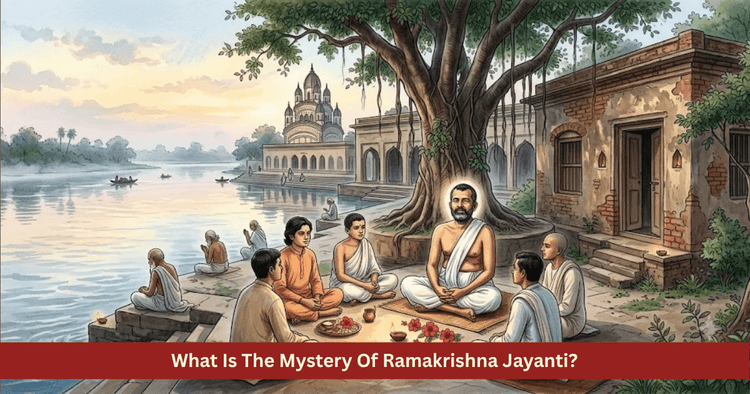
Table of Contents
Panchang Description And The Advent Of The Great Mystic
The second lunar day of the bright fortnight in the month of Phalguna represents a transformative date in the modern spiritual renaissance of Sanatana Dharma. Upon this auspicious lunar day, the supreme mystic of modern India, unreserved devotee of Mother Kali and spiritual preceptor of Swami Vivekananda, Bhagavan Sri Ramakrishna Paramahamsa, made his divine descent into the mortal world. According to the solar calendar, he was born on 18 February 1836 within the rural village of Kamarpukur, situated in the Hooghly district of West Bengal, into a pious, austere and impoverished Brahmin family. His devout father Kshudiram Chattopadhyaya and mother Chandramani Devi named the infant Gadadhar, following a divine prophetic vision received by his father at the holy pilgrimage shrine of Gadadhar Vishnu in Gaya.
| Panchang Component | Classical Description |
|---|---|
| Month and Fortnight | Phalguna Month, Shukla Paksha |
| Sacred Tithi | Shukla Paksha Dwitiya Tithi (Phulera Dooj Conjunction) |
| Constellation Conjunction | Purva Bhadrapada Nakshatra |
| Sacred Advent Site | Village Kamarpukur, Hooghly, West Bengal |
| Childhood Name | Gadadhar Chattopadhyaya |
| Spiritual Paths Practiced | Tantra, Vaishnava Love, Advaita Vedanta, Islam, Christianity |
| Principal Seat of Austerities | Dakshineswar Bhavatarini Kali Temple, Kolkata |
| Foundational Spiritual Dictum | Jato Mat Tato Path (As Many Faiths, So Many Paths) |
To assimilate his universal spiritual message on the anniversary of his appearance, an aspirant must observe rigorous satvic disciplines throughout the sacred day.
- Awakening before sunrise during Brahma Muhurta, bathing in cool water consecrated with holy Ganga drops and dressing in pristine white or yellow garments.
- Lighting a clarified butter lamp before the portraits of Sri Ramakrishna, Holy Mother Sri Sarada Devi and Swami Vivekananda on the altar.
- Offering fresh scarlet hibiscus blossoms and fragrant white sandalwood paste before Mother Bhavatarini Kali or one's chosen personal deity.
- Engaging in concentrated reading and contemplation of The Gospel of Sri Ramakrishna for at least one hour.
- Partaking in light satvic food while maintaining deep reverence for all spiritual traditions and world faiths.
- Eliminating malice, prejudice and sectarian pride regarding caste, social status or philosophical doctrines from the mind.
- Organizing collective silent meditation and devotional singing of sacred names during twilight.
- Serving destitute and hungry souls with food and clothing, treating each suffering individual as a living manifestation of Narayana.
The Sacred Sanctuary Of Dakshineswar And The Direct Realization Of Paths
The formative years of Gadadhar were characterized by natural simplicity, yet his inward consciousness spontaneously dissolved into states of transcendental absorption from early childhood. Moving to Kolkata alongside his elder brother Ramkumar, he was appointed head priest of the magnificent Bhavatarini Kali temple erected by Rani Rashmoni along the banks of the sacred Ganga in Dakshineswar. Upon this blessed ground unfolded a spiritual chapter that transformed world consciousness. The stone icon of Mother Kali was never an inanimate sculpture for him, she was the living, conscious Mother of the universe with whom he conversed directly, whom he fed with his own hands and for whose darshan he wept like an innocent child.
The distinctive genius of Sri Ramakrishna lay in his refusal to limit the spiritual quest to a single sectarian doctrine. Guided by the female ascetic Bhairavi Brahmani, he systematically executed the 64 complex and demanding disciplines of the Tantric tradition. Following this achievement, he plunged into the emotional moods of Vaishnava devotion, culminating in the ecstatic attitude of Radha. While cultivating this mood of divine longing for Lord Krishna, his physical body became so intensely aligned with transcendental love that drops of blood seeped from his pores.
In the year 1865, the wandering nondual ascetic Totapuri Maharaj arrived at Dakshineswar. Totapuri initiated Gadadhar into the severe disciplines of Advaita Vedanta and nondual absorption. While seasoned ascetics labor across decades to dissolve the subtle ego in Nirvikalpa Samadhi, Gadadhar, propelled by absolute dispassion, followed Totapuri's instruction to pierce the mental veil between the eyebrows using a shard of glass, merging effortlessly into the formless Absolute within three days. Astounded by this accomplishment, Totapuri conferred upon him the name Ramakrishna.
As Many Faiths So Many Paths: The Universal Message Of Harmony
The enduring majesty of Sanatana Dharma resides in its boundless openness and universal synthesis, an ancient truth revitalized in the modern era by Sri Ramakrishna. Having scaled the summit of Advaita Vedanta, he did not cease his spiritual explorations. He practiced the mystical paths of Sufi Islam, offering prayers in Islamic fashion, reciting sacred verses and attaining the direct vision of Allah. Subsequently, he meditated deeply upon the image of Jesus Christ, experiencing profound communion with the divine love of Christ consciousness.
Synthesizing these diverse realizations, Paramahamsa Deva gifted humanity the profound declaration: Jato Mat Tato Path, meaning As many faiths, so many paths. He illustrated this through the metaphor of a lake with multiple bathing ghats, where Hindus draw water calling it jal, Muslims call it pani and Christians call it water, the underlying substance remains identical, differing only in linguistic expression. Similarly, the Supreme Reality is one, approached through diverse paths matching human temperament. He condemned sectarian bigotry and theological arrogance as the greatest impediments to spiritual realization.
| Spiritual Discipline | Guiding Teacher | Prescribed Medium and Attitude | Attained Spiritual Realization |
|---|---|---|---|
| Shakta Tantra | Bhairavi Brahmani | Esoteric rites and meditation | Vision of the living Divine Mother |
| Vaishnava Bhakti | Diverse Vaishnava Masters | Ecstatic attitude of Radha | Ecstatic communion with Sri Krishna |
| Advaita Vedanta | Totapuri Maharaj | Dispassion and Om contemplation | Nirvikalpa Samadhi, nondual realization |
| Sufi Islam | Govinda Ray | Islamic prayer and surrender | Realization of the formless Divine |
| Christian Contemplation | Contemplation of Christ | Selfless love and divine sonship | Union with universal Christ consciousness |
Renunciation Of Lust And Wealth In Daily Spiritual Practice
The manifest life of Sri Ramakrishna demonstrated absolute detachment. He identified the two primary obstacles to spiritual illumination as lust and gold, designated in classical Bengali as kamini and kanchana. Kamini does not merely refer to women, it signifies sensual indulgence, physical craving and base bodily attraction. Similarly, kanchana does not solely denote physical gold, it represents the possessive instinct, greed and psychological dependence upon temporal wealth.
To instruct his disciples, he once took soil in one hand and silver coins in the other on the banks of the Ganga, repeating taka mati, mati taka (money is soil, soil is money), before casting both simultaneously into the sacred river currents. This physical detachment was so absolute that even during sleep, if a piece of metallic currency brushed against his skin, his nervous system recoiled involuntarily, locking his physical fingers in a rigid spasm.
His marriage with Holy Mother Sri Sarada Devi represents the most unblemished and transcendental marital relationship in recorded history. When Sarada Devi journeyed to Dakshineswar, Sri Ramakrishna inquired whether she had come to drag him down into worldly bondage. She replied with unhesitating purity that she had come solely to assist him upon the path of God realization. In response, Sri Ramakrishna seated her upon the sacred pedestal, worshiping her with sixteen classical rituals as the living embodiment of the Divine Mother Shodashi Tripurasundari, offering the fruits of all his past austerities at her lotus feet. Throughout their earthly lives, he regarded his companion as the Universal Mother herself.
The Transformation Of Naren Into Swami Vivekananda
Sri Ramakrishna was not merely an inward mystic, he was a master sculptor of spiritual leaders destined to awaken modern India. When the youthful Narendranath Datta, steeped in Western rationality, skepticism and the reformist ideas of the Brahmo Samaj, arrived at Dakshineswar demanding, "Sir, have you seen God?", Sri Ramakrishna replied with immediate simplicity: "Yes, I have seen God. I see Him as clearly as I see you here, only in a much deeper sense." This profound answer reshaped the destiny of modern spirituality.
Sri Ramakrishna did not merely impart nondual knowledge to Narendra, he ignited within him the fire of universal service. When Narendra expressed a wish to remain permanently absorbed in solitary samadhi, Sri Ramakrishna rebuked him: "How narrow is your vision! I thought you would grow into a mighty banyan tree offering shade to weary souls and you seek only your personal salvation?" Prior to his final departure, Sri Ramakrishna transmitted his accumulated spiritual powers into Narendra, establishing him as Swami Vivekananda, who proclaimed the eternal truths of Vedanta at the Parliament of Religions in Chicago in 1893.
Enduring Relevance Of Paramahamsa In The Contemporary Era
In an era troubled by severe mental restlessness, aggressive consumerism, fractured families and sectarian fanaticism, the life of Sri Ramakrishna serves as a radiant guiding light. He liberated spirituality from complicated scholasticism and rigid ritualism. He demonstrated that realizing God does not require retreating into solitary forests. One can fulfill worldly obligations while keeping the heart anchored in the Divine, just as a domestic helper cares tenderly for her employer's children while knowing in her heart that her true home lies elsewhere.
The anniversary of Sri Ramakrishna reminds humanity that true spirituality consists of direct realization rather than philosophical debates. Intellectual disagreements occur only on the surface of the mind; when human awareness ascends to the level of selfless love, artificial divisions dissolve. His timeless teachings inspire humanity to recognize the inherent divinity within the soul, serving every living being as an altar of the living God.
FAQ
On which lunar date is Sri Ramakrishna Jayanti celebrated?
It is celebrated annually on the second lunar day of the bright fortnight in the month of Phalguna, coinciding with Phulera Dooj.
What was the original birth name of Sri Ramakrishna?
His childhood name was Gadadhar Chattopadhyaya, before he was designated as Ramakrishna following his initiation into monastic life.
What is the meaning of the dictum Jato Mat Tato Path?
It signifies that all religious traditions, philosophies and sects are diverse paths leading to the realization of the one absolute Supreme Reality.
How did Sri Ramakrishna worship his consort Holy Mother Sarada Devi?
He worshiped Holy Mother upon the sacred altar as the living embodiment of the Goddess Shodashi Tripurasundari, offering all spiritual fruits at her feet.
What was Sri Ramakrishna's core teaching regarding lust and wealth?
He taught that unchecked physical desires and greed for wealth are the primary obstacles to spiritual illumination, requiring inward detachment and mental purity.
Get your accurate Kundali
Did you like it?
Author
Pt. Amitabh Sharma (56 Years)
Experience: 20
Consults About: Family Planning, Career
Clients In: Punjab, Haryana, Delhi
Share this article with friends and family
WELCOME TO
ZODIAQ
Right Decisions at the right time with ZODIAQ
