What Is The Spiritual Mystery Of Rangbhari Ekadashi?
By Pt. Suvrat Sharma
Kashi Lord Vishwanath Homecoming And First Spring Colors
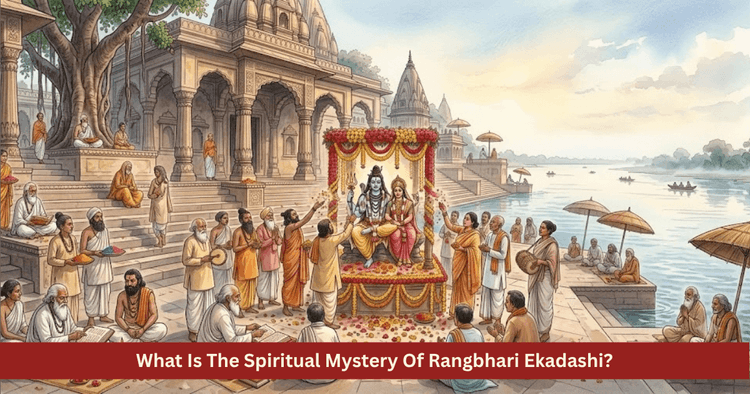
Table of Contents
Panchang Description And The Sacred Homecoming Tradition Of Kashi
The eleventh lunar day of the bright fortnight in the month of Phalguna is celebrated across the sacred Vedic calendar as Rangbhari Ekadashi. While observed throughout India as Amalaki Ekadashi, within the holy liberation giving city of Kashi this sacred day assumes an unmatched, transcendental and joyous character. According to ancient puranic tradition, the wedding between Lord Mahadeva and Mother Parvati took place on the fourteenth day of the dark fortnight of Phalguna during Mahashivratri. Following the nuptials, this eleventh lunar day was the sacred occasion when Lord Shiva brought Mother Parvati to his eternal city of Kashi for her formal post marital homecoming. In commemoration of this arrival, the entire sacred landscape of Kashi rejoices, bathing in sacred fragrant powders and colors.
| Panchang Component | Classical Description |
|---|---|
| Month and Fortnight | Phalguna Month, Shukla Paksha |
| Sacred Tithi | Shukla Paksha Ekadashi Tithi |
| Presiding Deities | Lord Vishwanath and Mother Annapurna of Kashi |
| Principal Seat of Celebration | Kashi Vishwanath Abode, Varanasi, Uttar Pradesh |
| Celebration Nature | Mother Parvati homecoming, divine procession, holy powders |
| Prescribed Offerings | Cannabis, herbal drinks, sweet butter, rock sugar, bilva leaves |
| Bestowed Spiritual Fruit | Dissolution of marital conflict, lasting fortune, liberation |
To secure divine grace and matrimonial harmony on Rangbhari Ekadashi, every seeker must maintain disciplined scriptural observances from the early morning hours.
- Awakening before sunrise during Brahma Muhurta, bathing in cool water consecrated with sacred Ganga drops and dressing in pure white or saffron garments.
- Lighting a clarified butter lamp using pure indigenous cow ghee before the joint icon of Lord Shiva and Mother Parvati.
- Bathing the sacred Shiva Lingam with Ganga water, raw unboiled milk, white sandalwood paste and unbroken three leaf bilva leaves.
- Offering fragrant crimson or pink herbal powdered colors before Lord Shiva and the Universal Mother with deep reverence.
- Observing an unbroken diurnal fast while chanting the sacred five syllable formula Om Namah Shivaya or reciting the Rudrashtakam.
- Reciting the Mother Annapurna Stotra alongside contemplation of Kashi Vishwanath to pray for domestic nourishment and prosperity.
- Lighting a clarified butter lamp near the holy Tulsi plant at twilight, performing reverent circumambulation.
- Guarding the mind against abrasive speech, envy, angry outbursts and domestic disputes throughout the day.
The Silver Palanquin Procession And The Divine Welcome In Kashi
The most magnificent tradition of Rangbhari Ekadashi originates from the traditional residential quarters of the historic temple preceptor family of Kashi Vishwanath. During the early morning hours, the rare five faced silver icon of Lord Vishwanath and Mother Parvati receives elaborate sixteen step ritual worship. All classical bridal homecoming rites are executed with reverence. Mother Gaura is adorned with the sixteen classical emblems of bridal grace and her hands are anointed with traditional paste of turmeric and natural henna.
Subsequently, the divine moving icons of Lord Mahadeva and Mother Gaura are installed within an exquisitely decorated silver palanquin. The sacred forms of Lord Ganesha and Kartikeya accompany the procession. As the palanquin departs through the ancient lanes of Varanasi toward the inner sanctum of the Vishwanath temple, resonant sounds of conches, hand drums, bells and chants of victory resound across the sky. Citizens, ascetics, mendicants and pilgrims welcome Mother Parvati with tears of devotion, showering the palanquin with cascades of fragrant crimson and herbal powders. The air fills with a crimson mist that turns the sky into an arch of sacred red. Scriptural tradition maintains that whenever these consecrated powders fall upon the brow or limbs of a pilgrim, all accumulated sins and negative vibrations are burned away.
The Formal Opening Of Holi And The Mystery Of Cremation Ground Rites
Rangbhari Ekadashi marks the formal and spiritual opening of the spring color festival within the sacred boundaries of Kashi. While across northern India the color festival culminates around the full moon night, in Varanasi the joyous play of colors commences on this sacred eleventh lunar day. Within the esoteric lore of Kashi, this festival is linked to the cremation ground rites observed at Manikarnika and Harishchandra Ghats.
On Rangbhari Ekadashi, Lord Shiva celebrates the joy of colors with the celestial devas, celestial musicians and householder citizens within the city. However, his unconventional companions, including wandering spirits, elemental entities and ascetics residing at the cremation grounds, cannot participate in the civic celebration due to social boundaries. Moved by selfless compassion for his unconventional devotees, Lord Shiva visits the cremation ground of Manikarnika Ghat on the following day, the twelfth lunar phase. There, amid the burning funeral pyres, he plays with sacred cremation ash alongside his companions. This observance demonstrates that the love of Shiva embraces not merely refined society, it encompasses death, grief and abandonment, transmuting them into spiritual bliss.
Astrological Remedies For Eradicating Marital Friction And Expanding Harmony
In the analytical systems of Vedic astrology, the union of Lord Shiva and Mother Parvati represents the pinnacle of matrimonial harmony and domestic fidelity. Rangbhari Ekadashi provides an extraordinary astrological opportunity for married couples confronting chronic estrangement, domestic arguments, coldness or emotional separation. Astrologically, when the planet Venus governing marital bliss and the Moon governing mental stability suffer from malefic afflictions by Saturn or lunar nodes, domestic peace is disturbed.
| Nature of Marital or Family Distress | Recommended Rite on Rangbhari Ekadashi | Intended Spiritual Benefit |
|---|---|---|
| Chronic friction between spouses | Offering fragrant red powders and attar upon Shiva Parvati icon | Resolution of disputes and mutual affection |
| Unexplained delay in marriage | Offering 16 bridal items and yellow veil to Mother Parvati | Swift alliance with a virtuous partner |
| Prolonged illness of a partner | Offering milk, honey and sacred ash marks upon Shiva Lingam | Physical vitality and preservation of health |
| Household impoverishment and strife | Chanting Mother Annapurna Stotra 11 times with focus | Influx of domestic grace and enduring wealth |
Presenting sacred red powders upon a single consecrated plate before the joint image of Shiva and Parvati on Rangbhari Ekadashi dismantles personal ego between married partners. Spouses who offer continuous water streams upon the Shiva Lingam and submit vermilion to Mother Gaura preserve the sanctity of their union against all adversity. When a married woman applies the vermilion consecrated at the feet of Mother Parvati along her hair parting, she receives blessings of longevity and domestic peace for her lineage.
Ritual Procedure And The Esoteric Science Of Powder Offerings
The offering of powdered colors on Rangbhari Ekadashi is rooted in ancient subtle sciences rather than mundane recreation. Synthetic, chemical based commercial pigments are strictly prohibited in classical worship. From ancient antiquity, this observance utilized natural powdered colors derived from dried blossoms of the palash tree, pure white mica and therapeutic sandalwood.
- Sit facing eastward or northward at the domestic altar during the morning hours, installing an unblemished image of Shiva and Parvati.
- Prepare a brass or silver vessel containing holy Ganga water, blending in a small portion of raw cow milk and natural floral attar.
- Pour this continuous stream over the Shiva Lingam or the combined icon with a serene, focused mind.
- Adorn the Shiva Lingam with a threefold mark of sacred ash and apply a mark of pure vermilion to the forehead of Mother Parvati.
- Arrange pure natural red powders upon a bronze or silver platter, offering them at the lotus feet of the Divine while chanting Om Namah Shivaya and Om Gauryai Namah.
- Present traditional offerings including cannabis leaves, rock sugar, seasonal fruits and consecrated bilva leaves.
- Conclude the rite by burning natural camphor to perform the joint waving of lights, taking a small pinch of the sanctified red powder to mark one's own forehead.
Inner Devotion And The Path To Ultimate Liberation
Rangbhari Ekadashi imparts the profound truth that within Sanatana Dharma, ascetic renunciation and divine joy do not contradict one another. Lord Shiva, who dwells in solitude, anoints his limbs with cremation ash and wears a garland of skulls, joyfully adorns himself in vibrant crimson powders out of love for his devotees. This proves that when genuine devotion and selfless surrender reside within the heart, even dispassion blossoms into celebration.
This sacred lunar day inspires humanity to dip all dark, resentful and fearful thoughts into the radiant crimson color of divine love. When a spiritual seeker rises above worldly dualities to contemplate this divine communion of Shiva and Shakti, the shadows of ancient karma and ignorance dissolve. Rangbhari Ekadashi illuminates the human heart with transcendental light, guiding the soul through worldly duties while anchoring it in ultimate liberation at the lotus feet of Lord Shiva.
FAQ
What is the classical significance of Rangbhari Ekadashi?
It commemorates the sacred post marital homecoming of Mother Parvati to Kashi with Lord Shiva following their wedding, celebrated through offerings of colored powders.
What is the connection between Rangbhari Ekadashi and Amalaki Ekadashi?
The eleventh lunar day of the bright fortnight of Phalguna is observed across India as Amalaki Ekadashi, while in Kashi it is celebrated as Rangbhari Ekadashi.
Which colors should be offered to Lord Shiva on Rangbhari Ekadashi?
Devotees should offer natural, non-toxic crimson powders prepared from palash flowers and fragrant white scented powders to Lord Shiva and Mother Parvati.
How is the cremation ground color celebration linked to Rangbhari Ekadashi?
Following the civic celebration on Rangbhari Ekadashi, Lord Shiva visits Manikarnika Ghat on the following day to celebrate with his disembodied companions using cremation ash.
What ritual should married couples observe for domestic harmony?
Husband and wife should jointly offer natural red powders to the divine couple Shiva and Parvati, applying a portion of the consecrated vermilion to the wife's hair parting.
Get your accurate Kundali
Generate KundaliDid you like it?
Author
Pt. Suvrat Sharma (63)
Experience: 20
Consults About: Family Planning, Career
Clients In: Punjab, Haryana, Delhi
Share this article with friends and family
WELCOME TO
ZODIAQ
Right Decisions at the right time with ZODIAQ
