How To Prevent Springtime Seasonal Allergies?
By Aparna Patni
Ayurvedic And Astrological Remedies For Pollen And Kapha Disorders
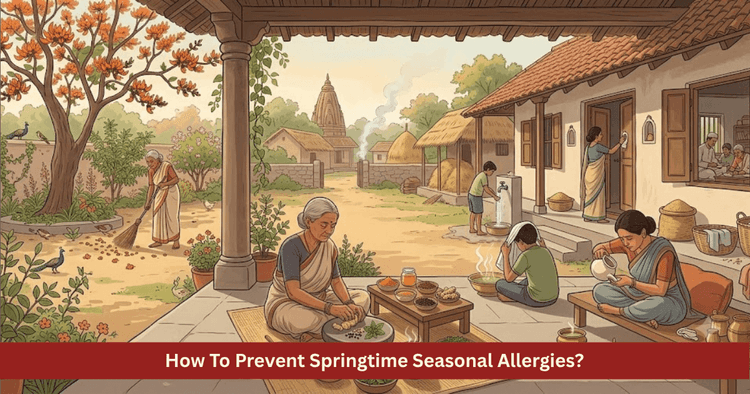
Table of Contents
Panchang Description And The Tridoshic Imbalance Of Seasonal Transition
According to the classical Vedic calendar, the temporal junction spanning the concluding half of the month of Phalguna and the inaugural half of Chaitra is revered as an exceptionally delicate transitional window. During this phase, the cold season of late winter yields completely to the radiant flowering of spring. From an astronomical perspective, Lord Surya Deva accelerates his northern traversal, causing daytime temperatures to rise steadily while nocturnal and dawn hours retain a crisp ambient chill. Within this ecological shift, while woodlands and orchards burst forth with emerald foliage, colorful blossoms and fresh floral buds, the surrounding atmosphere becomes saturated with billions of airborne micro-spores and pollen grains.
Foundational treatises of Indian medicine, including the Charaka Samhita and the Ashtanga Hridayam, explicitly warn that dense, unctuous and heavy kapha accumulated throughout midwinter begins to liquefy rapidly under the heating rays of the spring sun. This liquefied kapha travels through the micro-channels of the stomach, bronchial tubes and nasal cavities. When inhaled pollen grains enter the upper respiratory tract through breathing, they collide with this liquefied kapha, triggering an aggressive systemic allergic cascade. Classical Ayurveda classifies this pathology as Vata-Kaphaja Pratishyaya, recognized in modern clinical science as seasonal allergic rhinitis or airborne pollen allergy.
| Panchang and Seasonal Factor | Classical Ayurvedic Description |
|---|---|
| Calendar Transition Window | Concluding Phalguna to Opening Half of Chaitra |
| Primary Environmental Trigger | Suspended Micro-Pollen Grains and Atmospheric Dust |
| Dominant Internal Humor Disorder | Liquefaction of Kapha and Excitation of Bodily Vata |
| Anatomical Sites of Affliction | Nasal Passages, Bronchial Tree, Eyes, Throat, Dermis |
| Primary Clinical Symptoms | Paroxysmal Sneezing, Ocular Pruritus, Dyspnea, Dry Cough |
| Core Botanical Formulations | Giloy, Dry Ginger, Black Pepper, Turmeric, Tulsi, Neem |
| Bestowed Physiological Benefit | Purification of Vital Prana, Tridoshic Balance, Health |
To shield the biological vessel against airborne environmental pathogens and hypersensitivity during this seasonal transition, an aspirant must observe rigorous scriptural and natural disciplines from dawn onward.
- Awakening before sunrise during Brahma Muhurta, cleansing the facial features and oral cavity utilizing warm water instead of refrigerated fluids.
- Executing the yogic nasal cleansing techniques of Jalaneti and Sutraneti with consecrated warm saline water following morning evacuation.
- Anointing the interior lining of both nostrils with two drops of warm indigenous cow clarified butter or classical Anu Taila prior to outdoor activity.
- Practicing at least fifteen unbroken minutes of dynamic Bhastrika and Kapalabhati breath control following morning solar postures.
- Drinking exclusively warm or room temperature water throughout the day, renouncing refrigerated water and commercial ice completely.
- Consuming strictly fresh, warm, light and kapha pacifying culinary preparations while avoiding stale, refrigerated and deep fried foods.
- Keeping domestic chamber windows secured during late afternoon hours to prevent gusty winds from sweeping concentrated pollen into bedrooms.
- Purifying the indoor atmosphere at dusk by burning natural aromatic camphor, pure guggulu and dried neem leaves upon glowing coals.
Clinical Diagnosis Of Pollen Hypersensitivity And Respiratory Congestion
Authentic Ayurveda never seeks merely to suppress outward somatic distress through chemical antihistamines; its goal is the total eradication of root metabolic imbalances. The primary internal cause of springtime hypersensitivity is the impairment of systemic cellular immunity and the depletion of ojas. When digestive fire fluctuates, incomplete assimilation generates a toxic metabolic byproduct known as ama. This sticky metabolic residue enters the bloodstream, obstructing the micro-circulatory channels of the body.
When external airborne pollen particles touch the delicate nasal mucosa, a compromised immune system misinterprets these natural botanical proteins as lethal threats, releasing floods of histamine into surrounding tissues.
| Anatomical Zone | Observable Clinical Manifestations | Root Ayurvedic Pathology | Prescribed Natural Therapy |
|---|---|---|---|
| Nasal Mucosa and Airways | Paroxysms of 15 to 20 sneezes, clear rhinorrhea | Irritation of Vata and Kapha in Nasal Passages | Daily Jalaneti and Warm Ginger Decoction |
| Ocular Tissues and Sclera | Conjunctival injection, severe itching, lacrimation | Aggravation of Pitta and Blood Heat | Ocular irrigation with cooled Triphala Water |
| Pulmonary Bronchial Matrix | Wheezing, dry nocturnal cough, bronchial constriction | Obstruction of Prana Channels by Kapha | Ingestion of Sitopaladi Churna with Raw Honey |
| Dermal Layers and Biofield | Urticarial hives, cutaneous eruptions, pruritus | Spread of Pitta and Toxins into Plasma | Ingestion of Bitter Neem Leaves and Giloy Decoction |
Left unaddressed across recurrent spring seasons, this functional sensitivity advances into chronic allergic asthma and perennial sinusitis. therefore liquefying and purging stagnant bodily kapha during Phalguna constitutes the sole lasting scientific solution.
Astrological Dynamics Of Mercury And The Moon In Hypersensitivity
In the analytical systems of Vedic astrology, every discrete anatomical structure and physiological disorder corresponds to specific planetary radiations. In the manifestation of respiratory allergies and nervous hypersensitivity, two planetary forces-Budha Deva (Mercury) and Chandra Deva (the Moon)-exert decisive influence.
Mercury governs the bronchial architecture, nasal mucosa, cutaneous tissues and the central nervous system within the archetypal cosmic anatomy. Concurrently, the Moon presides over bodily fluids, lymphatic circulation, mucous secretions and emotional fluctuations. When Mercury occupies its debilitation sign in Pisces, suffers combustion from close solar proximity or when the Moon is depleted and afflicted by the lunar nodes Rahu or Ketu, the individual becomes vulnerable to seasonal pollen allergies.
- To fortify the strength of Mercury and pacify nervous hyper-reactivity, offer 21 fresh durva grass blades before Lord Ganesha on Wednesdays while chanting Om Bum Budhaya Namah 108 times.
- To stabilize the Moon and check excess bronchial secretions, pour unboiled cow milk mixed with water and dark sesame seeds over the sacred Shiva Lingam on Mondays.
- Store drinking water overnight within an unblemished silver vessel, consuming the water at dawn; this practice regulates physiological histamine responses naturally.
- Individuals experiencing chronic sneezing fits should feed fresh green fodder or soaked green gram directly to an indigenous cow on Wednesday mornings.
- Offer a libation of pure water blended with red sandalwood paste and raw jaggery from a copper vessel to Surya Deva at dawn; solar radiation reinforces the systemic immune barrier.
Therapeutic Synergy Of Tinospora Cordifolia, Golden Milk And Herbal Elixirs
To dismantle springtime hypersensitivity permanently, classical medicine prescribes potent botanical adaptogens, among which Tinospora cordifolia, known classically as Giloy or Amrita, holds the highest therapeutic rank. Giloy is exceptional because it balances all three biological humors simultaneously while acting as a natural immunomodulator. It neither suppresses the immune system nor allows it to overreact destructively against benign pollen particles.
For individuals suffering from airborne allergies during Phalguna, the following classical formulations act as biological nectar:
-
Therapeutic Decoction of Giloy and Holy Basil:
- Crush a four inch stem of fresh, clean Giloy vine.
- Add 7 fresh leaves of holy basil, 4 crushed black peppercorns and half a teaspoon of dried ginger powder.
- Boil this botanical mixture in two cups of clean water over gentle heat until the liquid reduces to half a cup.
- Strain and consume this warm decoction on an empty stomach at dawn. This formulation reinforces the integrity of the respiratory mucosa, eliminating pollen hypersensitivity.
-
Golden Turmeric Elixir (Haridra Khanda and Turmeric Milk):
- Turmeric contains concentrated curcumin, a potent natural anti-inflammatory agent.
- Boil half a teaspoon of pure ground turmeric and a pinch of freshly crushed black pepper into 200 milliliters of fresh cow milk each night before rest.
- Sweeten with raw rock sugar and consume it warm. Black pepper elevates the intestinal absorption of curcumin by up to two thousand percent.
-
Sitopaladi Churna with Raw Honey:
- For persistent bronchial irritation and tickling throat coughs, blend half a teaspoon of Sitopaladi Churna with raw unprocessed honey, licking the paste slowly twice daily to soothe inflamed mucosal linings.
Yogic Nasal Cleansing, Nasal Drops And Hexagonal Purification Rites
The classical purification techniques preserved within the Hatha Yoga Pradipika and the Gheranda Samhita provide an infallible defensive shield against spring allergies. An individual who performs regular Jalaneti and therapeutic nasal lubrication prevents micro-pollen particles from adhering to nasal passages.
-
Standard Execution of Jalaneti:
- Fill a clean neti vessel with lukewarm water, dissolving half a teaspoon of pure rock salt. The water temperature must match internal body heat.
- Assume a squatting posture, tilting the head gently sideways and insert the nozzle into the upper nostril.
- Breathe steadily through the open mouth; the water flows into one nostril and exits smoothly through the opposite channel.
- Reverse the procedure for the alternate nostril.
- Perform vigorous exhalations through Kapalabhati breath control immediately following the cleansing to ensure no moisture remains within the sinus cavities. This removes trapped pollen grains, particulate dust and stagnant mucus.
-
Therapeutic Nasal Lubrication (Pratimarsha Nasya):
- Recline upon a flat surface following Jalaneti, administering two drops of lukewarm indigenous cow clarified butter or classical Anu Taila into each nostril.
- Inhale deeply, allowing the soothing oil to coat the pharynx before spitting out residual secretions.
- This lipid coating creates a biological barrier over delicate mucosal tissues, preventing external pollen antigens from initiating allergic reactions.
Classical Spring Regimen And Lifestyle Recalibration
The foundational philosophy of Ayurveda dictates that lasting physical health is secured through seasonal lifestyle adaptation, known as Ritucharya. Scriptural authorities mandate several seasonal rules during the warmth of spring:
- Strict Prohibition of Daytime Sleep: Sleeping during daytime hours in spring is forbidden. Daytime sleep triggers a rapid surge in bodily kapha, worsening respiratory congestion and ocular inflammation.
- Herbal Pastes and Dynamic Exercise: Anoint the body with an exfoliating paste prepared from chickpea flour, ground turmeric and mustard oil prior to morning bathing. Engage in physical exercise until light perspiration appears upon the brow and axillary regions to clear blocked dermal pores.
- Incorporating Pungent and Bitter Dietary Tastes: Consume generous portions of bitter gourd, fenugreek leaves, tender neem buds, drumsticks and dry roasted chickpeas. These bitter and astringent botanicals cleanse the bloodstream and dehydrate excess kapha.
- Renouncing Heavy, Chilled and Fermented Consumables: Black gram lentils, freshly harvested polished rice, heavy bananas, cold curd and sour tamarind preparations must be eliminated entirely throughout this seasonal junction.
When a seeker incorporates these yogic, Ayurvedic and lifestyle disciplines, the arrival of spring transforms from a season of allergic distress into an unbroken celebration of vitality and renewal. Unimpeded circulation of vital prana preserves physical health, mental focus and spiritual enthusiasm throughout the annual cycle.
FAQ
Why do seasonal pollen allergies intensify dramatically during early spring?
Flowering vegetation releases dense clouds of microscopic pollen into the atmosphere, colliding with winter kapha liquefied by solar warmth to trigger acute allergic symptoms.
What are the primary clinical indicators of seasonal pollen hypersensitivity?
Paroxysmal sneezing fits, persistent clear nasal discharge, conjunctival redness, intense ocular itching, throat tickling and bronchial constriction are classic indicators.
How does the yogic practice of Jalaneti prevent allergic attacks?
Flushing the nasal passages with warm saline water cleanses away accumulated pollen grains, environmental dust and stagnant mucus adhering to the mucosal lining.
Which classical lipid is prescribed for daily protective nasal drops?
Administering two drops of warm indigenous cow clarified butter or medicated Anu Taila into each nostril provides a soothing biological barrier against airborne allergens.
Which planetary forces govern respiratory hypersensitivity and mucosal inflammation?
Mercury rules the respiratory mucosa, cutaneous tissues and nervous pathways, while the Moon governs lymphatic fluids and bodily kapha secretions.
Get your accurate Kundali
Generate KundaliDid you like it?
Author

Aparna Patni (63)
Experience: 20
Consults About: Family Planning, Career
Clients In: Punjab, Haryana, Delhi
Share this article with friends and family
WELCOME TO
ZODIAQ
Right Decisions at the right time with ZODIAQ
