What Is The Mystery Of Rama Victory Over Ocean?
By Pt. Narendra Sharma
The Causeway, Architectural Science And Restoration Of Willpower
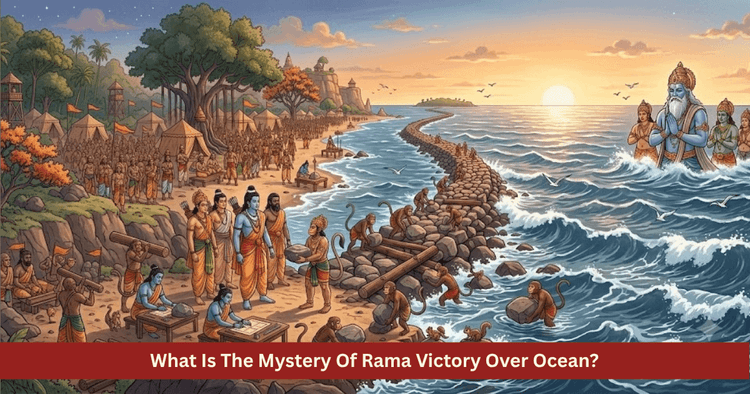
Table of Contents
Panchang Description And The Sacred Timeline Of The Causeway Construction
According to the classical Vedic calendar and the precise astronomical calculations recorded within the Yuddha Kanda of the Valmiki Ramayana, the dark lunar fortnight of the month of Phalguna represents the decisive, monumental and heroic temporal phase across the manifest pastimes of Lord Sri Rama. During this window, he constructed the historic ocean causeway across the fathomless Indian Ocean to establish righteousness over Lanka.
Within computational Vedic chronology, upon the eleventh lunar day of the dark fortnight of Phalguna, celebrated across scriptural traditions as Vijaya Ekadashi, Lord Sri Rama sat along the coastal shore alongside the legions of vanaras and bears. Observing an unbroken diurnal fast, he made a solemn vow to secure victory in the presence of the ocean deity. Following the spiritual merits of that fast and three continuous days of austere penance upon the shoreline, the deity of the ocean manifested, revealing the secret science for laying the stone causeway. Immediately thereafter, at the sensitive conjunction of Trayodashi and Chaturdashi, the monumental construction commenced under the engineering leadership of Nala and Nila, the celestial sons of the cosmic architect Vishwakarma.
| Astrological and Historical Factor | Classical Scriptural Description |
|---|---|
| Calendar and Fortnight Window | Phalguna Month, Dark Fortnight (Krishna Paksha) |
| Moment of Auspicious Vow | Vijaya Ekadashi Conjunction to Phalguna Amavasya |
| Geographic Alignment of Causeway | Dhanushkodi, Rameshwaram to Mannar Island (Sri Lanka) |
| Master Architects and Engineers | Vanara Heroes Nala and Nila (Sons of Vishwakarma) |
| Presiding Sovereign Transcendental Power | Lord Mahadeva Shiva (Consecration of Rameshwaram Jyotirlinga) |
| Planetary Planetary Transits | Solar Ingress through Aquarius, Exalted Martial Field of Mars |
| Bestowed Spiritual Fruit | Restoration of Unshakeable Confidence, Overcoming Obstacles |
To absorb the spiritual potency of Lord Sri Rama's conquest over the ocean and awaken dormant inner willpower during Phalguna, an aspirant must observe rigorous scriptural conduct from dawn onward.
- Awakening before sunrise during Brahma Muhurta, bathing in cool water consecrated with drops of holy Ganga currents.
- Dressing in clean unstitched cotton garments of scarlet or deep yellow following ablutions, sitting quietly facing eastward.
- Lighting an unbroken lamp fueled by indigenous cow clarified butter before the altar icons of Lord Sri Rama, Mother Janaki and Lord Hanuman.
- Submitting pure red sandalwood paste, unbroken rice grains and sacred tulsi leaves at the lotus feet of Lord Rama with deep surrender.
- Maintaining an unbroken mental repetition of the six syllable formula Om Ram Ramaya Namah or the classical victory formula throughout the day.
- Guarding the consciousness against harboring feelings of inferiority, psychological despair, anxiety or defeat under all circumstances.
- Reciting the Sundarakanda and the Setubandha sections of the Yuddha Kanda with clear vocal cadence during afternoon or twilight hours.
- Providing wholesome hot meals to the destitute, elderly and physically challenged, treating all living creatures with kindness.
- Meditating upon the Rameshwaram Jyotirlinga at dusk while offering pure water or raw unboiled milk over the sacred Shiva Lingam.
Three Days Of Shoreline Penance And The Universal Lesson Of Restraint
The Yuddha Kanda of the Valmiki Ramayana presents a moving, profound exposition of the spiritual discipline observed by Lord Sri Rama at the edge of the ocean. When the vast vanara legions stood paralyzed with dread before the fathomless expanse of roaring waters, Lord Rama, instead of displaying immediate apocalyptic violence, demonstrated deep humility, moral restraint and scriptural decorum.
Lord Sri Rama spread a sacred mat of kusha grass along the shoreline, folding his hands and fasting for three consecutive days and nights, petitioning the sovereign of the waters to grant peaceful passage. He was the Supreme Absolute Truth in human form; he could have evaporated the ocean in an instant with a single arrow. Yet he chose to teach humanity that as long as diplomacy, dialogue, patience and mutual respect remain possible, one must never deploy aggressive physical force.
When the ocean deity failed to appear after three days, intoxicated by natural pride and rigid physical laws, Lord Sri Rama turned to Lakshmana, declaring:
Vinaya na manata jaladhi jada gaye teena dina beeti. Bole Rama sakopa taba bhaya binu hoi na preeti.
Lord Rama drew an arrow of cosmic fire, seating the missile upon the bowstring of the Kodanda. The instant the weapon was set, the subterranean dimensions trembled, the waters of the ocean began to boil and marine creatures cried out in distress. Shaken to his core, the deity of the ocean emerged from the depths in the form of a learned brahmin, carrying a golden platter filled with rare gems, bowing at the lotus feet of Rama to beg for mercy. This pastime demonstrates that gentleness is not weakness; when a righteous soul assumes focused anger to protect cosmic dharma, the entire universe yields before that authority.
The Architectural Science Of Nala-Nila And The Buoyancy Of Inscribed Stones
Following his submission, the ocean deity revealed a confidential mystery to Lord Sri Rama: within your legions dwell two vanara artisans, Nala and Nila, blessed with the creative genius of their father Vishwakarma. During their youth, while playing near hermitage sanctuaries, Nala and Nila tossed the sacred stone icons of sages into forest streams. Moved to gentle amusement, the hermits granted them a boon disguised as a curse: whatever stone or heavy timber their hands touched would never sink beneath water.
Under the direction of Nala and Nila, the vanara army uprooted massive mountain ridges, basalt boulders and trees, carrying them to the coastline. Classical texts confirm that the construction of the causeway followed an architectural methodology superior to contemporary civil engineering:
- Material Collection: The vanaras utilized trunks of sal, tamala, mango, arjuna, bakula and palash trees to construct floating foundations.
- Binding Agents: To secure the boulders against crashing tides, a mortar of botanical resin, limestone and calcified clay was applied between stone joints.
- Dimensions: The monumental causeway spanned a length of one hundred yojanas (over 800 kilometers) and a width of ten yojanas.
- Speed of Execution: The causeway was completed in just five days: fourteen yojanas on the first day, twenty on the second, twenty one on the third, twenty two on the fourth and twenty three on the fifth.
- Sonic Activation of the Divine Name: When the warriors carved the two sacred syllables Sri Rama upon the surface of each stone, the rocks defied their physical density, floating upon the ocean waves.
| Construction Day | Completed Span (Yojanas) | Primary Materials Employed | Architectural and Spiritual Significance |
|---|---|---|---|
| First Day | 14 Yojanas | Monolithic boulders, sal and tamala trunks | Laying the foundation, depth stabilization |
| Second Day | 20 Yojanas | Medium basalt stones, arjuna branches | Acceleration of speed and balance |
| Third Day | 21 Yojanas | Botanical resins, limestone mortar, flat stones | Resistance against tidal surges |
| Fourth Day | 22 Yojanas | Smooth flagstones, packed crushed gravel | Creating an even surface for troop movement |
| Fifth Day | 23 Yojanas | Final interlocking stones, anchoring to shore | Uniting the causeway with Mount Suvela in Lanka |
The Contribution Of The Little Squirrel And The Power Of Collective Consciousness
Within the Lankakanda of the Ramacharitmanas, an endearing and timeless pastime unfolds during the construction of the causeway: the dedication of the little squirrel. While mighty warriors like Hanuman, Angada, Sugriva and Jambavan lifted mountain peaks to cast into the sea, a tiny striped squirrel resolved to participate in the sacred work of Lord Sri Rama.
The tiny creature dipped her body into the ocean waves, rolled in the dry sand along the shore until grains adhered to her fur, ran out onto the floating stones and shook the sand into the crevices between the boulders. When a proud vanara mocked her efforts, Lord Sri Rama scooped the little squirrel into his hands.
Lord Rama addressed the assembled forces, declaring that the devotion of this small squirrel held equal spiritual weight to the physical might of Hanuman, Nala and Nila. The fine sand grains she deposited were locking the stones together, cementing the causeway against the waves.
With paternal tenderness, Lord Rama stroked the back of the squirrel with three fingers. Tradition records that the three light stripes visible upon the backs of squirrels to this day represent the touch of Lord Rama. This narrative teaches that in noble endeavors, external magnitude and physical strength are secondary; unwavering dedication, purity of purpose and sincere surrender alone hold value before the Divine.
Solar And Martial Potency In Astrological Analysis
In classical Vedic astrology, Lord Sri Rama descended within the illustrious Solar Dynasty, taking birth in Cancer ascendant with an exalted Jupiter situated in the first house and a directionally empowered Sun occupying the tenth house. His triumph over the ocean during Phalguna illustrates the harmonious synthesis of solar authority and martial valor within the archetypal cosmic chart.
The Sun governs the soul, unyielding self-confidence, willpower and executive leadership. Concurrently, Mars governs raw courage, physical stamina, engineering sciences and strategic warfare. When an individual confronts obstacles in life that appear as wide and impenetrable as the ocean, activating solar and martial energies within consciousness provides the power to overcome them.
- If the Sun is weak in a natal chart, causing indecisiveness, poor confidence and dread of public failure, studying the Setubandha pastimes during Phalguna infuses the mind with solar vitality.
- If Mars is debilitated in Cancer or afflicted by Rahu, listening to the engineering accomplishments of Nala and Nila transmutes volatile energy into constructive focus.
- Aspirants facing demanding professional deadlines, competitive trials or difficult legal challenges should recite the Aditya Hridaya Stotra alongside the Sundarakanda daily throughout Phalguna.
The Consecration Of Rameshwaram And The Nondual Union Of Shiva And Rama
Prior to marching across the causeway to enter Lanka, Lord Sri Rama shaped an unblemished Shiva Lingam out of ocean sand with his own hands along the shoreline, performing its formal consecration. That holy site is venerated today as Sri Rameshwaram, among the foremost of the twelve sacred Jyotirlingas.
Revealing the esoteric nondual reality of this shrine, Lord Rama declared:
Ramasya Ishwarah Sah Rameshwarah (He who is the Lord of Rama is Rameshwaram).
Yet he also proclaimed: Ramah Ishwarah Yasya Sah Rameshwarah (He whose Lord is Rama is Rameshwaram).
Lord Rama announced that whoever professes love for him while harboring disdain for Lord Shiva can never attain his grace and whoever honors Shiva while disrespecting Rama faces spiritual degradation. There is no separation between Rama and Shiva. Rama is the heart of Shiva and Shiva is the soul of Rama.
Meditating upon the Rameshwaram Jyotirlinga during Phalguna while pouring sacred river water over the Shiva Lingam dissolves subconscious fears, negative thoughtforms and astrological afflictions, just as the turbulent ocean calmed before the presence of Lord Rama.
Restoring Self-Confidence And The Lessons Of Spiritual Leadership
This sacred historical pastime preserved within the month of Phalguna acts as an infallible restorative elixir for modern human beings struggling with anxiety, despair and self-doubt. Modern individuals often become overwhelmed by minor domestic setbacks, professional challenges or financial strain, believing all hope is lost.
Lord Rama's victory over the ocean imparts timeless principles of living:
- Lack of material resources is never a barrier to ultimate victory: Lord Rama had no royal treasury, no armored chariots and no professional mercenary divisions. His allies were forest dwellers, vanaras, bears and creatures of the woodland. Yet he possessed moral truth and an unbending will. When an objective is pure, nature provides the necessary instruments.
- The essence of compassionate leadership: An authentic leader recognizes the hidden potential in the humblest participant (such as the squirrel), integrating every soul into the collective mission.
- The synthesis of diplomatic patience and decisive courage: Exhausting peaceful diplomacy first, then drawing the bow of righteous resolve when untruth refuses to yield, represents true statecraft.
Contemplating this sacred victory during the seasonal shift of Phalguna incinerates the dread of worldly failure within the subconscious mind, granting the seeker confidence to traverse any ocean of adversity.
FAQ
On which lunar date did Lord Sri Rama take the vow to conquer the ocean?
Lord Sri Rama observed an unbroken fast along the shoreline, making the solemn vow to conquer the ocean on the sacred date of Vijaya Ekadashi in the month of Phalguna.
How many days did it take to construct the historical Rama Setu?
According to the Valmiki Ramayana, the vanara forces completed the one hundred yojana long causeway in five continuous days under the direction of Nala and Nila.
Who were the primary civil architects and engineers of Rama Setu?
The vanara heroes Nala and Nila, the sons of the divine architect Vishwakarma, were the master engineers of the causeway.
What spiritual lesson does the pastime of the little squirrel convey?
It teaches that in righteous endeavors, physical magnitude does not matter; sincere surrender, unwavering dedication and purity of purpose alone hold weight before God.
Which classical texts should be recited during Phalguna to enhance personal self-confidence?
Reciting the Sundarakanda, the Yuddha Kanda of the Ramacharitmanas and the classical Aditya Hridaya Stotra during Phalguna restores unshakeable self-confidence.
Get your accurate Kundali
Generate KundaliDid you like it?
Author
Pt. Narendra Sharma (63)
Experience: 20
Consults About: Family Planning, Career
Clients In: Punjab, Haryana, Delhi
Share this article with friends and family
WELCOME TO
ZODIAQ
Right Decisions at the right time with ZODIAQ
