What Is The Philosophical Significance Of Adi Shankaracharya Jayanti?
By Pt. Amitabh Sharma
Vaishakha Shukla Panchami, Advaita Vedanta Philosophy, Four Amnaya Peethas And Kanakadhara Lore
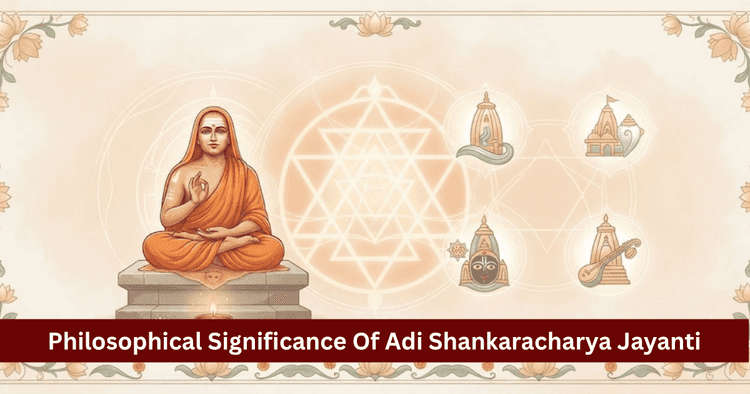
Table of Contents
Panchang Description And The Astrological Dimensions Of Shankaracharya's Advent
Within classical predictive astrology, the Madhaviya Shankara Digvijaya and the primary treatises of Advaita Vedanta, the fifth lunar day of the waxing fortnight in the month of Vaishakha-Vaishakha Shukla Panchami-is celebrated throughout the Indian subcontinent as Jagadguru Adi Shankaracharya Jayanti. In Sanatana spiritual history, Adi Shankaracharya is revered as an incarnation of Lord Sadashiva (Shankarah Shankarah Saakshaat), descending to revitalize Vedic wisdom during a period of fragmentation.
From an astronomical perspective, Vaishakha Shukla Panchami falls during the peak dignity of the Sun, which transits through its sign of deep exaltation in cardinal fiery Aries (Mesha). Concurrently, the Moon aligns with the sattvic lunar asterisms of Punarvasu or Pushya, fostering higher philosophical contemplation and clarity. Appearing in the village of Kalady along the banks of the Poorna River in Kerala to the devout Nambudiri couple Shivaguru and Aryamba, Shankara accomplished a monumental philosophical restoration within a brief lifespan of thirty-two years.
At a historical juncture when Vedic culture was splintered by dogmatism, rigid sectarianism and divergent interpretations, Shankara embraced renunciation (Sannyasa) in early youth. Journeying to Omkareshwar on the Narmada River, he received formal initiation from Govinda Bhagavatpada. He subsequently traversed the subcontinent entirely on foot, engaging scholars in open dialectical debate (Shastrartha), harmonizing competing philosophical schools and composing foundational commentaries upon the Prasthanatrayi (the Principal Upanishads, the Brahma Sutras and the Bhagavad Gita). By establishing the non-dual school of Advaita Vedanta and founding the four foundational cardinal seats (Amnaya Peethas), he integrated the intellectual and spiritual fabric of the subcontinent.
| Astrological Factor | Scriptural, Astrological and Historical Detail |
|---|---|
| Calendrical Station | Vaishakha Month | Shukla Paksha Panchami (5th Waxing Lunar Day) |
| Avataric Classification | Direct Incarnation of Lord Shiva (Shankarah Shankarah Saakshaat) |
| Nativity & Lineage | Kalady (Poorna River, Kerala) | Nambudiri Brahmin (Krishna Yajurveda) |
| Parents | Mother Aryamba and Sage Shivaguru |
| Preceptor of Initiation | Swami Govinda Bhagavatpada (Omkareshwar, Narmada River) |
| Core Philosophical Doctrine | Advaita Vedanta (Brahma Satyam Jagan-Mithya Jivo Brahmaiva Naaparah) |
| Foundational Treatises | Prasthanatrayi Bhashya (Upanishads, Gita, Brahma Sutras), Vivekachudamani |
| Devotional Literature | Saundarya Lahari, Sivananda Lahari, Bhaja Govindam, Kanakadhara Stotram |
| The Four Cardinal Peethas | Sringeri (South), Dwarka (West), Puri (East) and Jyotirmath (North) |
| Bestowed Spiritual Fruit | Dispelling ignorance (Avidya), non-dual awakening, inner illumination |
To connect with the wisdom of Adi Shankaracharya on his Jayanti, an aspirant should observe disciplined scriptural decorum:
- Awaken before sunrise during Brahma Muhurta, bathing in ambient cool water consecrated with sacred Ganga drops while meditating upon Jagadguru Shankara.
- Offer three continuous water libations mixed with red vermilion, unbroken raw rice and blossoms to Lord Surya Narayana from a copper vessel.
- Cleanse the domestic altar, spreading clean yellow silk across a wooden platform to install an icon of Adi Shankara or his sacred wooden sandals (Padukas).
- Conduct Shodashopachara worship honoring Lord Shiva and Adi Shankaracharya with white sandalwood paste, sacred ash (Bhasma), bilva leaves and white flowers.
- Recite his classical hymns, such as the Kanakadhara Stotram, the Nirvanashatkam (Chidananda Roopah Shivoham Shivoham) or Bhaja Govindam.
- Dedicate time to the study and contemplative reflection (Svadhyaya) of a chapter from the Upanishads or the Vivekachudamani.
- Donate books, educational supplies, food and cool drinking water to ascetics, students or those in need.
- Cultivate the non-dual perspective throughout the day, recognizing the presence of the one universal consciousness in all living beings without bias.
The Core Of Advaita Vedanta: 'Brahma Satyam Jagan-Mithya'
The essence of Adi Shankaracharya's philosophical realization is expressed in this classical verse:
Shlokardhena pravakshyami yad-uktam grantha-kotibhih.
Brahma satyam jagan-mithya jivo brahmaiva naaparah.
Meaning: In half a verse I summarize the core truth articulated across millions of sacred texts-"Brahman (the unconditioned Absolute Consciousness) alone is fundamentally real; the empirical, changing universe is Mithya (relative and dependent); and the individual soul (Jiva) is non-different from Brahman."
The Three Orders of Reality (Satta-Traividhya)
To resolve apparent contradictions between sensory perception and non-dual truth, Shankara formulated an epistemological framework of three orders of reality:
- Paramarthika Satta (The Absolute Reality): The transcendent, changeless Brahman, which remains uncontradicted across all three dimensions of time (past, present and future).
- Vyavaharika Satta (The Empirical / Conventional Reality): The day-to-day world of names, forms, laws, ethics and relationships. It remains functionally real and binding during the waking state until self-realization dawns.
- Pratibhasika Satta (The Apparent / Subjective Reality): Illusory perceptions that dissolve upon ordinary waking inquiry-such as dreams, optical mirages or mistaking a coiled rope for a snake (Raju-Sarpa Bhranti).
| Order of Reality | Canonical Sanskrit Term | Defining Characteristics |
|---|---|---|
| Absolute Reality | Paramarthika Satta | Brahman: Eternal, unchanging, pure awareness, unconditioned bliss |
| Empirical Reality | Vyavaharika Satta | The phenomenal world: Governed by causality, physical laws and ethics |
| Apparent Reality | Pratibhasika Satta | Subjective illusions: Dream states, mirages, perceptual errors |
The Four Amnaya Peethas: Anchoring Cultural And Spiritual Unity
Shankara recognized that enduring philosophical truth requires living institutional centers to preserve lineages of learning. He established four monastic seats (Amnaya Peethas) across the cardinal directions of India, assigning each a specific Veda, an Upanishadic Mahavakya and a monastic tradition:
1. Dakshina Amnaya: Sringeri Sharada Peetham (Karnataka)
- Veda & Mahavakya: Yajurveda | "Aham Brahmasmi" (I am Brahman).
- First Preceptor: Acharya Sureshwaracharya (formerly Mandana Mishra).
- Monastic Surnames: Saraswati, Bharati, Puri.
2. Pashchima Amnaya: Dwarka Sharada Peetham (Gujarat)
- Veda & Mahavakya: Samaveda | "Tat Tvam Asi" (Thou Art That).
- First Preceptor: Acharya Hastamalakacharya.
- Monastic Surnames: Tirtha, Ashrama.
3. Purva Amnaya: Govardhan Math, Puri (Odisha)
- Veda & Mahavakya: Rigveda | "Prajnanam Brahma" (Consciousness is Brahman).
- First Preceptor: Acharya Padmapadacharya.
- Monastic Surnames: Vana, Aranya.
4. Uttara Amnaya: Jyotirmath, Badrinath (Uttarakhand)
- Veda & Mahavakya: Atharvaveda | "Ayam Atma Brahma" (This Self is Brahman).
- First Preceptor: Acharya Totakacharya.
- Monastic Surnames: Giri, Parvata, Sagara.
| Seat (Matha) | Direction & Geography | Guardian Veda | Governing Mahavakya | Inaugural Preceptor |
|---|---|---|---|---|
| Sringeri Sharada Peetham | South (Chikkamagaluru, Karnataka) | Yajurveda | Aham Brahmasmi | Swami Sureshwaracharya |
| Govardhan Math | East (Puri, Odisha) | Rigveda | Prajnanam Brahma | Swami Padmapadacharya |
| Dwarka Sharada Peetham | West (Dwarka, Gujarat) | Samaveda | Tat Tvam Asi | Swami Hastamalakacharya |
| Jyotirmath Peetham | North (Badrinath, Uttarakhand) | Atharvaveda | Ayam Atma Brahma | Swami Totakacharya |
A Lifespan Of 32 Years: Works And Historical Milestones
The chronological life of Adi Shankaracharya spanned only thirty-two years, yet his accomplishments transformed philosophical discourse:
- Renunciation at Age Eight: Seeking permission from his mother Aryamba along the Poorna River through the allegory of the crocodile, he mastered Vedic learning in early childhood.
- Commentaries at Age Twelve: Residing in Omkareshwar and Kashi, he composed his monumental commentaries (Bhashyas) upon the twelve major Upanishads, the Bhagavad Gita and the Brahma Sutras.
- Philosophical Debates at Age Sixteen: Touring learning centers across India, he engaged in celebrated debates, notably with the Mimamsa scholar Mandana Mishra and his erudite wife Ubhaya Bharati in Mahishmati, establishing the primacy of Jnana (knowledge).
- The Dashanami Order: He organized wandering ascetics into the structured Dashanami Sampradaya (Tirtha, Ashrama, Vana, Aranya, Giri, Parvata, Sagara, Saraswati, Bharati and Puri).
- Panchayatana Puja: To resolve sectarian friction, he systematized the equal worship of five divine aspects-Shiva, Vishnu, Devi (Shakti), Surya and Ganesha-around a central chosen ideal (Ishta-Devata).
The Kanakadhara Incident: Compassion Manifesting As Golden Fruit
Shankara's commitment to non-dual wisdom was matched by deep compassion, as demonstrated in the lore of the Kanakadhara Stotram:
While begging for alms as a young student, Shankara arrived at the doorstep of an impoverished elderly woman. Having no grain to offer, she searched her home and placed a single dried gooseberry (Amla) into his bowl, weeping over her poverty.
Moved by her sincerity, Shankara spontaneously composed the twenty-one verses of the Kanakadhara Stotram, invoking the grace of Goddess Mahalakshmi. Tradition records that the Goddess showered golden gooseberries into the woman's courtyard, relieving her distress.
Philosophical Essence: Beyond Division Into Unity
The celebration of Adi Shankaracharya Jayanti offers an essential message for modern society:
Advaita means non-duality-not two but one undivided reality.
When human beings create divisions based on background, creed, language or social labels, they remain anchored in the illusion of separation (Dvaita). Shankara demonstrated that the same conscious awareness that animates one's own heart lives within every human being, creature and living form.
When this awareness is realized, fear, prejudice and conflict naturally dissolve: Yasmin sarvani bhutani atmaiva-abhud vijanatah (When a wise person perceives all beings as their own Self, what delusion or grief can remain?).
On Vaishakha Shukla Panchami, let us honor the memory of Jagadguru Adi Shankaracharya by looking beyond personal self-centeredness, cultivating clear discernment and recognizing the shared dignity of all life.
FAQ
When and where was Adi Shankaracharya born?
Adi Shankaracharya was born on Vaishakha Shukla Panchami in the village of Kalady, situated along the Poorna River in Kerala.
Who was the spiritual preceptor (Guru) of Adi Shankaracharya?
He was initiated into asceticism and higher non-dual wisdom by Swami Govinda Bhagavatpada at Omkareshwar on the banks of the Narmada River.
What are the four cardinal monastic seats (Amnaya Peethas) established by Shankara?
They are Sringeri Sharada Peetham in the south, Dwarka Sharada Peetham in the west, Govardhan Math (Puri) in the east and Jyotirmath (Badrinath) in the north.
What is the core philosophical axiom of Advaita Vedanta?
The core axiom is: "Brahma Satyam Jagan-Mithya Jivo Brahmaiva Naaparah"-Brahman alone is absolute truth; the phenomenal world is relative; and the individual soul is non-different from Brahman.
Which hymn did Shankara compose to assist an impoverished woman?
He composed the Kanakadhara Stotram, a devotional hymn to Goddess Mahalakshmi that is traditionally said to have brought a shower of golden amla fruits into her home.
Get your accurate Kundali
Generate KundaliDid you like it?
Author
Pt. Amitabh Sharma (56 Years)
Experience: 20
Consults About: Family Planning, Career
Clients In: Punjab, Haryana, Delhi
Share this article with friends and family
WELCOME TO
ZODIAQ
Right Decisions at the right time with ZODIAQ
