What Is The Spiritual Science Of Gayatri Mantra Purascharana In Vaishakha?
By Pt. Narendra Sharma
Vaishakha Gayatri Purascharana, Exalted Sun Sadhana, 24 Syllables Science & Solar Alignment
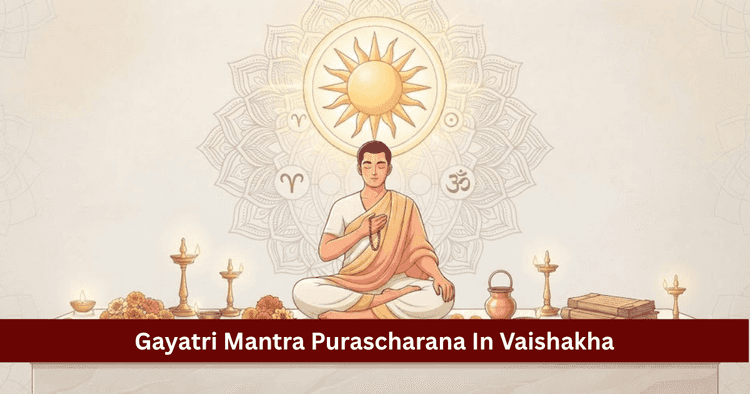
Table of Contents
Panchang Description And The Astrological Dimensions Of Gayatri Purascharana
Within classical Vedic traditions, the Yajurveda, the Devi Bhagavata Mahapurana, the Gayatri Tantra and the liturgical manuals composed by Maharishi Vishvamitra, the lunar month of Vaishakha is celebrated as the most potent window of the year for undertaking the formal spiritual discipline known as Gayatri Mantra Purascharana. Composed of twenty-four sacred syllables, the Gayatri Mahamantra is an ancient sonic framework that directly bridges human cognitive awareness with the luminous energy of Savitr, the solar consciousness sustaining the cosmos.
From an astronomical perspective, Vaishakha marks the transit of Lord Surya Deva through his sign of deep exaltation in cardinal fiery Aries (Mesha), spanning 0° to 30°. During this transit, solar radiation reaches its peak thermodynamic and bio-magnetic intensity across the terrestrial plane. The rays of the Sun are clear, penetrative and charged with subtle vitality. The Gayatri Tantra explicitly states that when the cosmic Sun occupies its highest station of exaltation, performing focused japa of the Gayatri Mantra illuminates the practitioner's inner solar center-the soul (Atman) and the Ajna Chakra-refining consciousness like pure gold. Completing a traditional Laghu Purascharana of 24,000 recitations or a full Maha Purascharana of 125,000 recitations during Vaishakha clears accumulated karmic imprints, sharpens intellect and expands the vital bio-energy field (Aura).
| Astrological Factor | Scriptural, Astrological and Liturgical Detail |
|---|---|
| Prescribed Timeframe | Throughout Vaishakha (Pratipada to Purnima) | Sandhya junctures |
| Solar Celestial Alignment | Sun exalted in Aries (Peak solar radiation across the terrestrial plane) |
| Presiding Sovereign Divinities | Param Brahma as Savitr, Veda Mata Gayatri (Brahmi, Vaishnavi, Shambhavi) |
| Mantra Architecture | 24 Sacred Syllables | 3 Padas | Foundations in Rigveda and Yajurveda |
| Primary Sadhana Modality | Laghu Purascharana (24,000 counts) or Maha Purascharana (125,000 counts) |
| Sacramental Media | Red or white sandalwood rosary, Rudraksha, copper pitcher, kusha mat |
| Seated Orientation & Posture | Facing East (Dawn) or North | Padmasana or Siddhasana |
| Planetary Balance | Harmonizes the Sun (Surya - Soul force) and Jupiter (Brihaspati - Wisdom) |
| Bestowed Spiritual Fruit | Awakening of Brahmavarchas, acute memory, clarity of discernment, liberation |
To assimilate the transformative grace of Gayatri Purascharana during Vaishakha, an aspirant should observe disciplined daily habits from dawn:
- Awaken during Brahma Muhurta (roughly 1 hour and 36 minutes before sunrise), bathing in ambient cool water consecrated with sacred Ganga drops.
- Dress in clean, unstitched white or pale yellow cotton garments, purifying the domestic practice space with water and fragrant incense.
- Seat oneself facing East upon a natural kusha grass mat or white woolen blanket, performing ceremonial sipping of water (Achamana) for purification.
- Fill a clean copper pitcher with cool spring water, red sandalwood paste, unbroken rice and red blossoms, offering three libations to Lord Surya Narayana using the Gayatri Mantra.
- On the first morning, hold water, kusha grass, raw rice and sesame seeds in the right palm, making a firm resolve (Sankalpa): "To purify my mind and cultivate spiritual radiance, I observe this Gayatri Purascharana during the sacred month of Vaishakha."
- Perform preliminary pranayama (three cycles), followed by traditional conscious placements (Nyasa-Rishyadi, Karanyasa and Hridayadi Anganyasa) to seal the body's subtle perimeter.
- Use a consecrated rosary of 108 beads made of red sandalwood, white sandalwood or rudraksha, chanting a consistent number of rounds each day (e.g., 10 rounds daily for 24 days to achieve 24,000 counts).
- Maintain an Upamshu chanting style (moving only the lips, inaudible to anyone nearby) or practice silent mental recitation (Manasa Japa).
- Observe strict personal discipline throughout the period-including celibacy, resting on a simple floor mat, minimizing speech and consuming a single daily satvic meal of barley, milk or fruit.
- Cultivate calm composure throughout the day, refraining from anger, idle debates and negative speech.
Anatomy Of The Mahamantra: Sonic Architecture Of The 24 Syllables
In the Yajurveda and the Taittiriya Aranyaka, the Gayatri Mantra is revealed as a precise matrix of cosmic acoustics:
Om Bhūr Bhuvah Svah Tat-Savitur-Varenyam Bhargo Devasya Dheemahi Dhiyo Yo Nah Prachodayāt.
1. The Twenty-Four Syllables and Subtle Glands
- The 24 syllables correspond directly to 24 subtle energy currents (Nadis) within the human subtle body and 24 foundational virtues.
- Pronouncing these syllables rhythmically stimulates specific points along the palate, tongue and throat, encouraging balanced endocrine secretions from the pineal and pituitary glands.
2. The Three Vyahritis (Bhur, Bhuvah, Svah)
- Bhūh: Represents the physical realm, the Earth Element and the grounding of the Muladhara Chakra.
- Bhuvah: Represents the subtle realm of prana, the atmosphere and the opening of the Anahata Chakra.
- Svah: Represents the causal dimension of illuminated consciousness and the Sahasrara Chakra.
- The mantra gently guides personal awareness from dense matter through subtle vitality into clear, unconditioned light.
| Metric Pada | Elemental Power | Physiological and Subtle Influence |
|---|---|---|
| Tat-Savitur-Varenyam | First Pada (8 Syllables) | Brahmi Shakti | Cleanses the physical form; dispels sluggishness and lethargy |
| Bhargo Devasya Dheemahi | Second Pada (8 Syllables) | Vaishnavi Shakti | Clears emotional tension; dissolves accumulated stress |
| Dhiyo Yo Nah Prachodayāt | Third Pada (8 Syllables) | Shambhavi Shakti | Refines higher intellect (Buddhi); awakens intuitive wisdom |
Liturgical Integrity: Nyasa And The Three Junctions (Trikala Sandhya)
Traditional manuals emphasize that chanting without internal alignment disperses subtle focus; the discipline relies on foundational safeguards:
1. Karanyasa and Anganyasa (Subtle Energetic Sealing)
Before reciting the rosary, the practitioner consciously directs sacred syllables to the fingers, palms, heart, crown and eyes:
- Angushthābhyām Namah, Tarjanībhyām Namah, Madhyamābhyām Namah, Anāmikābhyām Namah, Kanishthikābhyām Namah, Karatala-Karaprishthābhyām Namah.
- This practice grounds the practitioner's nervous system, creating an internal energetic boundary that shields the mind from distraction during deep meditation.
2. The Three Sandhya Junctures
- Pratah Sandhya (Dawn): Practiced before sunrise while stars remain faintly visible; honors Gayatri in her youthful, creative Brahmi form.
- Madhyahna Sandhya (Noon): Practiced at midday when the Sun reaches its peak; honors Gayatri in her sustaining, protective Vaishnavi form.
- Sayam Sandhya (Dusk): Practiced just before sunset as the sky turns amber; honors Gayatri in her tranquil, meditative Shambhavi form.
Acoustic Science And Biophysics: The Neurological Impact
Modern cognitive neuroscience and bio-physics research note measurable physiological shifts during rhythmic Sanskrit chanting:
1. Neuroplasticity and Coherent Brainwaves
- The rhythmic cadence of the 24 syllables stimulates the cerebral cortex and calms the amygdala.
- Brainwave patterns shift from scattered beta states (14-30 Hz) into coherent alpha and theta frequencies (7-10 Hz), fostering deep emotional poise and mental clarity.
2. Expansion of the Subtle Bio-Field (Aura)
- Electro-photonic imaging demonstrates that regular, disciplined recitation of the Gayatri Mantra stabilizes cellular vitality and expands the surrounding bio-field.
- During the exalted solar window of Vaishakha, this practice strengthens vitality, resilience and personal composure.
| Measured Indicator | Unregulated State | Following Vaishakha Gayatri Sadhana |
|---|---|---|
| Dominant Brainwaves | High-frequency Beta (Stress, 18-28 Hz) | Coherent Alpha & Theta (Calm, 8-10 Hz) |
| Heart Rate Variability (HRV) | Irregular, reactive to stress | Smooth, coherent, balanced autonomic tone |
| Immune Response | Depleted by seasonal heat fatigue | Enhanced cellular vitality and stamina |
| Bio-Field Radiance | Constricted and fluctuating | Steady, expansive and resilient |
Astrological Analysis: Strengthening The Sun And Jupiter
In predictive Vedic astrology, Gayatri Sadhana is regarded as a sovereign practice for harmonizing personal vitality and intellect:
1. Empowering the Sun (Surya)
- The Sun signifies the core self, leadership, moral conviction and vitality.
- Chanting the Gayatri Mantra while the Sun is exalted in Aries clears subtle afflictions related to low confidence, friction with authorities or physical lethargy, establishing balanced self-respect.
2. Awakening Jupiter (Brihaspati)
- The concluding phrase "Dhiyo Yo Nah Prachodayat" is a direct prayer for illumined intelligence (Dhee), which is governed by Jupiter.
- This practice strengthens moral discernment, helping the practitioner make balanced choices in daily life.
| Planetary Factor | Typical Chart Challenge | Remedial Result of Gayatri Sadhana |
|---|---|---|
| Sun-Rahu Shadows | Lack of confidence, friction with mentors | Cultivates clear self-respect, moral focus, vitality |
| Afflicted Jupiter | Ethical confusion, scattered judgment | Restores wisdom, sound judgment, emotional balance |
| Nodal Friction (Rahu-Ketu) | Chronic anxiety, unpredictable hurdles | Forms a steady, protective mental perimeter |
| Ancestral Lineage Strain | Domestic discord, recurring hurdles | Brings subtle peace to lineage memories, aiding harmony |
Philosophical Essence: Merging Inner Awareness With Universal Light
The practice of Gayatri Purascharana during Vaishakha conveys an enduring spiritual truth:
"Just as the physical sun banishes darkness across the earth to sustain life, the steady light of the Gayatri Mantra dispels inner confusion, aligning individual consciousness with universal truth."
This practice is not a transactional plea for material acquisitions; it is a dedicated effort to attune the mind to clarity, purpose and compassion.
Amidst the intense heat of Vaishakha, a quiet practitioner who awakens at dawn to meditate upon the Sun becomes an anchor of calm for those around them.
During this sacred month, let us awaken during Brahma Muhurta, offer cool water to the rising sun, take up the discipline of the Gayatri Mantra and illuminate our daily actions with wisdom, self-restraint and peace.
FAQ
Why is Vaishakha considered an ideal time for Gayatri Mantra Purascharana?
Because the Sun is exalted in Aries during Vaishakha, radiating peak bio-magnetic and solar energy; spiritual practices dedicated to Savitr during this transit yield deep clarity and focus.
What is the minimum count for a traditional Gayatri Purascharana?
A standard Laghu Purascharana consists of 24,000 recitations observed over 24 days (10 rounds of a 108-bead rosary each day), which is accessible and practical for householders.
Which rosary (mala) is best suited for chanting the Gayatri Mantra?
Rosaries strung with red sandalwood, white sandalwood, rudraksha or clear quartz (sphatika) are traditionally recommended for maintaining rhythmic count.
What vocal volume should be maintained during the japa?
The chanting should be practiced in the Upamshu style (moving only the lips, inaudible to others) or silently in the mind (Manasa Japa); loud chanting is avoided during formal purascharana.
Which planetary influences are balanced through this sadhana?
It directly empowers the Sun (vitality, leadership, self-respect) and Jupiter (wisdom, moral discernment), while soothing turbulent transits across the entire birth chart.
Get your accurate Kundali
Generate KundaliDid you like it?
Author

Pt. Narendra Sharma (63)
Experience: 20
Consults About: Family Planning, Career
Clients In: Punjab, Haryana, Delhi
Share this article with friends and family
WELCOME TO
ZODIAQ
Right Decisions at the right time with ZODIAQ
