What Is The Spiritual Lore Of Lord Narasimha Jayanti On Vaishakha Shukla Chaturdashi?
By Pt. Amitabh Sharma
Vaishakha Shukla Chaturdashi, Twilight Inception, Prahlada Lore, Mars-Rahu Balance & Kavacham
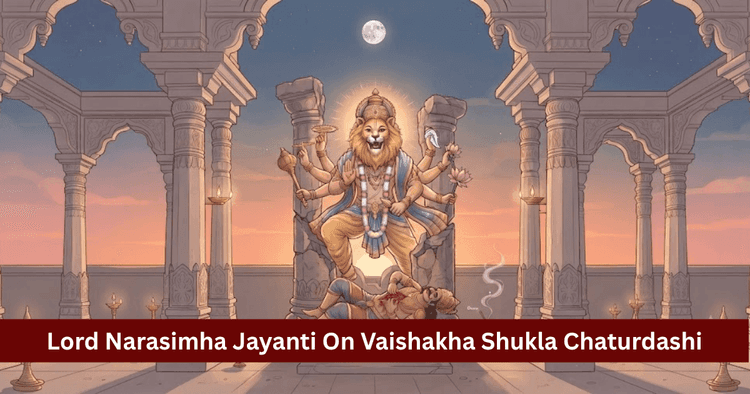
Table of Contents
Panchang Description And The Astrological Dimensions Of Narasimha's Advent
Within classical predictive astrology, the Seventh Canto of the Srimad Bhagavata Mahapurana, the Narasimha Purana and the liturgical guidelines of the Nirnayasindhu, the fourteenth lunar day of the waxing fortnight in the month of Vaishakha-Vaishakha Shukla Chaturdashi-is celebrated throughout the Indian subcontinent as Sri Narasimha Jayanti. This sacred tithi commemorates the twilight advent of Lord Sri Hari Vishnu's fourth incarnation: Lord Narasimha, the half-man, half-lion manifestation who appeared to protect his dedicated child-devotee Prahlada and dismantle the tyranny of the demon king Hiranyakashipu.
From an astronomical perspective, Vaishakha Shukla Chaturdashi carries intense thermodynamic and dynamic solar energy. Lord Surya Deva transits near the final degrees of his deep exaltation in cardinal fiery Aries (Mesha), while the Moon transits across the asterisms of Swati or Vishakha in Libra. The fourteenth tithi (Chaturdashi) belongs to the Rikta (subtle, transformative) classification, presided over by Lord Shiva. In Vedic astrology, Lord Narasimha is revered as the supreme sovereign deity governing Mars (Mangala - physical valor, blood, land, protection and righteous drive). Simultaneously, he serves as an unyielding shield against the psychological turmoil, hidden adversaries and disruptive karmic storms associated with the lunar nodes (Rahu and Ketu). By manifesting precisely at twilight (Godhuli Vela) from within a stone pillar, Lord Narasimha honored the intricate terms of Brahma's boon while establishing the omnipresence of divine protection.
| Astrological Factor | Scriptural, Astrological and Liturgical Detail |
|---|---|
| Sacred Liturgical Station | Vaishakha Month | Shukla Paksha Chaturdashi (14th Waxing Lunar Day) | Godhuli Vela |
| Avataric Classification | 4th Major Incarnation of Lord Vishnu (Avesha/Purna Manifestation) |
| Manifested Divine Form | Half-Man (Human torso) and Half-Lion (Lion head, mane and sharp claws) |
| Governing Planetary Deity | Supreme Master of Mars (Mangala); Pacifier of Rahu and Ketu |
| Sanctuary of Appearance | The imperial assembly hall of Hiranyakashipu (Bursting from a stone pillar) |
| Core Avataric Purpose | Vindicating the faith of child Prahlada; restoring cosmic order |
| Sacramental Media | Red sandalwood paste, hibiscus/rose blossoms, musk, tulsi, sattu, cooling drinks |
| Fasting Discipline | Full day fast until sunset; worship and concluding rites at dusk |
| Bestowed Spiritual Fruit | Protection against adversarial harm, courage, freedom from chronic fear |
To align with the protective and transformative grace of Lord Narasimha on his Jayanti, an aspirant should observe disciplined daily habits from dawn:
- Awaken before sunrise during Brahma Muhurta, bathing in ambient cool water mixed with drops of sacred Ganga water and red sandalwood paste.
- Dress in clean white, yellow or deep red cotton attire, offering three continuous water libations mixed with red vermilion, unbroken raw rice and blossoms to Lord Surya Narayana.
- Prepare a dedicated altar by covering a wooden platform with clean red or yellow silk, installing an icon of Lord Narasimha alongside child Prahlada and Goddess Lakshmi.
- Take kusha grass, unbroken rice and water in the right palm during the midday window, making a solemn vow (Sankalpa) to observe the day in fasting and contemplation until twilight.
- Maintain mindful speech, avoiding unnecessary arguments, gossip and criticism throughout the day.
- Bathe again prior to twilight (Godhuli Vela-spanning roughly 24 minutes before and after sunset), kindling a cow-ghee lamp at the domestic altar.
- Cleanse the icon with Panchamrita, cold rose water and consecrated river water, offering red blossoms, fresh tulsi leaves and yellow silks.
- Present hydrating summer offerings to balance seasonal heat and the deity's fiery radiance-such as chilled raw mango coolers (Aam Panna), roasted barley sattu sweets, jaggery and sweet melons.
- Recite the classical Narasimha Kavacham (composed by Prahlada) or the Narasimha Ashtakam with focused attention for at least 108 repetitions.
- Conclude the fast following twilight prayers with a light satvic meal, sharing consecrated fruit and coolers with family and visitors.
Puranic Lore: The Boon Of Hiranyakashipu And The Cleaving Of The Pillar
In the Seventh Canto of the Srimad Bhagavata Purana, it is recounted that the celestial gatekeepers Jaya and Vijaya took birth upon earth as the demonic brothers Hiranyaksha and Hiranyakashipu due to a sage's curse.
The Intricate Boon of Hiranyakashipu
Following the death of his brother Hiranyaksha at the hands of Lord Varaha, Hiranyakashipu performed severe austerities upon Mount Mandarachal, extracting an elaborate protective boon from Lord Brahma:
- "May I not meet death inside any dwelling, nor outside;
- Neither during the day, nor during the night;
- Neither upon the earth, nor high in the sky;
- Neither by any human being, nor by any beast;
- Neither by any entity born of a womb, nor by any lifeless object;
- And neither by any handheld weapon, nor by any missile."
Shielded by these intricate conditions, Hiranyakashipu declared himself supreme ruler, forbidding the recitation of Vedic mantras and persecuting spiritual seekers.
The Faith of Prahlada and the Confrontation
Within the tyrant's household, through the prenatal guidance of Sage Narada, a child of extraordinary spiritual devotion was born: Prahlada. Despite intense intimidation from his father-including being cast into snake pits, trampled by war elephants, poisoned and placed upon Holika's fire-Prahlada's heart remained centered in the Divine, emerging unharmed from every trial.
Enraged, Hiranyakashipu confronted the boy in his court, striking a polished stone pillar with his fist and drawing his sword:
"Where is this omnipresent Lord you speak of? If he is everywhere, is he present inside this stone pillar?"
Prahlada bowed with folded hands and replied calmly: "Yes, father. He resides within this pillar, within you and within me."
Manifestation at Twilight
As the king struck the pillar with his blade, a thunderous roar reverberated across the cosmos. The stone column split open and Lord Narasimha emerged:
- Possessing the head and mane of a lion with a powerful human torso, his eyes blazed like molten embers.
- Seizing Hiranyakashipu, the Lord carried him to the threshold (doorway) of the palace hall.
- He placed the tyrant across his lap (neither on the ground nor in the sky).
- The hour was twilight (neither daytime nor nighttime).
- The location was the doorway (neither indoors nor outdoors).
- The Lord's form was Narasimha (neither purely human nor purely animal).
- And deploying no metal weapons, the Lord pierced the tyrant's chest using his sharp claws (neither living entity nor inanimate weapon).
Through this manifestation, Lord Vishnu preserved every condition of Brahma's boon while demonstrating that divine protection transcends the boundaries of physical circumstance.
| Boon Condition | Classical Limitation | Divine Resolution by Lord Narasimha |
|---|---|---|
| Time of Departure | Neither day nor night | Manifested precisely at twilight (Godhuli Vela) |
| Location | Neither inside nor outside | Positioned upon the threshold (Dehali) of the palace |
| Realm | Neither on earth nor in sky | Placed across the Lord's lap above the ground |
| Form of Being | Neither human nor animal | Revealed as the half-man, half-lion (Narasimha) |
| Means of Resolution | Neither handheld weapon nor missile | Deployed his sharp natural claws (Nakha) |
Astrological Analysis: Pacifying Mars And Neutralizing Nodal Volatility
In predictive Vedic astrology, adoring Lord Narasimha is regarded as an effective practice for balancing energetic volatility in a birth chart:
1. Mastery Over Mars (Mangala)
- When Mars is debilitated, retrograde or creates challenging aspects (such as Manglik Dosha), an individual may experience impulsive anger, blood-related strain, property disputes or relational friction.
- Lord Narasimha embodies the constructive expression of Martian force-channeling intense physical energy into ethical protection rather than destructive aggression.
2. Neutralizing Rahu and Ketu
- Rahu governs psychological anxiety, sudden reversals and unseen manipulation, while Ketu influences eccentric emotional withdrawals.
- Meditating upon the lion-faced deity and reciting the Narasimha Kavacham creates a stabilizing energetic boundary around the practitioner's consciousness, dispelling paranoia and emotional turbulence.
Liturgical Protocol: Sacred Hymns And The Mantraraja
Approaching Lord Narasimha during the twilight window of Vaishakha Shukla Chaturdashi should be conducted with reverence and focus:
1. Contemplative Verse (Dhyana Shloka)
Kopadalola-kesham jvalad-anala-mukham deeptanetram trinetram,
Damshtra-karala-vaktram nakha-mukha-dashabhir-viprayuktari-chakram.
Hasta-dvayena shankham daram-atha dadhatam jaanu-samstham Nrisimham,
Vande vandaru-brindaraka-varada-padam bhakta-santapa-haram.
2. The Sovereign Narasimha Formula (Mantraraja Anushtup)
For cultivating inner strength, resolving deep anxieties and seeking protection, recite this classical formula using a rosary of red sandalwood beads:
Om Ugram Veeram Maha-Vishnum Jvalantam Sarvato-Mukham.
Nrisimham Bheeshanam Bhadram Mrityu-Mrityum Namamy-Aham.
Meaning:
"I bow before the supreme Lord Narasimha-who is formidable and heroic, the all-pervading Mahavishnu, radiating light in every direction, possessing a universal countenance, fierce yet deeply benevolent (Bhadra) toward his devotees and the conqueror of death itself."
From Wrath To Grace: The Advent Of Lakshmi-Narasimha
Following the dismantling of the tyrant, Lord Narasimha's fiery intensity continued to reverberate through the assembly hall. The celestial guardians, sages and even Goddess Lakshmi hesitated to approach the radiant form.
Recognizing that pure devotion transcends fear, the celestials urged child Prahlada forward. The young boy approached with tears of reverence, falling prostrate before the Lord's feet.
- Beholding his child-devotee, the Lord's fierce demeanor softened instantly into deep parental affection.
- Lifting Prahlada onto his lap, Lord Narasimha gently rested his hand upon the boy's head, soothing his exhaustion.
- Goddess Lakshmi took her place at his left side and the deity was celebrated in his peaceful, benevolent form: Lakshmi-Narasimha.
- When invited to ask for any worldly blessing, Prahlada asked only that his father's mistaken actions be forgiven. Moved by the child's compassion, the Lord granted spiritual peace to twenty-one generations of his lineage.
Philosophical Essence: The Divine Resides In Every Pillar
The observance of Sri Narasimha Jayanti conveys an enduring spiritual truth:
"The Divine is not confined to distant heavens or formal altars; conscious reality permeates every particle, every obstacle and every stone pillar in creation."
Hiranyakashipu's pride represents the rationalistic ego that doubts whatever falls outside its immediate sensory control. Prahlada's faith represents the intuitive awareness that perceives unity throughout existence.
When an individual cultivates genuine sincerity, free from fear and calculation, the supportive power of the cosmos responds directly, helping overcome long-standing obstacles and revealing light even in unexpected places.
On Vaishakha Shukla Chaturdashi, let us remember Lord Narasimha by confronting personal arrogance and self-doubt, speaking with courage and anchoring our daily lives in steady faith and quiet resolve.
FAQ
On which lunar date and time did Lord Narasimha manifest?
Lord Narasimha manifested during twilight (Godhuli Vela) on the fourteenth lunar day of the waxing fortnight of Vaishakha (Vaishakha Shukla Chaturdashi).
How did Lord Narasimha resolve the conditions of Hiranyakashipu's boon?
He manifested at twilight (neither day nor night), upon the palace threshold (neither indoors nor outdoors), placing the tyrant on his lap (neither earth nor sky), appearing as a half-man, half-lion and using his sharp claws rather than metal weapons.
Who soothed the initial fiery intensity of Lord Narasimha?
His intensity was softened by the humble prayers and unreserved devotion of the child Prahlada, leading to the manifestation of the peaceful Lakshmi-Narasimha form.
Which planetary influence is primarily associated with Lord Narasimha in Vedic astrology?
Lord Narasimha governs Mars (Mangala), helping balance fiery impulses and neutralizes the erratic, disruptive influences of Rahu and Ketu.
What traditional food offerings are presented on Narasimha Jayanti?
To balance seasonal summer heat and the deity's fiery radiance, offerings emphasize cooling hydration, including chilled raw mango coolers (Aam Panna), roasted barley sattu sweets, jaggery, sweet melons and rock sugar crystals.
Get your accurate Kundali
Generate KundaliDid you like it?
Author
Pt. Amitabh Sharma (56 Years)
Experience: 20
Consults About: Family Planning, Career
Clients In: Punjab, Haryana, Delhi
Share this article with friends and family
WELCOME TO
ZODIAQ
Right Decisions at the right time with ZODIAQ
